When Pension Benefits Meet the Taxman's Final Assessment
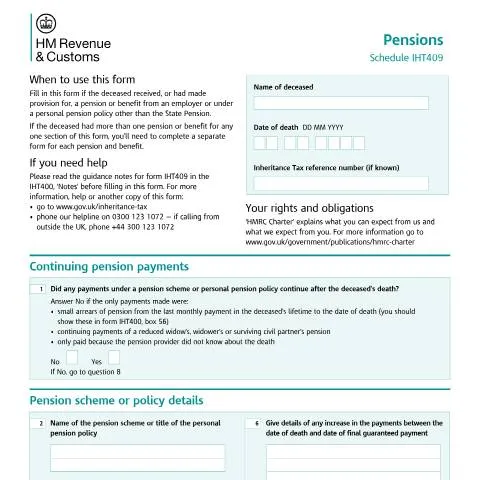
The moment death occurs in the UK, pension arrangements that once provided monthly income or promised future security suddenly transform into complex inheritance tax considerations. Form IHT409 emerges as the essential bridge between a deceased person's pension entitlements and HMRC's need to calculate the precise inheritance tax liability on their estate. Far from being a simple afterthought in estate administration, this schedule demands meticulous attention to pension arrangements that may have evolved over decades of working life.
Unlike the straightforward reporting of bank balances or property values, pension benefits present unique valuation challenges. Some payments continue after death under guarantee provisions, others trigger lump-sum death benefits, whilst certain arrangements may have been deliberately restructured in the final years of life. Each scenario carries distinct inheritance tax implications that form IHT409 navigates with surgical precision.
The form's significance extends beyond mere compliance. Personal representatives who overlook pension-related assets or misunderstand their tax treatment risk understating the estate's value, potentially triggering penalties and interest charges that compound an already stressful administration process. Conversely, those who grasp the form's intricacies can ensure accurate reporting whilst identifying legitimate reliefs and exemptions.
The Inheritance Tax Framework Governing Pension Death Benefits
Pension benefits occupy a distinctive position within the UK's inheritance tax regime, governed by principles that differ markedly from other estate assets. The fundamental distinction lies between benefits that form part of the deceased's estate and those that remain outside it, a boundary that form IHT409 helps establish through its carefully structured questions.
When pension payments continue after death under guarantee provisions, they represent a quantifiable asset that must be valued and included in the estate. The guaranteed annuity calculator referenced in question 7 provides the methodology for this valuation, converting future payment streams into a present-day inheritance tax liability. This calculation requires precision, as the value depends on factors including the deceased's age, the remaining guarantee period, and prevailing interest rates at the date of death.
Death benefits present more nuanced considerations. Benefits paid at trustees' discretion typically fall outside the estate, reflecting Parliament's recognition that discretionary arrangements serve legitimate pension policy objectives. However, this exemption carries strict conditions. If the deceased retained any power to direct where benefits should be paid, or if payments flow to their estate by default, the death benefit becomes chargeable to inheritance tax.
The two-year rule embedded in questions 17-24 reflects anti-avoidance legislation designed to prevent deathbed manipulation of pension arrangements. Transfers or changes made within this timeframe trigger enhanced scrutiny, with HMRC examining whether alterations were motivated by inheritance tax planning rather than genuine pension management considerations.
Distinguishing IHT409 from Related Estate Reporting Requirements
Form IHT409 operates as part of the broader IHT400 suite, but its specialized focus on pension arrangements distinguishes it from other supplementary schedules. Unlike IHT405 covering houses and land, or IHT407 dealing with household goods, IHT409 addresses assets whose value depends heavily on contractual terms and actuarial calculations rather than market prices.
The form specifically excludes State Pension arrangements, recognizing that these benefits cease entirely upon death and carry no residual value for inheritance tax purposes. This exclusion eliminates potential confusion for personal representatives who might otherwise wonder whether basic State Pension entitlements require reporting.
Significantly, the form draws clear distinctions between different types of continuing payments. Small pension arrears covering the period from the last monthly payment to the date of death are reported directly in the main IHT400 form rather than requiring a separate IHT409. Similarly, reduced survivor pensions paid to spouses or civil partners fall outside the form's scope, as these represent new entitlements rather than continuations of the deceased's benefits.
| Pension Element | Reporting Location | Inheritance Tax Treatment |
|---|---|---|
| Guaranteed pension payments continuing after death | IHT409 questions 1-7 | Chargeable - value using annuity calculator |
| Discretionary death benefits | IHT409 questions 8-16 | Usually exempt if genuinely discretionary |
| Death benefits paid to estate | IHT409 questions 8-16 | Chargeable as part of estate |
| Small pension arrears | IHT400 box 56 | Chargeable as estate asset |
| Survivor pensions to spouse | Not reported | Exempt - new entitlement |
Navigating the Form's Critical Decision Points
The architecture of IHT409 reflects the complex decision tree that pension death benefits present. Question 1 serves as the primary gateway, determining whether any pension payments continued beyond death. Personal representatives must exercise careful judgment here, as the form explicitly excludes certain categories of continuing payments that might initially appear relevant.
Questions 9-12 form the heart of the death benefit analysis, establishing whether payments fell within or outside the deceased's estate. The sequence matters critically: if death benefits were payable to personal representatives because no other recipient existed, they automatically become estate assets regardless of any discretionary elements. Similarly, protected rights elements in older personal pension policies carry specific rules that override general discretionary principles.
The nomination power test in question 11 often proves decisive. If the deceased could have executed a binding nomination right up to death, this retained control brings the death benefit within their estate for inheritance tax purposes. Personal representatives must examine pension scheme rules carefully, as some arrangements that appear discretionary actually provide members with nomination rights that transform the tax treatment entirely.
Questions 17-21 address the two-year anti-avoidance provisions, requiring detailed disclosure of any transfers or changes to pension benefits. The dates requested in question 21 prove particularly important, as they establish the chronology that HMRC will examine when determining whether alterations were motivated by tax considerations rather than legitimate pension planning.
Valuation Challenges and Actuarial Considerations
The valuation of continuing pension payments represents one of IHT409's most technically demanding aspects. Question 7 directs personal representatives to HMRC's guaranteed annuity calculator, but using this tool effectively requires understanding of several underlying factors that influence the final valuation.
The calculation depends fundamentally on the guarantee period remaining at death. A pension guaranteed for ten years that ceases after the member's death in year three creates a seven-year stream of future payments that must be valued. However, the valuation isn't simply the arithmetic sum of future payments; it requires discounting to present value using Treasury-approved rates that change periodically.
Increases to payments between death and the final guaranteed payment, addressed in question 6, add another layer of complexity. Many pension schemes include annual increases linked to inflation or fixed percentages. These escalations must be factored into the valuation, as they affect the total value of the continuing payment stream.
Personal representatives should be aware that the guaranteed annuity calculator may not accommodate every possible pension arrangement. Complex schemes with unusual guarantee provisions or multiple benefit streams may require professional actuarial advice to ensure accurate valuation. The cost of such advice is typically allowable as an administration expense, but obtaining it promptly is essential to avoid delays in the inheritance tax calculation.
Death Benefit Complexities and Discretionary Powers
The treatment of death benefits under IHT409 reflects decades of evolution in pension taxation policy. The form's detailed questioning around discretionary powers recognizes that genuine discretion can remove benefits from the inheritance tax net, but only where that discretion is real rather than theoretical.
Trustees' discretionary powers, examined in question 12, must be substantive rather than illusory. HMRC will look beyond formal scheme documentation to examine how discretion was actually exercised. If trustees invariably followed the deceased's wishes or adhered to a predetermined pattern, the discretion may be deemed ineffective for inheritance tax purposes.
The registration status enquired about in questions 3, 14, and 20 affects not just the inheritance tax treatment but also the administrative process. Unregistered schemes may face additional scrutiny, and their benefits might be subject to different valuation methodologies. Personal representatives should obtain confirmation of registration status directly from scheme administrators rather than relying on assumptions.
When death benefits are paid to someone other than the deceased's personal representatives, question 16 requires identification of the recipient and their relationship to the deceased. This information helps HMRC understand the family dynamics and assess whether any artificial arrangements were in place to manipulate the inheritance tax position.
The Two-Year Anti-Avoidance Spotlight
Questions 17-24 implement Parliament's concern that pension arrangements might be manipulated in anticipation of death to reduce inheritance tax liabilities. The two-year timeframe reflects a balance between preventing abuse and recognizing that legitimate pension decisions often occur in later life.
Transfers of pension benefits within this period don't automatically trigger adverse consequences, but they do invite enhanced scrutiny. HMRC will examine the circumstances surrounding any transfer, considering factors such as the deceased's health at the time, the terms of the receiving arrangement, and whether family members benefited from the change.
Changes to benefits covered in question 18 encompass a broad range of alterations including amendments to death benefit nominations, switches between different pension options, and variations to guarantee periods. Even seemingly minor administrative changes may require disclosure if they occurred within the critical two-year window.
The contribution provisions in questions 22-24 address scenarios where pension funding increased significantly before death. Large contributions by either the deceased or their employer might be challenged if they appear motivated by inheritance tax considerations rather than genuine retirement planning. Personal representatives should prepare detailed explanations for any substantial contributions made during the two-year period.
Submission Strategy and Administrative Aftermath
Form IHT409 integrates into the broader inheritance tax return process, but its technical complexity often requires coordination between personal representatives, pension scheme administrators, and professional advisers. The form's instruction to complete separate schedules for each pension arrangement can result in multiple IHT409 submissions for deceased individuals with complex retirement provision.
Obtaining the necessary information from pension providers often proves time-consuming, particularly for older arrangements where original documentation may be incomplete. Personal representatives should contact scheme administrators early in the probate process, as some providers require extensive internal procedures before releasing death benefit information.
The interplay between IHT409 and the main IHT400 form requires careful attention to ensure consistent reporting. Values calculated using the guaranteed annuity calculator must be transferred accurately to box 56 of the main form, while discretionary death benefits that escape inheritance tax should not appear in the estate valuation.
HMRC's processing of pension-related inheritance tax issues often involves specialist teams with particular expertise in pension taxation. This can result in more detailed enquiries than might be expected for straightforward estate assets, but it also means that technical questions receive informed consideration from officers who understand the complexities involved.
Personal representatives should retain comprehensive records of all pension-related calculations and correspondence, as these arrangements are among the most likely to attract post-submission enquiries. The combination of technical complexity and significant values often involved makes pension benefits a natural focus for HMRC's compliance activities, making thorough documentation essential for defending the reported position.
Pension Death Benefits and Inheritance Tax Implications
When dealing with inheritance tax on pensions through form IHT409, understanding how different types of death benefits are treated becomes crucial for accurate reporting. The inheritance tax treatment varies significantly depending on whether benefits are paid as lump sums or ongoing income, the age at death, and specific pension scheme rules.
Defined contribution pension death benefits typically fall outside the deceased's estate for inheritance tax purposes when paid to nominated beneficiaries or discretionary beneficiaries under the scheme rules. However, complications arise when benefits are paid to the estate rather than directly to beneficiaries. If the deceased had the power to direct where benefits should be paid—through nomination forms or similar arrangements—HMRC may argue these benefits form part of the taxable estate under the "general power of appointment" provisions.
The distinction becomes particularly important with expression of wish forms. While these forms typically give pension scheme trustees discretionary powers rather than binding instructions, HMRC examines the practical operation of such arrangements. If trustees routinely follow the deceased's wishes without exercising genuine discretion, the benefits may be treated as part of the estate for inheritance tax purposes.
Defined benefit scheme death benefits present different challenges. Spouse's pensions and dependant's pensions usually fall outside the estate, but lump sum death benefits may be includable depending on the scheme rules and timing of death. For deaths in service, lump sum benefits often equal multiple times annual salary and require careful consideration of their inheritance tax status.
Age at death significantly affects inheritance tax treatment under current pension flexibility rules. For deaths before age 75, most pension death benefits can be paid tax-free to beneficiaries and typically fall outside the estate for inheritance tax. Deaths at age 75 or later may trigger both income tax charges on beneficiaries and potential inheritance tax complications, particularly where benefits are paid to the estate rather than directly to beneficiaries.
Alternatively secured pensions (ASP) and income drawdown arrangements require special attention on form IHT409. The remaining fund value at death may be subject to inheritance tax depending on how benefits are subsequently paid. Where drawdown funds pass to nominated beneficiaries under scheme rules, they typically avoid inheritance tax. However, if funds become payable to the estate due to lack of eligible beneficiaries or scheme restrictions, inheritance tax may apply to the full fund value.
International pension arrangements add complexity to IHT409 reporting. Qualifying Non-UK Pension Schemes (QNUPS) may provide inheritance tax advantages for non-UK domiciled individuals, but UK domiciled individuals cannot generally escape inheritance tax through offshore pension arrangements. The location of pension scheme administration and the domicile status of the deceased affect both reporting requirements and potential tax liabilities.
Valuation Challenges and Professional Pension Scheme Considerations
Accurate valuation represents one of the most complex aspects of completing form IHT409 for pension arrangements. Unlike simple bank accounts or property, pension benefits often involve actuarial calculations, conditional entitlements, and future contingencies that require specialist expertise to value correctly.
Contingent liabilities within pension schemes pose particular valuation difficulties. For example, where the deceased was receiving an enhanced pension due to ill-health early retirement, the scheme may have contingent liabilities for spouse's benefits calculated on different assumptions. These contingent elements must be identified and valued appropriately, often requiring input from the scheme actuary.
Professional pension schemes—such as those for doctors, dentists, or other professionals—frequently include additional voluntary contributions (AVCs) alongside main scheme benefits. These AVC funds may have different inheritance tax treatment from main scheme benefits, particularly where they're held in separate arrangements or provide different nomination facilities. The interaction between main scheme death benefits and AVC death benefits requires careful analysis to ensure accurate IHT409 reporting.
Pension sharing orders from divorce proceedings create additional complications for inheritance tax valuation. Where the deceased retained pension rights following a pension sharing order, the reduced pension value must be accurately calculated. Conversely, where the deceased received pension credits through pension sharing, these arrangements may create inheritance tax liabilities that wouldn't otherwise exist, particularly in defined contribution arrangements where the pension credit holder gains control over benefit destinations.
Employer-sponsored pension arrangements sometimes include discretionary death benefits beyond standard scheme provisions. These might include additional lump sum payments, continued salary payments to families, or other ex-gratia payments. While such benefits often fall outside formal pension scheme rules, they may still be reportable on form IHT409 if they represent benefits arising from the employment relationship and pension arrangements.
Pension scheme borrowing against pension funds creates potential inheritance tax complications that require careful consideration. Where the deceased had borrowed against their pension fund—permitted in certain circumstances under pension legislation—the outstanding loan balance affects the net value of death benefits. However, the inheritance tax treatment depends on whether the loan was made to the pension scheme member personally or secured against the pension fund itself.
Small self-administered schemes (SSAS) and self-invested personal pensions (SIPP) holding unusual assets require specialist valuation approaches. Where pension funds hold commercial property, private company shares, or other alternative investments, professional valuations become essential for accurate IHT409 completion. The timing of valuations relative to the date of death can significantly affect inheritance tax calculations, particularly for illiquid or volatile assets within pension arrangements.
Pension liberation or pension scam arrangements create unique reporting challenges where the deceased was involved in such schemes. While legitimate pension benefits typically benefit from inheritance tax exemptions, funds extracted through unauthorized pension arrangements may lose their pension status for tax purposes, potentially creating unexpected inheritance tax liabilities that require disclosure on form IHT409.
Interaction with Other Inheritance Tax Reliefs and Complex Estate Planning
The intersection between pension death benefits and other inheritance tax reliefs creates sophisticated planning opportunities and potential pitfalls that affect form IHT409 completion. Understanding these interactions becomes essential for accurate tax reporting and identifying legitimate tax planning opportunities within the estate.
Spouse exemption interactions with pension death benefits require careful consideration of timing and benefit structures. While pension benefits paid directly to surviving spouses typically qualify for spouse exemption, the interaction with other estate assets affects overall inheritance tax calculations. For example, where substantial pension death benefits pass tax-free to a surviving spouse, this may influence decisions about claiming spouse exemption on other estate assets, particularly where the surviving spouse is non-UK domiciled and subject to the £325,000 spouse exemption limit.
Business property relief considerations become relevant where pension schemes hold business assets or where the deceased's business activities interact with pension arrangements. Executive pension schemes linked to family companies may qualify for business property relief on certain elements, particularly where pension scheme assets include shares in the family trading company. However, the business property relief rules require careful analysis to ensure pension-related business assets meet the qualifying conditions.
Agricultural property relief interactions occur where farming businesses operate pension arrangements or where pension schemes hold agricultural assets. Farm-based pension schemes, particularly those established for farming partnerships or family farming companies, may qualify for agricultural property relief on relevant assets. The interaction between pension death benefit exemptions and agricultural property relief can create complex valuation and relief allocation issues requiring specialist advice.
Charitable giving strategies intersect with pension death benefits in sophisticated estate planning arrangements. While pension death benefits themselves cannot typically be left directly to charity to claim charitable exemption, the overall estate planning strategy may involve balancing pension death benefits to family members against charitable legacies from other estate assets to optimize inheritance tax efficiency across the entire estate.
Residence nil rate band calculations may be affected by substantial pension death benefits passing outside the estate. Where significant wealth passes through pension death benefits, this reduces the need for other estate assets to pass to direct descendants, potentially affecting residence nil rate band claims. The interaction requires careful consideration of benefit destinations and family circumstances to optimize available reliefs.
Trust interactions with pension death benefits create complex inheritance tax scenarios requiring specialist consideration. Where pension death benefits are paid into discretionary trusts—either under scheme rules or through beneficiary elections—this triggers different inheritance tax considerations from direct payments to individuals. Relevant property trusts receiving pension death benefits become subject to the trust taxation regime, including ten-year anniversary charges and exit charges, which may influence benefit destination decisions.
Lifetime gift strategies may interact with pension arrangements in ways that affect inheritance tax calculations. Where the deceased made substantial lifetime gifts that utilize annual exemptions or potentially exempt transfers, the availability of pension death benefits to provide family financial security may influence the inheritance tax treatment of lifetime gifts, particularly regarding the seven-year potentially exempt transfer rules.
Deed of variation opportunities following death may allow post-death optimization of inheritance tax outcomes involving pension benefits. While pension death benefits themselves typically cannot be redirected through deeds of variation—as they're paid under scheme rules rather than under the will—the overall estate planning strategy may involve variations of other estate assets to optimize the combined effect of pension benefits and estate distributions. Such arrangements require careful consideration of the two-year time limits and other deed of variation requirements to ensure effectiveness for inheritance tax purposes.