Understanding the IHT403: Navigating Gift Declarations After a Death
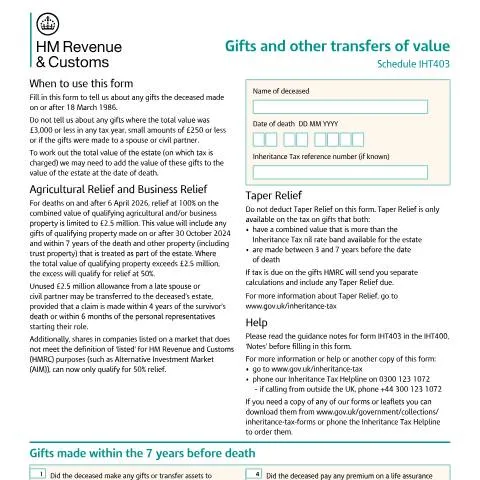
When someone passes away in the UK, their estate may be subject to Inheritance Tax, but calculating the true tax liability extends far beyond the assets they owned at death. The IHT403 form serves as a crucial component in this process, specifically designed to capture details of gifts and transfers the deceased made during their lifetime. These lifetime transfers can significantly impact the final Inheritance Tax calculation, potentially adding substantial value to the taxable estate.
The form's scope encompasses any gifts made on or after 18 March 1986, though not every gift needs reporting. HM Revenue & Customs has established specific thresholds and exemptions that determine when disclosure becomes necessary. Understanding these parameters is essential for personal representatives who must decide whether to complete this comprehensive document.
Recent Changes to Relief Provisions
Significant changes are approaching for deaths occurring on or after 6 April 2026. The traditional 100% relief on qualifying agricultural and business property faces a new £2.5 million combined limit. This cap represents a fundamental shift in how substantial business and agricultural assets receive preferential treatment under Inheritance Tax rules.
The implications extend to gifts made from 30 October 2024 onwards. Any qualifying agricultural or business property transferred within seven years of death will count towards this £2.5 million threshold. Once exceeded, relief drops to 50%, potentially doubling the effective tax rate on the excess value.
Determining Your Obligation to Complete Form IHT403
The decision to complete IHT403 hinges on six fundamental questions that appear on the form's opening page. Each question targets specific types of lifetime transfers that could affect the estate's Inheritance Tax liability.
Gift Threshold Considerations
Not every gift requires disclosure on IHT403. The form explicitly excludes gifts totalling £3,000 or less in any tax year, reflecting the annual exemption that most taxpayers can utilise. Additionally, individual gifts of £250 or less to different recipients fall outside the reporting requirements, as do transfers between spouses or civil partners, which benefit from the spouse exemption.
However, these thresholds can create complexity when multiple small gifts to the same person accumulate beyond £250 in a tax year, or when annual exemptions weren't fully utilised in previous years, potentially allowing unused portions to carry forward.
Trust-Related Transfers
The form pays particular attention to trust arrangements, recognising their potential for significant tax implications. Creating new trusts or adding assets to existing settlements often constitutes potentially exempt transfers that become chargeable if death occurs within seven years.
Equally important are situations where the deceased benefited from trust assets that subsequently came to an end during their lifetime. These arrangements can trigger complex calculations involving the loss of benefit and potential clawback provisions.
The Seven-Year Rule and Its Practical Application
Central to IHT403's purpose is the seven-year rule governing potentially exempt transfers. Gifts made within seven years of death may become chargeable to Inheritance Tax, depending on the total value of the estate and available exemptions.
Taper Relief Mechanics
While the form explicitly instructs against deducting Taper Relief during completion, understanding its operation remains crucial. Taper Relief applies to gifts made between three and seven years before death, but only becomes relevant when the combined value of chargeable gifts exceeds the nil rate band available to the estate.
| Years Before Death | Taper Relief Rate | Effective Tax Rate |
|---|---|---|
| 0-3 years | 0% | 40% |
| 3-4 years | 20% | 32% |
| 4-5 years | 40% | 24% |
| 5-6 years | 60% | 16% |
| 6-7 years | 80% | 8% |
HMRC calculates and applies Taper Relief separately from the form completion process, sending detailed calculations when tax becomes due on reported gifts.
Completing the Gift Details: Section 7 and Beyond
The heart of IHT403 lies in its detailed gift reporting sections, beginning with Section 7. Here, personal representatives must provide comprehensive information about each relevant transfer, including dates, recipients, asset descriptions, and valuations.
Valuation Complexities
Determining the "value at date of gift" requires careful consideration of market conditions at the time of transfer, not at death. This can prove particularly challenging for assets like shares in private companies or property where values fluctuate significantly.
The form's structure accommodates various exemptions and reliefs through columns B and C, allowing for charity exemptions, Agricultural Relief, and Business Relief to be properly documented. However, the recent changes to AIM-listed shares mean many previously qualifying assets now only receive 50% relief rather than the full exemption.
Gifts Out of Income Claims
Question 6 on the opening page addresses a particularly valuable exemption: gifts made from surplus income. These transfers can be entirely exempt from Inheritance Tax if they meet strict criteria, including being made from income rather than capital and not affecting the donor's standard of living.
Establishing this exemption requires detailed evidence of the deceased's income patterns, expenditure, and the regularity of the gifts. The additional pages (extending to page 8 when claiming this exemption) provide space for this crucial documentation.
Recipient Liability and Communication Protocols
An often-overlooked aspect of lifetime gifts involves the tax liability that may fall on recipients. When Inheritance Tax becomes due on lifetime transfers, the primary liability rests with those who received the gifts, not the estate.
Joint Liability Provisions
However, this liability structure changes one year after death. At that point, the deceased's executors or administrators become jointly liable for any unpaid tax on lifetime gifts, creating a potential financial exposure that extends beyond the estate's assets.
The form recognises this complexity by requesting contact details for gift recipients and clarifying whether personal representatives have authority to deal with HMRC on their behalf. Without proper authority, HMRC must communicate directly with recipients about their tax obligations, potentially complicating the administration process.
Strategic Considerations for Personal Representatives
Completing IHT403 requires more than mechanical form-filling; it demands strategic thinking about the estate's overall tax position and the implications of disclosed gifts.
Timing of Disclosure
While the form doesn't specify rigid deadlines for its completion, it typically accompanies the main IHT400 return, which must be submitted within 12 months of death. However, obtaining probate often requires earlier submission, creating pressure to complete gift investigations promptly.
Personal representatives face the challenge of gathering comprehensive information about potentially decades of financial transactions. Bank statements, solicitor records, and family recollections all contribute to building a complete picture of the deceased's lifetime giving.
Professional Valuation Requirements
Certain gifts may require professional valuation, particularly for business interests, agricultural land, or significant shareholdings. The cost of these valuations must be weighed against the potential tax savings from accurate relief claims.
For business and agricultural assets gifted after 30 October 2024, the approaching changes to relief provisions add urgency to accurate valuation work, as the distinction between 100% and 50% relief could represent substantial tax differences.
Managing Complex Family Situations
Real-world applications of IHT403 often involve intricate family dynamics and financial arrangements that don't fit neatly into standard categories.
International Considerations
When gifts involve non-UK assets or recipients living abroad, additional complexities arise. Exchange rate fluctuations between the gift date and death can affect valuations, while foreign tax credits may influence the overall liability calculation.
Similarly, gifts to overseas charities require careful documentation of their charitable status and eligibility for UK tax exemptions. The form specifically requests charity reference numbers and establishment countries to facilitate this verification.
Incomplete Records and Reconstruction
Personal representatives often encounter situations where complete records don't exist, particularly for older gifts approaching the seven-year threshold. In such cases, they must balance the duty to provide accurate information with practical limitations on available evidence.
HMRC recognises these challenges and may accept reasonable estimates supported by available evidence, but personal representatives should document their methodology and the sources consulted in reaching their conclusions.
Post-Submission Procedures and Follow-Up Actions
Submitting IHT403 marks the beginning rather than the end of the process. HMRC's review may trigger additional enquiries, valuation challenges, or requests for supporting documentation.
Assessment and Payment Procedures
When the form reveals chargeable gifts, HMRC issues separate calculations showing the tax due from each recipient. These calculations incorporate Taper Relief where applicable and provide payment instructions for the various parties involved.
The interaction between gift tax and estate tax can create cash flow challenges, particularly when recipients lack sufficient resources to meet their liabilities. Personal representatives must consider whether the estate should assist with these payments and how such arrangements affect the overall administration.
The form's comprehensive approach to lifetime transfers reflects the UK's integrated approach to Inheritance Tax, where lifetime giving and death transfers combine to determine the final tax liability. Success in completing IHT403 requires not just attention to detail, but understanding of how each disclosure fits within the broader tax calculation and the practical implications for all parties involved.
Valuation Complexities and Professional Assessments
One of the most challenging aspects of completing form IHT403 lies in accurately valuing gifts and transfers, particularly when dealing with assets that don't have readily available market prices. HMRC requires valuations to reflect the open market value at the date of transfer, but determining this figure often involves considerable complexity and professional judgement.
For quoted shares and securities, the valuation process is relatively straightforward, using the quarter-up rule based on Stock Exchange Daily Official List prices. However, unquoted shares present significant challenges. These might include shares in family companies, partnership interests, or holdings in companies with restricted marketability. The valuation must consider factors such as the size of the holding, any restrictions on transfer, the company's financial position, and potential discounts for minority interests or lack of control.
Property valuations require particular attention to timing and circumstances. The value used must reflect the property's condition and market circumstances at the date of the gift, not when you're completing the form. This distinction becomes crucial when property markets have moved significantly between the transfer date and the IHT403 submission. For jointly owned property, you must also consider whether any discount applies for the fractional interest being transferred, as a half-share in a property typically sells for less than half the property's total value.
Chattels and personal possessions create their own valuation challenges. While HMRC provides a £6,000 threshold below which individual items may be grouped together, valuable items such as jewellery, artwork, antiques, or collectibles require individual professional valuations. The valuation must consider the item's condition, provenance, and the appropriate market for sale. For instance, a piece of jewellery might have different values depending on whether it's sold for its gemstones, as a period piece, or through different market channels.
Life insurance policies transferred during lifetime require careful consideration of their surrender value at the date of transfer, while trust interests need valuation based on the beneficiary's specific rights and the trust's assets. Foreign assets add another layer of complexity, requiring conversion to sterling at appropriate exchange rates and consideration of any restrictions on transferability under foreign law.
When professional valuations are necessary, HMRC expects these to be carried out by appropriately qualified professionals with relevant experience. For property, this means RICS-qualified surveyors; for shares, appropriately qualified accountants or corporate finance specialists; for chattels, recognised specialists in the relevant field. The cost of these valuations can be significant, but they're essential for defending your position if HMRC queries the values declared.
Documentation supporting valuations should be comprehensive and retained for potential future enquiries. This includes the valuer's qualifications, methodology used, comparable evidence considered, and any assumptions made. Where estimates are used pending formal valuations, these should be clearly marked as such, with formal valuations provided as soon as available.
Trust Complications and Beneficial Interest Transfers
Transfers involving trusts present some of the most complex scenarios when completing form IHT403, requiring detailed understanding of both the trust's structure and the specific nature of the transfer being reported. The form must capture not only direct transfers into trust but also more subtle transactions that may constitute transfers of value for inheritance tax purposes.
When someone settles assets into a discretionary trust, this typically represents a chargeable lifetime transfer requiring disclosure on IHT403. However, the complications extend beyond straightforward settlements. For instance, if an existing beneficiary of a trust disclaims their interest, allowing other beneficiaries to benefit, this might constitute a transfer of value requiring reporting. Similarly, variations to trust deeds that alter beneficial interests could trigger reporting requirements, even when no cash or assets physically change hands.
Particular attention must be paid to transfers involving interest in possession trusts. When a life tenant assigns their interest to remainder beneficiaries, or when they allow their interest to lapse without taking steps to preserve it, these actions may constitute transfers of value. The valuation becomes complex because it requires assessment of the life tenant's actuarial interest based on life expectancy tables and the trust's asset composition.
Trust splitting arrangements, where a single trust is divided into separate trusts for different beneficiaries, may also require reporting depending on how the division affects different beneficiaries' interests. If the split results in some beneficiaries receiving disproportionately valuable assets compared to their previous interests, this could constitute a transfer of value between beneficiaries.
International trust structures add additional complexity. Transfers to or from foreign trusts may have different tax implications depending on the residence status of the settlor, trustees, and beneficiaries. The form requires disclosure of such arrangements, and you may need to consider whether the transfer falls within any relevant double taxation treaty provisions.
Protective trusts present another area of complexity. These trusts automatically convert from interest in possession to discretionary trusts when certain events occur, such as the beneficiary's bankruptcy. If the conversion occurs due to the beneficiary's deliberate action or omission, this might constitute a transfer of value requiring disclosure.
When completing IHT403 for trust-related transfers, you must clearly identify the trust involved, including any trust registration number if the trust is registered with HMRC's Trust Registration Service. The description should specify the exact nature of the transfer and identify all parties whose interests are affected. For complex trust arrangements, it may be advisable to include a professional trust deed analysis or legal opinion supporting your interpretation of the transfer's inheritance tax implications.
Cross-Border Transfers and International Considerations
International elements in gift transactions create substantial additional complexity when completing form IHT403, requiring careful consideration of UK inheritance tax rules alongside potential foreign tax implications and treaty provisions. The form must capture not only the basic details of cross-border transfers but also the various factors that might affect their UK inheritance tax treatment.
The domicile status of both the transferor and recipient significantly impacts reporting requirements and tax implications. UK-domiciled individuals face inheritance tax on their worldwide assets, making all gifts potentially relevant regardless of where the assets are located or the recipient resides. However, non-UK domiciled individuals generally face inheritance tax only on their UK assets, though deemed domicile rules may apply after extended UK residence periods.
Currency considerations require particular attention when valuing foreign assets or transfers. HMRC expects valuations in sterling using appropriate exchange rates for the transfer date, but fluctuating exchange rates can significantly impact values. For ongoing arrangements like regular foreign currency payments, you may need to consider whether each payment constitutes a separate transfer or whether they form part of a single arrangement for inheritance tax purposes.
Foreign property transfers present unique challenges, particularly regarding valuation and legal restrictions. Some jurisdictions impose restrictions on foreign ownership or transfer of property, which might affect the transfer's value or even its validity for UK inheritance tax purposes. Local taxes paid on the transfer may be relevant for double taxation relief calculations, but these don't automatically reduce the UK inheritance tax liability.
Transfers involving foreign companies or investment structures require careful analysis of their UK tax treatment. Some foreign entities might be treated as transparent for UK tax purposes, meaning transfers of interests in such entities are treated as transfers of their underlying assets. Others might be treated as opaque, meaning the transfer is of the entity interest itself. This distinction can significantly affect valuation and reporting requirements.
Double taxation treaties may provide relief where foreign taxes are paid on the same transfer, but the availability and extent of relief depends on the specific treaty provisions and the nature of the foreign tax. The form should identify any foreign taxes paid and any treaty relief claimed, as HMRC may require additional documentation to support such claims.
Trust structures with international elements create additional complexity. Foreign trusts may have different beneficial ownership concepts, and transfers to such trusts might require analysis under both UK and foreign legal concepts. The residence status of trustees can affect the trust's UK tax treatment, and changes in trustee residence during the trust's life might impact previous transfer reporting.
When reporting international transfers on IHT403, comprehensive documentation becomes crucial. This should include foreign legal opinions where the transfer's legal effect under foreign law differs from UK concepts, foreign tax computations where relevant taxes are paid abroad, and currency conversion calculations showing the methodology and rates used. Professional advice is often essential for complex international arrangements, given the interaction between UK inheritance tax rules and foreign legal and tax systems.