When Living Accommodation Becomes a Complex Tax Calculation
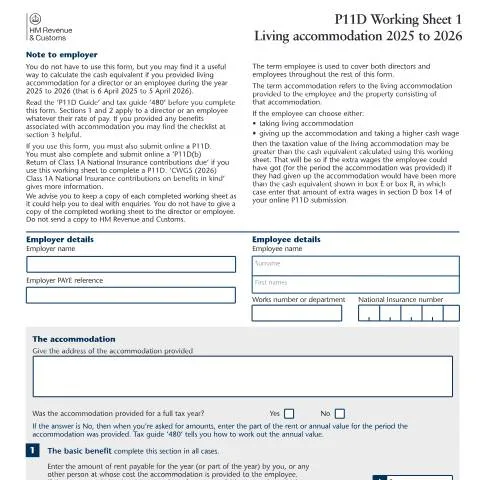
Providing living accommodation to directors and employees triggers intricate tax obligations that extend far beyond simple rental arrangements. The P11D WS1 working sheet serves as HMRC's structured framework for calculating the precise cash equivalent of accommodation benefits, transforming what might appear as straightforward housing provision into detailed tax computations that can significantly impact both employer liabilities and employee tax positions.
This working sheet operates within the broader P11D reporting ecosystem, where employers must declare benefits in kind for directors and employees earning over £8,500 annually. Unlike standard rental agreements, employment-related accommodation involves complex valuation methodologies, threshold calculations, and additional yearly rent provisions that can dramatically alter the final tax treatment.
The distinction between basic accommodation benefits and high-value property provisions creates a two-tier calculation system that catches many employers unprepared. Properties costing over £75,000 trigger additional yearly rent calculations at 3.75% of the excess value, potentially creating substantial tax charges that require careful planning and accurate reporting.
Understanding the £75,000 Threshold and Its Consequences
The £75,000 cost threshold represents a critical junction in accommodation benefit calculations, separating straightforward annual value assessments from complex additional yearly rent computations. When accommodation costs exceed this threshold, employers must navigate a sophisticated calculation framework that considers acquisition costs, improvements, market values, and temporal factors.
The cost calculation encompasses the original acquisition price plus subsequent improvements, minus any employee contributions toward costs or tenancy grants. This seemingly straightforward addition becomes complex when multiple parties are involved in providing or financing the accommodation, including connected persons and third-party arrangements.
For properties where the provider held interest throughout the six years preceding the employee's first occupation after 30 March 1983, a different valuation approach applies. The calculation shifts to market value at the relevant date plus subsequent improvement costs, potentially creating more favourable tax outcomes in appreciating property markets.
| Property Cost Range | Calculation Method | Additional Considerations |
|---|---|---|
| Under £75,000 | Basic benefit only (annual value vs rent paid) | No additional yearly rent |
| £75,001 to £150,000 | Basic benefit plus 3.75% of excess over £75,000 | Significant additional tax charge |
| Over £150,000 | Complex calculations with substantial tax implications | Professional advice typically essential |
The 3.75% additional yearly rent rate, set as the official rate of interest on 6 April 2025, applies to the excess over £75,000. For part-year provisions, this calculation requires precise daily apportionment, multiplying the annual charge by the number of days provided divided by 365.
Navigating Annual Value Determinations and Rental Calculations
Annual value determination forms the foundation of accommodation benefit calculations, yet this concept often proves elusive for employers unfamiliar with property valuation principles. HMRC's tax guide 480 provides detailed methodology, but practical application requires understanding local property markets, comparable rentals, and statutory valuation approaches.
The working sheet requires comparison between annual value and actual rent payable, with the greater amount forming the basis for benefit calculations. This comparison becomes particularly relevant in areas where market rents significantly exceed rateable values, or where employers have negotiated below-market rental arrangements with property providers.
Lease premium attributions add another layer of complexity for properties subject to leases of ten years or less entered into or extended before 22 April 2009. The total calculation must include both annual rent and attributed lease premium amounts, requiring careful documentation of lease terms and premium structures.
Employee contributions through 'making good' arrangements can reduce the final benefit charge, but only up to the calculated cash equivalent amount. Any excess payments by the employee cannot create negative benefits or refunds, maintaining the principle that accommodation benefits cannot generate tax deductions for recipients.
Part-Year Provision Complexities
When accommodation is provided for partial tax years, every element of the calculation requires proportional adjustment. This affects annual value apportionments, rent calculations, additional yearly rent computations, and employee contribution assessments. The precision required for these calculations often necessitates detailed record-keeping throughout the provision period.
Employers must carefully document start and end dates, ensuring accuracy in daily calculations that can significantly impact final benefit values. Mid-year changes in accommodation arrangements, employee contributions, or property improvements require separate calculations for each distinct period.
Alternative Cash Wage Elections and Their Tax Implications
One of the most sophisticated aspects of accommodation benefit taxation involves situations where employees can choose between receiving accommodation or higher cash wages. This election mechanism can fundamentally alter the tax treatment, potentially creating benefit values exceeding those calculated through standard working sheet methodologies.
When employees have genuine choice between accommodation and additional wages, the taxation value becomes the higher of the calculated cash equivalent or the foregone wages. This principle prevents artificial reduction of benefit charges through below-market accommodation arrangements where employees could otherwise receive equivalent cash compensation.
Establishing genuine choice requires careful documentation of employment terms, demonstrating that employees have real alternatives rather than theoretical options. The additional wages must represent actual increases the employee could have received, not hypothetical calculations based on accommodation costs or market values.
This provision particularly affects senior executives and directors who often have flexibility in remuneration structures. Employers must ensure that accommodation arrangements don't inadvertently create higher tax charges than intended, requiring careful coordination between accommodation provision and overall compensation planning.
Integration with P11D Reporting and Class 1A National Insurance
The P11D WS1 working sheet serves as a calculation tool rather than a submission document, with final amounts transferred to the main P11D return for online submission to HMRC. This integration requires careful attention to ensure calculated amounts appear in the correct sections and that supporting documentation remains available for potential enquiries.
Box 14 of section D on the P11D return receives the final accommodation benefit amount, whether from basic calculations (box E) or combined calculations including additional yearly rent (box R). The distinction between these amounts affects both income tax and National Insurance treatment, requiring accurate categorisation.
Class 1A National Insurance obligations arise automatically when accommodation benefits exceed £8,500 annually or apply to directors regardless of earnings level. The P11D(b) return captures these liabilities, with employers responsible for calculating and paying Class 1A contributions at 13.8% of the benefit value.
CWG5 guidance provides comprehensive information on Class 1A calculations, but the interaction between accommodation benefits and other benefits in kind can create complex aggregation requirements. Employers must consider total benefit packages when determining Class 1A liabilities and P11D submission requirements.
Record Retention and Enquiry Preparation
HMRC strongly advises retaining completed working sheets, recognising their value in responding to potential enquiries or compliance reviews. These documents demonstrate the calculation methodology and supporting evidence used in determining benefit values, providing crucial audit trails for complex accommodation arrangements.
Effective record retention extends beyond the working sheet itself to include property valuations, lease agreements, improvement receipts, employee payment records, and correspondence regarding accommodation arrangements. This comprehensive documentation package supports both annual reporting obligations and longer-term compliance requirements.
Connected Persons and Third-Party Accommodation Arrangements
Accommodation benefit rules extend beyond direct employer provision to capture arrangements involving connected persons and third-party providers. These extended relationships can create unexpected tax obligations where accommodation appears to be provided by independent parties but falls within the benefit-in-kind framework.
Connected person definitions encompass relatives, business partners, and entities under common control, creating broad scope for accommodation arrangements to trigger benefit charges. Employers must carefully evaluate all parties involved in accommodation provision, ensuring that apparent third-party arrangements don't inadvertently create unreported benefit obligations.
The cost calculation framework specifically includes expenses incurred by connected persons, recognising that accommodation benefits can arise through indirect funding mechanisms. This approach prevents avoidance arrangements where accommodation costs are borne by related entities to circumvent direct employer reporting obligations.
Professional property management arrangements require particular scrutiny, especially where management companies are connected to employers or employees. The substance of these arrangements determines whether accommodation benefits arise, regardless of the formal legal structures involved.
Associated Benefits and Comprehensive Accommodation Packages
Living accommodation rarely exists in isolation, typically forming part of comprehensive benefit packages that include furniture, utilities, maintenance services, and ancillary facilities. The P11D WS1 working sheet acknowledges this reality through section 3, providing a checklist of commonly associated benefits that require separate calculation and reporting.
Heating and lighting provisions represent the most common ancillary benefits, requiring separate valuation based on actual costs or reasonable estimates. These calculations often prove challenging where accommodation forms part of larger properties or where utility arrangements don't provide clear allocation mechanisms between accommodation and other uses.
Furniture benefits divide between items given to employees (creating disposal benefits) and items provided for temporary use (creating annual use benefits). The distinction affects both calculation methodologies and timing of benefit recognition, with disposal benefits potentially creating significant one-off charges.
| Associated Benefit Type | Calculation Basis | Reporting Requirements |
|---|---|---|
| Heating/Lighting | Actual costs incurred | Separate P11D entry required |
| Repairs/Decoration | Annual expenditure | May be substantial for older properties |
| Furniture (disposal) | Market value at disposal | One-off benefit charge |
| Furniture (annual use) | 20% of market value when first provided | Recurring annual charge |
Repair and decoration expenses require careful allocation between necessary maintenance and improvements that enhance property value. Only expenses that don't add lasting value to the property qualify as annual benefits, with improvements potentially affecting the cost base for additional yearly rent calculations.
Strategic Timing and Tax Year Planning Considerations
The timing of accommodation provision within tax years can significantly impact benefit calculations, employee tax positions, and employer National Insurance liabilities. Strategic planning around tax year boundaries offers opportunities to optimise accommodation arrangements while maintaining compliance with benefit-in-kind requirements.
Commencing accommodation provision early in tax years maximises the period over which setup costs and initial arrangements can be spread, potentially reducing per-day benefit rates for high-value properties. Conversely, short-term provisions near tax year ends may create disproportionate administrative burdens relative to the accommodation value provided.
The interaction between accommodation benefits and other remuneration elements requires careful coordination to avoid unintended tax consequences. High earners approaching higher rate tax thresholds may benefit from timing accommodation provision to spread tax impacts across multiple years.
Annual value assessments reflect property values at specific dates, creating opportunities for strategic timing where property markets are volatile or where improvements are planned. Understanding local property cycles and valuation methodologies can inform optimal timing decisions for accommodation arrangements.
Employers must balance these strategic considerations against practical operational requirements and employee needs, ensuring that tax optimisation doesn't compromise the underlying business purposes of accommodation provision. The complexity of these arrangements often justifies professional advice to navigate the intersection of tax planning and practical implementation.
Complex Accommodation Arrangements and Mixed-Use Properties
When accommodation serves multiple purposes or involves intricate ownership structures, the P11D WS1 calculations become significantly more nuanced. Mixed-use properties present particular challenges for HMRC compliance, requiring careful apportionment between business and personal elements.
For properties that function as both workplace and residence—such as farm manager accommodation above agricultural premises, or caretaker flats within commercial buildings—you must establish clear boundaries for benefit calculation purposes. The key principle involves identifying which portions of the property are genuinely necessary for employment duties versus those providing personal living space beyond reasonable occupational requirements.
Agricultural workers often encounter complex scenarios where accommodation is provided on working farms. The benefit calculation must distinguish between basic accommodation necessary for livestock care or security duties and enhanced living standards that exceed operational requirements. For instance, a farm cottage provided to ensure 24-hour animal welfare oversight may qualify for different treatment than a luxury farmhouse where the accommodation standard significantly exceeds functional necessities.
Multi-generational family businesses frequently involve accommodation arrangements where properties house both working family members and relatives not directly involved in the business. The P11D WS1 must carefully apportion costs between legitimate employee accommodation and personal family arrangements. This becomes particularly complex when utility bills, maintenance costs, and council tax cover the entire property but only portions relate to the employment benefit.
Temporary accommodation arrangements require special consideration when calculating annual rental values. Short-term lettings, seasonal worker housing, or project-based accommodation may not fit standard valuation approaches. You'll need to consider whether temporary arrangements justify pro-rata calculations or whether the full annual value applies regardless of occupancy duration.
Properties undergoing renovation or partial occupation present additional complexities. When employees occupy accommodation while building work continues, or when only portions of properties are habitable, the benefit calculation must reflect the actual standard of accommodation provided. Reduced amenities, restricted access to certain areas, or ongoing construction disruption may justify adjusted valuations, though clear documentation of circumstances remains essential.
Shared accommodation arrangements between multiple employees require careful cost allocation. When several staff members occupy the same property—whether in separate rooms, floors, or units—the P11D WS1 must appropriately divide the total accommodation benefit. This involves not just splitting rental values but also considering shared facilities, private spaces, and varying levels of accommodation quality between occupants.
International and Cross-Border Accommodation Considerations
Cross-border employment arrangements introduce additional layers of complexity to P11D WS1 reporting, particularly when accommodation benefits span multiple jurisdictions or involve international assignees working in the UK.
Expatriate employees receiving UK accommodation while maintaining overseas residences face intricate benefit calculations. The accommodation provided must be evaluated against UK market standards rather than home country comparisons, even when the employee's salary or living allowances reflect international packages. Currency fluctuations can significantly impact the relative value of accommodation benefits, requiring careful consideration of exchange rates and timing for benefit valuation purposes.
Diplomatic and consular staff present unique challenges for accommodation benefit reporting. While certain diplomatic immunities may apply, employees of international organisations or foreign governments working in the UK may still trigger P11D obligations depending on their specific status and the nature of their employment arrangements. The accommodation's diplomatic or official character doesn't automatically exempt it from benefit-in-kind reporting requirements.
Cross-border workers commuting between the UK and other countries—particularly common along the Northern Ireland border or for Channel Islands residents—may receive accommodation for UK working periods. These arrangements require careful analysis of whether the accommodation represents a taxable benefit or legitimate business necessity for cross-border employment duties.
International students or researchers receiving accommodation through UK educational institutions or research organisations may find themselves subject to P11D reporting if their arrangements constitute employment rather than purely academic relationships. The distinction between student accommodation and employee housing benefits can significantly impact tax obligations and reporting requirements.
Temporary overseas assignments where UK-based employees receive foreign accommodation funded by UK employers create reverse scenarios requiring careful consideration. While the P11D WS1 focuses on UK accommodation benefits, understanding these international arrangements helps ensure comprehensive compliance with UK employment tax obligations.
Multi-national corporate housing policies often involve complex cost-sharing arrangements between different country entities. When UK subsidiaries provide accommodation but costs are recharged internationally, or when global mobility budgets fund UK housing, the P11D WS1 must accurately reflect the true cost and benefit flowing to UK employees regardless of internal corporate accounting arrangements.
Brexit implications continue to evolve for cross-border accommodation arrangements, particularly affecting EU nationals working in the UK or UK companies providing accommodation for European operations. Changed immigration rules, tax treaties, and social security coordination may impact how accommodation benefits are calculated and reported for affected employees.
Record-Keeping Systems and Audit Preparation
Maintaining comprehensive documentation systems for accommodation benefits extends far beyond basic P11D WS1 completion, requiring sophisticated record-keeping approaches that can withstand detailed HMRC scrutiny during compliance reviews or investigations.
Establishing robust documentation protocols begins with creating individual employee accommodation files containing all relevant agreements, valuations, and supporting evidence. These files should include original tenancy agreements, purchase documentation, professional valuations, utility bills, council tax statements, insurance policies, and maintenance records. Regular updates ensure information remains current and accurate for ongoing benefit calculations.
Photographic documentation proves invaluable during HMRC enquiries, particularly for establishing accommodation standards and condition at specific points in time. Systematic photography should cover all rooms, facilities, garden areas, and any unique features affecting valuation. Date-stamped images help demonstrate property conditions during different benefit periods, especially relevant when accommodation undergoes improvements or deterioration.
Digital systems increasingly replace paper-based records, but careful attention to data backup and accessibility remains crucial. Cloud-based storage systems must comply with UK GDPR requirements while ensuring HMRC can access required information during investigations. Regular system backups and clear file naming conventions prevent crucial documentation from becoming inaccessible when needed most urgently.
Vendor management records become essential when third-party suppliers provide accommodation services. Contracts with letting agents, property management companies, or corporate housing providers should clearly define responsibilities for tax reporting and documentation. Regular reconciliation between vendor charges and internal benefit calculations helps identify discrepancies before they compound into significant compliance issues.
Employee communication records demonstrate reasonable efforts to inform staff about accommodation benefit implications. Email confirmations, signed acknowledgements, and meeting minutes showing benefit discussions help establish that employees understood their tax obligations. This documentation becomes particularly valuable when employees later dispute benefit calculations or claim ignorance of tax implications.
Professional valuation certificates require careful management, including tracking validity periods and renewal requirements. Relationships with qualified surveyors should be maintained to ensure timely revaluations when required. Documentation should demonstrate that valuers possess appropriate qualifications and maintain professional indemnity insurance adequate for the values involved.
Annual reconciliation processes should systematically review all accommodation arrangements against P11D WS1 submissions, identifying any discrepancies or changes requiring adjustment. These reviews should examine cost allocations, benefit calculations, and employee circumstances to ensure continued accuracy. Documentation of reconciliation processes demonstrates systematic compliance approaches to HMRC investigators.
Audit trail preparation involves organizing documentation to facilitate efficient HMRC review processes. Clear indexing systems, chronological filing, and summary schedules help inspectors understand accommodation arrangements quickly. Proactive preparation of explanation notes for unusual circumstances or complex calculations demonstrates professional compliance approaches and may reduce investigation scope or duration.