When Company Cars Transform into Tax Obligations: The P11D Working Sheet 2 System
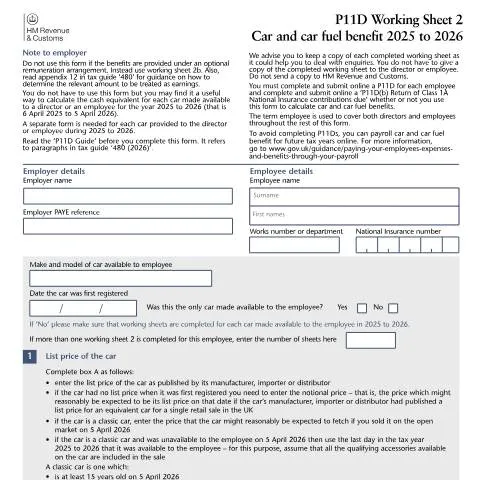
Every spring, as the tax year draws to a close on 5 April, employers across the UK face a familiar challenge: calculating the precise benefit-in-kind values for company cars provided to their workforce. The P11D Working Sheet 2 (WS2) emerges as HMRC's designated calculation tool for this purpose, transforming what could be a labyrinthine process into a structured methodology. Yet this seemingly straightforward form conceals layers of complexity that can catch even experienced payroll professionals off guard.
The worksheet operates within a dual framework: it serves as both a computational aid for employers and a protective mechanism ensuring compliance with benefit-in-kind regulations. Unlike the formal P11D return itself, which must be submitted online to HMRC, the WS2 functions as an internal working document—though one that could prove invaluable during a compliance enquiry.
Critical distinction: Employers dealing with optional remuneration arrangements must bypass WS2 entirely, using the alternative WS2b instead. This fundamental division reflects HMRC's recognition that salary sacrifice schemes require different calculation methodologies, as detailed in appendix 12 of tax guide 480.
Employer Profiles and Calculation Responsibilities
The WS2 system applies to employers across all sectors, from multinational corporations with extensive fleet arrangements to small businesses providing a single vehicle to their director. However, the practical implications vary significantly based on organisational structure and vehicle provision patterns.
Large Fleet Operators
Companies maintaining substantial car fleets face the most complex WS2 scenarios. Each vehicle requires individual calculation, meaning a business providing cars to fifty employees needs fifty separate worksheets. The administrative burden intensifies when employees receive multiple vehicles during the tax year—perhaps upgrading mid-term or receiving temporary replacements during maintenance periods.
These employers must maintain meticulous records of registration dates, CO2 emissions figures, and list prices across diverse vehicle types. The challenge multiplies when dealing with classic cars, where market valuations on 5 April 2026 become crucial factors, or electric vehicles with their zero-emission calculations.
Single-Vehicle Providers
Smaller businesses typically encounter simpler WS2 scenarios, often involving one director's vehicle. Yet simplicity can breed complacency—overlooking accessories, misunderstanding capital contributions, or incorrectly applying CO2 thresholds can generate significant tax implications even for single-car arrangements.
Director-shareholders face particular scrutiny, as HMRC closely examines benefit-in-kind arrangements that might constitute disguised remuneration. The WS2 calculation becomes especially critical when determining whether the vehicle represents genuine business provision or tax-advantageous personal benefit.
Specialist Scenarios
Certain employer categories encounter unique WS2 challenges. Leasing companies providing vehicles to their own staff must navigate complex list price determinations. Motor dealerships offering demonstration vehicles face intricate availability calculations. Emergency services and healthcare providers dealing with pool cars require careful assessment of private use elements.
Navigating the List Price Labyrinth: Section A Complexities
The WS2's opening section demands precise list price determination—a task that appears straightforward but conceals numerous complications. The form requires the published manufacturer, importer, or distributor list price, yet this seemingly simple requirement generates multiple interpretation challenges.
Standard List Price Scenarios
For mainstream vehicles with clear manufacturer pricing, employers enter the official list price including standard accessories. However, "standard" proves subjective—manufacturers increasingly offer multiple trim levels, option packages, and regional variations. The WS2 requires the specific list price applicable when the vehicle was first registered, not current pricing.
Import vehicles create additional complexity. European models entering the UK market through official distributors carry clear list prices, but parallel imports or grey market vehicles may lack official UK pricing structures. Employers must determine notional prices representing reasonable market expectations for equivalent vehicles.
Classic Car Valuations
Classic cars introduce an entirely different calculation methodology. The WS2 defines classics as vehicles meeting three criteria: at least fifteen years old on 5 April 2026, market value exceeding £15,000, and current value surpassing original list price including accessories.
For qualifying classics, employers abandon historical list prices, instead using open market valuations on 5 April 2026. This requirement demands professional valuations or detailed market research, particularly for rare or modified vehicles. The calculation assumes all qualifying accessories are included in the hypothetical sale.
Practical challenge: If the classic car becomes unavailable before 5 April 2026, employers use the last availability date for valuation purposes. This provision addresses scenarios where vehicles are sold, written off, or permanently withdrawn from service during the tax year.
Notional Price Determinations
Vehicles lacking published list prices when first registered require notional price calculations. This scenario commonly affects pre-production models, prototype vehicles, or extensively modified cars. Employers must estimate the price an equivalent vehicle might reasonably command if the manufacturer had published standard retail pricing.
The notional price methodology considers comparable models, market positioning, and specification levels. For heavily modified vehicles, the calculation includes both base vehicle value and modification costs, provided these represent standard market pricing rather than bespoke one-off work.
Accessory Calculations and Capital Contribution Limits
The WS2's treatment of accessories and capital contributions reveals HMRC's detailed approach to benefit-in-kind precision. These sections frequently generate calculation errors, particularly regarding what constitutes an accessory versus standard equipment.
| Accessory Type | Treatment | Calculation Impact |
|---|---|---|
| Factory-fitted options | Include in list price | Increases base calculation |
| Dealer-fitted accessories | Add to Section B | Separate accessory calculation |
| Employee-purchased additions | Generally exclude | No benefit impact |
| Replacement parts | Case-by-case assessment | Depends on enhancement value |
Defining Accessories
The P11D Guide provides detailed accessory guidance, but practical application requires careful judgment. Satellite navigation systems fitted by dealers constitute accessories, while factory-integrated systems form part of standard specification. Upgraded alloy wheels represent accessories, but standard manufacturer wheels do not.
Timing proves crucial—accessories fitted after initial registration require separate calculation, while factory options installed before first registration integrate into list price calculations. This distinction affects both the WS2 calculation methodology and subsequent benefit-in-kind values.
Capital Contribution Mechanics
Employee capital contributions reduce benefit-in-kind calculations, subject to a £5,000 maximum limit. However, the WS2 requires careful documentation of qualifying contributions. Initial deposits, ongoing rental payments, and maintenance contributions each receive different treatment under HMRC rules.
Key limitation: The £5,000 cap applies per vehicle, not per tax year. Employees providing multiple contributions across different vehicles cannot aggregate these amounts—each vehicle's contribution calculation remains independent.
Contributions must represent genuine capital payments, not operational expenses. Fuel costs, insurance premiums, and routine maintenance payments do not qualify as capital contributions, regardless of payment method or documentation.
CO2 Emissions and Fuel Type Classifications
Section 5 of the WS2 introduces HMRC's sophisticated CO2-based percentage calculation system, where emissions figures directly translate into benefit-in-kind percentages. This methodology reflects environmental policy objectives while creating complex calculation requirements for employers.
Registration Date Dependencies
The WS2 employs different percentage tables based on vehicle registration dates, acknowledging evolving emissions standards and testing methodologies. Cars registered before 1 January 1998 bypass CO2 calculations entirely, using engine capacity-based percentages instead. Vehicles registered from 1 January 1998 onwards enter the CO2 calculation framework, but face different percentage scales depending on their exact registration timing.
Post-6 April 2020 registrations encounter the current percentage structure, designed to reflect Real Driving Emissions (RDE) testing standards. Earlier vehicles use legacy percentage scales, creating a complex matrix of calculation methodologies within single employer fleets.
Diesel Differentials
The WS2 distinguishes between diesel vehicles meeting Euro 6d standards and older diesel cars, applying different percentage calculations to each category. This distinction requires technical verification of emissions compliance—information not always readily available from standard vehicle documentation.
Euro 6d compliance determines whether diesel vehicles receive standard treatment (Key letter F) or face penalty rates (Key letter D). Employers must verify compliance through manufacturer certificates or official databases, as vehicle registration documents may not specify Euro 6d status clearly.
Electric and Hybrid Complexities
Pure electric vehicles receive zero CO2 ratings, but plug-in hybrids face complex calculations involving both emissions figures and electric-only range capabilities. The WS2 requires approved zero-emission mileage data for vehicles with CO2 emissions between 1-50 g/km, information that may require manufacturer confirmation.
Electric range calculations use official test cycle data, not real-world performance figures. This creates potential discrepancies between theoretical WS2 calculations and practical vehicle usage patterns, though HMRC maintains test cycle data for consistency across all employers.
Percentage Table Navigation and Threshold Applications
Table 2 within the WS2 represents HMRC's most complex benefit-in-kind calculation matrix, incorporating registration dates, fuel types, CO2 emissions, and electric ranges into unified percentage determinations. Navigating this table requires systematic approach and careful attention to threshold applications.
Threshold Rounding Rules
The 2025-26 relevant threshold of 55g/km creates specific rounding requirements that frequently generate calculation errors. CO2 figures exceeding 55g/km must be rounded down to the nearest 5g/km increment—128g/km becomes 125g/km for calculation purposes. However, figures at or below 55g/km avoid rounding, maintaining their precise values for electric range assessments.
This rounding methodology ensures consistent application across all employers while simplifying percentage table navigation. Yet the 55g/km threshold creates a calculation cliff edge—vehicles with 54g/km and 56g/km emissions face dramatically different percentage treatments despite minimal emissions differences.
Column Selection Logic
Table 2's four-column structure requires careful selection based on registration date and fuel type combinations. Pre-6 April 2020 vehicles use columns 1 and 2, while newer registrations employ columns 3 and 4. Within each date category, fuel type determines specific column usage—petrol and compliant diesel vehicles sharing columns, non-compliant diesel facing penalty columns.
The column selection process becomes particularly complex for employers managing mixed fleets spanning multiple registration periods and fuel types. Each vehicle requires individual column determination, with no shortcuts or aggregation possibilities across different vehicle categories.
Electric Range Calculations
For low-emission vehicles (1-50g/km CO2), electric range capabilities significantly influence percentage calculations. The WS2 requires approved zero-emission mileage figures—official test data rather than manufacturer marketing claims or real-world estimates.
Range categories create percentage steps: vehicles achieving 130+ miles electric range receive minimum percentages, while shorter ranges face graduated increases. This structure incentivises genuine electric capability rather than token hybrid systems, though it requires precise technical data that may prove challenging to obtain for some vehicles.
Submission Protocols and Record Retention Requirements
Despite its critical role in benefit-in-kind calculations, the WS2 itself never travels to HMRC—it remains an internal employer document supporting formal P11D submissions. This arrangement creates specific obligations regarding record retention, accuracy verification, and enquiry preparation.
Internal Documentation Standards
HMRC explicitly advises retaining completed WS2 forms to assist with potential enquiries, though no specific retention period is mandated. Best practice suggests maintaining worksheets throughout the enquiry window—typically five years from the relevant 31 January submission deadline. This retention enables employers to demonstrate calculation methodologies and support P11D accuracy during compliance reviews.
The WS2's supporting role means employers must maintain underlying documentation proving list prices, CO2 figures, capital contributions, and availability periods. The worksheet itself provides calculation structure, but enquiry defence requires comprehensive source documentation spanning vehicle specifications, employee arrangements, and timing evidence.
P11D Integration Process
Completed WS2 calculations feed directly into online P11D submissions, where car benefit figures appear alongside other benefit-in-kind entries. Employers must ensure WS2 accuracy before P11D completion, as subsequent corrections require formal amendment procedures rather than simple resubmission.
The parallel P11D(b) return captures Class 1A National Insurance obligations arising from car benefits, using WS2 calculations as the foundation for contribution assessments. This dual submission requirement means WS2 errors cascade across multiple compliance obligations, amplifying the importance of initial accuracy.
Payroll Integration Alternatives
HMRC increasingly encourages employers to payroll car benefits rather than relying on year-end P11D processes. This approach eliminates WS2 requirements for future tax years, as benefits flow through regular payroll calculations rather than annual reporting cycles. However, transitioning to payrolled benefits requires careful planning and employee communication, particularly regarding tax code adjustments and monthly deduction patterns.
Employers considering payrolling must weigh administrative simplification against reduced flexibility—payrolled benefits become harder to adjust mid-year, while P11D reporting allows comprehensive year-end calculations incorporating all relevant factors and changes.
Managing Calculation Disputes and Compliance Challenges
WS2 calculations occasionally generate disagreements between employers, employees, and HMRC regarding benefit valuations, availability periods, or technical specifications. Understanding resolution pathways and defensive strategies proves essential for maintaining compliance while protecting legitimate business interests.
Valuation Disputes
Classic car valuations represent the most frequent WS2 dispute category, as market assessments involve subjective judgments rather than published pricing. HMRC may challenge employer valuations during enquiries, particularly for rare or extensively modified vehicles where comparable sales data proves limited.
Defensive preparation requires professional valuations from recognised specialists, detailed market research documenting comparable sales, and comprehensive condition assessments supporting valuation conclusions. The WS2's requirement for 5 April 2026 valuations creates timing challenges—employers must project forward from current market conditions to year-end expectations.
Availability Period Challenges
Determining precise vehicle availability periods can generate complex disputes, particularly regarding temporary withdrawals, shared usage arrangements, or vehicles under repair. The WS2 requires accurate availability calculations to ensure proportionate benefit assessments, yet documentation may not capture all relevant circumstances.
HMRC scrutinises claimed unavailability periods, seeking evidence of genuine withdrawal rather than artificial arrangements designed to reduce benefit calculations. Employers must maintain detailed records of maintenance periods, accident repairs, and legitimate business unavailability to support WS2 calculations during potential enquiries.
Technical Specification Disputes
CO2 emissions figures and electric range capabilities occasionally face challenge, particularly for modified vehicles or imports lacking clear UK certification. HMRC requires approved figures rather than manufacturer estimates or third-party testing, creating potential disputes where official data proves unavailable or contradictory.
Resolution typically requires manufacturer confirmation or independent testing to establish definitive technical specifications. This process can prove time-consuming and expensive, particularly for older or rare vehicles where original certification may no longer be readily accessible.