Understanding P11D Working Sheet 3: When Company Vans Cross the Line Between Business and Personal
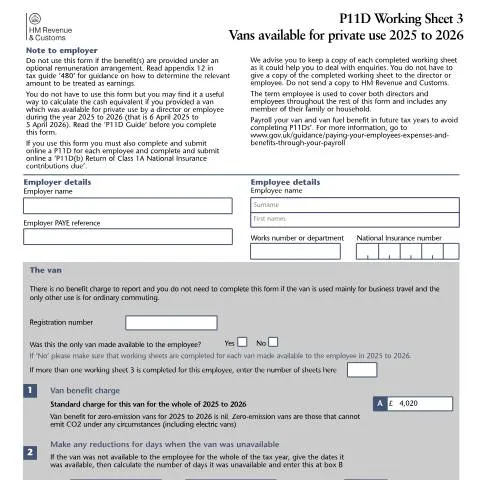
The moment a company van becomes more than just a tool for work—when it sits on an employee's driveway overnight, ferries the family to weekend shopping trips, or serves as the vehicle for the daily commute—it transforms into a taxable benefit that triggers specific reporting obligations for employers. The P11D Working Sheet 3 exists to capture this transformation with mathematical precision, calculating the exact cash equivalent value that HMRC expects to see declared.
This working sheet operates as the computational backbone behind the P11D form's section G, boxes 9 and 10, where van benefit charges must be reported. Unlike the straightforward company car calculations that many payroll professionals are familiar with, van benefit assessments involve distinct rules, different thresholds, and particular exemptions that can dramatically alter the final taxable amount.
The distinction between business use and private use forms the crux of this entire exercise. HMRC draws a clear line: if a van's only non-business use consists of ordinary commuting between home and a permanent workplace, no benefit charge arises. However, the moment that van serves any other personal purpose—collecting children from school, weekend DIY store visits, or holiday trips—the full benefit charge typically applies.
Employer Obligations and the P11D Ecosystem
The P11D Working Sheet 3 doesn't exist in isolation but forms part of a comprehensive benefits-in-kind reporting system that employers must navigate annually. Companies providing vans for private use must complete this working sheet for each affected employee during the tax year running from 6 April 2025 to 5 April 2026, then transfer the calculated figures to the main P11D form submitted online.
This process carries legal weight under both employment tax legislation and National Insurance regulations. Employers face potential penalties for failing to report van benefits accurately or missing the annual P11D submission deadline of 6 July following the tax year end. The working sheet serves as crucial supporting documentation that HMRC may request during enquiries, though it's not submitted directly to the tax authority.
Critical timing considerations emerge when vans become available or are withdrawn during the tax year. The pro-rata calculations built into the working sheet ensure that benefit charges reflect actual availability periods, but this requires meticulous record-keeping of dates when vans were genuinely unavailable for private use.
| Scenario | Van Benefit Charge | Fuel Benefit Charge |
|---|---|---|
| Business use + ordinary commuting only | Nil | Nil |
| Any private use (2025-26) | £4,020 (pro-rata if applicable) | £769 (if fuel provided) |
| Zero-emission van with private use | Nil | £769 (if fuel provided) |
| Shared van with private use | £4,020 divided on just and reasonable basis | £769 divided on same basis |
Navigating the Van Versus Car Classification Maze
One of the most frequent complications arising with P11D Working Sheet 3 involves vehicles that blur the boundaries between van and car classifications for tax purposes. HMRC's definition of a van for benefit charge purposes doesn't always align with the vehicle's marketing description or DVLA classification.
A van, in HMRC terms, must be a goods vehicle with a design weight not exceeding 3,500 kilograms and constructed or adapted primarily for carrying goods or burden. This technical definition excludes many vehicles commonly called vans if they're designed primarily for carrying passengers. Double-cab pickup trucks, for instance, often fall into car benefit charge rules despite their commercial appearance.
The payload test frequently determines classification for borderline vehicles. If a vehicle's payload capacity exceeds one tonne after accounting for a 75kg driver, it typically qualifies as a van for benefit purposes. However, modifications that reduce payload below this threshold can shift the vehicle into car benefit territory, with dramatically different tax implications.
Converted vans present particular challenges. A van converted for passenger use may lose its van status for benefit purposes, especially if the conversion is extensive or permanent. Conversely, some cars adapted for goods carrying might qualify for van treatment, though this remains relatively uncommon.
Zero-Emission Van Advantages
The 2025-26 tax year maintains the complete exemption from van benefit charges for zero-emission vans. This applies to vehicles that cannot emit CO2 under any circumstances, primarily encompassing fully electric vans. Hybrid vans, even those with minimal emissions, don't qualify for this exemption.
However, this zero-emission benefit extends only to the van itself, not to fuel. If the employer provides electricity for charging a zero-emission van used privately, the standard fuel benefit charge of £769 still applies, creating an apparent anomaly where the van generates no benefit charge but the 'fuel' does.
Decoding the Working Sheet's Calculation Framework
The P11D Working Sheet 3 follows a methodical reduction process, starting with the full annual benefit charge and applying various adjustments to reach the final taxable amount. Understanding this sequence proves essential for accurate completion and helps identify opportunities for legitimate benefit reduction.
The standard charge foundation begins with £4,020 for conventional vans in 2025-26, representing the full annual benefit if the van remains available for private use throughout the tax year. This figure applies regardless of the van's actual value, age, or condition—a significant difference from car benefit calculations that consider list prices and CO2 emissions.
Unavailability periods offer the first reduction opportunity. The working sheet accommodates various scenarios where vans become temporarily unavailable for private use, but HMRC applies strict criteria. The van must be genuinely unavailable, not merely inconvenient to use. Mechanical breakdowns qualify if the van cannot be driven, but routine servicing typically doesn't unless it extends for significant periods.
Calculating Unavailability Reductions
The pro-rata calculation for unavailability uses a 365-day year, regardless of leap years. Employers must identify specific periods when the van was unavailable, with particular attention to the requirement that periods of unavailability lasting fewer than 30 continuous days generally don't qualify for reduction unless they occur at the year's beginning or end.
Multiple unavailability periods can be combined, but each must be calculated separately on the working sheet. The form provides space for three separate periods, requiring additional sheets if more periods occur. The total reduction applies the formula: (Standard charge × Total unavailable days) ÷ 365, with results rounded up to the next whole number.
Shared Van Arrangements and Just and Reasonable Reductions
When multiple employees share access to the same van for private use, the benefit charge doesn't simply divide equally among users. Instead, HMRC requires a just and reasonable allocation based on actual usage patterns, creating both opportunities and administrative challenges for employers.
The working sheet requires employers to explain their sharing reduction basis, and this explanation may face scrutiny during HMRC enquiries. Simple equal division rarely reflects reality—one employee might use the van extensively for weekend activities while another makes only occasional personal trips. The allocation should reflect these usage differences.
Documentation becomes crucial for shared van arrangements. Employers should maintain records showing when each employee had access to the van for private purposes, the nature of that use, and any agreements governing sharing arrangements. Mileage logs, booking systems, or signed agreements can support the chosen allocation method.
The sharing reduction applies to both the van benefit charge and any fuel benefit charge, typically using the same percentage for both elements. However, different sharing arrangements might apply if fuel provision varies between employees—for instance, if one employee receives a fuel card while another pays for their own fuel during private use.
Employee Contributions and Benefit Reduction
Employees can reduce their benefit charge by making payments specifically for private use of the van. These contributions must be made to the employer (not third parties) and must relate specifically to private use rather than general running costs or business mileage.
The payment timing matters significantly. Contributions must be made during the tax year when the benefit arises, and retrospective payments in subsequent tax years don't reduce the earlier year's benefit charge. This creates planning opportunities for employers and employees to structure arrangements beneficially.
Fuel Benefit Calculations and Withdrawal Strategies
The van fuel benefit operates independently from the van benefit itself, with its own £769 annual charge for 2025-26. This charge applies whenever the employer provides fuel for private journeys, regardless of the actual cost or quantity of fuel provided. Even minimal private fuel provision—a few pounds worth—triggers the full annual charge.
Unlike van benefit charges, fuel benefit charges can be eliminated entirely through strategic withdrawal of fuel provision. If an employer withdraws fuel provision and doesn't reinstate it during the same tax year, the fuel benefit charge applies only for the period when fuel was available.
Withdrawal timing significantly impacts the benefit charge calculation. The working sheet uses the same 365-day pro-rata approach as van unavailability, but the withdrawal date becomes crucial. Fuel withdrawal on 1 January, for example, eliminates the fuel benefit charge for the final quarter of the tax year.
However, fuel withdrawal strategies require careful implementation. The withdrawal must be genuine and complete—employees cannot retain company fuel cards or access to employer fuel accounts for any purpose. Partial restrictions or temporary suspensions typically don't qualify as complete withdrawal.
Business Fuel Reimbursement Considerations
Employers withdrawing fuel provision for benefit purposes must establish alternative arrangements for business fuel costs. Employees might reclaim business mileage at HMRC's approved rates, receive separate business fuel allowances, or use company fuel cards restricted to business use only.
The administrative burden of managing these alternative arrangements often influences employers' decisions about fuel benefit strategies. Simple continuation of fuel provision with acceptance of the £769 annual charge might prove more cost-effective than complex withdrawal and reimbursement systems.
Integration with Payroll Systems and Optional Remuneration Arrangements
The P11D Working Sheet 3 explicitly excludes benefits provided under optional remuneration arrangements, commonly known as salary sacrifice schemes. These arrangements require different treatment under the OpRA rules, with calculations based on the higher of the benefit's cash equivalent or the amount of salary foregone.
For conventional van benefits outside OpRA arrangements, employers increasingly opt to process benefit charges through payroll rather than via P11D forms. This approach, known as payrolling benefits, eliminates the need for P11D submissions and provides employees with real-time tax adjustments throughout the year.
Payrolling van benefits requires prior HMRC registration and affects how the working sheet calculations are used. While the computational methodology remains identical, the results feed into payroll systems rather than annual P11D submissions. This shift demands coordination between payroll and benefits administration functions.
The working sheet's calculations become particularly valuable for payrolling purposes when vans become available or are withdrawn during the tax year. Payroll systems need accurate pro-rata calculations to ensure correct tax deductions, making the working sheet's methodology essential even when P11D forms aren't required.
Record Keeping and HMRC Enquiry Preparation
HMRC's guidance emphasizes retaining completed working sheets as supporting documentation for potential enquiries, even though the sheets aren't submitted directly. These records prove invaluable when HMRC questions benefit calculations, sharing arrangements, or unavailability periods claimed.
The working sheet's structured format provides a clear audit trail showing how final benefit charges were calculated. This transparency becomes particularly important for complex arrangements involving multiple vans, sharing arrangements, or significant unavailability periods that might appear unusual to HMRC officers.
Employers should maintain supporting evidence for all working sheet entries: vehicle registration documents, availability records, sharing agreements, payment receipts from employees, and fuel withdrawal notifications. This documentation should be readily accessible and clearly linked to the relevant tax year and employee.
The integration of van benefit calculations into broader compliance systems ensures that P11D Working Sheet 3 serves not just as a calculation tool, but as a foundation for robust benefits administration that withstands regulatory scrutiny while minimizing unnecessary tax burdens for both employers and employees.