Understanding the P11D Working Sheet 4: A Critical Tool for Managing Employee Loan Benefits
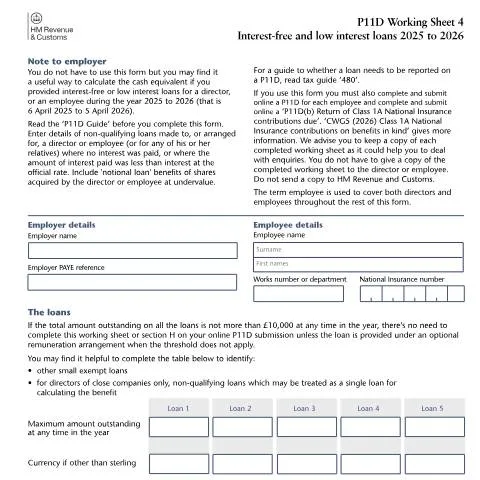
When employers provide interest-free or low interest loans to directors and employees, the financial advantage these individuals receive constitutes a taxable benefit in kind. The P11D Working Sheet 4 (P11D WS4) serves as HMRC's structured calculation tool, helping employers determine the precise cash equivalent of loan benefits for the tax year 6 April 2025 to 5 April 2026. This worksheet transforms what could be complex benefit calculations into a systematic process, ensuring accurate reporting on P11D forms whilst maintaining compliance with benefit-in-kind taxation rules.
The significance of this worksheet extends beyond mere calculation convenience. It provides employers with a standardised methodology that aligns with HMRC's official interest rates and benefit calculation principles, reducing the risk of computational errors that could trigger compliance issues or employee tax code complications.
The £10,000 Threshold: When Loan Benefits Become Reportable
The P11D WS4 operates around a crucial financial threshold that determines whether loan benefits require formal reporting. If the total amount outstanding on all loans never exceeds £10,000 at any point during the tax year, employers typically face no obligation to complete this worksheet or report the benefit on P11D submissions.
However, this threshold contains a significant exception that catches many employers unaware. When loans are provided under optional remuneration arrangements — where employees sacrifice salary in exchange for the loan facility — the £10,000 threshold becomes irrelevant. Even modest loans arranged through salary sacrifice schemes must be calculated and reported regardless of their value.
| Loan Type | Threshold Application | Reporting Requirement |
|---|---|---|
| Standard employer loan | £10,000 threshold applies | Report only if exceeded |
| Optional remuneration loan | No threshold exemption | Always reportable |
| Director of close company | £10,000 threshold applies | Special aggregation rules |
For directors of close companies, additional complexity arises through loan aggregation rules. Multiple non-qualifying loans in the same currency that exist simultaneously can be treated as a single loan for calculation purposes, but this election requires careful consideration as incorrect application constitutes an inaccurate return.
Currency Considerations and Official Interest Rates
The worksheet accommodates loans in various currencies, though sterling remains the standard. For loans denominated in Japanese Yen or Swiss Francs, special official rates apply when specific conditions outlined in paragraph 17.5 of tax guide 480 are satisfied. This provision recognises the international nature of modern employment relationships whilst maintaining appropriate tax treatment.
Official interest rates form the cornerstone of benefit calculations, representing the benchmark against which actual interest payments are measured. HMRC publishes these rates regularly, with the average official rate for the tax year serving as the calculation baseline. Importantly, when rates remain unchanged throughout the entire tax year, the average rate equals the standard rate even for loans existing only partially within that period.
Employers must access current official rates through HMRC's dedicated publication: "Rates and allowances: beneficial loan arrangements – HMRC official rates" available on gov.uk. This ensures calculations reflect the most accurate and up-to-date rate information.
Mastering the Calculation Formula: From Maximum Balances to Cash Equivalents
The P11D WS4 employs a sophisticated yet logical calculation methodology that accounts for loan fluctuations throughout the tax year. The formula begins by establishing two critical balance points: the maximum balance on either 5 April 2025 or the loan commencement date (whichever occurs later), and the maximum balance on either 5 April 2026 or loan discharge date (whichever occurs earlier).
This dual-point approach ensures the calculation captures the loan's highest values during its existence within the tax year, preventing artificial reduction of benefit values through strategic timing of loan advances or repayments.
- Balance Averaging: The two maximum balances are totalled and divided by two, creating an average outstanding amount
- Time Apportionment: The number of complete tax months (calculated from the 6th of each month to the 5th of the following month) during which the loan remained outstanding
- Annual Adjustment: The averaged balance is multiplied by the number of months, then divided by 12 to reflect the actual loan duration
- Interest Application: The resulting figure is multiplied by the official interest rate percentage
- Credit for Payments: Any actual interest paid during 2025-26 is deducted to arrive at the final cash equivalent
This methodology ensures that employees receive appropriate credit for any interest actually paid whilst capturing the full benefit value of interest-free or below-market-rate financing.
Optional Remuneration Arrangements: When Salary Sacrifice Complicates Calculations
Loans provided through optional remuneration arrangements introduce an alternative calculation approach that can significantly impact the reported benefit value. When employees forego salary in exchange for loan facilities, the cash equivalent calculation must compare two figures: the theoretical interest benefit and the actual salary sacrificed.
If the amount of salary foregone exceeds the interest that would have been payable at the official rate, the reportable benefit becomes the salary sacrifice amount minus any interest actually paid. This ensures employees cannot artificially reduce their benefit-in-kind liability through excessive salary sacrifice arrangements.
Conversely, when the salary sacrifice amount falls below the theoretical interest benefit, the standard calculation methodology applies, using the lower figure to determine the reportable benefit. This dual approach prevents both under-reporting and over-penalisation of employees participating in legitimate salary sacrifice schemes.
Joint Loans and Multi-Borrower Scenarios
When loans involve multiple borrowers — such as joint facilities for married couples or business partners — the P11D WS4 requires benefit apportionment among all participants. The calculated cash equivalent or salary sacrifice amount must be divided by the number of borrowers to determine each individual's reportable benefit.
This apportionment applies regardless of whether borrowers are employed by the same organisation or have different employment relationships. Each employer remains responsible for reporting their respective employee's portion of the joint loan benefit, necessitating coordination between multiple organisations when joint borrowers work for different employers.
Integration with P11D Submissions and Class 1A National Insurance
The P11D WS4 functions as a preparatory document rather than a submission requirement. HMRC explicitly states that completed worksheets should not be sent to the department, though employers must retain copies for potential enquiry purposes. The worksheet's calculated figures transfer directly to Section H, box 15 of the online P11D submission.
For employees with more than two loans, the online P11D system requires the notation "see attached" in box 15, accompanied by a copy of the completed worksheet. However, when calculating Class 1A National Insurance contributions on the P11D(b) return, employers must aggregate all loan benefits to determine the total liability.
The relationship between the worksheet and formal submissions creates a documentation trail that supports compliance whilst providing HMRC with detailed calculation methodologies when required. The 'CWG5 (2026) Class 1A National Insurance contributions on benefits in kind' guide provides comprehensive information about the National Insurance implications of reported loan benefits.
Alternative Calculation Methods and Employee Elections
While the P11D WS4 provides HMRC's standard calculation methodology, employees retain the right to elect for more complex but potentially more accurate calculation methods. These alternative approaches might account for daily interest calculations, variable loan balances, or other factors that could reduce the benefit value compared to the worksheet's averaging methodology.
Crucially, employers bear no responsibility for providing these alternative calculations. Employees seeking to use different methodologies must engage their own tax advisers or complete the calculations independently. This division of responsibility protects employers from additional administrative burdens whilst preserving employee rights to optimise their tax positions through legitimate calculation alternatives.
The availability of alternative methods reflects HMRC's recognition that the worksheet's simplified approach, while suitable for most circumstances, may not capture the precise benefit value in all scenarios. Employees with fluctuating loan balances or complex repayment patterns might achieve more accurate results through detailed daily calculations, though the administrative burden typically outweighs the potential tax savings for modest loan amounts.
Common Types of Interest-Free and Low-Interest Employee Loans
Understanding the specific categories of loans that qualify for P11D reporting helps ensure accurate completion of the WS4 worksheet. HMRC recognises several distinct types of employee lending arrangements, each carrying particular considerations for tax treatment.
Season ticket loans represent one of the most prevalent forms of interest-free employee lending. These arrangements typically cover annual or monthly travel passes for public transport, allowing employees to spread the cost throughout the year whilst benefiting from bulk purchase discounts. The outstanding balance fluctuates as employees make regular repayments through payroll deductions, requiring careful tracking for each tax year's P11D reporting.
Technology and equipment loans have become increasingly common, particularly following the shift towards hybrid working arrangements. These might include laptops, mobile phones, or home office equipment where the employee takes ownership upon full repayment. The benefit calculation considers the full outstanding amount at each year-end, regardless of the asset's depreciation.
Car purchase loans present more complex scenarios, especially when combined with company car arrangements. Where an employer provides finance for vehicle purchase, the loan benefit runs alongside any company car benefit, potentially creating dual tax charges. Employees should understand how these interact with existing car benefit calculations and whether salary sacrifice arrangements might prove more advantageous.
Relocation and housing loans often carry specific terms reflecting their purpose. These might include bridging finance for property purchases, rental deposits, or removal expenses. HMRC guidance acknowledges that certain relocation expenses may qualify for separate relief, but loan benefits remain fully taxable regardless of any underlying expense exemptions.
Emergency or hardship loans demonstrate employer compassion but carry the same tax implications as commercial lending arrangements. These might arise from unexpected personal circumstances, medical expenses, or temporary financial difficulties. The beneficial loan treatment applies even where the employer's motivation is purely supportive rather than commercial.
Professional development loans, covering training courses, qualifications, or conference attendance, require careful consideration of whether the expense might otherwise qualify for tax relief. Whilst the loan benefit remains taxable, employees may separately claim relief for qualifying professional development costs, creating potential offsetting effects.
Managing Fluctuating Loan Balances Throughout the Tax Year
The P11D WS4 calculation relies on average outstanding balances rather than year-end figures, creating administrative complexity for loans with irregular repayment patterns. Understanding how to accurately track and calculate these averages ensures compliance whilst avoiding unnecessary over-reporting.
Monthly balance tracking provides the foundation for accurate benefit calculations. Best practice involves recording the outstanding balance on the same date each month, typically coinciding with payroll processing dates. This approach captures the natural fluctuation that occurs as employees make regular repayments whilst maintaining consistency for calculation purposes.
For loans with irregular repayments, such as bonus-related lump sums or seasonal variations, employers should maintain detailed records showing the exact dates and amounts of each transaction. The average calculation considers the time-weighted impact of each balance change, meaning a large repayment early in the year carries greater beneficial impact than a similar payment near year-end.
New loans during the tax year require pro-rata calculations based on the period outstanding. A loan advanced on 1 October would contribute just six months to the annual average, whilst the full loan amount impacts the calculation only from the advance date. This principle applies equally to loans fully repaid before year-end, where the average considers only the period when balances remained outstanding.
Multiple loan arrangements for individual employees require separate tracking and reporting on the P11D WS4. Where an employee maintains both a season ticket loan and a technology loan, each appears as a distinct entry with its own beneficial interest calculation. However, the £10,000 aggregate threshold applies across all loans for that employee, potentially bringing previously exempt smaller loans into charge.
Refinancing or loan modifications during the tax year create particular complexity. Where loan terms change significantly—such as extending repayment periods or reducing interest rates—HMRC guidance suggests treating these as new lending arrangements from the modification date. This approach ensures the benefit calculation reflects the actual terms under which the employee received advantage.
Automated payroll systems can simplify balance tracking through integration with loan management modules. However, employers should verify that system calculations align with HMRC methodology, particularly regarding average balance calculations and the treatment of partial-year loans. Manual verification of system outputs helps identify discrepancies before they affect P11D reporting.
Record-Keeping Requirements and Audit Considerations
HMRC's approach to beneficial loan audits reflects the complexity of these arrangements and the potential for significant tax liabilities. Maintaining comprehensive records protects both employers and employees whilst demonstrating compliance with reporting obligations.
Essential documentation extends beyond basic loan agreements to encompass all variations, amendments, and administrative communications. Original loan documentation should clearly specify interest rates, repayment terms, and any conditions affecting the beneficial treatment. Where verbal agreements exist, contemporaneous written confirmations help establish the actual terms under which employees received benefits.
Monthly balance statements provide crucial audit evidence, particularly where employees dispute benefit calculations or claim alternative repayment patterns. These records should reconcile with payroll deductions, showing clear linkage between recorded balances and actual cash flows. Discrepancies between balance records and payroll data often trigger extended audit enquiries.
Interest rate documentation requires particular attention where employers apply rates below the official rate but above zero. Commercial loan agreements, bank statements, or financial institution confirmations help establish the actual cost of funds, supporting any claims that beneficial treatment is limited. HMRC may challenge artificially low rates that don't reflect genuine commercial arrangements.
Email correspondence and internal memoranda often provide valuable context during audits, particularly regarding the business rationale for loan arrangements. Communications discussing loan purposes, repayment difficulties, or modifications help demonstrate genuine commercial substance rather than artificial tax avoidance arrangements.
Cross-referencing with other benefits becomes crucial where employees receive multiple forms of assistance. Salary sacrifice arrangements, expense reimbursements, or other taxable benefits may interact with loan calculations, requiring comprehensive record-keeping across all benefit categories. HMRC auditors typically examine the complete benefit package rather than isolated arrangements.
System audit trails provide additional protection, showing when data was entered, by whom, and what changes occurred throughout the tax year. These electronic records help demonstrate systematic compliance procedures whilst identifying any unusual patterns that might indicate errors or manipulation.
Employee acknowledgements create valuable evidence that individuals understood their tax liabilities and agreed to the benefit arrangements. Written confirmations of loan terms, benefit calculations, and tax implications help defend against subsequent employee claims of misunderstanding or inadequate disclosure.
Regular internal reviews of loan portfolios help identify potential compliance issues before they develop into significant problems. Quarterly assessments of outstanding balances, interest rate applications, and threshold calculations enable proactive corrections whilst demonstrating systematic compliance management to potential auditors.