The £0.05 Per Litre Advantage: Understanding Fuel Duty Relief Claims
For businesses operating specific types of vehicles or machinery, fuel duty relief represents a tangible saving of 5 pence per litre on road fuel purchases. This relief mechanism, administered through form HO81, transforms what might seem like modest per-litre savings into substantial annual benefits for eligible operations. From agricultural contractors running diesel tractors to mobile crane operators powering hydraulic systems, the cumulative impact of claiming this relief can significantly improve operational margins.
The fuel duty relief system operates on a monthly claim cycle, requiring registered businesses to submit detailed purchase records to HMRC. Unlike many tax reliefs that operate automatically through the tax system, fuel duty relief demands active monthly engagement with the claims process, making form HO81 a recurring fixture in eligible businesses' administrative routines.
Registration Prerequisites and the RF Reference System
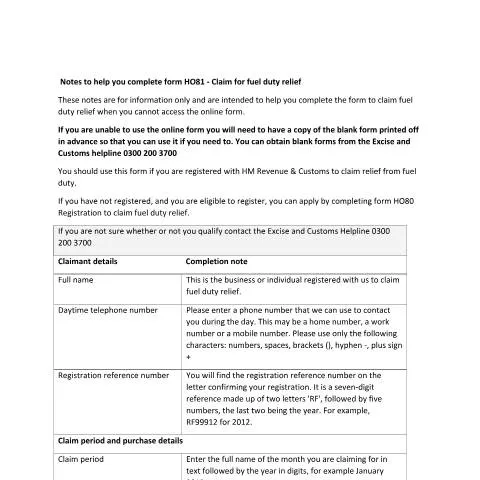
Before any claim can be processed through form HO81, businesses must complete the registration process using form HO80. This initial registration establishes eligibility and assigns the crucial RF reference number that appears on every subsequent claim. The RF reference follows a distinctive seven-digit format: the letters 'RF' followed by five numbers, with the final two digits indicating the registration year.
For example, a business registered in 2024 might receive reference RF12324, while another registered in the same year could be allocated RF45624. This reference number serves as the primary identifier linking all claims to the registered entity, and its accurate transcription on form HO81 ensures proper processing and payment allocation.
The registration letter confirming approval contains this reference prominently displayed, and businesses should retain multiple copies as this number becomes essential for every monthly claim submission. Without valid registration and the corresponding RF reference, form HO81 submissions will be rejected regardless of their accuracy or completeness.
Eligible Activities and Vehicle Classifications
Fuel duty relief eligibility extends beyond simple vehicle ownership to encompass specific operational activities. Agricultural operations using red diesel alternatives, construction equipment operating on public roads, and certain mobile machinery fall within the relief scope. The key distinction lies in the qualifying use of the fuel rather than the vehicle type alone.
Commercial road haulage, private car usage, and standard business transport typically remain ineligible, ensuring the relief targets specific sectors where fuel costs represent disproportionate operational expenses. Understanding these boundaries prevents inadvertent overclaiming and the subsequent adjustment complications that form HO81 accommodates.
Navigating the Monthly Claim Cycle
Form HO81 operates within a strict monthly framework, with each submission covering purchases made within a single calendar month. The claim period specification requires the full month name in text format followed by the four-digit year – January 2024, February 2024, and so forth. This precise formatting prevents processing delays and ensures claims are allocated to the correct accounting periods.
The monthly cycle creates both opportunities and obligations. Businesses benefit from regular cash flow through monthly relief payments, but must maintain consistent submission schedules to avoid accumulating claims or missing deadlines. Late submissions may still be accepted, but prompt monthly filing ensures predictable payment timelines and reduces administrative complications.
Purchase Documentation Requirements
Each fuel purchase within the claim period requires individual entry in the form's purchase details table. This granular approach demands comprehensive record-keeping, with businesses needing to maintain receipts showing purchase dates, volumes, and fuel types for every transaction. Service station receipts, bulk fuel delivery invoices, and corporate fuel card statements all serve as valid documentation supporting the claim details.
The purchase table accommodates both petrol and diesel purchases, with separate columns for each fuel type. Mixed purchases require careful separation, with petrol volumes entered in Column A, diesel volumes in Column B, and the combined total in Column C. This separation ensures accurate relief calculations while maintaining clear audit trails for HMRC verification purposes.
Decoding the Purchase Details Table
The heart of form HO81 lies in its purchase details table, where each row represents an individual fuel transaction. This systematic approach requires businesses to break down their monthly fuel expenditure into constituent purchases, creating a comprehensive record of relief-eligible fuel consumption.
| Column | Content | Calculation Method |
|---|---|---|
| A | Petrol Volume (litres) | Direct transcription from receipt |
| B | Diesel Volume (litres) | Direct transcription from receipt |
| C | Total Volume (litres) | Column A + Column B |
For businesses with extensive fuel purchases, the standard table may prove insufficient. In such cases, additional sheets detailing extra purchases must accompany the form, maintaining the same columnar structure and calculation methodology. These supplementary sheets require clear labelling and sequential numbering to ensure proper integration with the main claim.
Volume Totalling and Relief Calculations
The totalling section consolidates individual purchase entries into cumulative figures for relief calculation. Separate totals for petrol (Column A) and diesel (Column B) feed into the overall total (Column C), which forms the basis for relief computation. This staged totalling process reduces calculation errors while providing clear verification points for both claimants and HMRC processors.
Relief calculation follows a straightforward formula: total volume in litres multiplied by £0.05. This fixed rate applies regardless of the actual fuel duty rates or purchase prices, simplifying calculations while providing predictable relief amounts. A business claiming relief on 1,000 litres of mixed fuel would receive £50.00, regardless of whether the fuel cost £1,400 or £1,600 to purchase.
Managing Adjustments and Corrections
The adjustment mechanism within form HO81 addresses the practical reality that businesses may discover errors in previous claims or identify previously unreported eligible purchases. Rather than requiring separate correction submissions, the form incorporates adjustment fields that allow for immediate rectification alongside current month claims.
Underclaimed amounts typically arise when businesses discover additional eligible purchases from previous months or identify calculation errors that resulted in lower relief claims. These amounts are added to the current month's relief total, providing immediate correction without separate administrative processes.
Overclaimed amounts present more serious implications, as they may indicate misunderstanding of eligibility criteria or calculation errors. When identified, overclaimed amounts are deducted from current relief calculations, and may trigger enhanced scrutiny of future submissions. Significant or repeated overclaiming could prompt HMRC investigations into business practices and eligibility status.
Adjustment Period Specification
Adjustment entries require precise period identification, using the same month-year format as the main claim period. This specification enables HMRC to track corrections against original submissions and maintain accurate relief payment records. Businesses should retain documentation supporting adjustment calculations, as these may be requested during routine compliance checks or formal investigations.
Submission Channels and Processing Pathways
While HMRC encourages online submission for efficiency and speed, form HO81 provides essential backup capability for businesses unable to access digital channels. The paper form submission route maintains full functionality, ensuring no business faces exclusion from relief eligibility due to technological limitations or connectivity issues.
Paper submissions require advance preparation, as blank forms must be obtained from the Excise and Customs helpline (0300 200 3700) before they are needed. This forward planning requirement reflects HMRC's preference for digital submissions while maintaining accessibility for businesses with specific operational constraints.
Contact Information and Communication Preferences
Form HO81 requires daytime contact details enabling HMRC to reach claimants for clarification or additional information. The telephone number field accepts various formats – home, work, or mobile numbers – with specific character restrictions limited to numbers, spaces, brackets, hyphens, and plus signs. This flexibility accommodates different business communication preferences while ensuring reliable contact capability.
Providing accurate contact information proves crucial when HMRC requires purchase verification or eligibility confirmation. Businesses operating across multiple locations or using shared telephone systems should nominate a primary contact capable of accessing relevant fuel purchase records and registration documentation.
Payment Processing and Cash Flow Integration
Successful form HO81 submissions trigger direct payments to registered businesses, with funds typically appearing within established HMRC payment cycles. The relief payment represents a direct cash benefit rather than a tax credit, providing immediate operational cash flow rather than future tax reductions.
This payment structure makes fuel duty relief particularly valuable for cash-sensitive operations, where the monthly relief receipts can support working capital requirements or equipment maintenance schedules. Unlike corporation tax reliefs that may not benefit businesses until year-end calculations, fuel duty relief provides monthly financial support aligned with operational fuel expenditure patterns.
Businesses should integrate expected relief payments into their cash flow projections, treating the monthly submissions as routine administrative tasks supporting financial planning. The predictable nature of relief calculations – 5 pence per litre on verified purchases – enables accurate forecasting of monthly relief receipts based on anticipated fuel consumption patterns.
Record Retention and Compliance Monitoring
HMRC requires businesses to maintain comprehensive fuel purchase records supporting their relief claims, with retention periods extending several years beyond the claim dates. These records must substantiate every entry on form HO81, from individual purchase volumes to adjustment calculations and contact information updates.
Regular compliance reviews may involve detailed examination of purchase records, vehicle usage logs, and operational activities to verify continued eligibility and claim accuracy. Businesses should maintain organised filing systems enabling rapid retrieval of supporting documentation, as compliance requests often specify tight response deadlines requiring immediate access to historical records.
Understanding the Different Categories of Fuel Duty Relief
Fuel duty relief in the UK encompasses several distinct categories, each with specific eligibility criteria and application processes. The most commonly accessed relief is red diesel (gas oil), which carries a reduced duty rate compared to standard diesel fuel. This relief primarily applies to agricultural vehicles, construction machinery, and heating systems in commercial premises.
Agricultural businesses can claim relief on fuel used in tractors, combine harvesters, and other farming equipment that operates exclusively off public roads. However, the definition of 'agricultural use' is strictly interpreted by HMRC. The fuel must power machinery directly involved in cultivation, harvesting, or livestock management. Administrative vehicles used on farms, such as Land Rovers for general transport, typically don't qualify unless they're fitted with specialised agricultural equipment.
Construction and quarrying operations represent another significant category. Relief applies to excavators, bulldozers, cranes, and similar plant machinery. The key requirement is that these machines must be stationary during operation or move only as an ancillary function to their primary purpose. A mobile crane that travels between construction sites while carrying out lifting operations would qualify, but a lorry used purely for transporting materials would not.
Commercial heating represents a third major category, where businesses can use red diesel for heating non-domestic premises. This includes warehouses, factories, offices, and retail spaces. Residential properties, including those used as business premises (such as bed and breakfasts in domestic buildings), generally don't qualify for this relief.
Marine vessels operating commercially often qualify for marine gas oil (MGO) at reduced duty rates. This applies to fishing boats, commercial freight vessels, and passenger ferries. However, pleasure craft and private yachts, even those occasionally used for commercial charter, typically don't qualify unless they meet strict commercial operation criteria.
Aviation fuel relief operates under different principles, primarily benefiting commercial airlines and cargo operators. Private aircraft owners generally cannot access these reduced rates, though specific exemptions may apply for emergency services or charitable operations.
Compliance Requirements and Record-Keeping Obligations
Maintaining comprehensive records forms the cornerstone of any successful fuel duty relief claim. HMRC requires businesses to demonstrate not only their eligibility but also their ongoing compliance with relief conditions. This documentation must be readily available for inspection and retained for specific periods, typically extending beyond the standard six-year requirement for most business records.
Vehicle and machinery logs represent essential documentation. These must detail every journey or period of operation, specifying the fuel consumed, the purpose of use, and confirmation that the activity qualifies for relief. For agricultural operations, this might include field-by-field records showing cultivation activities, harvest dates, and livestock movements. Construction businesses should maintain site-specific logs correlating fuel consumption with particular projects and machinery deployment.
Fuel purchase records must clearly identify the supplier, quantity purchased, duty rate applied, and intended use. When purchasing red diesel, businesses must provide suppliers with signed declarations confirming their eligibility for relief. These declarations carry legal weight – providing false information constitutes a criminal offence under the Hydrocarbon Oils Duties Act 1979.
Storage and handling documentation becomes crucial for businesses maintaining on-site fuel reserves. Separate storage tanks for different fuel types help demonstrate proper segregation, while transfer records should track fuel movement from storage to individual vehicles or machinery. Cross-contamination between relief and standard-rate fuels can invalidate relief claims and trigger significant penalties.
Training records for staff handling relief fuels provide additional compliance evidence. Employees must understand the restrictions surrounding relief fuel use and the consequences of misuse. Regular training updates help demonstrate ongoing commitment to compliance, particularly valuable during HMRC investigations.
Digital record-keeping systems increasingly support compliance efforts, though HMRC doesn't mandate specific software solutions. However, any system must provide audit trails, prevent retrospective alteration of records, and generate reports in formats suitable for HMRC review. Cloud-based systems should comply with UK data protection requirements, particularly when storing commercially sensitive information.
Financial reconciliation between fuel purchases and consumption patterns helps identify potential compliance issues before they escalate. Significant variances between expected and actual fuel consumption may indicate misuse or administrative errors requiring immediate investigation.
Managing Multi-Use Vehicles and Mixed-Purpose Operations
Many businesses operate vehicles or machinery serving both qualifying and non-qualifying purposes, creating complex compliance challenges that require careful management and detailed record-keeping. HMRC recognises these practical realities but maintains strict requirements for apportioning fuel consumption between different uses.
Agricultural vehicles frequently illustrate this complexity. A tractor might spend 80% of its operating time on legitimate agricultural activities but also transport farm workers to town or collect supplies from retailers. Only the fuel consumed during qualifying agricultural work can benefit from duty relief. Farmers must therefore maintain detailed logs showing time allocation between different activities, supported by journey records and work schedules.
The apportionment methodology must be reasonable, consistent, and verifiable. Simple time-based calculations often work effectively – if a tractor operates 100 hours monthly, with 75 hours on qualifying agricultural work, then 75% of fuel consumption can attract relief. However, different activities may consume fuel at varying rates. Heavy cultivation work typically uses more fuel per hour than lighter tasks like hedge trimming or livestock checking.
Construction businesses face similar challenges with mobile plant equipment. A mobile crane might spend morning hours on a construction site (qualifying for relief) before moving to a private residential property for tree removal (non-qualifying). Detailed work schedules, customer invoices, and GPS tracking data can support accurate apportionment calculations.
Some businesses attempt to simplify administration by dedicating specific vehicles to qualifying activities only. While this approach reduces compliance complexity, it may prove impractical for smaller operations with limited equipment fleets. HMRC doesn't require such segregation but recognises it as evidence of genuine compliance commitment.
Seasonal variations add another layer of complexity. Agricultural operations typically show dramatic fuel consumption changes between planting, growing, and harvest seasons. Construction businesses may experience similar patterns based on weather conditions or project types. Historical data helps establish reasonable baselines for apportionment calculations, but businesses must adjust for operational changes or unusual circumstances.
Emergency use presents particular challenges. Agricultural vehicles responding to livestock emergencies or construction equipment deployed for flood defence work may qualify for relief even when operating outside normal parameters. However, businesses must document these exceptional circumstances thoroughly, demonstrating that the emergency use genuinely relates to qualifying activities rather than general transport needs.
Staff training becomes crucial for mixed-use operations. Drivers and operators must understand which activities qualify for relief and maintain appropriate records. Simple decision trees or flowcharts can help staff make correct determinations in borderline situations, reducing compliance risks and administrative burdens.