Business Relief on Trust Assets: When Tax Planning Meets Complex Ownership Structures
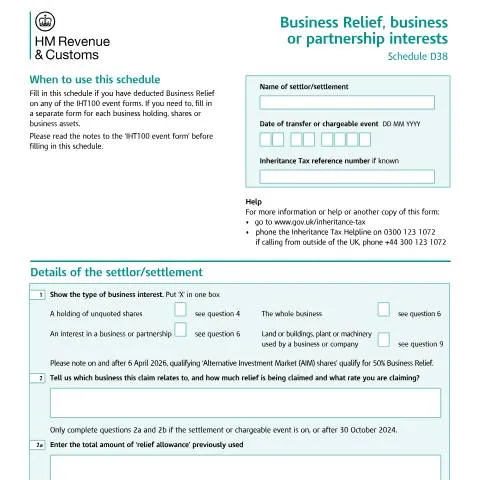
When trustees hold business assets or shares that qualify for inheritance tax relief, the administrative landscape becomes considerably more intricate than straightforward personal ownership scenarios. The D38 schedule serves as HMRC's mechanism for capturing the specific details of business relief claims where assets sit within trust structures, requiring trustees to demonstrate not only the qualifying nature of their holdings but also the continuity of ownership and business activity that underpins the relief.
This complexity stems from the fundamental tension between trust law and tax law: whilst trusts create beneficial ownership separate from legal ownership, inheritance tax relief typically depends on demonstrating sustained business engagement and control. The D38 schedule bridges this gap by requiring detailed disclosure of the underlying business relationships, ownership history, and the specific circumstances that justify relief within the trust context.
Navigating the Ownership Continuity Requirements
The two-year ownership rule represents perhaps the most challenging aspect of business relief claims within trusts. Question 3 on the D38 requires confirmation that trustees owned the relevant business interest throughout the two years preceding the chargeable event. This seemingly straightforward requirement becomes complex when considering the various ways business interests can enter trust structures.
Where shares or business interests were settled into trust less than two years before a chargeable event, relief would normally be denied. However, HMRC recognises certain continuity scenarios. If the settlor personally held qualifying business assets for the required period before settlement, and the trustees have maintained that holding without interruption, the combined ownership period may satisfy the requirement.
Partnership interests present particular challenges. The D38 specifically requests details of when partnerships began, capital contributions, and profit-sharing arrangements. This reflects HMRC's need to establish that the trust's interest represents genuine business engagement rather than passive investment. Working partners who settle partnership interests into trust must demonstrate that the trustees' holding maintains the business character of the original interest.
| Business Interest Type | Key Ownership Evidence Required | Common Complications |
|---|---|---|
| Unquoted shares | Share certificates, board minutes, voting records | Corporate restructures during ownership period |
| Partnership interests | Partnership agreements, capital accounts, profit shares | Changes to partnership composition |
| Sole trading business | Business accounts, asset registers, trading records | Incorporation or business transfers |
| Business property | Property deeds, lease agreements, usage evidence | Changes in business occupancy |
The AIM Shares Transition and Relief Allowance Mechanics
The April 2026 changes to Alternative Investment Market shares relief create a transitional challenge that the D38 addresses through questions 2a and 2b. From 6 April 2026, AIM shares will qualify for only 50% business relief rather than the current 100% rate. This change introduces the concept of a relief allowance - a lifetime limit on the amount of full business relief available to each individual.
For settlements or chargeable events occurring on or after 30 October 2024, trustees must track the relief allowance usage. The statutory allowance amount will be set by HMRC closer to the implementation date, but trustees must begin accounting for relief usage immediately. Question 2a requires disclosure of previously used allowance, whilst 2b calculates the remaining allowance available for the current chargeable event.
This creates particular complexity for discretionary trusts with multiple beneficiaries or trusts where AIM holdings form part of a diversified business portfolio. Trustees must maintain detailed records of relief claims across all relevant transactions to ensure accurate reporting. The restriction to 50% relief once the allowance is exhausted applies regardless of when the original shares were acquired or settled into trust.
Practical Implications for Trust Administration
The relief allowance system requires trustees to adopt a more strategic approach to business relief planning. Where trusts hold substantial AIM portfolios, the timing of distributions or other chargeable events becomes crucial. Trustees may need to prioritise relief usage for the most valuable holdings or consider restructuring to maximise the benefit of available allowances.
Professional valuations become increasingly important where relief allowances are limited. The D38 specifically requests copies of professional valuations, and trustees should ensure these accurately reflect both the business nature of holdings and their market value to optimise relief utilisation.
Distinguishing Business Character from Investment Activity
The D38's structure reflects HMRC's need to distinguish genuine business activity from investment holding. Questions 8 and 11 require detailed descriptions of business activities, not merely the legal form of holdings. This reflects the policy intention that business relief should support active commercial enterprises rather than passive wealth accumulation.
For unquoted companies, trustees must demonstrate that the company conducts qualifying business activities. Investment companies, property investment businesses, and dealing activities generally do not qualify. The D38 requires specific disclosure of the company's main activities, creating an audit trail for HMRC's assessment of qualifying status.
Professional service companies present particular challenges. Where trustees hold shares in companies providing professional services, the business relief qualification depends on the extent of business activity beyond passive investment. Detailed business accounts for the three years preceding the chargeable event help establish this pattern of activity.
Asset-Based Relief Claims
Question 9 addresses situations where trustees own assets used by businesses they don't control - typically property or equipment leased to operating companies. This relief requires demonstrating that the assets are integral to the business activity rather than mere investment property. Lease agreements, usage patterns, and the relationship between the trust and the operating business all become relevant factors.
The requirement in question 12 to consider whether property would have qualified for relief if trustees had made a transfer creates an additional layer of analysis. This provision ensures that relief remains available only where the underlying business relationship continues to meet qualifying criteria throughout the trust's holding period.
Pre-Commencement Settlements and Transitional Protections
Question 13 introduces the concept of pre-commencement settlements - trusts that held qualifying business or agricultural property on 30 October 2024. This date marks the beginning of the relief allowance regime, and settlements holding qualifying property before this date receive certain transitional protections.
Pre-commencement settlements may benefit from grandfathering provisions that protect existing holdings from the full impact of the relief allowance restrictions. However, trustees must carefully document the qualifying property held on the relevant date and track any subsequent changes to the trust's holdings.
The requirement to disclose sales of qualifying property since 30 October 2024 reflects HMRC's concern that trustees might manipulate holdings to optimise relief claims. Genuine commercial transactions remain acceptable, but trustees should document the business rationale for any significant changes to qualifying holdings during the transitional period.
Valuation Methodologies and Supporting Documentation
The D38's emphasis on valuation evidence reflects the complexity of valuing business interests held in trust. Unlike quoted securities with readily available market prices, unquoted shares and business interests require detailed analysis of the underlying business performance, market conditions, and specific attributes of the shareholding or business interest.
For partnership interests, valuation becomes particularly complex where the trust's interest differs from the original settlor's involvement in the business. The D38 requires detailed information about capital contributions and profit sharing to establish the economic substance of the trust's interest. This information directly affects both the value of the interest and its qualification for business relief.
Professional valuations should address both the business relief qualification criteria and the market value of interests. Valuers must consider factors such as marketability restrictions, minority interest discounts, and the specific rights attached to trust-held interests. These factors often differ significantly from the position of the original business owner who settled the interests into trust.
Accounting Evidence Requirements
The three-year accounting history requirement serves multiple purposes beyond simple valuation support. HMRC uses this information to assess the consistency of business activity, the sustainability of trading patterns, and the genuine commercial nature of operations. Significant fluctuations in business performance may trigger additional scrutiny of business relief claims.
For trusts holding interests in multiple businesses, the administrative burden of maintaining comprehensive accounting records across all holdings can be substantial. Trustees should establish systems to ensure ongoing compliance with these disclosure requirements, particularly where business interests form a significant proportion of trust assets.
Submission Procedures and Integration with IHT100 Returns
The D38 operates as a supplementary schedule to the main IHT100 event form, creating specific procedural requirements for trustees. The schedule must be completed separately for each distinct business holding, potentially requiring multiple D38 forms for trusts with diversified business portfolios.
The integration requirement means that values entered on the D38 must correspond precisely with entries in the appropriate sections of the IHT100 form. Box BR1 on the D38 feeds directly into the businesses and business assets section of the main return, creating a clear audit trail for HMRC verification purposes.
Electronic submission is available through HMRC's online services, but the supporting documentation requirements often necessitate postal submission of paper evidence. Trustees should ensure that all supporting documents are clearly referenced to the specific D38 schedule to avoid processing delays.
The inheritance tax reference number becomes crucial for tracking multiple related submissions. Where trusts have ongoing relationships with HMRC through previous settlements or events, maintaining consistent reference numbering helps ensure efficient processing of relief claims.
Post-Submission Procedures
Following submission, HMRC may request additional information to support business relief claims, particularly where valuations appear optimistic or business activities are complex. Trustees should prepare for potential queries by maintaining comprehensive records beyond the minimum D38 requirements.
The relief allowance tracking system creates ongoing compliance obligations for trustees. Even after successful relief claims, trustees must maintain records of allowance usage for future chargeable events. This creates a cumulative administrative burden that increases over time, particularly for long-established trusts with regular business relief claims.
Trust Asset Valuation Requirements and Professional Assessments
When claiming business relief for trust-held assets, establishing accurate valuations proves critical for both HMRC compliance and maximising legitimate relief entitlements. The valuation process requires particular attention to the specific nature of trust ownership and the complex interplay between beneficial interests and legal title.
For business assets within discretionary trusts, valuations must reflect the restricted marketability inherent in trust structures. Unlike assets held outright, trust-held business interests often command lower valuations due to limitations on disposal, beneficiary restrictions, and trustee decision-making requirements. Professional valuers experienced in trust work understand these nuances and typically apply appropriate discounts for lack of control or marketability constraints.
Unquoted company shares present particular challenges when held in trust. The valuation must consider not only the underlying business performance but also the specific rights attached to the shares within the trust context. Minority shareholdings in family companies, commonly found in trust arrangements, may qualify for substantial discounts reflecting their limited influence over company decisions. However, these discounts must be professionally justified and documented to withstand HMRC scrutiny.
Agricultural property held in trust requires specialist agricultural valuers who understand both farming economics and trust law implications. The interaction between Agricultural Property Relief (APR) and Business Property Relief can create complex scenarios where different relief rates may apply to various elements of the same property. For instance, farmland may qualify for APR whilst associated trading activities could claim BPR, requiring careful apportionment in the valuation report.
Partnership interests within trust structures demand particularly sophisticated analysis. The partnership agreement's provisions regarding transfer restrictions, profit-sharing arrangements, and decision-making rights significantly impact valuation. Where trusts hold limited partnership interests, the valuation must reflect the constrained nature of these holdings, often resulting in substantial discounts from pro-rata asset values.
Documentation requirements for trust asset valuations extend beyond standard valuation reports. HMRC expects comprehensive analysis of the trust deed provisions, any letters of wishes, and the practical constraints these impose on asset realisation. The valuation report should explicitly address how trust restrictions affect marketability and reference comparable transactions involving similar constrained interests where available.
Regular revaluations become necessary for ongoing IHT planning, particularly where business assets experience significant value fluctuations. Trustees should establish systematic valuation procedures, especially for assets approaching the seven-year anniversary of potentially exempt transfers or where business circumstances change materially. Professional valuers may recommend annual desktop reviews with full revaluations every three to five years, depending on asset volatility and tax planning requirements.
Interaction with Other Tax Reliefs and Anti-Avoidance Provisions
Business Property Relief for trust assets operates within a complex web of other tax reliefs and anti-avoidance measures, creating scenarios where careful coordination becomes essential for optimal tax outcomes. Understanding these interactions prevents inadvertent relief losses and ensures compliance with increasingly sophisticated HMRC monitoring systems.
The relationship between BPR and Agricultural Property Relief frequently creates strategic choices for trustees. Where agricultural businesses qualify for both reliefs, the higher APR rate (typically 100%) generally takes precedence, but mixed-use properties may require careful apportionment. Trustees managing diversified agricultural estates must consider whether business activities beyond traditional farming might qualify separately for BPR, potentially securing relief for previously unprotected assets.
Entrepreneur's Relief (now Business Asset Disposal Relief) interactions with trust-held business assets require particular attention during disposal planning. While trustees cannot directly claim this relief, strategic restructuring before disposal might enable beneficiaries to qualify, significantly reducing overall tax liabilities. However, such arrangements must satisfy HMRC's increasingly stringent anti-avoidance scrutiny, particularly the genuine commercial purpose requirements.
The pre-owned assets tax (POAT) provisions create potential complications where settlors retain interests in trust-held business assets. Business property qualifying for IHT relief typically escapes POAT charges, but changes in business activities or relief qualification can trigger unexpected income tax liabilities for settlors. Regular monitoring ensures compliance and identifies opportunities for remedial action before POAT charges crystallise.
Corporate envelope structures, where trusts hold companies owning business assets rather than direct asset ownership, face particular anti-avoidance scrutiny. While such structures may offer commercial advantages, HMRC examines whether they constitute artificial arrangements designed primarily for tax avoidance. The business substance and commercial rationale must be clearly demonstrable, with comprehensive documentation supporting legitimate business purposes.
The associated operations provisions target arrangements where business relief claims form part of wider tax avoidance schemes. These rules can deny relief where transactions lack genuine commercial substance or form part of artificial arrangements. Trustees must ensure that business activities and relief claims stand on their own merits, avoiding arrangements that might appear contrived or primarily tax-motivated.
Reservation of benefit rules create additional complexity where settlors maintain involvement in trust-held businesses. Active participation in business management might not constitute reservation of benefit if conducted on commercial terms, but informal arrangements or excessive influence could jeopardise the entire trust structure. Clear documentation of roles, remuneration, and decision-making authority helps demonstrate arms-length relationships.
The interaction with international tax rules becomes increasingly complex for trusts with foreign business interests or beneficiaries. Double tax treaties may affect relief availability, while controlled foreign company (CFC) rules can impact offshore business structures. Professional advice becomes essential for cross-border arrangements, ensuring compliance with both UK and foreign tax obligations whilst preserving relief entitlements.
Practical Management and Ongoing Compliance Strategies
Effective management of BPR-qualifying trust assets requires systematic approaches to compliance, documentation, and strategic planning that extend far beyond initial relief claims. Successful trustees develop comprehensive frameworks addressing both immediate requirements and long-term wealth preservation objectives.
Establishing robust governance procedures proves fundamental for maintaining relief qualification throughout the trust's duration. Regular trustee meetings should specifically address business asset performance, relief qualification status, and emerging compliance requirements. Minutes should document discussions about business development plans, capital investment decisions, and their potential impact on relief entitlement, creating an audit trail demonstrating active management and commercial focus.
Investment policy statements for trusts holding business assets should explicitly address BPR considerations alongside traditional investment criteria. These policies should define acceptable business activities, diversification limits, and procedures for evaluating new opportunities. Regular policy reviews ensure alignment with changing legislation, beneficiary needs, and market conditions whilst maintaining focus on relief preservation.
Due diligence procedures for business asset acquisitions within trust portfolios require enhanced scrutiny compared to conventional investments. Trustees should verify relief qualification prospects, assess management quality, and evaluate long-term business sustainability. Professional advisers should provide written opinions on relief prospects, creating documented support for trustee decision-making and HMRC compliance.
Monitoring systems should track key performance indicators affecting relief qualification, including trading activity levels, asset utilisation rates, and business development progress. Regular reporting enables early identification of potential issues, allowing corrective action before relief qualification becomes compromised. Dashboard reporting systems help trustees maintain oversight without requiring detailed business management involvement.
Succession planning within business assets requires careful coordination between business needs and trust objectives. Management succession, ownership transition, and family involvement strategies must align with maintaining relief qualification whilst serving beneficiary interests. Early planning prevents crisis-driven decisions that might compromise tax efficiency or business continuity.
Professional relationships require careful management to ensure consistent, high-quality advice across multiple disciplines. Coordinating between tax advisers, solicitors, valuers, and business consultants prevents conflicting recommendations and ensures holistic approach to trust management. Regular adviser meetings help maintain strategic alignment and identify emerging opportunities or risks.
Record-keeping systems should capture not only standard financial information but also qualitative evidence supporting relief claims. Business development activities, market research, customer relationships, and strategic planning documentation demonstrate genuine trading activity beyond mere investment holding. Digital systems facilitate comprehensive record maintenance whilst ensuring accessibility for compliance reviews.
Beneficiary communication strategies must balance transparency requirements with confidentiality needs, particularly regarding business-sensitive information. Regular updates on asset performance and strategic developments help maintain beneficiary engagement whilst protecting commercial interests. Clear communication policies prevent misunderstandings and support long-term trust relationships.
Exit planning requires sophisticated analysis of timing, structure, and tax implications well before disposal decisions become necessary. Multiple disposal scenarios should be evaluated, considering relief preservation, beneficiary needs, and market conditions. Contingency planning ensures optimal outcomes regardless of eventual disposal circumstances, whether planned transfers or emergency situations requiring rapid asset realisation.