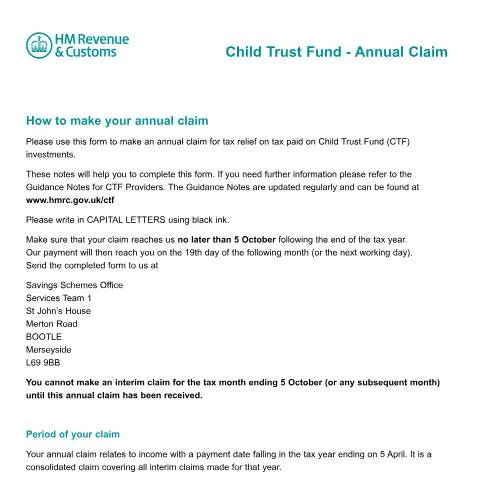
Navigating the Child Trust Fund Annual Tax Relief Claims: Insights into Form CTF14
The Child Trust Fund (CTF) scheme stands as an essential financial initiative aimed at providing children with a strong financial foundation upon reaching adulthood. Within this framework, the Child Trust Fund: claim annual tax relief (CTF14) form plays a pivotal role. It's not just another piece of paperwork; it embodies the opportunity for CTF providers to reclaim tax deductions on investments made on behalf of children. Understanding the intricacies of this form is crucial for those managing Child Trust Funds—whether they are parents, guardians, or financial institutions. Let’s delve into the specifics of the CTF14 form, its importance, and how to effectively complete and submit it.
Understanding the Distinction: CTF14 Compared to Other Forms
While the CTF14 form serves a distinct purpose in the realm of Child Trust Funds, it often gets conflated with other forms related to financial claims and tax reliefs. Here’s what sets it apart:
- Specificity of Claims: The CTF14 is exclusively designed for claiming tax relief on Child Trust Fund investments, unlike other forms that may address broader categories of income or investment.
- Consolidated Nature: This form acts as a comprehensive submission that consolidates all interim claims made throughout the tax year, differentiating it from forms that require individual claims for each event.
- Eligibility Requirements: Only CTF providers managing Child Trust Funds can submit the CTF14, whereas other tax relief forms may be available to a wider audience.
The Submission Pathway: How to Submit CTF14
When it comes to submitting the CTF14 form, a clear understanding of submission pathways is essential. The form can be submitted via various channels:
1. Paper Submission
The traditional paper submission method requires the completed form to be sent via post. It’s vital to ensure that the claims reach HM Revenue & Customs (HMRC) by the deadline of 5 October following the end of the tax year.
Address for submission:
Savings Schemes Office Services Team 1 St John’s House Merton Road BOOTLE Merseyside L69 9BB
2. Online Submission
While the CTF14 form is primarily a paper form, CTF providers should always check if HMRC offers any online avenues for submission. As of now, the traditional method remains primarily paper-based.
3. In-person Submission
In-person submissions are not standard practice for HMRC, but if immediate assistance is required, visiting a local HMRC office may provide guidance on the claim processes, although direct submissions are not standard.
A Step-by-Step Guide to Completing the CTF14 Form
Completing the CTF14 requires attention to detail. Each section of the form warrants close examination to avoid pitfalls that could delay your claim.
Part 1: Amount Claimed
This section requires the total amount of tax deducted from the Child Trust Fund investments during the tax year. Accurate data entry here is crucial; ensure the tax deducted is correctly recorded.
Part 2: Amounts Payable
In this part, you must include adjustments from previous claims and tax deducted on chargeable events. This section may confuse some due to the need for adjustments, hence meticulous reconciliation of previous claims is advisable.
Part 3: Reconciliation
Here, the net amount claimed (or payable) must be derived from the amounts specified in the previous parts. This section is pivotal as it affects the final outcome of your claim. Accurate calculations must be performed as errors can lead to delays.
Part 4: Net Amount from Interim Claims
This section refers to any interim claims made prior to the annual claim. It's crucial to maintain records of these claims to provide accurate figures.
Part 5: Total Amount for Year
This part demands a comprehensive view of all calculations made so far. It sums the claims and any potential payments owed. Errors at this stage could result in significant reimbursement delays, so review your entries thoroughly.
Timing Your Claim: Understanding the Calendar for CTF14
The timing of your CTF14 submission is critical. Here’s how the calendar plays a role:
- Tax Year Overview: The tax year in the UK runs from 6 April to 5 April of the following year. All claims made on the CTF14 must relate to this period.
- Submission Deadline: Your completed CTF14 must reach HMRC by 5 October following the end of the tax year for which you are making your claim. Late submissions may not be processed.
- Payment Timeline: Once your claim is received, payments are processed, usually arriving by the 19th day of the following month or the next working day if this date falls on a weekend.
Special Circumstances Surrounding CTF Claims
There are scenarios where CTF providers may face unique circumstances when filling out the CTF14 form. Understanding these can ensure that no claim is left unattended.
1. Claims for Non-Residents
If the child associated with the Child Trust Fund resides outside the UK, the CTF provider must navigate additional regulations regarding tax relief claims. It's advisable to consult HMRC guidance on international tax matters.
2. Minors and Guardians
For claims made on behalf of children, the CTF provider must be a parent or guardian. It’s essential to have the appropriate legal documentation in place when submitting claims as a guardian to avoid potential issues.
3. Complex Financial Situations
In scenarios involving trusts, joint accounts, or multiple account holders, additional documentation may be required to validate claims. Careful documentation and adherence to HMRC regulations are paramount in these cases.
Identifying Who Should File and Specific Profiles
Not every individual will need to file a CTF14 claim. Understanding who should be submitting this form is crucial for an efficient process.
- CTF Providers: Only those registered as Child Trust Fund providers are eligible to submit the CTF14 form. This could include financial institutions or individuals acting in a fiduciary capacity.
- No Interim Claims Made: If no interim claims were made within the tax year, the CTF14 does not need to be submitted. Providers should retain documentation for their records.
- Providers Managing Multiple Funds: For those managing multiple Child Trust Funds, care should be taken to consolidate all claims accurately within the CTF14.
As we explore the complexities surrounding the CTF14 form, it’s clear that precision in documentation, understanding deadlines, and recognizing the unique circumstances surrounding each claim will lead to a successful tax relief experience.
Understanding Child Trust Funds and Their Purpose
The Child Trust Fund (CTF) was introduced in the UK in 2005 as a government initiative aimed at encouraging saving for children. Each eligible child received a monetary voucher from the government, which could then be used to open a CTF account. This fund grows over the years through investments and contributions from parents, family, and friends, with the primary goal of helping children build a financial nest egg for their future. The funds become accessible when the child turns 18, promoting financial literacy and independence among young adults.
It's important to note that the CTF scheme is no longer open to new applications, having been replaced by the Junior Individual Savings Account (JISA) in 2011. However, existing CTFs remain significant, especially in terms of understanding tax relief implications for parents or guardians managing these funds.
Claiming Annual Tax Relief on Child Trust Fund Contributions
When it comes to Child Trust Funds, understanding the tax implications can lead to substantial financial benefits for both the child and the contributors. Although CTF accounts themselves are tax-free when it comes to growth, parents might be keen to understand if they can claim any tax relief on contributions made to the fund. Unfortunately, the current regulations state that contributions made to a Child Trust Fund do not qualify for tax relief. This means that while parents can contribute to the account, they will not receive any additional tax benefits from these contributions.
However, if the CTF account is managed within a broader investment framework that includes other tax-advantaged accounts, parents can sometimes benefit indirectly. For instance, contributions to an Individual Savings Account (ISA) or a SIPP (Self-Invested Personal Pension) may yield tax relief, which can then be reallocated to enhance the total sum being saved for the child. This indirect method isn’t straightforward and requires careful planning and advice from financial professionals.
Factors Influencing Child Trust Fund Growth and Long-term Savings Strategies
When managing a Child Trust Fund, one of the key considerations is the impact of the chosen investments on the growth potential of the fund. Parents should be aware of the various investment options available, including stocks, bonds, and mutual funds. The performance of these investments can significantly affect the total amount available when the child turns 18. Therefore, understanding market conditions and making informed investment choices is crucial.
Moreover, regular contributions can amplify the benefits of compounding interest. Parents should consider setting up a direct debit or a regular transfer to ensure consistent investment. This approach not only maximizes potential returns but also instills a saving habit that can benefit children in the long run.
It's also essential to review the CTF account periodically. Changes in financial circumstances, market conditions, or even shifts in the child’s educational or career aspirations can influence investment decisions. Engaging with a financial advisor can provide tailored strategies suited to individual circumstances, ensuring that the Child Trust Fund aligns with the long-term financial goals of both the parents and the child.