Understanding the Official UK Form D36A: Notice of Application for a Conditional Order to Be Made Final
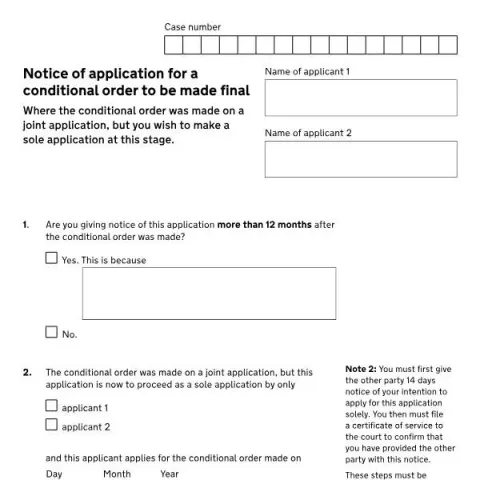
In the realm of family law within the United Kingdom, the process of finalising a divorce or dissolution involves several procedural steps. One critical document in this process is the Form D36A, titled Notice of Application for a Conditional Order to Be Made Final. This official form, managed by the HM Courts and Tribunals Service, plays a vital role when a party seeks to convert a conditional order—commonly known as a decree nisi—into a final order, or decree absolute.
Purpose and Situations for Using Form D36A
The primary purpose of Form D36A is to formally notify the court and the other party involved in a divorce or dissolution proceeding that an applicant wishes to progress from a conditional order to a final order. Specifically, this form is used in two main situations:
- When the conditional order was made on a joint application but the applicant now wishes to proceed as a sole applicant. For example, if one party no longer wishes to continue with the joint application or if circumstances have changed, this form allows them to formalise the transition to a sole application.
- When more than 12 months have passed since the conditional order was made. This period is significant because, under UK family law, applications to make a conditional order final are generally expected within this timeframe unless specific reasons justify a delay.
Using this form ensures that the legal process is properly documented and that the court is formally informed of the applicant’s intentions to conclude the divorce proceedings.
Key Information Required on the Form
The completion of Form D36A involves providing essential details to facilitate the court’s review and processing:
Applicant Details
- Names of the applicants: Applicant 1 and Applicant 2.
- Application type: Indicate whether the application is more than 12 months after the conditional order or if it is a sole application following a joint application.
- Details of the conditional order: The date when the conditional order was made (day, month, year).
Notice and Certification
- Notice to the other party: Confirm whether 14 days’ notice has been given to the other party, which is a legal requirement before making this application.
- Certificate of service: The applicant must file a certificate confirming that the other party has been notified of the intention to apply solely, if applicable.
Legal Declaration
The form includes a declaration of truth, where the applicant or their legal representative affirms that the information provided is accurate and that they understand the legal implications of submitting false statements. The declaration is signed and dated accordingly.
How to Submit Form D36A
Once completed, the form should be returned to the HMCTS Divorce and Dissolution Service at the address below:
Fill in your form directly online
No printing: type your details into the boxes of the official form, tick, then download the PDF ready to send.
- 1Type into the form boxes
- 2Tick in one click
- 3Save and download the PDF
- Address: PO Box 13226, Harlow, CM20 9UG
- Email: [email protected]
- Phone: 0300 303 0642 (Monday to Friday, 10am to 6pm)
It is important to ensure that all parts of the form are correctly filled out, especially the declaration of truth, to avoid delays or rejection of the application.
Points of Attention and Practical Tips
- Timing: Be aware that applications made more than 12 months after the conditional order may require additional justification or evidence to proceed.
- Notice to the other party: Failing to provide the required 14 days’ notice and a certificate of service will prevent the application from being accepted by the court.
- Legal advice: Consider consulting a solicitor or legal adviser to ensure that the application is correctly completed and that all procedural requirements are met.
- Record keeping: Keep copies of all documents, notices, and certificates filed with the court for your records and future reference.
Conclusion
The Notice of Application for a Conditional Order to Be Made Final (Form D36A) is a crucial document in the UK family law process, enabling applicants to formally request the finalisation of their divorce or dissolution proceedings. Understanding when and how to use this form, along with adhering to legal requirements such as notice periods and declarations, ensures a smooth transition from a conditional to a final order. Always ensure that the form is accurately completed and submitted through the proper channels to facilitate an efficient resolution of your case.