Understanding the M10 Form: A Guide to Applying for a Final Conditional Order in Northern Ireland
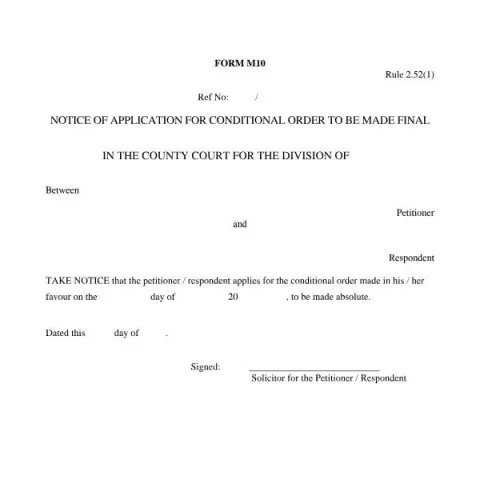
The Form M10, titled Notice of Application for Conditional Order to be Made Final, is an official document issued by the Department of Justice Northern Ireland. It plays a crucial role within the family law proceedings related to divorce or dissolution of civil partnerships. This guide aims to clarify who needs to complete this form, how to do so correctly, and the key steps involved in submitting your application.
What Is the Purpose of the M10 Form?
The primary function of the Form M10 is to formally notify the court and other parties that the applicant (either the petitioner or the respondent) intends to have the conditional order made final. A conditional order is a legal step in the divorce process, equivalent to a decree nisi in other jurisdictions, which, once made final, legally ends the marriage or civil partnership.
This form is used after the court has granted the conditional order and the applicant wishes to proceed to the final stage. Making the order final confirms the dissolution and allows for the legal consequences to follow, such as the division of assets or arrangements for children, if applicable.
Who Should Fill Out the M10 Form?
The applicant—either the petitioner (the person who initiated the divorce proceedings) or the respondent (the other party)—must complete and submit this form. It is essential that the individual submitting the form is aware of the court’s procedures and has the relevant case details at hand.
Typically, the form is completed by legal representatives or solicitors acting on behalf of the applicant. However, individuals representing themselves can also fill out and submit the form directly.
How to Complete the M10 Form
Essential Information to Provide
- Case details: The reference number (if available) and the names of both parties involved.
- Application details: Indicate whether the application is made by the petitioner or respondent.
- Date of the hearing: The specific date on which the conditional order was or is to be made final.
- Signature: The form must be signed by the solicitor or the individual applicant, confirming the accuracy of the information provided.
Completing the Form Correctly
When filling out the form, ensure all fields are completed clearly and accurately. Use black ink or type the information, and avoid leaving any mandatory sections blank. The form should be signed and dated at the bottom to authenticate the application.
Supporting Documents and Attachments
Generally, the M10 form itself does not require additional attachments. However, it is essential to have the case documentation ready, such as the original conditional order and any relevant court papers, should the court request them during processing.
Where and How to Submit the M10 Form
Submission Process
The completed form must be submitted to the relevant County Court in Northern Ireland where the case was heard. Submission can typically be made in person, by post, or through any electronic filing systems the court may operate.
Fill in your form directly online
No printing: type your details into the boxes of the official form, tick, then download the PDF ready to send.
- 1Type into the form boxes
- 2Tick in one click
- 3Save and download the PDF
It is advisable to keep copies of the submitted form and any correspondence with the court for your records. If you are represented by a solicitor, they will handle the submission on your behalf.
Common Mistakes to Avoid
- Incorrect case details: Double-check the case reference number and names to prevent delays.
- Missing signatures or dates: Ensure the form is signed and dated before submission.
- Incomplete information: Fill out all mandatory fields to avoid rejection or requests for clarification.
By carefully completing and submitting the Form M10, applicants facilitate the smooth progression of their divorce proceedings, moving closer to the final legal dissolution of their marriage or civil partnership.