When Courts Accept Voluntary Promises Instead of Imposing Orders
In the midst of heated legal disputes, parties sometimes find themselves at a crossroads where formal court orders might seem inevitable. Yet the English legal system offers a more collaborative path: the undertaking. Form N117 serves as the official mechanism through which individuals or organisations can make binding promises to the court, providing an alternative to contested injunctions whilst maintaining the full force of judicial authority.
This general form of undertaking represents a sophisticated legal instrument that bridges voluntary compliance with court enforcement powers. Unlike a standard contract between private parties, an undertaking given to the court carries the weight of contempt proceedings if breached, making it a powerful tool for resolving disputes without the adversarial nature of imposed orders.
The Strategic Context of Voluntary Undertakings
Undertakings typically emerge during interim hearings where one party seeks urgent relief against another. Rather than forcing the court to determine contested facts and impose an injunction, the potential defendant may offer to voluntarily restrict their conduct in specific ways. This approach often proves attractive to all parties: claimants achieve their protective objectives without the cost and uncertainty of a contested hearing, whilst defendants avoid the stigma and potential adverse findings associated with having an injunction imposed against them.
The court's role becomes one of scrutinising the proposed undertaking to ensure it provides adequate protection whilst remaining practical and enforceable. Judges frequently prefer undertakings because they demonstrate the defendant's willingness to comply voluntarily, suggesting a lower risk of future breaches compared to reluctantly accepted court orders.
Distinguishing Undertakings from Injunctive Relief
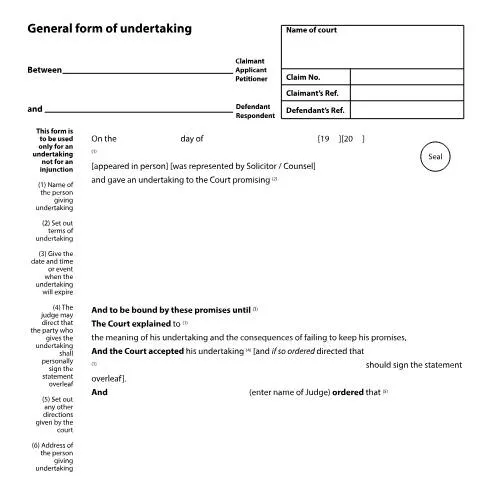
The N117 form explicitly states its purpose: "This form is to be used only for an undertaking not for an injunction". This distinction carries profound legal significance that extends far beyond mere procedural formality.
When a court grants an injunction, it makes findings of fact and conclusions of law that may influence future proceedings. The claimant has successfully demonstrated, at least on an interim basis, that they have an arguable case and that the balance of convenience favours granting relief. An undertaking, by contrast, involves no judicial determination of the merits. The person giving the undertaking does so without any admission of liability or wrongdoing.
Practical Implications of This Distinction
This difference proves particularly significant in commercial disputes where reputational considerations matter enormously. A company facing allegations of intellectual property infringement, for instance, might readily offer an undertaking to cease the disputed activity whilst vigorously denying any wrongdoing. The same company might strenuously resist an injunction that could be perceived as a judicial finding against them.
From an enforcement perspective, however, both undertakings and injunctions carry identical weight. Breach of either can result in committal proceedings for contempt of court, with penalties including imprisonment, fines, or asset seizure.
Navigating the Form's Essential Components
The N117 structure reflects the formal requirements necessary to create a binding court undertaking. Each numbered section serves a specific legal purpose that practitioners must understand to avoid deficiencies that could render the undertaking unenforceable.
| Section | Purpose | Key Considerations |
|---|---|---|
| Section 1: Identity | Names the person giving undertaking | Must precisely identify the individual or entity bound |
| Section 2: Terms | Sets out specific promises | Requires clear, measurable obligations |
| Section 3: Duration | Defines temporal scope | May specify date, time, or triggering event |
| Section 4: Personal signature | Judicial discretion for emphasis | Reinforces personal responsibility |
| Section 5: Additional directions | Court's supplementary orders | Often includes reporting requirements |
| Section 6: Address | Service details | Ensures enforceability through proper service |
Crafting Enforceable Terms
Section 2, which sets out the undertaking terms, demands particular attention to precision and clarity. Vague promises such as "to behave reasonably" or "to avoid causing nuisance" invite future disputes about compliance. Effective undertaking terms specify measurable actions or restraints: "not to enter the property at 15 High Street, Manchester" or "to deliver all allegedly infringing products to the claimant's solicitors by 4pm on [date]".
Courts scrutinise proposed terms for practicality and fairness. An undertaking that would effectively destroy a defendant's business whilst the underlying dispute remains unresolved might be rejected as oppressive, even if voluntarily offered. Conversely, terms so narrow as to provide no meaningful protection to the claimant serve little purpose.
The Court's Role in Accepting and Enforcing Undertakings
The judicial process surrounding undertakings involves more than mere administrative recording. When presented with a proposed undertaking, the court must satisfy itself that the person offering it understands both the commitment being made and the consequences of breach.
The standard wording on form N117 records that "The Court explained to [the person giving the undertaking] the meaning of his undertaking and the consequences of failing to keep his promises". This explanation serves both protective and evidential functions. It ensures that undertakings are given with full knowledge of their implications, whilst creating a clear record for any future enforcement proceedings.
Judicial Discretion in Shaping Undertakings
Courts possess considerable discretion to modify proposed undertaking terms or impose additional conditions through section 5 of the form. Common judicial additions include requirements for regular reporting on compliance, provisions for varying the undertaking if circumstances change, or directions about how disputes over interpretation should be resolved.
Some judges require personal attendance when undertakings are given, particularly in cases involving alleged harassment or domestic violence. This personal appearance serves to emphasise the gravity of the commitment and ensures that the person giving the undertaking cannot later claim they were unaware of the proceedings.
Personal Liability and the Significance of Individual Commitment
Unlike many court documents that primarily concern corporate entities or legal representatives, undertakings create intensely personal obligations. Even when given on behalf of a company, the individual providing the undertaking typically becomes personally liable for ensuring compliance.
Section 4 of form N117 specifically provides for the judge to direct personal signature of the statement on the form's reverse, which reads: "I understand the undertaking that I have given, and that if I break any of my promises to the Court I may be fined, my assets seized or I may sent to prison for contempt of court."
Corporate Undertakings and Individual Responsibility
When companies give undertakings, courts often require a senior officer to sign personally, creating dual liability. The company remains bound by the undertaking terms, but the signing individual faces personal contempt proceedings if the company breaches its promises. This dual liability mechanism proves particularly effective in ensuring corporate compliance, as directors and senior managers cannot simply treat potential fines as a business expense.
Professional advisers must carefully consider who should give an undertaking on a client's behalf. A junior employee or consultant lacking authority to control the relevant conduct cannot meaningfully promise compliance. Courts may reject undertakings from inappropriate representatives or require additional signatures from those with actual decision-making power.
Temporal Dimensions and Undertaking Expiry
Section 3 of form N117 addresses the crucial question of duration: when does the undertaking cease to bind the person who gave it? This apparently simple question often generates complex considerations in practice.
Some undertakings specify fixed expiry dates, particularly in commercial disputes where interim relief is sought pending a substantive hearing. Others tie expiry to specific events: completion of a trial, delivery of particular documents, or resolution of the underlying dispute. A third category remains open-ended until the court makes further orders or the parties jointly apply for discharge.
Managing Changing Circumstances
Long-duration undertakings may become inappropriate as circumstances evolve. The original dispute might resolve whilst the undertaking remains technically binding, or changed circumstances might make compliance impossible or unfair. Form N117 provides no automatic mechanism for variation or discharge, requiring separate applications to court when modifications become necessary.
Parties should anticipate potential changes when drafting undertaking terms. Including provisions for review at specified intervals or mechanisms for seeking variations can prevent future difficulties. However, such flexibility must be balanced against the certainty that makes undertakings effective protective measures.
Enforcement Mechanisms and Contempt Proceedings
The power of undertakings derives ultimately from the court's contempt jurisdiction. The prominent warning on form N117 makes this explicit: breach may result in imprisonment, fines, or asset seizure. Understanding the enforcement process proves crucial for both those giving undertakings and those seeking to rely on them.
Contempt proceedings for breach of undertaking follow established procedural rules, typically requiring an application supported by evidence demonstrating the breach. The standard of proof is the criminal standard - beyond reasonable doubt - reflecting the serious consequences that may follow. This high evidential threshold means that vaguely worded undertakings become practically unenforceable, emphasising the importance of precision in drafting terms.
Defences and Mitigation in Enforcement
Alleged contemnors can raise various defences to enforcement proceedings. These might include arguments that the undertaking terms were ambiguous, that compliance was impossible due to circumstances beyond their control, or that they reasonably believed their conduct fell outside the undertaking's scope. The court's original explanation of the undertaking's meaning, recorded on form N117, becomes crucial evidence in such disputes.
Even where breach is established, courts retain discretion in sentencing. Factors influencing penalty decisions include the seriousness of the breach, whether it was wilful or inadvertent, the impact on the protected party, and the contemnor's attitude to compliance. Immediate imprisonment represents the most serious sanction, typically reserved for deliberate, serious breaches or cases where other penalties have proved ineffective.
Procedural Integration Within Broader Litigation
Form N117 rarely exists in isolation but typically forms part of broader litigation strategies. Understanding its relationship to other procedural steps proves essential for effective case management.
In many cases, undertakings represent interim measures pending substantive hearings. The N117 form documents temporary arrangements that preserve the status quo whilst allowing proper determination of the underlying dispute. This interim nature affects how undertaking terms should be crafted - they must provide adequate protection without pre-empting the final resolution of contested issues.
Cross-undertakings in damages frequently accompany undertakings given to court. Where a claimant seeks urgent interim relief, they typically must promise to compensate the defendant for any loss caused if the interim measures later prove to have been wrongly granted. These cross-undertakings require separate documentation but significantly influence the overall risk allocation between parties.
Strategic Considerations in Multi-Party Disputes
Complex commercial disputes often involve multiple potential defendants, raising questions about who should give undertakings and in what terms. Joint undertakings from several parties can provide comprehensive protection but may create difficulties in enforcement if only some parties breach their promises. Individual undertakings from each party offer clearer liability but might leave gaps in protection if the undertaking terms are not carefully coordinated.
The timing of undertaking offers also carries strategic significance. Early offers may demonstrate good faith and willingness to resolve disputes constructively, potentially influencing costs orders and the court's general approach to the case. However, premature offers might concede more than necessary or fail to address all the claimant's legitimate concerns.
Understanding the Legal Weight and Enforcement of Your N117 Undertaking
Once you submit Form N117 and the court accepts your undertaking, you've entered into a legally binding commitment that carries the same weight as a court order. This distinction is crucial because many applicants underestimate the serious nature of what they're agreeing to do or refrain from doing.
The court treats breach of an undertaking as contempt of court, which can result in imprisonment, unlimited fines, or both. Unlike contractual obligations where remedies typically involve financial compensation, undertakings engage the court's coercive powers directly. The Criminal Justice Act 1981 and the Contempt of Court Act 1981 provide the legal framework for enforcement, meaning the consequences extend beyond civil remedies into potential criminal sanctions.
When drafting your undertaking on Form N117, precision in language becomes paramount. Vague terms like "reasonable efforts" or "as soon as possible" can create enforcement difficulties later. Courts prefer specific, measurable commitments with clear timeframes. For instance, rather than undertaking to "maintain the property," specify "to ensure heating system remains operational and conduct monthly safety inspections, providing written reports to the court by the 15th of each month."
The territorial scope of your undertaking also requires careful consideration. While UK courts generally cannot enforce undertakings regarding actions outside their jurisdiction, they can prevent you from leaving the jurisdiction if your undertaking relates to ongoing obligations within England and Wales. In family proceedings, this often becomes relevant when one parent undertakes not to remove children from the country.
Financial undertakings present particular complexities. You might undertake to pay specific sums, maintain insurance, or preserve assets pending trial. These monetary commitments don't automatically create charging orders over your property, but the court can make additional orders to secure compliance. If your financial circumstances change significantly after giving an undertaking, you should immediately seek legal advice about potential variation applications rather than simply defaulting.
Cross-undertakings in damages represent another sophisticated aspect, particularly in interim injunction cases. When seeking urgent relief, you might be required to undertake to compensate the other party for any losses they suffer if your case ultimately fails. This creates a contingent liability that could be substantial, especially in commercial disputes involving business interruption or reputational damage.
Variation, Discharge, and Strategic Considerations for Form N117
Undertakings given via Form N117 aren't set in stone, but varying or discharging them requires formal court approval through specific procedures. The application process typically involves filing Form N244 (Application Notice) with a detailed witness statement explaining why circumstances have changed sufficiently to justify modification.
Courts apply the test established in American Cyanamid Co v Ethicon Ltd when considering variation requests, examining whether there has been a material change in circumstances since the original undertaking was given. This might include changes in your financial position, health conditions, family circumstances, or developments in the underlying legal dispute. However, simply finding compliance inconvenient or more difficult than anticipated rarely suffices for variation.
The timing of variation applications can be strategically significant. In family proceedings, for example, undertakings about child contact arrangements might need modification as children grow older or circumstances change. Commercial undertakings might require adjustment if market conditions shift dramatically or if regulatory requirements change.
Discharge applications follow similar procedural requirements but require demonstrating that the original purpose of the undertaking has been fulfilled or is no longer necessary. In property disputes, an undertaking to maintain premises might become redundant once sale completion occurs. In harassment cases, undertakings might be discharged if the protected party no longer requires protection or if criminal proceedings resolve the underlying issues.
When multiple parties have given cross-undertakings, coordinating variation or discharge applications becomes complex. Each party's undertaking might be interdependent, meaning unilateral variation could upset the overall balance the court originally sought to achieve. This often requires careful negotiation and potentially joint applications.
Strategic timing also applies to the initial decision whether to offer an undertaking via Form N117. In some cases, accepting the court's suggestion for an undertaking might seem like an easy resolution, but it could prejudice your position in subsequent proceedings. Unlike admissions, undertakings don't necessarily constitute admissions of liability, but they can create evidential implications for trial.
The interplay between undertakings and other court orders requires careful analysis. If you're subject to existing injunctions or other court orders, new undertakings must be consistent or explicitly vary the previous arrangements. Conflicting obligations could place you in an impossible position where compliance with one order necessitates breach of another.
Practical Compliance Management and Risk Mitigation Strategies
Successfully managing ongoing compliance with Form N117 undertakings requires systematic approaches that many litigants overlook until problems arise. Establishing robust monitoring systems from the outset can prevent inadvertent breaches and provide evidence of your commitment to compliance.
Documentation strategies should begin immediately after the court accepts your undertaking. Create a compliance file containing copies of all relevant documents, including the sealed court order incorporating your undertaking, any supporting evidence filed with Form N117, and correspondence with other parties about the undertaking's scope. This file becomes crucial if disputes arise about interpretation or if you need to demonstrate compliance history for variation applications.
Calendar management systems should incorporate all undertaking deadlines, including any ongoing obligations like monthly reporting requirements or periodic review dates. Many undertakings include automatic review provisions or sunset clauses that require proactive action to prevent unintended consequences. Missing these deadlines can result in contempt proceedings even if you've otherwise complied perfectly.
Communication protocols with other parties can prevent many compliance disputes from escalating. While you're not required to provide running commentary on your compliance efforts, maintaining professional dialogue about practical implementation can resolve ambiguities before they become enforcement issues. This is particularly important in family cases where undertakings about child arrangements require ongoing cooperation.
Insurance considerations often arise with undertakings, especially those involving financial commitments or potential liability for damages. Your existing insurance policies might not cover liabilities arising from court undertakings, and you should review coverage with your insurer. Professional indemnity insurance, in particular, often excludes liabilities arising from court orders or undertakings.
Record-keeping for compliance becomes evidentially important if enforcement proceedings arise. Courts expect detailed records showing not just what you did, but when, how, and with what results. For undertakings involving property maintenance, photographic evidence with timestamps can be invaluable. For financial undertakings, bank statements and payment confirmations create clear audit trails.
Risk assessment should be ongoing rather than a one-time exercise when giving the undertaking. Your ability to comply might change due to health issues, financial difficulties, or external factors beyond your control. Early identification of potential compliance problems allows time to seek court guidance through variation applications rather than facing contempt proceedings.
The interaction between undertakings and parallel proceedings requires careful management. If you're involved in related criminal proceedings, employment tribunals, or regulatory investigations, your undertaking obligations continue unless specifically varied or discharged. This can create complex situations where different legal proceedings impose conflicting requirements or where compliance with one set of obligations might prejudice your position in another forum.
Professional support networks become particularly valuable for complex or long-term undertakings. While you cannot delegate your personal compliance obligations, professional advisers can help monitor compliance, identify potential issues early, and prepare variation applications when circumstances change. This is especially important for undertakings involving technical matters like building regulations, environmental compliance, or financial regulatory requirements.