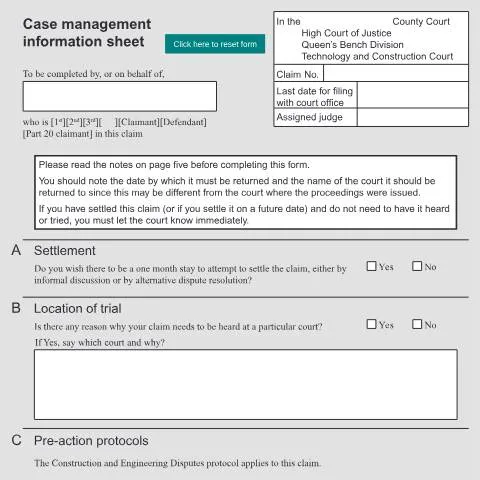
The Technology and Construction Court's Gateway to Efficient Case Management
When construction disputes, professional negligence claims, or complex technical matters reach the specialist Technology and Construction Court (TCC), parties face a crucial preliminary step that can significantly influence how their case unfolds. The Form TCC/CM1 Case Management Information Sheet serves as the court's primary intelligence-gathering tool, enabling judges to tailor case management directions to the specific characteristics and complexities of each dispute.
This comprehensive questionnaire, developed specifically for the TCC's unique caseload, goes far beyond basic case details. It captures the nuanced requirements of construction and engineering disputes, from expert witness coordination to disclosure challenges involving technical documentation. The form's strategic importance becomes apparent when considering that ineffective case management can transform a straightforward professional dispute into a protracted, costly battle.
The TCC, operating within both the High Court's Queen's Bench Division and County Court framework, handles some of the most technically complex civil litigation in England and Wales. Each case presents distinct challenges—whether involving Building Information Modelling (BIM) systems, complex engineering calculations, or multi-party construction projects spanning several years.
Mandatory Completion Timeline and Strategic Considerations
The case management information sheet operates under strict deadlines that vary depending on when and where proceedings were issued. Crucially, the return address may differ from the issuing court, as the TCC operates from multiple locations including London, Birmingham, Manchester, Leeds, Liverpool, Newcastle, Cardiff, and Bristol.
Parties must complete the form within the timeframe specified in the case management directions, typically within 14 days of allocation to the TCC list. Missing this deadline triggers the court's discretionary powers under Civil Procedure Rules, potentially resulting in adverse directions or orders that could prejudice a party's position before the substantive case even begins.
The timing proves particularly critical in construction disputes where seasonal factors, project completion deadlines, or professional availability constraints may influence hearing dates. Early identification of these constraints through the TCC/CM1 form enables judges to accommodate legitimate scheduling requirements whilst maintaining efficient case progression.
Multi-track Allocation and Transfer Considerations
The form includes specific provisions for cases that might benefit from transfer to alternative tracks or courts. Small claims track cases—those valued under £10,000—rarely reach the TCC, but when they do, parties must justify why the technical complexity warrants specialist judicial consideration rather than standard County Court procedures.
Fast track allocation remains possible for lower-value TCC cases, though the court maintains discretion based on complexity rather than monetary value alone. Cases involving novel legal points, extensive expert evidence, or multi-party disputes typically remain within the TCC's multi-track framework regardless of financial quantum.
Settlement Facilitation and Alternative Dispute Resolution Framework
Section A of the TCC/CM1 form addresses settlement prospects through a mandatory consideration of one-month stays for alternative dispute resolution. This provision reflects the court's recognition that construction disputes often benefit from specialist mediation or adjudication processes that understand technical complexities.
The settlement section requires parties to actively consider whether informal discussion or formal ADR processes might resolve matters without trial. This isn't merely procedural—judges use these responses to assess whether case management directions should incorporate ADR requirements or whether early neutral evaluation might prove beneficial.
Construction disputes frequently involve ongoing commercial relationships where maintaining business connections proves as important as resolving immediate legal issues. The TCC's approach acknowledges this reality by encouraging settlement discussions whilst ensuring that parties who genuinely require judicial determination aren't unnecessarily delayed.
Pre-action Protocol Compliance Verification
The Construction and Engineering Disputes Protocol applies automatically to TCC cases, requiring parties to exchange technical information, engage in pre-action meetings, and attempt resolution before issuing proceedings. Section C of the form verifies compliance, with non-compliance potentially triggering cost penalties or adverse directions.
Parties unable to confirm protocol compliance must provide detailed explanations on separate sheets, addressing why standard pre-action procedures weren't followed. Common legitimate reasons include urgent applications to prevent irreparable harm, limitation period constraints, or situations where one party refuses to engage constructively.
Expert Evidence Coordination and Technical Witness Management
The TCC/CM1 form dedicates substantial attention to expert evidence—reflecting the reality that construction and engineering disputes rarely proceed without specialist technical input. The form distinguishes between single joint experts and party-appointed specialists, recognising that some technical issues benefit from collaborative expert approaches whilst others require adversarial examination.
| Expert Type | Typical Applications | Court Approach |
|---|---|---|
| Single Joint Expert (SJ) | Standard technical assessments, building surveys, straightforward professional negligence | Preferred where technical issues are discrete and factual |
| Party-appointed Experts | Complex causation disputes, design liability, quantum assessments | Permitted where genuine technical disagreement exists |
| Court-appointed Experts | Novel technical issues, assessor roles, complex multi-party disputes | Exceptional circumstances only |
The form requires parties to specify whether experts should give oral evidence at trial. This proves crucial in TCC cases where expert evidence often determines outcomes, but where written reports may sufficiently address technical issues without requiring expensive cross-examination.
Parties must identify expert fields precisely—"surveyor" proves insufficient where "building surveyor specialising in structural defects in 1960s concrete construction" provides the specificity judges require for effective case management. This granular approach enables courts to identify potential overlaps, conflicts, or gaps in technical coverage.
Witness of Fact Coordination
Construction disputes typically involve multiple witnesses spanning project duration—from initial design meetings through completion and beyond. The TCC/CM1 form requires comprehensive witness identification, including parties themselves when they'll provide factual evidence.
Effective witness planning proves particularly important given the TCC's preference for witness statements that address technical issues without straying into expert opinion territory. The form enables judges to assess hearing length requirements and identify potential scheduling conflicts early in case management.
Disclosure Challenges in Technical Documentation
Section addressing disclosure recognises the unique challenges posed by technical documentation in construction disputes. Building Information Modelling (BIM) systems, Computer-Aided Design (CAD) files, project management software outputs, and electronic communications create disclosure obligations that extend far beyond traditional document categories.
The form specifically asks whether special considerations affect disclosure, acknowledging that technical documents may require specialist software for access, involve confidential design information, or include commercially sensitive data requiring protective measures.
Parties must identify disclosure issues early because technical document review often proves more time-consuming and expensive than standard commercial litigation. Issues might include:
- Proprietary software requirements for accessing technical files
- Intellectual property concerns in design documentation
- Third-party confidentiality obligations affecting subcontractor records
- Physical inspection requirements for construction defects
- Ongoing project constraints limiting access to live construction sites
Electronic disclosure in TCC cases frequently involves terabytes of data requiring specialist legal technology support. Early identification through the case management information sheet enables courts to make appropriate directions for electronic document management and review platforms.
Hearing Duration Assessment and Practical Logistics
The TCC/CM1 form requires realistic time estimates for trial duration, recognising that construction disputes often involve extensive technical evidence requiring careful judicial consideration. Parties must provide estimates in days, hours, and minutes—reflecting the court's preference for precision over approximation.
Time estimates prove crucial for TCC scheduling because specialist judges have limited availability and technical cases cannot easily be transferred between different judicial expertise areas. Underestimating hearing time can result in part-heard trials with significant adjournment delays.
The form captures availability constraints for parties, essential witnesses, and experts. Construction disputes often involve international experts, witnesses with project commitments, or seasonal constraints affecting site inspections. Early identification enables judges to coordinate complex scheduling requirements effectively.
Video Link and Technology Requirements
Modern TCC practice increasingly incorporates video conferencing for international witnesses, remote expert evidence, and preliminary hearings. The form specifically addresses video link requirements, enabling courts to ensure appropriate technical facilities are available.
Technology requirements extend beyond video links to include presentation facilities for technical drawings, 3D modelling demonstrations, and collaborative document review systems. The "Other Information" section enables parties to specify technical requirements that influence hearing venue selection.
Cost Management and Proportionality Considerations
The costs section of TCC/CM1 requires both retrospective and prospective cost estimates, recognising that construction disputes can escalate rapidly in expense. Parties must provide current cost figures and overall case estimates, enabling judges to assess proportionality and make appropriate case management directions.
Cost management proves particularly important in TCC cases because technical complexity can justify substantial expert fees, specialist legal representation, and extensive disclosure exercises. However, the court maintains strict proportionality requirements ensuring that case management directions reflect claim value and complexity appropriately.
Parties represented by solicitors in cases exceeding small claims track must complete detailed cost information. This enables judges to make costs budgeting orders under Civil Procedure Rule Part 3, providing cost control throughout case progression rather than solely at conclusion.
The form's cost disclosure requirements also assist in settlement discussions by providing realistic expense projections that inform commercial decision-making about litigation continuation versus negotiated resolution.
Judicial Assignment and Case Management Integration
The TCC operates through designated specialist judges who develop expertise in particular technical areas. The case management information sheet assists in appropriate judicial assignment by identifying case characteristics that benefit from specific technical knowledge or judicial experience.
Assigned judges use TCC/CM1 responses to develop bespoke case management directions that address the specific requirements identified by parties. This might include directions for joint expert meetings, technical site inspections, preliminary issues trials, or phased disclosure addressing technical and quantum issues separately.
The form integrates with the TCC Guide's comprehensive case management framework, enabling judges to apply established best practices whilst accommodating individual case requirements. Effective completion of the case management information sheet directly influences the quality and appropriateness of subsequent judicial directions.
Parties should approach TCC/CM1 completion strategically, recognising that responses influence not merely administrative arrangements but substantive case management approaches that determine litigation efficiency, cost, and ultimate prospects of success. The form represents an opportunity to educate the assigned judge about case complexities whilst demonstrating professional competence in technical dispute management.
Specific Considerations for Different Case Types
The TCC/CM1 form requirements vary significantly depending on the nature of your Technology and Construction Court case, with each category demanding specific information and documentation approaches.
Construction Disputes and Professional Negligence Claims
For construction-related disputes, the case management information sheet requires detailed project specifications that go beyond basic contract details. You must identify all relevant construction phases, including design, procurement, construction, and handover stages where disputes arose. The form expects you to specify whether claims involve defective work, delay damages, variations disputes, or final account disagreements.
Professional negligence cases against architects, engineers, or quantity surveyors require particular attention to the duty of care timeline. Your CM1 submission should clearly delineate when the alleged breach occurred, when damage manifested, and when you reasonably discovered the negligence. This distinction proves crucial for limitation period assessments and case management directions.
Multi-party construction disputes demand careful consideration of party relationships. You'll need to identify main contractors, subcontractors, employers, and professional consultants, explaining their contractual relationships and how each party's involvement affects case management. The court expects clarity on whether claims involve back-to-back contracts, collateral warranties, or third-party proceedings.
Technology and IT-Related Disputes
Information technology disputes require specialized disclosure considerations within the CM1 framework. Software development disputes, system implementation failures, and intellectual property breaches each present unique case management challenges that your form completion must address comprehensively.
For software disputes, you must specify the development methodology used (waterfall, agile, or hybrid approaches), as this affects evidence preservation and expert witness requirements. The court needs to understand whether disputes involve specification disagreements, delivery delays, performance failures, or intellectual property violations.
Data protection and cybersecurity incidents require particular sensitivity in case management planning. Your CM1 submission should indicate whether the case involves personal data breaches, requiring compliance with Data Protection Act 2018 and UK GDPR provisions. This affects disclosure protocols, witness anonymization, and hearing arrangements for sensitive commercial information.
Fill in your form directly online
No printing: type your details into the boxes of the official form, tick, then download the PDF ready to send.
- 1Type into the form boxes
- 2Tick in one click
- 3Save and download the PDF
Technology cases often require specialized expert evidence on complex technical matters. Your case management information should identify the technical disciplines involved – software engineering, cybersecurity, data analytics, or telecommunications – enabling the court to plan appropriate case management directions and expert witness protocols.
International and Cross-Border Case Management Considerations
Technology and Construction Court cases frequently involve international elements that significantly impact case management planning, requiring specific attention within your TCC/CM1 submission to ensure proper procedural handling.
Jurisdiction and Applicable Law Issues
Cross-border construction projects and international technology contracts often raise complex jurisdictional questions that your case management information sheet must address comprehensively. You should specify whether your case involves foreign law elements, requiring expert evidence on overseas legal systems, particularly for contracts governed by civil law jurisdictions or specialized international construction law frameworks.
The form requires clear identification of any parallel proceedings in foreign courts or arbitration tribunals. This includes ongoing or concluded proceedings in other jurisdictions involving the same parties, similar issues, or related contracts. The court uses this information to coordinate case management directions and avoid conflicting judgments or duplicative proceedings.
International enforcement considerations affect case management planning significantly. Your CM1 submission should indicate whether eventual judgments require enforcement in specific overseas jurisdictions, as this influences evidence gathering, witness location planning, and procedural compliance with international legal assistance treaties.
Evidence Collection Across Jurisdictions
International cases present unique evidence gathering challenges that require early case management attention. Your form completion should identify evidence located in foreign jurisdictions, including documents held by overseas entities, witness testimony from foreign nationals, and site inspections in other countries.
Data protection compliance becomes particularly complex in cross-border cases. You must specify whether evidence involves personal data subject to foreign data protection regimes, as this affects disclosure protocols and requires coordination between different legal frameworks. The court needs advance notice to establish appropriate protective measures and comply with international data transfer requirements.
Translation requirements represent a significant case management consideration. Your CM1 should identify foreign language documents requiring certified translation, specifying the languages involved and estimated document volumes. This enables the court to plan realistic case management timetables and establish translation protocols that ensure accuracy while managing costs effectively.
International Arbitration Interface
Many international construction and technology disputes involve arbitration clauses or existing arbitration proceedings that interact with TCC litigation. Your case management information sheet must clearly explain any arbitration relationships, including whether court proceedings involve arbitration challenges, enforcement actions, or parallel proceedings addressing different aspects of the same underlying dispute.
The form should specify the arbitration seat and governing arbitration rules (ICC, LCIA, UNCITRAL, or specialized construction arbitration rules) as these affect procedural coordination between court and arbitration proceedings. The court requires this information to establish appropriate case management directions that complement rather than conflict with arbitration procedures.
Advanced Case Management Strategies and Procedural Innovations
The Technology and Construction Court continues evolving its case management approaches, incorporating technological innovations and procedural refinements that your TCC/CM1 submission should anticipate and address proactively.
Digital Case Management and Electronic Bundles
Contemporary TCC practice increasingly relies on sophisticated digital case management systems that require specific planning considerations within your case management information sheet. You should indicate the anticipated volume of electronic documents, specifying file formats, database structures, and any specialized software required for document review.
Building Information Modelling (BIM) evidence presents particular case management challenges in construction disputes. Your CM1 submission should identify whether the case involves 3D models, 4D scheduling information, or 5D cost modeling, as these require specialized software and hardware for effective case presentation. The court needs advance notice to ensure appropriate technological infrastructure and expert witness protocols.
Video evidence, including site inspections, construction progress recordings, and expert demonstrations, requires specific case management planning. Your form should specify video evidence volumes, formats, and any specialized viewing requirements that affect courtroom technology needs and hearing scheduling.
Innovative Expert Evidence Approaches
Modern TCC practice embraces innovative expert evidence presentation methods that your case management planning should incorporate effectively. Hot-tubbing (concurrent expert evidence) has become increasingly common for technical disputes, requiring specific procedural arrangements that your CM1 should anticipate.
Virtual site visits and remote expert inspections, accelerated by recent technological developments, present new case management opportunities. Your form completion should consider whether remote inspection protocols could enhance efficiency while maintaining evidential integrity, particularly for international projects or hazardous construction sites.
Real-time expert evidence presentation, including live modeling demonstrations and interactive technical presentations, requires advance case management planning. Your CM1 submission should identify opportunities for enhanced expert evidence presentation that could improve case efficiency and judicial understanding of complex technical issues.
Proportionality and Cost Management Integration
Advanced case management increasingly integrates proportionality assessments with procedural planning from the earliest stages. Your case management information sheet should demonstrate clear understanding of how procedural choices affect overall case costs and align with the dispute's financial significance.
The court expects realistic assessment of whether your case justifies sophisticated case management approaches or whether streamlined procedures better serve the interests of justice. This requires honest evaluation of claim values, complexity levels, and party resources within your CM1 submission.
Alternative dispute resolution integration represents a sophisticated case management approach that your form should address comprehensively. Early neutral evaluation, expert determination for technical issues, and mediation scheduling can be integrated with litigation case management to provide flexible dispute resolution pathways that preserve party relationships while ensuring efficient resolution.