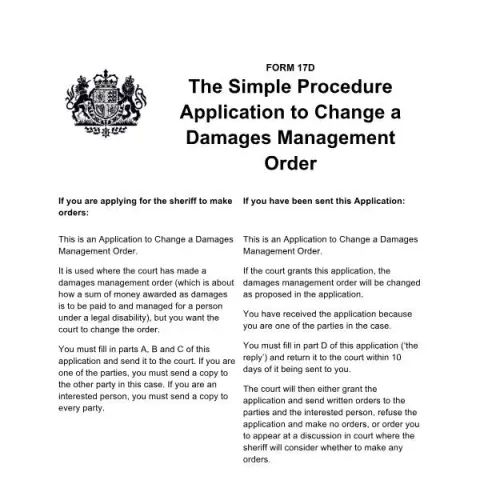
Introduction to Form 17D: Application to Change a Damages Management Order
The Form 17D is an official document used within the Scottish Courts and Tribunals Service to request modifications to an existing damages management order. This form is part of the court’s simple procedure, designed to streamline the process of applying for changes to orders concerning the management of damages awarded in legal cases involving persons under a legal disability.
Understanding the Purpose and Scope of the Form
This application form is specifically used when a party involved in a case wishes to ask the sheriff to alter an existing damages management order. Such orders typically regulate how a sum of money awarded as damages is to be paid and managed on behalf of a person who cannot handle their finances independently, such as a minor or someone under legal guardianship.
Once the court grants a change, the damages management order will be amended according to the details provided in the application. This process ensures that the management of damages remains appropriate to the current circumstances of the case or the individual involved.
Who Should Use this Form and Who Receives It?
- Parties involved in the case: The applicant, whether claimant, respondent, or interested person, must complete parts A, B, and C of the form and submit it to the court.
- Other parties: The applicant must send a copy of the completed form to all other parties involved in the case.
- Interested persons: If you are not a party but have an interest in the case, you must also send copies to each party involved.
Filling Out the Application: Step-by-Step Guide
Part A: About the Case
Provide details such as the name of the sheriff court, the claimants and respondents, and the case reference number. These details identify the specific case for which the damages management order is being amended.
Part B: About You
- B1: Enter your full name, including any middle name, and your role in the case (claimant, respondent, or interested person).
- B2: Specify your role clearly.
- B3: If applicable, explain your interest in the case, such as responsibilities for managing the damages or caring for the individual under the order.
Part C: The Application
- C1: Outline the specific changes you seek in the damages management order. For instance, you may request the appointment of a different manager or direct payment to the individual.
- C2: State the reasons why the court should approve these changes, such as changes in circumstances or concerns about the current management.
- C3: Record the date on which the application was sent to the court. This date is crucial, as any reply from other parties must be submitted within 10 days of this date.
Responding to the Application: Part D
If you are the respondent or another party receiving this application, you must complete Part D. This section asks whether you agree with the proposed changes and requires you to provide reasons if you oppose them.
Part D: The Reply
- D1: Your full name and role in the case.
- D2: Indicate whether you believe the damages management order should be changed.
- D3: If you oppose the change, explain why the court should not amend the order.
Legal Considerations and Submission Deadlines
It is essential that the application is completed accurately and sent to the court promptly. The deadline for responses is 10 days from the date the application is sent. The court will then review the application and decide whether to grant, refuse, or schedule a hearing regarding the proposed changes.
Fill in your form directly online
No printing: type your details into the boxes of the official form, tick, then download the PDF ready to send.
- 1Type into the form boxes
- 2Tick in one click
- 3Save and download the PDF
Conclusion
The Form 17D provides a clear, streamlined process for parties to request modifications to damages management orders within Scottish courts. Proper completion and timely submission are vital to ensure that the court can consider the application effectively, maintaining the appropriate management of damages awarded in cases involving individuals under legal disability.