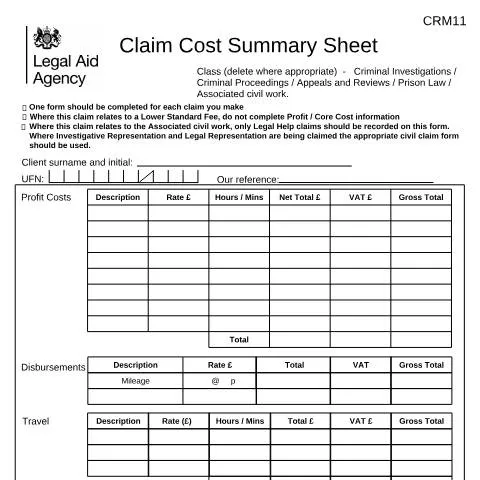
Understanding the CRM11 Generic Costs Claim Sheet Framework
When legal representatives handle legally aided cases across criminal investigations, proceedings, appeals, or prison law matters, the CRM11 generic costs claim sheet serves as the cornerstone document for recovering professional fees and expenses. This Legal Aid Agency form operates within a complex remuneration system where solicitors and barristers must meticulously document their work to secure payment from public funds.
The form's versatility spans multiple legal disciplines, yet its completion demands precision. A single error in classification or rate calculation can delay payment by weeks or trigger costly assessment procedures. Unlike standard commercial billing, legal aid claims operate under strict statutory frameworks where every minute of work, every mile travelled, and every disbursement must be justified according to predetermined criteria.
The CRM11's significance extends beyond mere administrative convenience—it represents the intersection between access to justice and public accountability. Legal representatives must balance thorough case preparation with economic efficiency, knowing that excessive claims face scrutiny whilst inadequate documentation risks financial loss.
Classification Systems and Case Categories
The form's opening section requires practitioners to identify their case classification by deleting inappropriate options from the list: Criminal Investigations, Criminal Proceedings, Appeals and Reviews, Prison Law, or Associated civil work. This classification determines which fee structure applies and influences assessment criteria.
Criminal Investigations typically involve pre-charge advice, police station attendance, or early investigative work. These cases often operate under fixed fee arrangements, though exceptional circumstances may warrant escape threshold applications. Criminal Proceedings encompass magistrates' court and Crown Court representations, where standard fees frequently apply based on case complexity and hearing duration.
Appeals and Reviews cover post-conviction challenges, sentence appeals, or judicial review applications. These cases require careful documentation as they often involve novel legal arguments or procedural complexities that justify enhanced rates. Prison Law encompasses disciplinary hearings, categorisation reviews, or parole board representations—specialist areas where practitioners command premium rates due to limited availability of qualified representatives.
| Case Classification | Typical Fee Structure | Key Documentation Requirements |
|---|---|---|
| Criminal Investigations | Fixed fees with escape provisions | Police station attendance logs, custody records |
| Criminal Proceedings | Standard fees (lower/higher category) | Representation orders, hearing schedules |
| Appeals and Reviews | Hourly rates with case complexity factors | Grounds of appeal, court transcripts |
| Prison Law | Enhanced hourly rates | Institutional correspondence, hearing notices |
Standard Fee Categories and Core Cost Calculations
For proceedings where representation orders exist, practitioners must indicate whether they claim lower standard fee or higher standard fee categories. This distinction fundamentally affects how the remainder of the form should be completed. Lower standard fee cases prohibit detailed profit cost breakdowns, whilst higher standard fee cases require comprehensive time recording.
The lower standard fee typically applies to straightforward guilty pleas, simple either-way matters resolved at magistrates' court level, or routine Crown Court appearances lasting under half a day. These cases operate under presumptive fee structures designed to streamline administration whilst providing reasonable remuneration for standard work.
Higher standard fee cases involve complex legal arguments, multiple defendants, substantial documentary evidence, or extended hearing periods. These cases justify detailed time recording because their complexity exceeds standard parameters. Practitioners must demonstrate that case characteristics warrant enhanced remuneration through meticulous documentation of preparation time, research requirements, and advocacy demands.
The Total Core Costs section aggregates all profit costs excluding disbursements. This figure becomes crucial for assessment purposes, as it determines whether claims exceed prescribed limits triggering detailed scrutiny. Core costs encompass preparation time, court attendance, client conferences, and case-related research calculated at prescribed hourly rates.
Pre-Order Work Considerations
When representation orders are granted after initial work commencement, practitioners face complex timing issues. Pre-order work requires separate justification, as legal aid coverage typically begins from the order's grant date. The form specifically requests the date order granted to establish this crucial temporal boundary.
Pre-order work may include emergency court appearances, urgent client interviews, or preliminary case analysis conducted before formal legal aid approval. Such work risks non-recovery if inadequately documented or if retrospective legal aid applications fail. Practitioners must balance professional obligations to provide immediate assistance with financial prudence regarding unremunerated work.
Profit Costs Breakdown and Time Recording
The profit costs section demands granular detail regarding professional time expenditure. Each entry requires description, hourly rate, time allocation (hours and minutes), and resulting totals including VAT calculations. This level of detail reflects the Legal Aid Agency's emphasis on transparency and value-for-money assessments.
Descriptions must be sufficiently specific to justify the work's necessity and proportionality. Vague entries like "case preparation" or "general correspondence" invite assessment queries and potential cost reductions. Effective descriptions specify the work's purpose: "Analysis of CCTV evidence for identification issues" or "Research into admissibility of hearsay statements under Criminal Justice Act 2003, s.114".
Hourly rates depend on the fee-earner's grade and the work's complexity. Senior solicitors and Queen's Counsel command premium rates, whilst trainee solicitors and paralegals operate at lower rates. The Legal Aid Agency publishes prescribed rates updated periodically to reflect market conditions and inflation adjustments.
Time recording accuracy becomes critical for assessment survival. Six-minute units represent standard practice, though some practitioners prefer more granular recording to demonstrate thoroughness. Time must be contemporaneously recorded—retrospective reconstruction often appears artificial and faces assessment challenges.
Waiting Time Claims
Court waiting represents a significant cost component in criminal cases where listing practices create inefficiencies. Practitioners may claim waiting time when attending court for listed hearings subsequently adjourned or delayed beyond reasonable periods. However, waiting time claims require careful justification to distinguish legitimate delays from routine court management.
Effective waiting time claims demonstrate that attendance was necessary and that delays resulted from factors beyond the practitioner's control. Claims must specify the reason for delay, the duration waited, and any productive work undertaken during waiting periods. Some practitioners use waiting time for case preparation or client conferences, potentially justifying higher rates than pure waiting time.
Disbursement Documentation and Recovery Procedures
Disbursements encompass third-party expenses incurred for case progression: expert witness fees, medical reports, forensic analysis costs, or translation services. Unlike profit costs, disbursements require prior authority for amounts exceeding prescribed thresholds, making accurate forecasting essential for case budgeting.
Each disbursement entry requires comprehensive documentation including supplier details, service descriptions, and VAT treatment. The Legal Aid Agency operates strict rules regarding VAT recovery—practitioners must understand which disbursements qualify for VAT claims and which fall outside scope.
Expert witness fees represent substantial disbursement categories requiring particular attention. Medical experts, forensic specialists, or technical consultants often charge significant fees warranting detailed justification. Prior authority applications must demonstrate the expert's necessity, their qualifications, and fee reasonableness compared to market rates.
Document production costs, including copying charges, photographic reproduction, or digital media preparation, require itemised presentation. The Legal Aid Agency applies standard rates for routine copying whilst exceptional costs require specific justification. Practitioners must balance comprehensive case preparation with cost-effective document management.
VAT Calculations and Treatment
VAT treatment varies depending on the supplier's registration status and service type. Legal representatives must accurately calculate VAT on qualifying disbursements whilst ensuring compliance with HMRC regulations. Incorrect VAT claims can trigger assessment queries and potential recovery proceedings.
Some disbursements, particularly those from VAT-exempt providers like certain medical practitioners, carry no VAT liability. Others, including most commercial services, attract standard VAT rates. Practitioners must maintain adequate records supporting VAT treatment decisions to satisfy both Legal Aid Agency and HMRC requirements.
Travel and Mileage Cost Recovery
Travel costs encompass mileage claims, public transport expenses, and accommodation costs for cases requiring attendance away from the practitioner's usual location. The Legal Aid Agency applies standard mileage rates updated periodically to reflect fuel costs and vehicle operating expenses.
Mileage claims require destination specification, journey purpose, and distance calculations. The form provides space for rate per mile calculations, typically expressed in pence per mile. Practitioners must justify travel necessity—local alternatives or video conferencing options may render physical attendance unreasonable for cost recovery purposes.
Public transport costs require receipt retention and reasonable cost demonstration. First-class travel typically requires specific justification based on journey duration or professional necessity. Accommodation costs apply when overnight stays become unavoidable due to hearing scheduling or distance factors.
Travel time may qualify for separate remuneration under certain circumstances, particularly for substantial journeys to remote court locations. However, travel time claims require careful justification to demonstrate productive use rather than mere transportation periods.
Unique File Number Systems and Reference Management
The UFN (Unique File Number) system provides crucial case tracking throughout the legal aid process. Each matter receives a distinctive identifier linking all associated claims, payments, and correspondence. Accurate UFN usage prevents administrative confusion and ensures correct case attribution.
UFN format follows prescribed conventions incorporating provider identification codes, date elements, and sequential numbering. Errors in UFN recording can delay processing significantly as the Legal Aid Agency's automated systems rely on accurate matching for claim processing.
Client identification requires surname and initial specification, providing additional verification alongside UFN references. This dual identification system helps prevent case confusion, particularly important when practitioners handle multiple matters for clients with similar names or when family members face separate proceedings.
Internal reference systems vary between firms but must provide clear audit trails linking claim forms to case files. Effective reference management enables rapid response to assessment queries and supports detailed cost justification when required.
Assessment Procedures and Post-Submission Processes
Following CRM11 submission, claims enter the Legal Aid Agency's assessment process where costs officers evaluate work necessity, time reasonableness, and rate appropriateness. Assessment outcomes range from full acceptance through partial reductions to complete rejection in exceptional circumstances.
Standard assessments focus on mathematical accuracy, rate compliance, and work description adequacy. Complex cases may trigger detailed assessments involving file reviews, client interviews, or expert evaluation of work quality. Practitioners should anticipate assessment queries and maintain comprehensive file records supporting their claims.
Assessment appeals provide recourse when practitioners disagree with cost reductions. The appeals process requires detailed grounds specification and often benefits from precedent citation or expert evidence regarding work necessity. However, appeals carry cost risks if unsuccessful, potentially resulting in additional liability for assessment costs.
Payment timing depends on assessment complexity and current processing volumes. Straightforward claims typically process within predetermined timeframes, whilst complex assessments may extend significantly. Practitioners must factor payment delays into cash flow management, particularly for substantial claims or when significant disbursement recovery is involved.
The CRM11 represents more than administrative compliance—it embodies the delicate balance between access to justice and public resource stewardship. Effective completion requires technical accuracy, detailed documentation, and strategic awareness of assessment criteria, ensuring that legal representatives receive fair remuneration whilst maintaining system integrity and public confidence in legal aid expenditure.
Common Pitfalls When Completing the CRM11 Form
Practitioners frequently encounter specific challenges when preparing their CRM11 submissions, often resulting in delayed payments or requests for additional information from the Legal Aid Agency. Understanding these common errors can significantly streamline your claims process and ensure timely remuneration.
One of the most prevalent issues involves inadequate time recording granularity. The LAA expects detailed breakdowns of activities, not broad categories like "case preparation" spanning multiple hours. Instead, entries should specify distinct tasks: "reviewing prosecution evidence bundle (pages 1-47)", "preparing cross-examination notes for complainant", or "researching legal authorities on admissibility of hearsay evidence". This level of detail demonstrates the necessity and reasonableness of time spent.
Travel time calculations frequently cause complications, particularly when practitioners fail to distinguish between different journey purposes or combine multiple case-related trips in a single entry. The CRM11 requires separate entries for travel to court, client meetings, and expert consultations. Additionally, practitioners must justify unusual travel arrangements—for instance, if attending a court hearing in a distant jurisdiction rather than seeking an adjournment for a local venue.
Disbursement documentation presents another common stumbling block. The LAA may reject claims for expert witness fees without proper supporting evidence, including the expert's CV demonstrating relevant qualifications, a detailed breakdown of their hourly rates, and confirmation that their involvement was essential rather than merely advantageous to the case. Medical expert reports, in particular, require clear justification of why standard medical records were insufficient.
Counsel fee arrangements often generate queries when practitioners fail to provide adequate context for instruction decisions. The LAA expects explanations for choosing particular counsel, especially when fees exceed typical rates for similar cases. Junior counsel instructions in straightforward matters may require justification, whilst selecting leading counsel for complex fraud cases should include details of their specific expertise and case complexity factors.
VAT calculations create frequent administrative headaches, particularly for mixed supply situations where some services are VAT-exempt whilst others attract standard rates. Practitioners must clearly separate attendance at police stations (typically VAT-exempt as legal aid services) from other advisory work that may be subject to VAT. Incorrect VAT applications can delay payment processing significantly whilst the LAA seeks clarification.
Regional Variations and Specialist Court Procedures
The CRM11 form accommodates various regional differences and specialist court procedures across England and Wales, each presenting unique claiming considerations that practitioners must navigate carefully. Understanding these variations ensures accurate claims preparation and reduces the likelihood of LAA queries.
Crown Court centres operate with different administrative arrangements that can affect claiming procedures. For instance, circuit judge-only courts may have different listing practices compared to High Court judge venues, potentially affecting preparation time requirements and travel arrangements. Manchester Crown Court's complex multi-building structure might necessitate additional time allowances for moving between courtrooms, whilst smaller circuit venues like Carlisle Crown Court may require longer travel times but offer more predictable hearing schedules.
Specialist courts present particular claiming challenges. The Central Criminal Court (Old Bailey) operates under unique protocols that may justify additional preparation time, particularly for cases involving national security considerations or high-profile defendants requiring enhanced security measures. These circumstances often necessitate earlier arrival times, extended court days, and additional liaison with court security personnel—all legitimate claims under the CRM11 framework.
Youth courts require different claiming approaches, particularly regarding appropriate adult arrangements and specialist youth advocacy requirements. Time spent explaining proceedings to young defendants in age-appropriate language, coordinating with social services, and attending multi-agency meetings represents claimable activity that might not arise in adult proceedings. The CRM11 should reflect these additional responsibilities clearly.
Mental health tribunal representations involve unique preparation requirements, including reviewing extensive medical records, liaising with treating clinicians, and potentially arranging independent medical assessments. The tribunal's inquisitorial rather than adversarial nature may require different preparation approaches, with emphasis on collaborative information-gathering rather than confrontational examination techniques.
Magistrates' courts in different regions operate varying administrative systems that can affect claiming patterns. Some courts maintain paper-based systems requiring physical attendance for case management, whilst others operate digital platforms allowing remote participation. These differences impact travel time claims and court attendance duration calculations.
Coroner's courts present distinctive claiming considerations, particularly regarding the scope of representation and the investigative nature of proceedings. Unlike criminal trials, coroner's inquests may require extensive pre-hearing investigation, witness liaison, and coordination with other interested parties. The CRM11 should reflect the collaborative yet thorough nature of this preparation work.
Technology Integration and Digital Case Management
The Legal Aid Agency's increasing emphasis on digital processes significantly impacts CRM11 completion and submission procedures, requiring practitioners to adapt their claiming practices to align with technological developments whilst maintaining accurate record-keeping standards.
The Client and Cost Management System (CCMS) integration with CRM11 submissions creates both opportunities and challenges for practitioners. Whilst digital submission reduces processing times and provides immediate acknowledgment of receipt, it also requires more rigorous data validation at the point of entry. The system's automated checks can identify inconsistencies between claimed hours and case complexity indicators, potentially flagging claims for manual review that might previously have passed through routine processing.
Electronic case management systems employed by different courts create varying implications for time recording and claiming. The Common Platform system used across criminal courts provides digital case files that can reduce preparation time for document review but may increase time spent on technical troubleshooting or system navigation. Practitioners should reflect these efficiency gains and technical challenges accurately in their CRM11 entries, demonstrating how technology affects their working patterns.
Video hearing participation, particularly prevalent following recent procedural changes, requires careful consideration in CRM11 claims. Technical preparation time, including system testing and backup arrangement preparation, represents legitimate claiming activity. However, reduced travel time and court attendance duration should be reflected accurately. The LAA expects practitioners to demonstrate how remote hearing participation affects their overall case costs, potentially reducing some expenses whilst creating others.
Digital evidence management increasingly affects case preparation time calculations. Large-scale fraud cases involving extensive electronic disclosure may require significant time investment in digital evidence review, potentially using specialist software or requiring technical support. The CRM11 should detail these activities clearly, distinguishing between standard document review and technical evidence analysis requiring specialist skills or software.
Secure communication requirements, particularly for sensitive cases, may necessitate additional time investment in encrypted communication setup, secure file transfer arrangements, and technical security compliance. These activities represent legitimate case preparation time, particularly in cases involving national security considerations or vulnerable witnesses requiring enhanced protection measures.
The LAA's own digital transformation affects payment processing timescales and query resolution procedures. Electronic submission enables faster initial processing but may result in more detailed automated queries requiring comprehensive responses. Practitioners should maintain detailed contemporaneous records supporting their digital submissions, as the electronic format may facilitate more granular LAA analysis of claiming patterns and time allocation decisions.