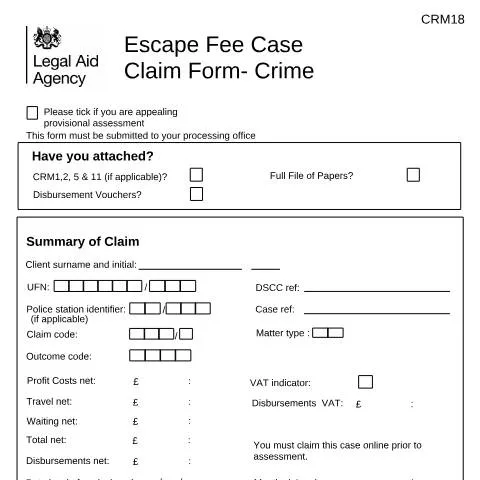
When Criminal Defence Costs Spiral Beyond Fixed Fees: The Escape Route Mechanism
In the labyrinthine world of criminal legal aid, solicitors occasionally encounter cases that defy the standard fixed fee structure. A straightforward theft charge might evolve into a complex multi-defendant conspiracy, or a routine police station interview could stretch across multiple sessions involving vulnerable clients. When legal costs threaten to exceed the prescribed thresholds, the Legal Aid Agency's CRM18 escape fee case claim form becomes the crucial lifeline that prevents practitioners from absorbing unsustainable financial losses.
This specialised claim mechanism operates within the broader framework of criminal legal aid contracting, where most work is remunerated through predetermined fixed fees. However, the system acknowledges that certain cases, by their very nature or unexpected developments, require substantially more work than the standard fee anticipates. The escape fee provision ensures that access to justice remains viable for complex cases whilst maintaining cost control for the public purse.
The Architecture of Exceptional Case Thresholds
The escape fee system hinges on specific exceptional case thresholds that vary according to the type and stage of criminal proceedings. Understanding these thresholds is fundamental to determining when a CRM18 claim becomes viable, as they represent the financial trigger points beyond which standard fixed fees prove inadequate.
For police station work, the threshold typically relates to time spent rather than pure monetary value. Cases involving multiple interviews, complex disclosure reviews, or clients requiring additional support due to vulnerability factors may qualify. Crown Court proceedings follow different criteria, often based on the volume of evidence, number of defendants, or procedural complexity that extends beyond normal case parameters.
| Case Type | Typical Threshold Indicators | Assessment Focus |
|---|---|---|
| Police Station Advice | Extended interview duration, multiple sessions | Time spent and complexity factors |
| Magistrates' Court | Unusual case preparation requirements | Documentary evidence volume |
| Crown Court | Multi-defendant cases, substantial evidence | Case management complexity |
| Appeals | Novel legal points, extensive research | Legal complexity and preparation time |
The form's design reflects this threshold-based approach, requiring practitioners to demonstrate not merely that costs have been incurred, but that the case genuinely falls outside normal parameters. The "Relevant Case Information" section specifically asks for details explaining why the exceptional threshold was exceeded, demanding concrete justification rather than generic assertions.
Navigating the Chronological Documentation Requirements
The CRM18's most distinctive feature lies in its detailed Schedule of time spent section, which demands chronological precision that many practitioners initially find daunting. This isn't merely administrative pedantry; it reflects the Legal Aid Agency's need to verify that claimed time genuinely relates to legitimate case progression rather than inefficient working practices.
Each entry must specify the exact nature of work undertaken, broken down into discrete categories: travel, waiting, attendance, preparation, and communications. The form's instruction to use "a separate line for each type of work" means that a single court hearing involving travel, waiting, and attendance requires three distinct entries, each with precise time recordings.
Fee earners must record their initials against each entry, creating an audit trail that enables the Legal Aid Agency to cross-reference claims against individual practitioner rates and authorisations. This granular approach serves multiple purposes: it prevents double-claiming, enables quality assurance checks, and provides data for future fee-setting exercises.
For duty solicitor work, additional complexity arises from the requirement to use "only one hourly rate on each line". Cases involving both senior and junior fee earners must separate their time entries accordingly, even when working simultaneously on the same task. This reflects the graduated fee structure that recognises different levels of practitioner experience and qualification.
The Critical Importance of Contemporary Records
The chronological documentation extends beyond mere time recording to encompass the quality and contemporaneity of underlying records. Legal Aid Agency assessors routinely scrutinise whether time claims align with file notes, correspondence dates, and court records. Practitioners who maintain detailed, contemporary time records throughout case progression typically encounter fewer assessment challenges than those attempting retrospective reconstruction.
Travel time calculations require particular attention, as assessors may verify claimed distances against mapping software and question apparently excessive journey times. Waiting time must be justified by reference to specific circumstances - court delays, client unavailability, or co-defendant scheduling conflicts - rather than general assertions about system inefficiencies.
Disbursement Claims: Beyond Basic Expenses
The CRM18's disbursement section reflects the reality that exceptional cases often generate costs extending far beyond standard court fees and travel expenses. Expert witness fees, extensive copying charges, or specialist translation services can significantly impact case budgets, particularly in complex fraud or serious crime cases.
Each disbursement requires individual justification, with the form demanding "reasons for each" rather than blanket approvals. This granular approach recognises that whilst some disbursements are routine necessities, others require careful scrutiny to ensure value for money and genuine case relevance. The VAT indicator column acknowledges the varying tax treatment of different expense categories, crucial for accurate financial processing.
Common disbursements in escape fee cases include forensic reports, psychiatric assessments, and extensive document production costs. However, practitioners must demonstrate that such expenses were reasonably necessary for effective case conduct rather than merely convenient or comprehensive. The Legal Aid Agency's assessment considers whether alternative, more cost-effective approaches might have achieved similar outcomes.
Managing Complex Multi-Defendant Scenarios
Multi-defendant cases present particular challenges for disbursement allocation, especially where costs benefit multiple clients or co-defendants. The form's structure requires practitioners to apportion shared costs appropriately, avoiding the temptation to claim full disbursements against each individual client representation. This becomes particularly complex in conspiracy cases where document sets, expert reports, or venue costs genuinely benefit all defendants whilst being initially funded by individual legal aid certificates.
The Digital Submission Prerequisite and Processing Timeline
A crucial requirement embedded within the CRM18 process mandates that practitioners "must claim this case online prior to assessment". This digital-first approach reflects the Legal Aid Agency's broader technological transformation, but creates potential pitfalls for practitioners unfamiliar with the online claiming system's requirements and limitations.
The online submission generates a unique reference number that must align with the paper CRM18 form, creating a dual-track process where digital and physical elements must correlate precisely. Discrepancies between online and paper submissions frequently trigger assessment delays, as processing officers must reconcile conflicting information before progressing claims.
Processing timescales vary significantly depending on claim complexity and the completeness of initial submissions. Straightforward cases with clear threshold justification and comprehensive documentation may achieve assessment within 8-12 weeks, whilst complex or incomplete claims can extend significantly longer. The Legal Aid Agency operates a risk-based assessment approach, with higher-value claims receiving more intensive scrutiny.
Regional Processing Variations
The form's instruction to submit to "your processing office" reflects the Legal Aid Agency's regionalised structure, where different offices may apply varying assessment approaches whilst maintaining national consistency in outcome standards. Practitioners operating across multiple regions sometimes observe subtle differences in assessment emphasis or documentation expectations, though core requirements remain uniform.
Understanding your designated processing office's particular characteristics can prove valuable for optimising submission timing and documentation approaches. Some offices prioritise early engagement for complex cases, whilst others prefer complete submissions with minimal subsequent correspondence.
Quality Assurance and the Appeal Mechanism
The CRM18 form includes a specific tick box for practitioners "appealing provisional assessment", acknowledging that initial assessments may not fully recognise case complexity or may contain errors requiring correction. This appeal mechanism operates as a crucial safeguard within the broader legal aid system, ensuring that genuinely exceptional cases receive appropriate remuneration despite initial assessment concerns.
Provisional assessments typically reduce claimed costs based on assessors' judgements about reasonable time expenditure, necessity of particular activities, or appropriate hourly rates for specific tasks. The appeal process enables practitioners to provide additional context, correct factual errors, or challenge assessment methodologies that may not adequately reflect case realities.
Successful appeals often hinge on practitioners' ability to demonstrate specific case factors that justified apparently excessive time expenditure or unusual approaches. Generic arguments about case complexity rarely succeed, whereas detailed explanations of particular procedural requirements, client vulnerabilities, or co-defendant complications frequently achieve positive outcomes.
The Provider Certification Responsibility
The form's certification section imposes significant professional responsibility on practitioners, requiring them to confirm that "the information provided is correct". This isn't merely administrative formality; it creates potential professional conduct implications where subsequent investigation reveals inaccuracies or deliberate misrepresentations.
The certification encompasses not only factual accuracy of time records and disbursements, but also the reasonableness of claimed activities and their genuine necessity for effective case conduct. Practitioners must balance thorough representation of their work against realistic assessment of what external scrutiny might consider reasonable and proportionate.
Strategic Considerations for Complex Case Management
Effective CRM18 utilisation requires strategic thinking from case inception rather than retrospective damage limitation when costs spiral beyond control. Experienced practitioners identify potential escape fee candidates early, implementing enhanced time recording and documentation protocols that support subsequent claims whilst maintaining efficient case progression.
This forward-thinking approach involves regular cost monitoring against emerging case complexity, proactive communication with clients about potential implications, and careful documentation of factors driving increased time expenditure. Cases involving vulnerable clients, novel legal points, or unusual procedural requirements merit particular attention for potential escape fee qualification.
The interplay between fixed fees and escape provisions creates interesting tactical considerations. Practitioners must balance thorough case preparation against cost constraints, whilst ensuring that genuine complexity receives appropriate resource allocation. The escape fee mechanism provides crucial flexibility within an otherwise rigid fee structure, but requires careful navigation to achieve optimal outcomes for both clients and practitioners.
Documentation Standards That Support Assessment
Successful escape fee claims invariably reflect exceptional documentation standards throughout case progression. This extends beyond basic time recording to encompass detailed file notes explaining decision-making processes, correspondence demonstrating case complexity, and contemporaneous records of unusual circumstances or client requirements.
The Legal Aid Agency's assessment process increasingly emphasises evidential verification, cross-referencing claimed activities against file contents, court records, and third-party documentation. Practitioners whose files demonstrate clear correlation between claimed time and documented activities typically achieve more favourable assessment outcomes than those relying on reconstruction or generic explanations.
Understanding CRM18 Fee Categories and Calculation Methods
The CRM18 form operates within a structured fee framework that determines how escape fee calculations are processed for different types of criminal cases. Understanding these categories is crucial for legal representatives seeking reimbursement outside the standard fee arrangements.
Magistrates' court cases fall under specific fee bands depending on the complexity and duration of proceedings. Category 1 cases typically involve straightforward guilty pleas with minimal preparation time, whilst Category 2 encompasses contested matters requiring substantial case preparation. Category 3 cases represent the most complex magistrates' court work, often involving multiple defendants or extensive disclosure requirements.
Crown Court matters operate under the Advocates' Graduated Fee Scheme (AGFS) or Litigators' Graduated Fee Scheme (LGFS), depending on whether you're claiming as a barrister or solicitor. The escape fee mechanism becomes relevant when the standard graduated fees fail to adequately compensate for exceptional circumstances or case complexity that falls outside normal parameters.
When completing the fee calculation section of CRM18, practitioners must demonstrate why the standard fee structure inadequately reflects the work undertaken. This might include cases involving vulnerable defendants requiring additional support, complex legal arguments necessitating extensive research, or proceedings interrupted by unforeseen circumstances requiring repeated hearings.
The Legal Aid Agency applies strict scrutiny to hourly rates claimed through escape fee applications. Senior solicitors and Queen's Counsel face different rate caps, and the form requires detailed justification for any enhanced rates claimed. Time recording must be meticulous, with clear descriptions of tasks undertaken and their necessity to the case progression.
Preparation time calculations often form the most contentious aspect of CRM18 submissions. The LAA expects realistic time estimates supported by contemporaneous records. Claims for travel time, waiting time at court, and ancillary activities like client conferences require specific justification within the form's structured format.
Common Rejection Reasons and How to Address Them
The Legal Aid Agency frequently rejects CRM18 applications for specific, recurring reasons that practitioners can anticipate and address proactively. Understanding these common pitfalls significantly improves the likelihood of successful escape fee claims.
Insufficient evidence of exceptional circumstances represents the most frequent rejection ground. The LAA requires concrete demonstration that your case genuinely falls outside standard fee parameters, not merely that it involved significant work. Generic statements about case complexity fail to meet evidential thresholds. Instead, provide specific examples: unusual legal points requiring extensive research, multiple co-defendants necessitating separate conferences, or disclosure running to thousands of pages requiring detailed analysis.
Inadequate contemporaneous records frequently undermine otherwise valid claims. The LAA expects time recording that demonstrates when work was undertaken, its duration, and its necessity. Retrospective time estimates, particularly those prepared months after case completion, face heightened scrutiny. Best practice involves maintaining detailed time records throughout case progression, noting specific activities and their relevance to client representation.
Failure to exhaust standard fee options before claiming escape fees often results in rejection. The form requires explicit confirmation that graduated fees or fixed fees cannot adequately compensate for work undertaken. This means demonstrating familiarity with current fee scales and explaining precisely why they prove insufficient for your specific case circumstances.
Unrealistic hourly rate claims frequently trigger rejection, particularly where practitioners claim rates exceeding their usual charging levels or LAA guidelines without proper justification. The form requires declaration of your standard hourly rate and explanation of any enhancement claimed. Factors justifying enhanced rates might include specialist expertise required, urgent timescales, or work undertaken outside normal business hours.
Poor case outcome correlation sometimes undermines escape fee applications. Whilst case results shouldn't determine fee entitlement, the LAA considers whether claimed work genuinely benefited client representation. Claims for extensive preparation in cases resulting in early guilty pleas require careful justification, demonstrating that preparation work remained necessary despite the eventual outcome.
Missing supporting documentation frequently delays or derails applications. The CRM18 form references various supporting materials that must accompany submission. Court listings, correspondence with prosecution, expert reports, and client attendance records all support claims for exceptional work levels. Incomplete documentation packages suggest inadequate case preparation for the escape fee application itself.
Strategic Considerations for Complex Multi-Defendant Cases
Multi-defendant criminal proceedings present unique challenges for escape fee applications, requiring careful navigation of the CRM18 process to secure appropriate compensation for genuinely exceptional work levels.
Joint representation scenarios often generate escape fee claims where conflicts of interest emerge mid-case, necessitating separate legal teams. The CRM18 form requires detailed explanation of when conflicts arose, steps taken to address them, and additional work generated. This might include separate client conferences, duplicated preparation work, or additional court attendances for mention hearings addressing representation issues.
Cut-throat defences typically generate substantial additional work falling outside standard fee calculations. Where co-defendants blame each other, legal teams must undertake extensive case analysis, potentially requiring separate expert witnesses, additional disclosure review, and complex legal argument preparation. The CRM18 form should detail how cut-throat dynamics increased work levels beyond normal multi-defendant case expectations.
Severance applications and their consequences often justify escape fee claims. Where cases split into separate trials, legal representatives may undertake duplicated preparation work, attend multiple hearings, and manage complex evidential issues across different proceedings. The form requires clear demonstration of additional work generated by severance, distinguishing between necessary duplication and work that would have been required regardless.
Vulnerable defendant considerations in multi-defendant cases frequently generate escape fee claims. Where one defendant requires interpreter services, has mental health issues, or needs intermediary support, their legal representative may undertake substantially more work than colleagues representing co-defendants. The CRM18 form should detail specific vulnerabilities and their impact on case preparation and presentation.
Disclosure management in large multi-defendant cases often exceeds standard fee assumptions. Where prosecution serves thousands of pages of evidence, multiple expert reports, or complex digital evidence, legal teams may require substantial additional time for review and analysis. The form requires quantification of disclosure volumes and explanation of review processes undertaken.
Case management hearing attendance in multi-defendant matters frequently generates escape fee claims where multiple hearings address complex evidential or procedural issues. The form should detail each hearing's purpose, duration, and necessity, demonstrating that attendance levels exceeded normal expectations for similar case types.