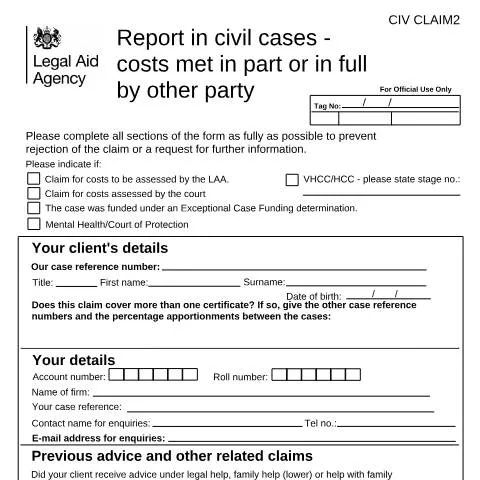
Navigating the CIV CLAIM2: Understanding Its Crucial Role in Legal Aid
In the intricate world of legal proceedings, financial transparency and accountability are paramount. The CIV CLAIM2 form represents a fundamental component of this objective, particularly for those engaged in cases funded by the Legal Aid Agency (LAA). To comprehend the significance of this document, one must consider the practical scenarios in which it becomes essential, the stakeholders involved, and the consequences of meticulous completion—or the lack thereof.
Who Files the CIV CLAIM2?
The CIV CLAIM2 form is primarily filed by solicitors or legal representatives acting on behalf of their clients who have received funding from the LAA. The essence of this document lies in its function as a detailed account of costs incurred in the course of legal proceedings. This includes both solicitors’ fees and other necessary expenses associated with the case.
- Legal Representatives: Solicitors must ensure that all relevant details are accurately captured to facilitate the recovery of costs from the opposing party or from the legal aid fund itself.
- Clients: While clients do not directly submit the form, their information is critical as it establishes the claim's basis.
Specific Situations for Filing
Several scenarios necessitate the filing of the CIV CLAIM2 form. Understanding these can help legal professionals determine when to utilise this form effectively:
- Final Billing: If the legal proceedings have concluded and costs have been awarded, the solicitor must submit this form to claim those costs.
- Multiple Case References: In cases involving multiple certificates, the form enables legal representatives to apportion costs correctly among them.
- Exceptional Case Funding (ECF): The form is vital when the case was funded under ECF, as it assists in justifying the costs to be recovered from the LAA.
The Legal Framework Behind the CIV CLAIM2
The necessity of the CIV CLAIM2 form is rooted in the regulations governing legal aid funding in the UK. The Legal Aid, Sentencing and Punishment of Offenders Act 2012 provides the legislative backdrop, ensuring that legal aid resources are allocated efficiently and transparently.
Additionally, the Data Protection Act 2018 and UK GDPR impose strict guidelines on how personal data is processed within the context of legal aid claims. This framework mandates that all information submitted through the CIV CLAIM2 form adheres to these legal requirements, ensuring clients' data protection and privacy is maintained while allowing the LAA to process claims effectively.
Key Regulatory Considerations
- Eligibility Criteria: Legal aid funding is subject to means testing, which varies based on the client's financial situation and the nature of the case.
- Cost Recovery: The LAA maintains robust mechanisms to scrutinise claims for accuracy and adherence to established legal aid rates, providing clear guidelines for solicitors.
Completing the CIV CLAIM2: A Step-by-Step Guide
Accurate completion of the CIV CLAIM2 form is essential to avoid delays or rejections of claims. Legal representatives should follow a methodical approach to ensure all sections of the form are filled out completely and correctly.
Detailing Client and Case Information
The initial sections require precise information regarding the client and the nature of the case. Here are critical pieces of information that should not be overlooked:
- Client’s Details: Full name, date of birth, and case reference number must be provided to verify the identity and relevance of the claim.
- Legal Representative’s Details: This includes the name of the firm, the solicitor’s case reference, and previous advice given to the client.
- Case History: Provide any prior claims or funding history linked to the current case, detailing the nature of legal advice received.
Documenting Costs: Breakdown is Key
One of the most critical components of the CIV CLAIM2 form is the thorough documentation of all costs associated with the case. This ensures clarity and facilitates faster processing of claims. Solicitors must provide a comprehensive summary of costs, including:
| Type of Cost | Details | Amount (£) |
|---|---|---|
| Solicitors’ Fees | Standard legal fees as per agreed rates | [Amount] |
| Counsel’s Fees | Fees paid to barristers for representation | [Amount] |
| Expert Costs | Fees for experts consulted during the case | [Amount] |
| Other Disbursements | Any additional costs incurred (filing fees, etc.) | [Amount] |
| Total Costs | [Total Amount] |
Filing and Submission Channels: Paper vs. Digital
Once the form is completed, the method of submission plays a significant role in ensuring that claims are processed efficiently. Legal representatives have several options:
Paper Submission
While many practitioners are moving towards digital solutions, submitting the CIV CLAIM2 form by post remains an option. This approach necessitates:
- Mailing the completed form to the specified address of the LAA.
- Including any required supporting documentation to prevent delays.
Online Submission
The Legal Aid Agency encourages electronic submissions, which expedite the claims process and reduce the risk of paperwork being lost or delayed. To make an online submission, solicitors must:
- Access the LAA's online portal, creating or logging into an existing account.
- Complete the online form directly, ensuring all details align with the hard-copy version to prevent discrepancies.
Consequences of Incomplete or Incorrect Claims
Submitting an inaccurate or incomplete CIV CLAIM2 form can have significant repercussions. Legal representatives must be vigilant to avoid the following outcomes:
- Rejection of the Claim: Failure to provide necessary details may result in the LAA rejecting the claim outright, necessitating a reapplication and potentially delaying the recovery of costs.
- Request for Further Information: The LAA may contact the solicitor for additional information, prolonging the processing time and creating uncertainty for clients.
- Financial Implications: Delays in claims can impact cash flow for legal firms, leading to operational challenges.
Post-Submission Process: What Happens Next?
Once the CIV CLAIM2 form is submitted, the LAA undertakes a thorough review of the claim. Understanding the subsequent steps is crucial for both solicitors and clients.
Assessment of the Claim
The LAA will evaluate the accuracy of the information provided, cross-referencing it with their records and the guidelines set forth in the current legal aid policies. This process generally includes:
- Verification of Costs: The agency will ensure the claimed costs align with those typically reimbursed under legal aid policies.
- Communication of Outcomes: Solicitors will receive notifications regarding the status of their claims, whether approved or requiring further information.
Appealing Decisions
In cases where claims are denied or contested, legal representatives have the right to appeal the decision. This process involves:
- Submitting a detailed appeal outlining the reasons for contesting the decision, along with any additional evidence to support the claim.
- Following the designated procedures as stipulated by the LAA's guidelines on appeals.
Timelines and Important Dates in the Legal Aid Process
The timeline associated with the filing and processing of the CIV CLAIM2 form can be significant in the broader context of legal proceedings. Here’s a breakdown of important dates to consider:
| Milestone | Date/Timeline |
|---|---|
| Submission of CIV CLAIM2 | As soon as the case concludes and costs awarded |
| LAA Processing Time | Typically within 28 days, but can vary |
| Notification of Outcome | Following assessment, usually within the same processing timeframe |
| Appeal Period | Usually 30 days from notification of decision |
Understanding these timelines is critical for legal representatives to manage client expectations and operational planning effectively.
Final Thoughts on the CIV CLAIM2 Process
The CIV CLAIM2 form is more than just a bureaucratic necessity; it’s a pivotal instrument for ensuring that legal professionals recover costs associated with providing essential services to clients in need. By comprehensively understanding its purpose, the procedures surrounding its completion, and the implications of its accuracy, solicitors can better navigate the complexities of the legal aid landscape.
Ultimately, attention to detail and adherence to procedural guidelines when handling the CIV CLAIM2 form can substantially influence the outcomes for both legal representatives and their clients. This form not only facilitates the financial sustainability of legal practices but also upholds the integrity of the legal aid system designed to serve vulnerable populations across the UK.
Understanding the Process of Claiming Costs in Civil Litigation
When engaging in civil litigation, one of the crucial aspects that can arise is the claim for costs against the other party. In the UK, the principles governing the recovery of costs are primarily outlined in the Civil Procedure Rules (CPR), particularly in Part 44. Understanding how to claim costs can significantly affect the financial outcome of your case.
Generally, the party that wins the case (the claimant) can recover their costs from the losing party (the defendant), unless the court orders otherwise. This claim can include various costs associated with the litigation process, including legal fees, court fees, and other expenses deemed necessary for the preparation and presentation of the case.
Cost claims can be made in full or in part, and the court will determine the reasonable amount recoverable based on the specifics of the case. It's important to prepare a detailed breakdown of incurred costs, justifying them with appropriate evidence such as invoices and correspondence. The CPR encourages parties to seek to resolve costs disputes sensibly and proportionately, often suggesting that negotiations occur before resorting to litigation over costs.
Factors Influencing the Claim for Costs
Several factors influence the decision of the court regarding costs recovery in civil claims. Understanding these factors can help you anticipate potential outcomes and better prepare your cost claim. Key considerations include:
- The Conduct of the Parties: Courts assess the behavior of both parties during the proceedings. If one party is deemed to have acted unreasonably or caused unnecessary delays, this may affect the allocation of costs. For instance, if the defendant failed to respond to correspondence in a timely manner, this could lead the court to order them to pay a higher proportion of costs.
- Proportionality: The costs claimed must be proportionate to the value of the claim. In other words, if the claim amount is relatively small, the costs claimed should not exceed what is reasonable in that context. Courts often reference the guidelines set forth in CPR 44.3 to ensure that the costs are justified.
- Success of the Claim: Naturally, the outcome of the case plays a significant role. If you succeed in your claim, it strengthens your position for claiming costs. However, even in partially successful claims, courts may still allow for a proportionate recovery of costs.
- Pre-Action Conduct: The court may also consider how parties conducted themselves before formal proceedings began. Engaging in alternative dispute resolution (ADR) methods before escalating to litigation can reflect positively on the parties' willingness to settle and could influence costs awards.
Appealing Cost Orders: What You Need to Know
If you are dissatisfied with a court's decision regarding costs, there is a process for appealing these decisions under Part 52 of the CPR. This can occur for various reasons, including disputes over the quantum of costs awarded or interpretations of whether a party is entitled to costs at all.
The appeal process generally involves the following steps:
- Notice of Appeal: You must file a Notice of Appeal within 21 days of receiving the order regarding costs. This document must specify the grounds for the appeal and outline why you believe the court made an error in their decision.
- Grounds for Appeal: It's crucial to delineate clear and convincing grounds for your appeal. Common grounds include procedural missteps by the court, an error in the application of law concerning costs, or failure to consider relevant evidence.
- Costs Implications: Be aware that appealing a costs order can also have financial implications. If you are unsuccessful in your appeal, you may be liable for the other party's costs incurred during the appeal process.
Moreover, during the appeal, the court may grant interim orders regarding the payment of costs, which means you might be required to pay an initial amount while the appeal is under consideration. It's advisable to seek legal advice when considering an appeal to navigate this complex area effectively.