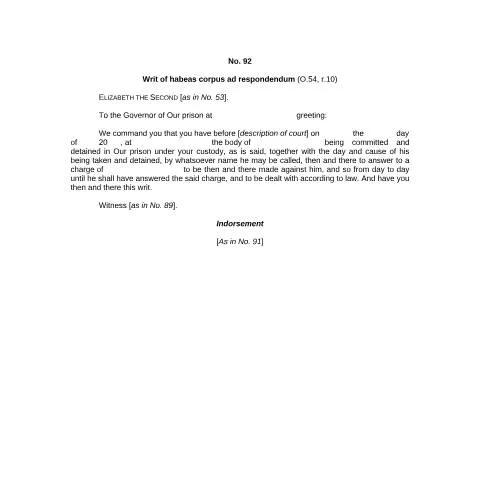
Understanding the Writ of Habeas Corpus ad Respondendum
The Writ of Habeas Corpus ad Respondendum, often referred to simply as a writ of habeas corpus, serves as a critical legal instrument within the UK judicial system. This document commands the custodian of an individual detained in prison to present them before a specified court. Its primary function is to ensure that the detained individual can respond to the charges against them, thereby upholding the principle of due process.
The Role of the Writ in the Legal Landscape
Within the framework of UK law, the writ of habeas corpus is a vital mechanism designed to protect individual rights. This form, categorized under the purview of the HM Courts & Tribunals Service, is pivotal in maintaining legal oversight over detention practices. It ensures that no person is held without sufficient cause or legal justification.
Typically, the writ is initiated by a concerned party, often a legal representative or the detained individual themselves, who seeks to challenge the legality of their detention. In doing so, it functions as a safeguard against unlawful imprisonment, reinforcing the rule of law and the rights afforded to individuals under UK law.
Who Initiates the Writ and Under What Circumstances?
The initiation of this writ is not confined to a singular profile; it caters to a variety of situations. Here are some common scenarios:
- Legal Representatives: Solicitors acting on behalf of clients who believe their detention is unlawful.
- Family Members: Individuals who are concerned about the prolonged detention of a loved one.
- The Detained Individual: In certain instances, individuals may submit this writ themselves if they believe their rights are being infringed upon.
Common circumstances warranting the initiation of a writ include:
- Prolonged detention without charge.
- Failure to follow proper legal procedures in the detention process.
- Concerns regarding the treatment of the detainee in custody.
Steps to Complete and Submit the Form
Completing the writ of habeas corpus ad respondendum involves several specific steps, each designed to ensure that the document is both accurate and comprehensive. The following outlines the key stages of this process:
1. Gather Necessary Information
Before filling out the form, gather all relevant information concerning the detained individual:
- Full Name: As it appears on official documents.
- Details of Detention: The specific reasons for their detention and the legal basis for it.
- Details about the Court: The court before which the individual is to be presented.
2. Fill Out the Form
When completing the writ, ensure clarity and accuracy. The following sections are typically included:
- Court Details: Specify the court's name and location.
- Description of Charges: Clearly outline the charges against the detainee.
- Indorsements: Include any necessary endorsements as required by the guidelines of the HM Courts & Tribunals Service.
3. Review and Validity Check
Before submission, conduct a thorough review of the completed form:
- Ensure all fields are filled in correctly.
- Cross-check names, dates, and legal references.
- Verify compliance with the Data Protection Act 2018 and UK GDPR guidelines to protect personal data.
4. Submission of the Writ
The completed writ must be submitted to the appropriate court. Here are key points to consider:
- Delivery Method: Writs can often be submitted in person or by post, depending on the court's regulations.
- Filing Fees: Be aware of any potential fees associated with the filing of the writ.
What Happens After Submission?
Once the writ has been submitted, a series of actions follow:
- Notification to the Custodian: The court will notify the prison governor or relevant authority regarding the writ.
- Court Date: A date will be set for the court hearing where the detainee must be presented.
- Legal Representation: Both the detainee and the state may have legal representation present during the hearing.
At this hearing, the court will assess the validity of the detention and the charges against the individual. The outcome may lead to either the confirmation of detention, release, or an order for further proceedings.
Special Cases and Considerations
There are special circumstances where the application of the writ may differ significantly:
1. Non-UK Nationals
Foreign nationals may face unique challenges. It’s essential to consider:
- Their legal status in the UK.
- Potential involvement of consular representatives.
- Additional complexities arising from international law.
2. Minors and Vulnerable Individuals
When the detainee is a minor or considered vulnerable, additional protections are in place:
- Representation must be tailored to safeguard their rights.
- A guardian or legal representative must be involved in the process.
3. Urgent Applications
In situations where there is an immediate risk to the detainee's well-being, urgent applications may be made. This involves:
- Requesting expedited processing from the court.
- Providing substantial evidence of the necessity for swift action.
Common Challenges and How to Address Them
In the process of filing the writ of habeas corpus ad respondendum, applicants may encounter several challenges:
Error in Documentation
Errors on the form can lead to delays or rejections. To mitigate this, applicants should:
- Double-check legal references and terminology.
- Utilize checklists to ensure all necessary information is included.
Lengthy Processing Times
In some cases, the processing of the writ may take longer than anticipated. Applicants can:
- Contact the court for updates on the status of the writ.
- Consider legal counsel to assist in expediting the process.
Insufficient Evidence
If the court finds the evidence insufficient, they may dismiss the writ. To prevent this:
- Compile comprehensive documentation and witness statements where applicable.
- Prepare a robust legal argument outlining the basis for the writ.
Comparative Analysis: Writ of Habeas Corpus vs. Related Legal Instruments
| Legal Instrument | Purpose | Key Distinction |
|---|---|---|
| Writ of Habeas Corpus ad Respondendum | To challenge unlawful detention | Focuses on the right to respond to charges |
| Writ of Habeas Corpus ad Subjiciendum | To contest the legality of detention itself | Questions the legal basis for detention, rather than specific charges |
| Judicial Review Applications | To review the lawfulness of decisions made by public bodies | Addresses broader administrative decisions, not just detention |
Preparing Supporting Documents and Evidence
When filing a writ of habeas corpus, it’s essential to prepare supporting documents effectively. Here’s how to approach this:
1. Documentation of Detention
- Include any notices of detention or arrest.
- Gather legal documents related to the charges faced by the detainee.
2. Witness Statements
- Collect statements from individuals who can attest to the circumstances of detention.
- Incorporate any evidence of procedural errors during the arrest or detention process.
3. Expert Opinions
- Seek opinions from legal experts or human rights advocates regarding the case's merits.
- Incorporate these opinions into the submission to strengthen the argument.
The Path Forward: What to Anticipate Post-Hearing
The hearing following the submission of the writ is a pivotal moment, and the outcomes can vary significantly:
- Release of the Detainee: If the court finds the detention unlawful, the individual may be released immediately.
- Further Proceedings: In some cases, the court may order further hearings or initiate other legal processes.
- Legal Recourse: If the writ is denied, individuals may still seek other legal remedies, such as an appeal or review through judicial channels.
Understanding the implications and potential pathways following the hearing can help manage expectations and prepare for subsequent actions.
Conclusion: Navigating the Complex Landscape of Detention Rights
The writ of habeas corpus ad respondendum stands as a testament to the commitment to individual rights and justice within the UK legal framework. Navigating its complexities requires diligence, comprehensive preparation, and an awareness of the broader legal context. Whether for oneself or on behalf of another, understanding this process is crucial for ensuring fair treatment under the law.
Understanding the Writ of Habeas Corpus ad Respondendum
The writ of habeas corpus ad respondendum is a specific application of the wider habeas corpus principle, which protects against unlawful detention. This writ allows an individual who is already detained to challenge their detention and seek to appear before a court to respond to legal proceedings. It is particularly significant in cases where an individual claims that their continued detention is unjust or unlawful. To initiate this process, the detainee or their legal representative must file a formal request that meets specific legal requirements.
This writ not only aims to ensure the detainee's right to a fair hearing but also serves as a mechanism to hold the state accountable for the legality of the detention. In practical terms, the application process typically involves detailing the circumstances surrounding the detention, the legal grounds for the writ, and the relief sought. Importantly, the courts will consider the validity of the claims and the appropriateness of the detention in the context of the law.
Legal professionals must be astute in preparing this application, as it often involves navigating complex legal frameworks. It is advisable to reference precedents and applicable statutes that support the argument against unlawful detention. Moreover, it is essential to consider the timing of the application, as delays could impact the court’s consideration of the case. Understanding the implications of submitting a writ of habeas corpus ad respondendum within the broader scope of human rights legislation can also aid in constructing a compelling argument.
Practical Steps to File a Writ of Habeas Corpus ad Respondendum
Filing a writ of habeas corpus ad respondendum involves several practical steps that require careful attention to detail. Understanding these steps can significantly improve the chances of a successful application. Here are some key actions to consider:
- Consult with a Legal Professional: Before proceeding, it is critical for detainees or their families to consult with a solicitor who has experience in habeas corpus cases. They can provide invaluable guidance on the likelihood of success, the necessary documentation, and the legal grounds for the petition.
- Gather Documentation: Collect all pertinent documents related to the detention. This may include arrest warrants, police reports, court orders, and any previous legal decisions affecting the case. A comprehensive understanding of the detainee's situation is crucial for building an effective argument.
- Complete the Application Form: Accurately filling out the appropriate application form is essential. Practice form No. 92 should be completed in full, ensuring all sections are addressed. Provide detailed information regarding the legal basis for the writ, including relevant case law and statutory provisions.
- File with the Appropriate Court: The application must be filed with the High Court of Justice, typically in the Administrative Court division. It is important to submit the application to the correct court to avoid delays in the processing.
- Serve the Application: Once filed, the application must be served on the detaining authority, such as a prison or police station, to inform them of the legal proceedings. This step is vital to ensure that the authority has the opportunity to respond to the claims made in the writ.
- Attend the Hearing: If the court schedules a hearing, it is important for the detainee or their representative to attend. This presents the opportunity to argue the case directly before a judge, answer any questions, and clarify any points of law.
Each of these steps carries its own set of challenges and may involve intricate legal considerations. Therefore, working closely with a solicitor throughout the process is recommended, as they can help navigate the potential complexities and enhance the chances of a favorable outcome.
The Role of Human Rights in Habeas Corpus Cases
In the UK, the principles of human rights heavily influence the application and interpretation of habeas corpus, including the writ of habeas corpus ad respondendum. The Human Rights Act 1998 incorporates the European Convention on Human Rights (ECHR) into UK law, which enshrines the right to personal liberty and security under Article 5. This provision is especially pertinent when discussing unlawful detention, as it sets out that everyone has the right to liberty and security of person and that no one shall be deprived of their liberty save in the cases provided for by law.
As such, when filing a writ of habeas corpus ad respondendum, it is essential to consider how the detention may contravene these human rights protections. Courts are increasingly attentive to human rights arguments, and invoking these rights can bolster the detaining individual's case. For example, if the detaining authority fails to provide a proper legal basis for the detention or does not follow due process, there is a strong argument to be made for the writ’s issuance on the grounds of human rights violations.
A thorough understanding of human rights law ensures that legal professionals can effectively highlight any breaches in their applications. The court's consideration of these rights demonstrates the importance of habeas corpus in not only protecting individuals from unlawful detention but also in reflecting broader principles of justice and fairness within the legal system.
In summary, the interplay between habeas corpus and human rights legislation is vital in shaping the outcome of applications. Legal representatives should remain cognizant of recent case law and emerging human rights issues that may impact the interpretation and enforcement of the writ of habeas corpus ad respondendum.