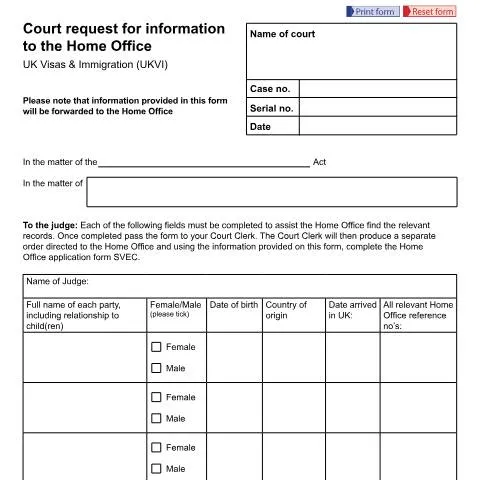
When UK Courts Need Immigration Intelligence: The EX660 Gateway Process
Family courts, immigration tribunals, and criminal proceedings often reach a critical juncture where judicial decisions hinge on immigration status information held exclusively by the Home Office. Form EX660 serves as the formal conduit between HM Courts & Tribunals Service and UK Visas & Immigration (UKVI), enabling judges to request vital immigration records that can determine custody arrangements, deportation orders, or asylum claims.
This court-initiated process reflects the complex intersection of judicial independence and administrative cooperation. Unlike standard immigration enquiries from legal representatives or individuals, EX660 requests carry judicial authority and trigger a specialised response protocol within the Home Office Liaison Team.
The form's design acknowledges that courts require immigration intelligence across diverse proceedings: from family disputes where a parent's visa status affects child arrangements, to criminal cases where deportation liability influences sentencing, through to civil matters involving immigration-related evidence.
The Judicial Trigger: When Courts Exercise Information Powers
EX660 requests typically arise in four distinct judicial contexts, each with different urgency levels and information requirements:
Family Court Proceedings
Child arrangement orders frequently require verification of parental immigration status. Courts need to establish whether a parent faces removal proceedings that could affect long-term custody decisions. The form enables judges to request comprehensive immigration histories, including:
- Current visa status and expiry dates
- Pending applications or appeals
- Previous refusal decisions
- Deportation or removal directions
Immigration and Asylum Tribunals
First-tier and Upper Tribunal judges use EX660 to obtain Home Office case files when appellants claim missing documentation or dispute official records. This proves particularly valuable in fresh claim applications where historical immigration decisions require verification.
Criminal Court Sentencing
Crown Courts and magistrates' courts request immigration status information when considering sentences for foreign nationals. Understanding deportation liability helps judges assess whether custodial sentences trigger automatic deportation under the UK Borders Act 2007.
Civil Proceedings
High Court judges occasionally require immigration evidence in judicial review cases, human rights claims, or commercial disputes involving visa fraud allegations.
Completing the EX660: Judicial Precision Requirements
The form's structure reflects Home Office data retrieval systems that rely on specific identifiers to locate relevant records across multiple databases. Incomplete or inaccurate information can delay responses significantly.
Essential Party Identification
Each individual subject to the information request requires comprehensive identification details. The form demands precision across six key data points:
| Field | Critical Elements | Common Issues |
|---|---|---|
| Full Name | All known names, aliases, maiden names | Transliteration variations from non-Latin scripts |
| Date of Birth | Exact format DD/MM/YYYY | Calendar system differences, approximate dates |
| Country of Origin | Birth country, not current nationality | Historical border changes, disputed territories |
| UK Arrival Date | First documented entry | Multiple entries, clandestine arrivals |
| Home Office References | All known reference numbers | Legacy system numbers, partial references |
Formulating Effective Questions
The "What questions would you like UKVI to answer?" section requires judicial precision. Vague requests like "current immigration status" yield less useful responses than specific enquiries such as:
- "Is the appellant subject to a deportation order dated [specific date]?"
- "What immigration applications has the respondent submitted since [date]?"
- "Are there any outstanding removal directions against this individual?"
Judges experienced in immigration matters often phrase questions to address specific legal tests or evidential requirements relevant to their proceedings.
The Court Clerk's Administrative Bridge
Once judges complete EX660, court clerks assume crucial administrative responsibilities that bridge judicial requirements with Home Office protocols. This handover involves two distinct but connected processes.
Producing the Formal Court Order
Court clerks must generate a separate court order directed to the Home Office, incorporating information from the completed EX660. This order provides the legal authority for UKVI to disclose immigration records that would otherwise remain confidential under data protection legislation.
The order typically includes specific judicial directions about information scope, disclosure limitations, and any restrictions on further distribution of received intelligence.
Completing the SVEC Application
Clerks transfer EX660 details onto the Home Office's internal SVEC application form, which routes requests through appropriate UKVI channels. This dual-form system ensures both judicial authority and administrative processing requirements are satisfied.
Experienced court clerks maintain direct contact with the Home Office Liaison Team to clarify ambiguous requests or expedite urgent cases.
Disclosure Authorization and Supporting Documentation
The EX660 process operates within strict data protection and disclosure frameworks that balance judicial information needs against individual privacy rights and national security considerations.
Court-Approved Disclosure Scope
Judges must explicitly authorize disclosure of supporting documentation beyond basic immigration status information. The form's checkbox system requires clear judicial decisions about:
- Case summaries and background reports
- Interview transcripts and witness statements
- Medical or psychological assessments
- Third-party correspondence and representations
Courts cannot authorize disclosure of information outside their jurisdiction or unrelated to pending proceedings. Immigration judges, for example, cannot request criminal records, while family courts cannot access national security assessments.
Document Attachment Protocols
When courts have granted leave to disclose supporting documentation, these materials must accompany the EX660 submission. Common attachments include:
- Anonymised case summaries outlining relevant factual background
- Previous court orders or directions affecting the parties
- Expert reports requiring immigration context
- Skeleton arguments highlighting specific information needs
Home Office Response Timelines and Liaison Protocols
The minimum four-week processing requirement reflects the complexity of retrieving immigration records across multiple UKVI systems and conducting necessary security clearances before disclosure.
Standard Processing Pathway
Home Office Liaison Team operations follow established protocols for EX660 requests:
- Initial Assessment (Days 1-3): Verification of court order validity and request scope
- Database Searches (Days 4-14): Comprehensive record retrieval across immigration systems
- Security Clearance (Days 15-21): National security vetting of information proposed for disclosure
- Response Preparation (Days 22-28): Compilation and quality assurance of disclosure package
Expedited Processing Requests
Courts can request expedited processing for urgent cases, but must demonstrate compelling circumstances such as:
- Imminent removal or deportation proceedings
- Child welfare emergencies
- Time-limited asylum appeal windows
- Custody time limits in criminal cases
Expedited requests require direct judicial communication with the Home Office Liaison Team, typically through senior court administrators.
Complex Cases and Specialist Considerations
Certain categories of EX660 requests require enhanced processing protocols due to their sensitive nature or complex information requirements.
National Security and Closed Material
When requested information touches national security matters, the Home Office may invoke closed material procedures. Courts receive edited responses with sensitive details redacted, and may need to hold closed sessions for full disclosure.
Immigration tribunals handling deportation appeals on national security grounds frequently encounter this scenario, requiring specialist judicial handling.
Multiple Jurisdiction Coordination
Cases involving multiple courts or jurisdictions require careful coordination to avoid conflicting information requests. Family courts and immigration tribunals sometimes need information about the same individuals, requiring liaison between court administrative teams.
Historical Record Challenges
Legacy immigration cases predating electronic record-keeping present particular challenges. The Home Office may need to conduct manual archive searches, extending response times significantly beyond the standard four-week minimum.
Courts dealing with long-term UK residents or historical asylum claims should anticipate extended processing periods and consider interim orders where appropriate.
Quality Control and Information Verification
The EX660 system incorporates multiple verification stages to ensure accuracy and completeness of immigration information provided to courts.
Cross-Database Validation
UKVI responses undergo systematic cross-referencing across immigration databases to identify discrepancies or missing information. This process helps prevent incomplete or contradictory intelligence reaching judicial proceedings.
Legal Review and Disclosure Limitations
Home Office legal teams review all EX660 responses to ensure compliance with data protection legislation and disclosure restrictions. Information that could prejudice ongoing investigations or compromise immigration enforcement operations may be withheld or redacted.
Courts receive clear explanations of any information limitations, enabling judges to assess the completeness of immigration intelligence available for their decisions.
Contact Point Designation
The form requires designation of a specific contact person for additional information requests. This ensures continuity when UKVI needs clarification about court requirements or when judges require supplementary intelligence following initial responses.
Effective contact designation proves particularly valuable in complex cases requiring iterative information exchange between courts and immigration authorities.
Specific Information Categories and Documentation Requirements
The EX660 form accommodates various types of information requests, each with distinct documentation requirements and processing considerations. Understanding these categories helps ensure your request includes appropriate supporting evidence and realistic expectations regarding response times.
Immigration history requests typically require proof of identity through passport copies, National Insurance number, and any previous Home Office reference numbers. If requesting records spanning multiple decades, specify approximate date ranges as immigration records prior to digitalisation may require manual archive searches. Former applicants should include details of previous addresses in the UK, as records are sometimes filed by location of original application.
Citizenship documentation requests often involve complex verification processes, particularly for individuals who acquired British citizenship through descent or registration rather than naturalisation. Include parents' birth certificates, marriage certificates, and any previous British passports held by family members. For citizenship acquired before 1983, additional documentation may be required due to changes in nationality law.
Fill in your form directly online
No printing: type your details into the boxes of the official form, tick, then download the PDF ready to send.
- 1Type into the form boxes
- 2Tick in one click
- 3Save and download the PDF
Visa and entry clearance records should specify the exact type of visa or entry clearance involved, including sponsor details where applicable. Student visa records might require university confirmation letters, while work visa documentation could necessitate employer verification. Family visit visa records often need relationship evidence, even for historical requests.
Deportation or removal records represent particularly sensitive requests requiring careful handling. Include legal representation details if applicable, as these cases often involve multiple departments and external agencies. Specify whether you're seeking records for legal proceedings, as this may expedite processing under legal professional privilege considerations.
Biometric data requests require specific consent forms, particularly when requested by third parties such as legal representatives or family members. The Home Office maintains strict protocols around biometric information sharing, even with explicit consent.
Processing Timelines and Status Tracking Methods
EX660 processing times vary significantly based on request complexity, record age, and current departmental workloads. Standard processing typically ranges from 20 to 40 working days, though complex historical requests may extend beyond this timeframe.
Expedited processing circumstances include ongoing legal proceedings, urgent travel requirements, or employment verification needs. However, urgency claims require supporting documentation—court hearing dates, employer deadlines, or travel booking confirmations. The Home Office reserves discretion over expedited processing and may charge additional fees for urgent handling.
Digital records generally process faster than archived paper files. Records from 2008 onwards are typically digitised, while earlier records may require physical archive access. Immigration records from the 1990s and earlier often involve manual searches across multiple storage facilities, significantly extending processing times.
Status tracking relies primarily on the unique reference number provided upon form submission. Unlike some government departments, the Home Office doesn't offer online tracking portals for EX660 requests. Progress inquiries before the standard processing period expires are generally discouraged unless exceptional circumstances apply.
Partial responses sometimes occur when some requested information is readily available while other elements require extended searches. The Home Office may issue interim responses containing immediately accessible information, followed by supplementary responses as additional records are located.
Complex requests involving multiple departments—such as records spanning immigration, customs, and security services—require inter-departmental coordination, potentially doubling standard processing times. Cross-referencing with other government databases adds verification steps that, while ensuring accuracy, extend overall timelines.
Seasonal variations affect processing times, with delays common during summer holiday periods and around Christmas. Budget year-end periods (March-April) may also experience slower processing as departmental resources focus on annual reporting requirements.
Legal Rights, Appeal Procedures, and Complaint Mechanisms
Subject access rights under UK GDPR and the Data Protection Act 2018 provide strong legal foundations for EX660 requests, though specific immigration legislation may impose additional considerations that affect information release.
Exemption applications by the Home Office most commonly cite national security, prevention of crime, or immigration control grounds. Section 31 exemptions under data protection legislation allow withholding information that could prejudice immigration control functions. These exemptions require case-by-case assessment and must be proportionate to the protection sought.
Third-party information redaction frequently occurs in immigration files containing details about other individuals—sponsors, family members, or witnesses. The Home Office must balance your access rights against others' privacy rights, often resulting in heavily redacted documents. This redaction process can extend response times as each document requires individual assessment.
Review procedures exist for dissatisfied applicants, though these operate differently from standard government complaint mechanisms. Initial reviews should be requested within 40 working days of the original response, clearly stating why the response is considered inadequate. Reviews focus on procedural compliance rather than policy disagreements.
Information Commissioner's Office (ICO) complaints provide independent oversight when internal reviews prove unsatisfactory. ICO complaints must be submitted within six months of the Home Office's final response and should demonstrate specific breaches of data protection legislation rather than general dissatisfaction with outcomes.
Parliamentary complaints through MPs offer alternative recourse, particularly for cases involving significant delays or apparent administrative failures. MPs can request departmental explanations and may escalate matters to the Parliamentary and Health Service Ombudsman for maladministration investigations.
Legal challenges through judicial review represent the final recourse for cases involving significant public law errors. However, judicial review focuses on decision-making processes rather than information content, and legal costs risks make this option suitable only for cases with clear procedural failures or fundamental rights implications.
Professional representation rights allow solicitors and barristers to submit EX660 requests on clients' behalf, though specific consent requirements and professional indemnity considerations apply. Legal representatives often receive more detailed responses due to their professional obligations regarding information handling.
Data protection breach notifications become relevant if the Home Office fails to protect personal information during the EX660 process. Breaches involving immigration data carry particular sensitivity due to potential impacts on individuals' safety and family relationships in their countries of origin.