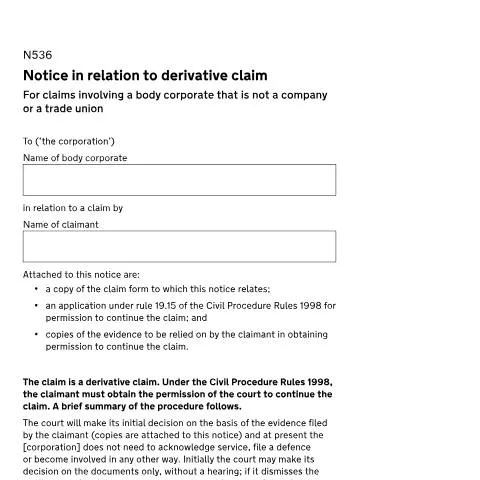
Navigating the N536 Notice: A Critical Component in Derivative Claims
In the labyrinth of corporate and legal frameworks, the N536 Notice issued by HM Courts & Tribunals Service serves as a crucial document for initiating a derivative claim involving a body corporate that is neither a registered company nor a trade union. Understanding its specifications is paramount for claimants and corporates involved in such proceedings. This notice is pivotal, particularly when dealing with claims that hinge on the governance and actions of corporate entities.
Understanding Derivative Claims: The Why and the How
At the heart of the N536 Notice lies the concept of a derivative claim. This type of claim allows individuals, often shareholders or members of a corporate body, to bring actions on behalf of the corporate entity when the corporation itself fails to take action. It is particularly relevant to those situations where the corporate governance may be flawed or where the interests of the members are not adequately represented.
Key Features of a Derivative Claim
- Permission Requirement: Under the Civil Procedure Rules 1998, claimants must seek the court's permission to proceed with their claim.
- Initial Assessment: The court conducts an initial evaluation based solely on the evidence submitted by the claimant.
- Decision-Making Process: The court may dismiss the application without a hearing if it does not disclose a prima facie case.
- Adjournments: Should the claim not be dismissed, the court will allow the corporation to file evidence and be heard.
Decoding the N536 Notice: What’s Inside?
The N536 Notice is designed to convey essential information to the involved corporate entity. It outlines the context of the claim, details what the claimant seeks, and emphasizes the need for the corporation to be aware of the claim's existence and its consequences.
Components of the N536 Notice
The notice comprises several critical elements:
- Claim Form: A copy of the initial claim form is attached to the notice, providing context and foundation for the claim.
- Application for Permission: This includes a request under Rule 19.15, seeking judicial approval to continue the claim.
- Supporting Evidence: Copies of the evidence that the claimant will rely upon are included to substantiate their request.
Limitations and Scope of the N536 Notice
While the N536 Notice is instrumental, it is not all-encompassing. It addresses specific scenarios and claims but does not extend its application to every possible derivative claim situation. Understanding its limitations is crucial for both claimants and corporate entities.
The Role of the Corporation: A Non-Participatory Initial Phase
One notable aspect of the N536 Notice is that, at the outset, the corporation does not need to engage in the proceedings. It is not required to acknowledge the claim or file a defence immediately. This non-participation can lead to certain misconceptions about the urgency or importance of responding to the claim.
The Initial Decision-Making Process
The court typically makes its initial ruling based only on the documents provided by the claimant. As a result, it is essential for claimants to ensure their submissions are comprehensive and compelling, as this will largely dictate the direction of the case.
Avoiding Common Misinterpretations: What to Watch Out For
One challenge that arises in the realm of derivative claims and the use of the N536 Notice is the potential for misinterpretation. Individuals unfamiliar with legal jargon or procedural nuances may misread the implications of the notice, leading to poor decision-making or failure to act appropriately.
Misunderstood Concepts
- Prima Facie Case: Claimants often confuse this term with a guaranteed success in court. It merely means that the evidence presented must be sufficient to warrant further examination.
- Adjournment Implications: The adjournment allows the corporation to respond, but it does not guarantee that the original claim will succeed.
Who Should Utilize the N536 Notice?
The audience for the N536 Notice is primarily those involved in derivative claims against bodies corporate that do not operate as registered companies or trade unions. This includes individual members or shareholders who feel aggrieved by the corporate actions that have not been addressed by the entity itself.
Situational Necessities
There are several scenarios where the N536 Notice becomes indispensable:
- When a member believes that the corporation is being mismanaged or wronged by its leadership.
- If there are allegations of misconduct that have not been acted upon by the corporation.
- In cases where corporate governance fails to protect the interests of its members.
Understanding the Legal Context: Statutory Framework and Procedural Rules
The N536 Notice operates within a specific legal framework established by the Civil Procedure Rules 1998. Familiarity with these rules is essential for claimants and legal representatives alike. A robust understanding of the statutory background provides clarity and enhances the likelihood of a favourable outcome.
Key Statutory References
Here are some important rules and statutes relevant to the N536 Notice:
| Statute/Rule | Description |
|---|---|
| Rule 19.15 | Procedures for obtaining permission to continue a derivative claim. |
| Civil Procedure Rules 1998 | Framework outlining the conduct of civil litigation, including derivative claims. |
Practical Steps Following Receipt of the N536 Notice
Upon receipt of the N536 Notice, it is critical for the corporation to undertake several practical steps to navigate the situation effectively.
Recommended Actions
- Review the Notice: Ensure that all components, including the claim form and supporting evidence, are thoroughly examined.
- Seek Legal Counsel: Engage legal experts who specialize in corporate law to formulate a strategic response.
- Prepare Evidence: If the application proceeds, gather evidence and prepare to present the corporation’s side during the adjournment hearing.
Each step plays a pivotal role in the corporation’s ability to respond effectively to the claims made against it. Legal representation is particularly vital at this stage to navigate the complexities of proceedings.
Engaging with the Process: Understanding Notifications and Outcomes
Once the initial decision has been made, the court will communicate its findings to the involved parties. Awareness of this procedural step helps both claimants and corporations anticipate the next phases of their engagement with the court.
Outcomes of the Initial Decision
- Application Dismissed: If the court dismisses the application, the claimant is afforded the option to request a hearing for reconsideration.
- Application Adjourned: Should the application not be dismissed, the corporation is then allowed to present its evidence and participate in subsequent hearings.
Understanding these outcomes is critical for all parties involved, as they shape the next steps in the legal process.
The Importance of Documentation and Evidence
Evidence plays a crucial role in the derivative claim process. The N536 Notice emphasizes the need for comprehensive documentation to support the claimant's case. Quality evidence often delineates the difference between a successful claim and a dismissed application.
Types of Evidence to Consider
- Corporate Documents: Minutes of meetings, financial statements, and reports can provide insight into the corporation’s governance.
- Testimonies: Statements from witnesses or expert opinions can substantiate claims of misconduct or mismanagement.
By carefully curating the evidence submitted, claimants can significantly enhance their chances of overcoming initial court challenges.
Future Implications: What Lies Ahead After the N536 Notice?
The issuance of the N536 Notice is just the beginning of a lengthy legal process. Whether the application is dismissed or proceeds to a hearing, the implications of the derivative claim will extend beyond immediate court decisions. Stakeholders must remain vigilant and proactive in their approaches.
Long-Term Considerations
- Corporate Governance: Outcomes may prompt changes in corporate governance practices and policies.
- Financial Implications: Legal proceedings can have substantial financial consequences, impacting shareholder value and corporate reputation.
Ultimately, the ramifications of engaging with the N536 Notice can shape the future landscape of corporate governance and accountability.
Understanding Derivative Claims in the UK
Derivative claims are a legal mechanism that allows a shareholder to initiate a lawsuit on behalf of a company or a body corporate when wrongdoing has occurred that warrants such action. In the UK, this claim process is governed primarily by the Companies Act 2006, which outlines the conditions under which derivative claims can be pursued.
It is essential to understand that a derivative claim is not taken against the company itself, but rather against individuals, typically directors or other parties whose actions may have harmed the company. Such claims are designed to protect the interests of the company and indirectly the shareholders. A significant aspect of derivative claims is that they require the claimant to demonstrate that they have made a request to the company to take action, and that the company has failed to do so, unless it would be futile to do so.
The Form N536, which is specifically tailored for derivative claims involving bodies corporate that are not companies or trade unions, demands that the claimant provides substantial evidence regarding the allegations against the wrongdoers. This includes demonstrating that the claim is in the best interests of the corporate body and that the wrongdoers in question are indeed accountable for their actions. Additionally, the claimant may need to disclose any financial interest in the body corporate, which can influence the legitimacy of their claim.
Filing Procedures and Key Considerations for Form N536
When preparing to file Form N536, it’s imperative to understand the procedural intricacies involved. The form itself comprises several sections that require detailed information about the claimant, the body corporate, the alleged wrongdoing, and the parties involved. This precision is crucial, as incomplete or inaccurate submissions can lead to delays or rejections from HM Courts & Tribunals Service.
Firstly, the claimant must ensure that they have the requisite standing to make a derivative claim, meaning they must be a member of the body corporate at the time of the alleged wrongdoing. Additionally, the claimant should prepare a robust statement of claim, outlining the particulars of the case, as this is a critical aspect of the filing process.
Once the form is completed, the next step involves filing it with the appropriate court. It is essential to determine the correct court jurisdiction based on the body corporate's registered office or other relevant factors. The court will subsequently assess whether the claim meets the criteria for proceeding, including evaluating the merits of the case.
Moreover, it is crucial to note the time limits associated with making a derivative claim. In the UK, there is a six-year limitation period from the date of the alleged wrongdoing, although exceptions may apply where the claimant was unaware of the wrongdoing at the time. Claimants should also consider the implications of the Data Protection Act 2018 and UK GDPR when disclosing personal data about individuals involved in the claim.
The Role of Legal Representation in Derivative Claims
While it is possible to represent oneself in a derivative claim, engaging legal representation can be highly beneficial. Legal experts specializing in corporate law can provide invaluable guidance through the complexities of the legal framework surrounding derivative claims. They can assist in thoroughly reviewing the allegations, preparing necessary documentation, and strategizing the best approach for litigation.
Additionally, solicitors can help navigate the nuances of the court system, ensuring that all procedural requirements are met while minimizing the risk of costly errors. They can also play a crucial role in mediating between the claimant and the body corporate, potentially facilitating a resolution without the need for prolonged litigation.
It’s worth noting that in certain instances, the court may grant permission for the claimant to proceed with the claim on the body corporate's behalf, which can further underscore the importance of having professional legal support. Any costs incurred during the legal process may also be recoverable from the losing party, which can help mitigate the financial risks involved in pursuing a derivative claim.