Navigating the WU01 (Scot): Your Essential Guide to Court Orders in Scottish Company Liquidations
The winding-up process for a company in Scotland can be a complex maze of legal obligations and procedural requirements. Understanding how to effectively utilize the WU01 (Scot), a document required for notifying Companies House of a court order in a winding-up scenario, is crucial for liquidators. This guide aims to demystify the document's purpose, the procedural steps involved, and the common pitfalls that may arise along the way.Understanding the WU01 (Scot): A Key Document in Company Insolvency
The WU01 (Scot) serves as a formal notice to Companies House, indicating that a Scottish company has been subject to a court order for winding up. This process is governed by Section 130 of the Insolvency Act 1986, and it is vital for liquidators to ensure that all necessary details are communicated effectively.What Information Does the WU01 (Scot) Contain?
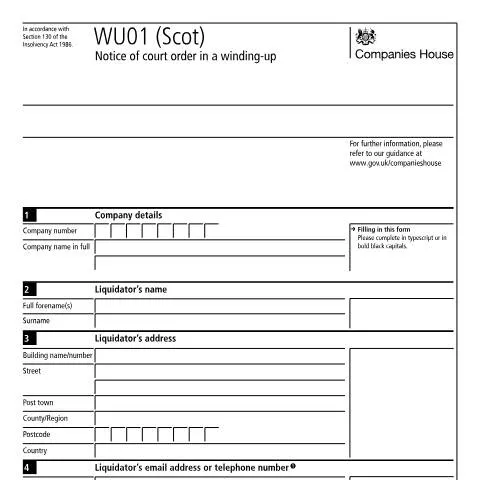
The document is structured to capture specific information about the company and the details of the winding-up order:- Company Details: This includes the full name of the company and its registration number, which must match the information on the public Register held by Companies House.
- Liquidator's Information: The liquidator's name, address, email, and telephone number are mandatory. This information becomes part of the public record.
- Court Order Details: The date of the court order must be clearly identified. A copy of the court order itself must accompany the WU01 (Scot).
- Signature: The liquidator must sign and date the document to validate it.
Step-by-Step Process: How to Leverage the WU01 (Scot)
Proper utilization of the WU01 (Scot) involves several key steps, enabling liquidators to navigate the complexities of the winding-up procedure effectively.Step 1: Gather Necessary Information
Prior to filling out the WU01 (Scot), ensure that you have the following information at hand:- The full name and registration number of the company.
- Details of the liquidator, including their contact information.
- The date on which the court order was issued.
- A copy of the court order itself, which is crucial for completeness.
Step 2: Complete the Document
The WU01 (Scot) must be filled out using typescript or bold black capitals. Any handwritten entries might lead to misinterpretation or processing delays.Step 3: Verification Before Submission
It is essential to conduct a thorough verification check of the completed WU01 (Scot). Ensure that:- All details align with the company’s information as recorded by Companies House.
- The court order is accurately attached and meets the submission criteria.
- The liquidator has signed and dated the document appropriately.
Step 4: Submission to Companies House
While the WU01 (Scot) can be returned to any Companies House address, for expedience, it is advisable to send it to: The Registrar of Companies, Companies House, Fourth Floor, Edinburgh Quay 2, 139 Fountainbridge, Edinburgh, Scotland, EH3 9FF. DX ED235 Edinburgh. Submitting the document promptly can help to avoid delays in the winding-up process.Pitfalls to Avoid When Using the WU01 (Scot)
Despite its straightforward nature, several common pitfalls can hinder the effective use of the WU01 (Scot). Being aware of these issues can save time and prevent unnecessary complications.Common Misinterpretations
One frequent error arises from misunderstanding the legal implications of the court order. Liquidators should ensure they fully comprehend the order’s stipulations, as any discrepancies can lead to legal challenges or delays in the winding-up process.Incorrect or Incomplete Information
A recurring issue is the submission of forms with inaccurate or missing information. This includes failing to match the company name and number with official records. Companies House may return the form for corrections, causing further delays.Failure to Attach the Court Order
Neglecting to include the court order is another critical mistake that can halt proceedings. The WU01 (Scot) cannot be processed without the accompanying documentation.Ignoring the Public Record Implications
Liquidators must understand that all information submitted via the WU01 (Scot) becomes part of the public record. Any sensitive information should be considered carefully before submission, as it will be publicly accessible.Procedural Queries: Addressing Common Concerns
As with any official procedure, liquidators may have specific queries regarding the use of the WU01 (Scot). These questions can often arise during the winding-up process.What Should I Do if the Company Name Has Changed?
If there have been any changes to the company’s name prior to filing the WU01 (Scot), it is essential to provide evidence of this change. Amendments must be consistent with records held at Companies House.Can I Submit the WU01 (Scot) Electronically?
Currently, the WU01 (Scot) must be submitted in paper format. However, double-checking for any updates regarding e-filing options on the Companies House website can be beneficial.What Happens After Submission?
After submission, Companies House will process the WU01 (Scot) and update the public record accordingly. Liquidators should keep a copy of the document for their own records and follow up if there are any delays in processing.The Importance of Timeliness in the WU01 (Scot) Process
The timing of the WU01 (Scot) submission can significantly affect the winding-up process. Liquidators must be mindful of the deadlines associated with court orders and the immediate actions required.Linking the WU01 (Scot) to the Wider Winding-Up Timeline
The WU01 (Scot) is part of a broader timeline in the winding-up process. Delays in submitting this document can create a ripple effect, potentially extending the length of the liquidation process and impacting creditors and stakeholders.Consequences of Delayed Submission
Failing to notify Companies House promptly can result in penalties or additional scrutiny of the liquidation process. Therefore, establishing a timeline for all required actions, including the WU01 (Scot), is advisable.Key Takeaways for Liquidators
Successfully navigating the complexities of the WU01 (Scot) is essential for any liquidator handling a Scottish company. Here are the central points to keep in mind:- Thorough Preparation: Ensure all required information is accurate and readily available.
- Attention to Detail: Double-check all entries on the WU01 (Scot) to avoid processing delays.
- Timely Submission: Submit the document quickly to adhere to winding-up timelines and protect stakeholder interests.
- Understand Public Implications: Be aware that all submitted information will be publicly accessible.
Understanding the Winding Up Process in Scotland
The process of winding up a company in Scotland is governed by specific legal frameworks that differ from those in other parts of the UK. A winding up order may originate from a creditor’s petition or a voluntary process initiated by the company itself. In either case, understanding the categories of winding up is crucial. There are two primary types of winding up in Scotland: compulsory winding up and voluntary winding up. Compulsory winding up occurs when a court order is granted, which may arise from a failure to pay debts, among other reasons. Voluntary winding up can occur in two forms: members’ voluntary winding up, which is initiated when the company is solvent, and creditors’ voluntary winding up when the company is insolvent. For companies facing financial difficulties, the compulsory winding up process can be initiated by creditors seeking recovery of debts. Generally, this requires the creditor to demonstrate that the company cannot pay its debts, which is often evidenced by the company’s failure to respond to a statutory demand for payment. The court will then consider the evidence and, if satisfied that the criteria are met, will issue a winding up order. Once a winding up order is made, it is the responsibility of the appointed liquidator to manage the company’s affairs. The liquidator's duties include collecting assets, paying off creditors, and ultimately dissolving the company. This highlights the importance of a clear understanding of the process, as well as the valuation of assets and liabilities, to ensure compliance with both legal and financial obligations.Steps to Notify Creditors and Stakeholders
When a winding up order is granted, it is essential to notify all relevant parties, including creditors, employees, and stakeholders. The completion of Form WU01 (Scot) is a critical step in this process, as it serves as a formal notice of the winding up order. The form requires specific details about the company, including its registered office, the names of directors, and a brief explanation of the reasons for the winding up. It is also essential to provide the court’s details and the name of the liquidator. After completing Form WU01 (Scot), it must be served to all known creditors and stakeholders. This process involves sending a copy of the notice by post or electronically if an email address is available. Additionally, it is advisable to publish the notice in the Edinburgh Gazette, which serves as a public record, ensuring that any unknown creditors have an opportunity to be informed. The notification period is paramount. Typically, creditors must be notified within a specified timeframe, which is often within 14 days from the date of the winding up order. This timeframe allows creditors to lodge their claims, ensuring they have the opportunity to participate in the distribution of any assets. Failure to adequately notify creditors can result in legal complications for the liquidator, potentially leading to claims of negligence. Therefore, meticulous attention to detail in this step is necessary to uphold the integrity of the winding up process.Consequences of Non-Compliance with the Winding Up Order
Non-compliance with the requirements set forth in a winding up order can have serious repercussions for directors and the company itself. It is crucial to understand these consequences to mitigate any potential risks. Firstly, if directors fail to comply with the winding up order, they may be personally liable for the company's debts. The law imposes strict obligations on directors to act in the best interests of creditors once insolvency is established. If a director is found to have acted recklessly or in bad faith during the winding up process, they may face disqualification from serving as a director in the future, as well as potential criminal charges. Furthermore, failing to follow the proper procedures, such as notifying creditors through Form WU01 (Scot), can lead to further legal actions. Creditors who believe their interests have been neglected may petition the court for a review of the winding up process, which can prolong the entire procedure and complicate asset distribution. In scenarios where the winding up order is contested, the court may require a hearing to address any disputes. This adds another layer of complexity and can result in significant legal costs for all parties involved. Directors must, therefore, take the winding up process seriously and ensure they adhere strictly to all legal obligations to avoid potential liabilities and penalties. By understanding the comprehensive nature of the winding up process and the specific requirements for notifying relevant parties, companies and their directors can navigate this challenging situation more effectively, ensuring compliance with Scottish legal frameworks while protecting the interests of creditors and stakeholders alike.Online editing included
Fill in your form directly online
No printing: type your details into the boxes of the official form, tick, then download the PDF ready to send.
- 1Type into the form boxes
- 2Tick in one click
- 3Save and download the PDF