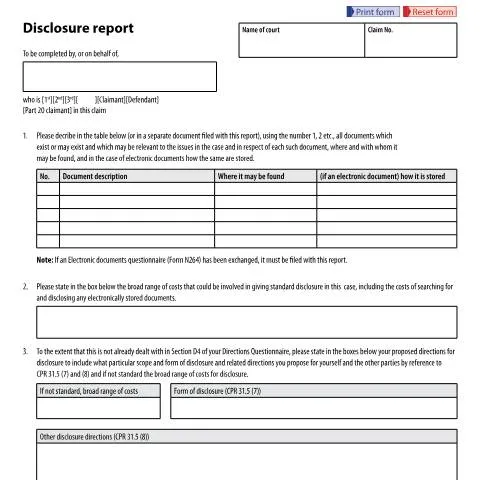
When Court Proceedings Demand Full Card Disclosure: Understanding Form N263
Civil litigation in England and Wales operates on a fundamental principle: parties must lay their cards on the table. This duty of disclosure ensures that justice is served not through concealment, but through the comprehensive examination of all relevant evidence. Form N263, the Disclosure Report, sits at the heart of this process, serving as the formal mechanism through which parties inform the court and opposing sides about documents that could influence the outcome of their case.
Unlike the informal exchange of correspondence that might precede legal action, the disclosure report represents a pivotal moment where legal obligations crystallise. Parties must systematically identify, locate, and assess every document that might be relevant to the issues in dispute, regardless of whether these documents support or undermine their position. This requirement extends far beyond obvious correspondence or contracts to encompass emails, internal memos, electronic records, and even documents that may have been destroyed or lost.
The timing of Form N263 submission typically follows the court's directions for case management, often occurring after the Defence has been filed and the court has issued directions for the conduct of proceedings. This placement in the litigation timeline is deliberate: by this stage, the issues in the case have been crystallised through the Claim Form and Defence, enabling parties to make informed assessments about document relevance.
Mapping the Documentary Landscape: Section 1 Requirements
The opening section of Form N263 demands what many practitioners consider the most intellectually demanding aspect of litigation: identifying every document that "exists or may exist and which may be relevant to the issues in the case." This requirement operates on multiple levels, each presenting distinct challenges for legal representatives and their clients.
Document identification begins with a systematic review of the client's filing systems, both physical and electronic. However, the scope extends considerably beyond documents in the party's immediate possession. The form specifically requires disclosure of documents that "may exist" – encompassing materials that might be held by third parties, former employees, or even documents that are known to have existed but cannot currently be located.
The tabular format of Section 1 demands precision in three key areas: document description, location, and storage method for electronic materials. The description must be sufficiently detailed to enable the opposing party to understand the document's nature and potential relevance, whilst the location information must be specific enough to facilitate production if required.
| Document Category | Typical Locations | Electronic Storage Considerations |
|---|---|---|
| Contractual documents | Legal department, client files, counterparty records | Document management systems, email attachments |
| Internal communications | Employee files, archived emails, messaging systems | Email servers, backup systems, mobile devices |
| Financial records | Accounting department, auditor files, bank records | Accounting software, cloud storage, archived databases |
| Technical documentation | Engineering departments, supplier records, regulatory submissions | CAD systems, version control software, technical databases |
For electronic documents, the form requires specification of storage methods, reflecting the reality that modern litigation increasingly involves digital evidence. This encompasses not only obvious locations like email servers and document management systems, but also less apparent repositories such as backup systems, mobile devices, and cloud storage platforms.
The Electronic Documents Questionnaire Integration
Form N263 explicitly references Form N264, the Electronic Documents Questionnaire, which must be filed alongside the disclosure report if it has been exchanged between parties. This integration reflects the courts' recognition that electronic disclosure often involves technical complexities requiring specialist consideration. The questionnaire addresses issues such as data preservation, search methodologies, and the proportionality of electronic disclosure exercises.
The interplay between these forms is crucial for cost management. While N263 provides the broad framework for disclosure obligations, N264 enables parties to address the technical and financial implications of electronic document retrieval before costly disclosure exercises commence.
Financial Reality Check: Costing Standard Disclosure
Section 2 of Form N263 requires parties to confront the financial implications of their disclosure obligations head-on. The requirement to state "the broad range of costs that could be involved in giving standard disclosure" serves multiple purposes within the case management framework established by the Civil Procedure Rules.
Standard disclosure, as defined by CPR Part 31, requires parties to disclose documents on which they rely, documents which adversely affect their case or support another party's case, and documents they are required to disclose by relevant practice directions. The cost assessment must encompass not merely the legal fees associated with document review, but the full spectrum of expenses including:
- Electronic data processing and extraction costs
- Document imaging and preparation expenses
- External storage and retrieval fees
- Third-party document collection costs
- Translation expenses for foreign-language documents
- Expert witness fees for technical document analysis
The "broad range" formulation acknowledges that precise cost calculation is often impossible at the disclosure report stage. However, the requirement serves as an early warning system, enabling courts to consider proportionality issues before disclosure directions are finalised. In cases where standard disclosure costs appear disproportionate to the claim value or the issues in dispute, this section provides the foundation for applications for alternative disclosure orders.
Cost Implications Across Case Types
The financial impact of disclosure varies dramatically depending on case characteristics. Commercial disputes involving multinational corporations may generate disclosure costs running into hundreds of thousands of pounds, particularly where electronic document searches span multiple jurisdictions and languages. Conversely, straightforward contractual disputes between small businesses might involve disclosure costs measured in thousands rather than tens of thousands.
Professional negligence claims often present particular challenges, as relevant documents may span extended periods and involve multiple professional relationships. The temporal scope of document searches in such cases can significantly impact costs, particularly where firms have undergone system migrations or changes in document retention policies.
Crafting Proportionate Disclosure Directions: Section 3 Strategic Considerations
Section 3 represents the strategic heart of Form N263, requiring parties to propose specific directions for disclosure that balance thoroughness against proportionality. This section operates in conjunction with the Directions Questionnaire (particularly Section D4), but provides additional space for detailed proposals that reflect the specific characteristics of each case.
The reference to CPR 31.5(7) and (8) is fundamental to understanding the court's approach to modern disclosure. These provisions empower courts to order disclosure that is appropriately tailored to case circumstances, moving away from the one-size-fits-all approach of traditional standard disclosure.
CPR 31.5(7) provides a menu of disclosure forms, ranging from no disclosure at all through various levels of targeted disclosure to full standard disclosure. The form requires parties to specify which approach they propose for themselves and their opponents, supported by reasoning that demonstrates proportionality considerations.
Alternative Disclosure Models
The range of disclosure options available under CPR 31.5(7) reflects judicial recognition that disclosure requirements should be calibrated to case needs:
- Disclosure confined to specific issues: Appropriate where disputes centre on narrow factual questions
- Disclosure limited by reference to categories of documents: Suitable for cases where certain document types are clearly irrelevant
- Disclosure limited by date, location, or custodian: Useful for managing large-scale disclosure in institutional litigation
- Staged disclosure: Enabling initial limited disclosure followed by expanded requirements if necessary
- Electronic documents sampling: Permitting statistically valid sampling rather than comprehensive review
CPR 31.5(8) addresses related directions that may be necessary to make disclosure effective, including provisions for document inspection, copying arrangements, and confidentiality protections. These "other disclosure directions" might encompass specialised arrangements for commercially sensitive documents, procedures for handling privileged materials, or protocols for managing voluminous electronic disclosure.
Procedural Integration and Case Management Implications
Form N263 operates within a carefully orchestrated case management framework designed to ensure that disclosure serves rather than subverts the efficient resolution of disputes. The timing of disclosure report submission, typically ordered alongside other case management directions, reflects judicial awareness that disclosure decisions impact virtually every other aspect of case preparation.
The form's integration with other procedural steps is particularly evident in its relationship to costs budgeting under CPR Part 3. Courts increasingly scrutinise disclosure proposals against approved costs budgets, requiring parties to justify disclosure expenditure that exceeds budgeted amounts. This interconnection means that Form N263 submissions must be consistent with earlier costs estimates and realistic about the financial implications of proposed disclosure directions.
Case management conferences frequently focus heavily on disclosure issues, with Form N263 providing the foundation for judicial decision-making. Courts may use disclosure reports to identify cases requiring enhanced case management, particularly where electronic disclosure issues threaten to overwhelm proportionality considerations.
The Multi-Track Disclosure Pilot
Recent procedural developments, including the Disclosure Pilot for the Business and Property Courts, have introduced additional complexity to Form N263 completion. Cases subject to pilot provisions may require enhanced disclosure reporting, including detailed consideration of document review methodologies and technology-assisted review procedures.
Under pilot provisions, parties may need to address predictive coding technologies, artificial intelligence applications in document review, and statistically valid sampling methodologies. These technical considerations require specialist input and may significantly impact the cost assessments required by Section 2 of the form.
Completing Form N263: Technical Requirements and Common Pitfalls
The seemingly straightforward structure of Form N263 conceals several technical requirements that can trap unwary practitioners. The form's emphasis on comprehensiveness means that omissions or inadequate descriptions can have serious consequences for case progression and costs liability.
Document descriptions in Section 1 must strike a careful balance between specificity and manageability. Overly generic descriptions such as "correspondence" or "internal documents" fail to provide opposing parties with sufficient information to assess relevance or privilege claims. Conversely, excessively detailed descriptions can make the disclosure report unwieldy and may inadvertently reveal privileged information.
The requirement to specify document locations extends beyond simple filing cabinet references to encompass the full range of modern document storage methods. For electronic documents, this includes consideration of metadata preservation requirements, version control systems, and backup procedures that might contain relevant materials.
Electronic Storage Complexity
Modern business operations generate electronic documents across multiple platforms and storage locations, creating particular challenges for Form N263 completion:
- Email systems: Including archived mailboxes, deleted items, and distribution list messages
- Collaborative platforms: Such as Microsoft Teams, SharePoint, or Google Workspace environments
- Mobile devices: Encompassing both corporate and personal devices used for business purposes
- Cloud storage: Including both corporate subscriptions and individual accounts
- Social media: Where business communications may have occurred through platforms like LinkedIn
- Instant messaging: Including WhatsApp, Slack, or other business communication tools
Each storage location may require different technical approaches for document retrieval, with corresponding cost implications that must be reflected in Section 2 assessments.
Post-Submission Procedures and Ongoing Obligations
Submission of Form N263 marks the beginning rather than the end of disclosure obligations. The court's response to disclosure reports varies depending on case complexity and the degree of consensus between parties regarding appropriate disclosure directions.
Where parties agree on disclosure proposals, courts may make directions largely in the terms requested, subject to proportionality considerations. However, disputed disclosure applications frequently result in case management conferences where detailed argument about disclosure scope and methodology takes place.
Ongoing disclosure obligations continue throughout proceedings, with parties required to supplement their disclosure if additional relevant documents are discovered or become available. This continuing obligation applies regardless of whether documents emerge from sources identified in the original Form N263 or from previously unknown repositories.
The form also establishes a framework for monitoring disclosure compliance, with opponents entitled to challenge apparently inadequate disclosure by reference to the scope and locations identified in the original disclosure report. This creates an incentive for comprehensive initial reporting, as subsequent challenges may result in costs sanctions for parties whose disclosure proves inadequate.
Enforcement and Sanctions
Inadequate completion of Form N263 can result in significant procedural disadvantages, including:
| Deficiency Type | Potential Consequences | Remedial Action Required |
|---|---|---|
| Incomplete document identification | Further disclosure orders, costs sanctions | Supplementary disclosure report, extended searches |
| Inadequate cost assessment | Disclosure directions exceeding party's financial capacity | Updated cost estimates, proportionality arguments |
| Unrealistic disclosure proposals | Court-imposed directions, adverse costs orders | Revised proposals, enhanced case management |
Courts possess wide-ranging powers to enforce disclosure obligations, including unless orders that can result in statements of case being struck out for non-compliance. The comprehensive nature of Form N263 means that parties cannot credibly claim ignorance of their obligations or the scope of relevant documentation.
The disclosure report thus serves not merely as an administrative exercise, but as a fundamental component of modern case management that can determine both the trajectory and outcome of civil proceedings. Its completion requires careful consideration of legal obligations, technical capabilities, and financial constraints – making it one of the most strategically significant documents in contemporary litigation practice.