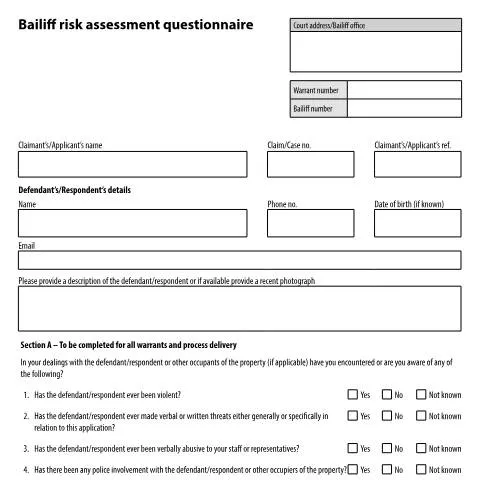
When Property Recovery Meets Personal Safety: Understanding the EX97A Risk Assessment Protocol
The moment a bailiff receives instructions to enforce a warrant, whether for possession, goods seizure, or process delivery, a critical safety assessment must take place. Form EX97A serves as the formal channel through which creditors, landlords, and their representatives communicate potential risks to enforcement officers before they visit a property. This bailiff risk assessment questionnaire represents a crucial junction where legal process meets personal safety, transforming what could be dangerous blind enforcement into informed, measured action.
The form emerged from recognition that bailiffs often arrive at properties with minimal knowledge of the occupants' circumstances, behaviour patterns, or potential hazards. By requiring systematic risk disclosure, EX97A helps prevent confrontations, reduces the likelihood of enforcement officers walking into volatile situations, and ensures appropriate resources are allocated to each case based on its specific risk profile.
The Three-Tier Assessment Framework: Sections A Through C Explained
Form EX97A employs a structured approach that categorises risk information according to the type of enforcement action and the nature of potential hazards. This systematic breakdown ensures comprehensive risk evaluation whilst avoiding information overload for enforcement officers.
Section A: Universal Risk Indicators for All Warrant Types
Every enforcement action, regardless of its specific nature, requires completion of Section A's eight core questions. These queries focus on behavioural patterns and environmental factors that could affect bailiff safety during any property visit:
- Violence history: Previous aggressive behaviour by the defendant or respondent provides the most direct indicator of potential physical risk
- Threat patterns: Verbal or written threats, whether general or case-specific, signal escalating tensions that could manifest during enforcement
- Verbal abuse incidents: Abusive behaviour toward staff indicates poor impulse control and potential for confrontation
- Police involvement: Any police contact with occupants suggests existing conflict or criminal activity at the property
- Social services engagement: Social services involvement may indicate vulnerable occupants or complex family dynamics requiring sensitive handling
- Dangerous animals: Dogs or other animals pose immediate physical risks that require specific precautions
- Occupancy status: Whether the property remains occupied affects approach strategies and legal considerations
- Mental health and substance issues: Conditions affecting behaviour require specialised approach protocols
The "Not known" option acknowledges that creditors may have limited information about defendants, particularly in cases involving minimal prior contact or third-party enforcement instructions.
Section B: Possession-Specific Logistics and Access Arrangements
Possession warrants involve unique complexities that Section B addresses through two critical operational questions. The requirement to identify the representative attending possession ensures clear communication channels during what can be emotionally charged proceedings. This representative serves as the primary liaison between the bailiff and the instructing party, facilitating real-time decision-making if complications arise.
The locksmith arrangement question addresses a frequent source of enforcement delays and complications. Failure to arrange locksmith attendance can result in aborted possession attempts, additional costs, and extended timelines. By confirming arrangements in advance, the form helps prevent logistical failures that could compromise enforcement effectiveness.
Access difficulties represent another common challenge, particularly in converted properties, blocks of flats, or buildings with complex entry systems. Detailed disclosure of access arrangements, including arrangements for communal entrances or security systems, enables bailiffs to plan appropriate approaches and bring necessary equipment or authorisations.
Section C: Intelligence Gathering and Contact Protocols
The final section focuses on information management and communication channels. Database checks ensure that all available intelligence about the defendant and property has been considered and shared. This requirement recognises that relevant information may be scattered across different systems or departments within creditor organisations.
Additional information requests capture operational details that don't fit standard categories but could significantly impact enforcement planning. Working hours, vehicle registrations, and availability patterns help bailiffs time visits for maximum effectiveness whilst minimising disruption.
| Information Type | Enforcement Impact | Safety Consideration |
|---|---|---|
| Working patterns | Optimal visit timing | Reduces confrontation likelihood |
| Vehicle details | Occupancy verification | Situational awareness |
| Availability windows | Successful contact probability | Minimises repeat visits |
Risk Scoring Methodology: From Assessment to Action
The form's "For official use only" section reveals the systematic approach HM Courts & Tribunals Service employs to convert qualitative risk information into actionable enforcement protocols. The risk scoring matrix evaluates both hazard severity and likelihood, producing an overall risk assessment that determines appropriate response measures.
Low-risk cases typically proceed with standard enforcement protocols, whilst medium-risk situations may require additional officers, specific timing considerations, or enhanced communication procedures. High-risk assessments trigger comprehensive safety protocols, potentially including police attendance, specialist equipment, or alternative enforcement strategies.
This systematic approach ensures consistent risk evaluation across different bailiff offices and enforcement companies, whilst providing clear documentation for audit and review purposes. The scoring system also enables trend analysis and continuous improvement of safety protocols based on actual enforcement experiences.
Completing EX97A: Navigating Information Requirements and Disclosure Obligations
Effective completion of Form EX97A requires careful consideration of information sources and disclosure obligations. Creditors and their representatives must balance comprehensive risk communication with data protection requirements and evidence standards.
Information Gathering Strategies
Systematic information gathering begins with internal database searches across all relevant systems. Customer service records, payment history files, and previous enforcement attempts often contain behavioural indicators that inform risk assessment. Property management companies may have additional intelligence about occupant behaviour, neighbourhood conditions, or access challenges.
External information sources require careful evaluation. Police reports, social services involvement, or neighbour complaints may provide relevant risk indicators, but creditors must ensure they have appropriate authority to access and disclose such information. Hearsay or unsubstantiated allegations should be clearly identified to enable bailiffs to evaluate information reliability appropriately.
Documentation Standards and Evidence Requirements
The form's requirement for detailed explanations when answering "Yes" to risk questions demands specific, factual information rather than general concerns or assumptions. Effective risk communication includes:
- Specific incident descriptions: Dates, circumstances, and nature of concerning behaviour
- Source identification: Whether information comes from direct experience, reliable reports, or secondary sources
- Context provision: Circumstances that may have influenced behaviour or may affect future interactions
- Current relevance: How recent information is and whether circumstances may have changed
Photograph provision, whilst optional, can significantly enhance bailiff safety by enabling positive identification and reducing confusion at properties with multiple occupants. However, data protection considerations require ensuring photographs are current, accurately represent the relevant individual, and are obtained and used lawfully.
Submission Protocols and Post-Assessment Communication
Form EX97A submission marks the beginning rather than the end of risk communication responsibilities. The document must reach the appropriate bailiff office or enforcement company sufficiently in advance of planned enforcement action to enable proper assessment and planning.
Timing and Delivery Considerations
Effective risk assessment requires sufficient lead time for bailiffs to evaluate information, adjust protocols, and arrange appropriate resources. Rush submissions or last-minute risk disclosures can compromise enforcement effectiveness and safety outcomes. Standard practice typically requires EX97A submission alongside initial enforcement instructions, ensuring integrated planning from the outset.
The form's emphasis on maintaining ongoing communication reflects the dynamic nature of risk assessment. Circumstances can change rapidly, particularly in cases involving mental health issues, domestic disputes, or escalating financial stress. Creditors retain responsibility for updating bailiffs about emerging risks even after initial form submission.
Multi-Party Coordination Requirements
Complex enforcement cases often involve multiple parties with different information sources and communication channels. Property management companies, legal representatives, and direct creditors may each possess relevant risk intelligence that requires coordination and integration.
The contact details section enables bailiffs to reach appropriate parties quickly when questions arise or circumstances change during enforcement. Clear identification of primary contacts, alternative numbers, and availability patterns facilitates effective communication during time-sensitive enforcement situations.
Legal Framework and Regulatory Context
Form EX97A operates within a complex regulatory framework that balances enforcement effectiveness with safety requirements and individual rights. The Tribunals, Courts and Enforcement Act 2007 provides the statutory foundation for bailiff powers and procedures, whilst Health and Safety at Work Act 1974 obligations require systematic risk assessment and appropriate control measures.
Data Protection and Information Handling
The form's information requirements intersect with Data Protection Act 2018 and UK GDPR obligations in complex ways. Creditors must ensure they have lawful bases for processing and sharing personal information about defendants, particularly sensitive information relating to mental health, substance abuse, or family circumstances.
Information sharing with bailiffs typically relies on legitimate interests provisions, but creditors must demonstrate that enforcement necessity justifies any intrusion into defendant privacy. Proportionality assessments require balancing enforcement effectiveness and safety considerations against privacy impacts and potential discrimination risks.
Professional Standards and Industry Codes
Certified bailiffs operate under strict professional standards that emphasise proportionate enforcement and risk minimisation. The Civil Enforcement Association and other professional bodies provide guidance on risk assessment interpretation and appropriate response protocols.
These standards influence how bailiffs interpret EX97A information and determine appropriate enforcement strategies. Over-reporting risks can lead to unnecessarily heavy-handed approaches, whilst under-reporting may result in inadequate safety precautions or unsuccessful enforcement attempts.
Operational Impact and Enforcement Outcomes
The practical effectiveness of Form EX97A extends beyond immediate safety considerations to influence broader enforcement outcomes and creditor recovery rates. Systematic risk assessment enables more targeted and effective enforcement strategies, potentially improving success rates whilst reducing costs and complications.
Well-completed risk assessments enable bailiffs to allocate appropriate time and resources to each case, reducing the likelihood of aborted visits or escalated confrontations that require additional interventions. This efficiency translates into better outcomes for creditors whilst minimising stress and disruption for defendants.
The form's systematic approach also supports continuous improvement in enforcement practices. Risk assessment data enables identification of common risk factors, development of specialised protocols for specific situations, and refinement of training programmes for enforcement officers.
Regular review of risk assessments against actual enforcement experiences helps calibrate the system's effectiveness and identify areas where additional information gathering or different approaches might improve outcomes. This feedback loop ensures that Form EX97A continues to serve its essential function of protecting enforcement officers whilst maintaining effective debt recovery and possession enforcement capabilities.
Understanding the Legal Framework Behind Form EX97A
Form EX97A operates within a complex legal framework that balances creditor rights with debtor protection. The form derives its authority from the Tribunals, Courts and Enforcement Act 2007 and the Taking Control of Goods Regulations 2013, which fundamentally reformed bailiff powers and introduced stricter protections for vulnerable debtors.
The legislation recognises that enforcement action can have severe consequences beyond the immediate debt recovery. When bailiffs seize essential items or property belonging to vulnerable individuals, the social and economic impact can be disproportionate to the original debt. This recognition led to the creation of EX97A as a formal mechanism for third parties to intervene before irreversible harm occurs.
Under regulation 11 of the Taking Control of Goods Regulations, bailiffs must consider any representations made about the debtor's circumstances or the goods they intend to seize. However, the regulations don't specify a particular timeframe for this consideration, which can create uncertainty. The Civil Procedure Rule 83.7 provides additional guidance on controlled goods and the process for challenging enforcement action, but EX97A serves as a preventive measure rather than a reactive challenge.
The form also intersects with human rights legislation, particularly Article 8 of the European Convention on Human Rights (right to respect for private and family life), which remains part of UK law through the Human Rights Act 1998. Courts have recognised that aggressive enforcement action can breach these rights, especially when it involves the family home or affects children's welfare.
Significantly, the Equality Act 2010 places duties on enforcement agents to make reasonable adjustments for disabled debtors. If your EX97A submission highlights disability-related risks, bailiffs must demonstrate they've considered these obligations. Failure to do so could render any subsequent enforcement action unlawful, providing grounds for judicial review or civil action.
Recent case law has strengthened the position of EX97A applicants. In Arden v Stubbs and related cases, courts have emphasised that enforcement agents must genuinely engage with risk assessments and cannot simply dismiss them without proper consideration. This creates a stronger foundation for challenging inadequate responses to EX97A submissions.
Strategic Timing and Coordination with Other Legal Remedies
The effectiveness of Form EX97A often depends on strategic timing and coordination with other available remedies. Understanding when and how to deploy this form as part of a broader legal strategy can significantly improve outcomes for vulnerable debtors.
Fill in your form directly online
No printing: type your details into the boxes of the official form, tick, then download the PDF ready to send.
- 1Type into the form boxes
- 2Tick in one click
- 3Save and download the PDF
Ideally, EX97A should be submitted as early as possible in the enforcement process, preferably before the bailiff's first visit. However, the form remains relevant even after initial contact, particularly if circumstances change or new risks emerge. The key is demonstrating that the risks you're highlighting weren't apparent to the bailiff during their initial assessment.
Consider coordinating your EX97A submission with other protective measures. If the debtor is experiencing mental health difficulties, you might simultaneously pursue a Disability Living Allowance or Personal Independence Payment application, as successful claims can affect the bailiff's approach to enforcement. Similarly, if housing issues are involved, parallel applications to the local authority for emergency accommodation or homelessness assistance can strengthen your risk assessment.
The timing also matters in relation to court procedures. If you're planning to apply for a stay of execution or to set aside the judgment, submit EX97A first. Courts view favourably cases where all available protective measures have been attempted before seeking judicial intervention. Conversely, if court proceedings are already underway, reference your EX97A submission in your evidence bundle to demonstrate proactive risk management.
For council tax debts, coordination becomes particularly important because local authorities often use different enforcement companies for different areas. Your EX97A submission should account for the possibility that enforcement might transfer between agents, requiring you to potentially resubmit the form to new bailiffs.
In cases involving commercial rent arrears recovery (CRAR), timing is critical because landlords can seize goods without court proceedings. Here, EX97A serves as one of the few opportunities to highlight risks before seizure occurs. Coordinate with any negotiations for payment arrangements or challenges to the rent arrears themselves.
Consider also the interaction with insolvency procedures. If the debtor is contemplating bankruptcy or an Individual Voluntary Arrangement (IVA), your EX97A submission should highlight this, as enforcement action against someone preparing insolvency proceedings can be counterproductive for all creditors.
When multiple creditors are involved, strategic coordination becomes even more complex. Different bailiff companies may be pursuing the same debtor simultaneously, and your EX97A submission to one may need to be adapted and sent to others. Keep detailed records of all submissions to avoid confusion and ensure consistent messaging about the risks involved.
Post-Submission Monitoring and Escalation Procedures
Submitting Form EX97A is not the end of the process – effective monitoring and knowing when to escalate are crucial for protecting vulnerable debtors. The period following submission often determines whether the form achieves its protective purpose or merely becomes another document in the case file.
Most bailiff companies should acknowledge receipt of EX97A within 5-7 working days, though this isn't legally mandated. If you receive no acknowledgement, follow up immediately with both the bailiff company and the creditor. Document these communications meticulously, as delays in acknowledgement can indicate systemic problems with the company's procedures.
The bailiff's response should address each risk you've identified and explain what measures they'll implement to mitigate these risks. Generic responses that fail to engage with specific concerns may indicate inadequate consideration. If the response seems perfunctory, request a detailed written explanation of their risk assessment methodology and how they've evaluated your specific concerns.
Monitor the debtor's situation continuously after submission. Circumstances can deteriorate rapidly, particularly with health conditions or housing situations. If new risks emerge, submit an updated EX97A immediately rather than waiting for the next bailiff visit. Include a clear cover letter explaining what has changed since your original submission.
Pay particular attention to any enforcement visits that occur after your submission. The bailiff should demonstrate awareness of the risks you've highlighted and modify their approach accordingly. If they proceed with standard enforcement procedures without acknowledging the risks, this may constitute grounds for complaint or legal challenge.
Document any deterioration in the debtor's condition that could be linked to enforcement stress. Medical evidence showing that enforcement action has exacerbated mental health conditions or physical ailments can be powerful in subsequent proceedings. Ensure healthcare providers understand the connection between enforcement stress and health impacts when preparing medical reports.
If the bailiff company fails to respond appropriately to your EX97A submission, escalation options include complaints to their trade association (such as the Civil Enforcement Association), the creditor organisation, or ultimately to the courts through judicial review proceedings. Each escalation level requires different evidence standards, so maintain comprehensive records throughout.
For high court enforcement officers, additional oversight comes through the High Court Enforcement Officers Association. Their complaints procedure specifically addresses failures to consider vulnerability and risk assessments, making EX97A submissions particularly relevant to their disciplinary processes.
Consider also reporting to relevant regulatory bodies. If the case involves regulated creditors (such as banks or utilities), their financial conduct obligations may require them to ensure their enforcement agents consider vulnerability properly. Similarly, local authority creditors are subject to public law duties that can be enforced through different mechanisms than private debt recovery.
In extreme cases where enforcement action proceeds despite clear risks highlighted in EX97A, emergency legal remedies may be necessary. Applications for interim injunctions to prevent seizure of goods can reference your EX97A submission as evidence that you attempted to resolve matters without court intervention. Courts generally require applicants to demonstrate they've exhausted other options before granting emergency relief.
Finally, maintain long-term monitoring even after successful EX97A interventions. Enforcement cases often remain active for months or years, and new bailiff companies may become involved without awareness of previous risk assessments. Regular review of the debtor's circumstances and proactive communication with new enforcement agents helps maintain the protective effect of your original submission.