When Court Approval Becomes Essential for Vulnerable Parties
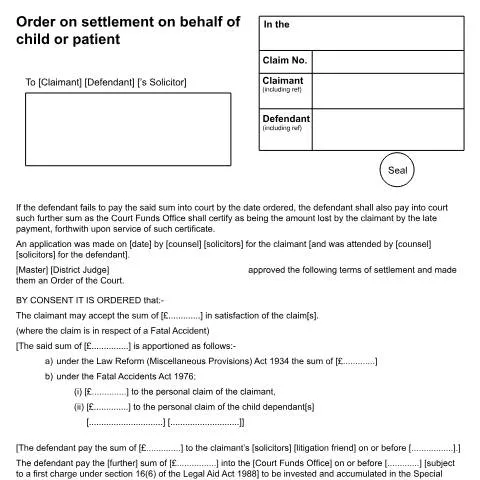
Legal settlements involving children or adults lacking mental capacity cannot simply be agreed between solicitors and signed off privately. The Court Funds Office and judicial oversight exist precisely to protect these vulnerable individuals from potentially inadequate compensation or inappropriate financial arrangements. Form N292 represents the formal mechanism through which HM Courts & Tribunals Service transforms negotiated settlements into legally binding court orders, ensuring proper protection and future management of awarded funds.
This protective framework stems from fundamental legal principles recognising that children under 18 and patients without capacity cannot make binding legal decisions independently. Whether the settlement involves a road traffic accident, medical negligence claim, or fatal accident compensation, the court must scrutinise proposed terms before they become enforceable. The process safeguards against settlements that might appear reasonable to adults but fail to serve the protected party's long-term interests.
Distinguishing Settlement Orders from Standard Civil Proceedings
Form N292 occupies a unique position within the civil litigation landscape, fundamentally different from standard Tomlin orders or consent orders between capable adults. The court's role shifts from passive approval to active protection, examining whether proposed settlement terms genuinely serve the protected party's welfare rather than merely resolving the dispute expeditiously.
Unlike typical civil settlements where parties enjoy broad autonomy, proceedings involving children or patients trigger mandatory judicial oversight regardless of settlement amount. Even modest sums exceeding £1,000 typically require court approval, though practice varies between courts. This threshold differs markedly from clinical negligence cases, where any settlement involving a protected party demands judicial scrutiny regardless of quantum.
The form itself serves dual purposes: documenting agreed settlement terms and providing the court with sufficient information to assess appropriateness. Crucially, submission of N292 doesn't guarantee approval - the court retains discretion to reject settlements deemed inadequate or request additional evidence supporting the proposed arrangement.
Essential Components of the Settlement Framework
Form N292's structure reflects the complexity of protecting vulnerable parties while facilitating fair dispute resolution. The document must specify precise payment arrangements, distinguishing between immediate payments and funds requiring court protection through the Court Funds Office investment scheme.
| Settlement Element | Typical Arrangement | Court Considerations |
|---|---|---|
| Immediate expenses | Payment to solicitor/litigation friend | Reasonableness and necessity |
| Future needs provision | Court Funds Office investment | Adequacy for long-term care |
| Legal costs recovery | Standard or detailed assessment | Proportionality to settlement |
| Fatal accident apportionment | Separate allocations per dependant | Fair distribution between claimants |
Fatal accident claims require particularly careful apportionment between Law Reform (Miscellaneous Provisions) Act 1934 claims and Fatal Accidents Act 1976 dependency claims. The form must specify exact allocations for each dependant, including child dependants who cannot consent to proposed distributions.
Navigating the Application Process and Judicial Scrutiny
The application process begins when legal representatives reach provisional settlement terms, typically following extensive negotiations or mediation. Timing proves critical - applications should be made promptly after agreement to avoid complications if circumstances change or limitation periods approach expiry.
Applications require attendance by counsel or solicitors representing the protected party, with defendant representation often present to confirm agreement terms. The hearing allows the court to probe settlement adequacy, question assumptions about future needs, and ensure the protected party's interests take precedence over litigation convenience.
Judges frequently scrutinise whether proposed arrangements adequately address long-term care needs, education costs, or loss of future earnings. Medical evidence supporting settlement quantum becomes particularly important, especially in cases involving permanent disability or ongoing treatment requirements. The court may request additional expert reports if existing evidence appears insufficient to justify proposed settlement levels.
District Judges and Masters bring considerable experience to these assessments, often identifying potential shortfalls in provision that might not be apparent to legal representatives focused on achieving settlement. Their protective role can result in recommendations for higher settlement amounts or modified payment structures better serving the protected party's needs.
Managing Funds Through the Court Funds Office
Once approved, settlements involving protected parties often require sophisticated fund management through the Court Funds Office's Special Investment Account. This arrangement ensures professional investment management while maintaining judicial oversight over significant expenditure decisions.
The Court Funds Office operates distinct investment strategies depending on the protected party's circumstances and likely future needs. Funds designated for children typically remain invested until majority, with accumulated interest enhancing the available sum when access becomes appropriate. However, provisions exist for earlier access to meet specific needs like education costs or medical treatment not covered by NHS provision.
For patients lacking capacity, the court may direct transfer to the Court of Protection, which assumes ongoing responsibility for fund management and expenditure decisions. This transfer requires formal application and appointment of suitable receivers, processes that can extend several months beyond initial settlement approval.
Investment performance and fund security remain paramount considerations, with the Court Funds Office maintaining detailed records accessible to appointed representatives. Regular statements provide transparency regarding fund growth and any approved expenditure, ensuring accountability throughout the protection period.
Special Circumstances and Complex Cases
Certain situations demand modified approaches to the standard N292 process, requiring careful consideration of additional factors beyond typical settlement approval.
International elements complicate proceedings significantly. Where protected parties reside abroad or settlements involve foreign defendants, questions arise regarding appropriate court jurisdiction and fund management arrangements. The court must consider whether English protective mechanisms adequately serve parties residing in different legal systems with varying protection standards.
Multiple protected parties within single proceedings create complex apportionment challenges. Fatal accident cases frequently involve several child dependants requiring separate provision, while catastrophic injury cases might affect both the primary victim and dependent children. The court must ensure fair distribution while maintaining appropriate protection levels for each vulnerable party.
Legal aid implications add further complexity, particularly regarding cost assessment and potential statutory charges on awarded damages. Form N292 must address these charges explicitly, ensuring protected parties understand how legal aid recovery might affect their ultimate compensation.
Urgent applications occasionally arise where delay risks prejudicing the protected party's position. Courts can accommodate expedited hearings, though abbreviated timescales may limit detailed scrutiny of proposed arrangements. Such urgency typically involves medical treatment costs or accommodation needs that cannot await standard processing times.
Consequences of Approval and Long-term Implications
Court approval through Form N292 creates binding legal obligations extending well beyond simple contractual arrangements. Defendants face specific payment deadlines with potential penalties for late compliance, while approved terms become enforceable through contempt proceedings if necessary.
The order's finality provides certainty for all parties, preventing future claims regarding the settled matters while establishing clear frameworks for ongoing fund management. Protected parties gain security through court oversight, though this protection necessarily restricts their autonomy over awarded compensation.
For children approaching majority, the transition from court protection to personal control requires careful planning. The court may impose conditions on fund release, ensuring appropriate financial advice or structured payment arrangements that prevent dissipation of compensation intended for lifetime needs.
Breach of approved settlement terms can result in serious consequences for defaulting parties. Late payment penalties, calculated by the Court Funds Office, compensate for investment losses caused by delayed compliance. More serious breaches might justify committal proceedings or additional damages claims.
Professional Responsibilities and Ongoing Obligations
Legal representatives bear significant responsibilities throughout the N292 process, extending beyond simple form completion to active protection of their vulnerable clients' interests. Solicitors must maintain detailed records justifying settlement recommendations, particularly where proposed terms might appear modest compared to potential trial outcomes.
The duty to attend settlement approval hearings cannot be delegated to unqualified staff, reflecting the court's expectation of experienced advocacy during these protective proceedings. Representatives must be prepared to address judicial concerns about settlement adequacy, providing detailed explanations of risk assessments and expert opinion underlying agreed terms.
Post-approval obligations include ensuring timely compliance with payment deadlines and maintaining communication with the Court Funds Office regarding investment directions. Solicitors often retain responsibility for future applications relating to fund management, creating ongoing professional relationships extending years beyond initial settlement.
Regular review of protected parties' circumstances may necessitate further court applications, particularly where changing needs or circumstances suggest modifications to approved arrangements. These ongoing responsibilities reflect the court's continuing protective jurisdiction over vulnerable parties, ensuring initial settlements remain appropriate throughout the protection period.
Settlement Approval Criteria and Court Assessment Framework
The court applies a rigorous assessment framework when evaluating settlement proposals submitted via Form N292, with different criteria depending on whether the protected party is a child or patient. Understanding these evaluation standards helps legal representatives present compelling cases that expedite approval whilst safeguarding the protected party's interests.
For child settlements, courts primarily assess whether the proposed agreement serves the child's best interests, considering both immediate needs and long-term welfare. The assessment encompasses the strength of the underlying claim, comparing the settlement figure against potential trial outcomes and associated litigation risks. Courts examine whether the settlement adequately compensates for established losses including pain, suffering, future care needs, loss of earnings capacity, and educational support requirements.
The court scrutinises the reasonableness of legal costs, ensuring they don't disproportionately erode the child's compensation. Where legal costs exceed one-third of the settlement value, additional justification becomes essential. Courts also evaluate whether alternative funding arrangements, such as after-the-event insurance or damages-based agreements, might have provided better value for the child's estate.
Patient settlements undergo additional complexity layers, particularly where the protected party lacks capacity to understand the proceedings' nature. The court must satisfy itself that the litigation friend has genuinely acted in the patient's best interests throughout negotiations. This includes examining whether medical evidence supports the settlement quantum, especially regarding future care costs and life expectancy assessments.
Courts pay particular attention to structured settlement proposals versus lump sum arrangements. For significant sums, judges often favour structured settlements providing guaranteed income streams over the patient's lifetime, protecting against investment risks and ensuring ongoing care funding. However, the court recognises that structured settlements aren't universally appropriate, particularly where the patient's life expectancy remains uncertain or where immediate capital requirements are substantial.
The assessment includes reviewing whether independent financial advice has been obtained regarding investment strategies for lump sum awards. Courts expect evidence that consideration has been given to Court of Protection involvement for ongoing financial management, particularly where the patient's incapacity is permanent.
Provisional damage claims require special consideration, where the settlement allows for future claims if the protected party develops anticipated conditions. Courts examine whether the provisional damage threshold is appropriately set and whether the time limits for making future claims adequately protect the child or patient's interests.
Fill in your form directly online
No printing: type your details into the boxes of the official form, tick, then download the PDF ready to send.
- 1Type into the form boxes
- 2Tick in one click
- 3Save and download the PDF
Managing Complex Multi-Party and International Settlement Scenarios
Form N292 applications become significantly more complex when dealing with multi-party settlements or cases involving international elements, requiring careful coordination and additional documentation to satisfy court approval requirements.
In multi-defendant scenarios, the form must clearly delineate each defendant's contribution to the overall settlement, particularly where joint and several liability applies. Courts need to understand the apportionment rationale, especially if some defendants have reached separate agreements or if contribution proceedings between defendants remain ongoing. The application should address whether the settlement prejudices potential contribution claims and whether all relevant parties have been joined to the proceedings.
Where settlements involve both English and foreign defendants, complications arise regarding enforcement mechanisms and currency fluctuations. The Form N292 should specify which jurisdiction's law governs different aspects of the settlement and how currency conversion will be handled, particularly for ongoing periodic payments. Courts require assurance that foreign defendants can meet their obligations and that appropriate security has been obtained.
Insurance coverage disputes add another complexity layer, particularly where policy limits affect settlement negotiations. The application should clarify whether insurers have admitted coverage and whether any reservation of rights letters affect the settlement's enforceability. Where multiple insurance layers apply, courts need to understand how coverage gaps might impact the protected party's recovery.
Settlements involving government bodies or NHS trusts require specific attention to statutory compensation schemes and potential recoupment obligations. The Criminal Injuries Compensation Authority may have prior claims on settlement proceeds, whilst NHS charges recovery provisions can significantly impact net settlement values. Form N292 applications must demonstrate that these statutory obligations have been properly calculated and provided for within the settlement structure.
International cases involving EU cross-border enforcement mechanisms require additional documentation confirming that settlements will be recognised in relevant jurisdictions. Brexit implications may affect enforcement procedures, particularly for settlements involving continuing obligations such as periodic payments or medical treatment provision abroad.
Class action settlements require modified approaches to Form N292, where the application represents multiple children or patients with varying injury severities and settlement entitlements. Courts demand detailed breakdowns of individual allocations and confirmation that each protected party's interests have been individually assessed rather than averaged across the class.
Settlement timing coordination becomes crucial where related criminal proceedings are ongoing, as publicity restrictions may limit the court's ability to fully scrutinise settlement terms. The application should address whether deferred approval might better serve the protected party's interests and whether interim payment arrangements can bridge any gaps.
Post-Approval Implementation and Ongoing Court Supervision
Court approval via Form N292 marks the beginning rather than the conclusion of the court's supervisory role, particularly for substantial settlements or ongoing periodic payment arrangements requiring continued judicial oversight.
Payment implementation requires careful monitoring to ensure defendants comply with approved settlement terms. Where lump sum payments are delayed, the litigation friend must promptly notify the court, as interest accrual and potential enforcement proceedings may be necessary to protect the child or patient's position. Courts expect regular updates on payment status, particularly where instalments are spread over extended periods.
Investment of settlement funds triggers additional supervisory obligations, especially where the child won't reach majority for several years or where the patient lacks permanent capacity. The court may require periodic investment reports demonstrating that funds are being managed according to approved strategies and generating appropriate returns relative to risk levels.
Structured settlement arrangements necessitate ongoing monitoring of annuity provider solvency and payment performance. The litigation friend should establish reporting procedures ensuring that any payment defaults or provider financial difficulties are promptly brought to the court's attention. This becomes particularly important for settlements extending over decades, where provider circumstances may change substantially.
Variation applications may become necessary where circumstances change significantly after approval. For children, this might involve educational needs assessments revealing requirements not anticipated in the original settlement. Patient settlements may require modification where medical conditions deteriorate beyond original prognoses or where care cost inflation exceeds settlement assumptions.
The court maintains jurisdiction to approve variation agreements between parties, provided they continue serving the protected party's best interests. However, variations that substantially reduce the protected party's benefits face heightened scrutiny and may require fresh expert evidence supporting the changes.
Periodic review mechanisms should be established for long-term settlements, particularly where the protected party may recover capacity. For patients, this involves coordination with the Court of Protection regarding capacity assessments and potential transfer of financial management responsibilities. The timing of such reviews should be built into the original settlement structure rather than left to ad hoc applications.
Tax implications require ongoing attention, particularly where settlement structures involve offshore elements or complex trust arrangements. Changes in tax legislation may affect the settlement's efficiency, requiring professional advice and potential restructuring applications to maintain the protected party's financial position.
Discharge applications mark the conclusion of court supervision, typically when children reach majority or patients recover capacity. These require demonstration that all settlement obligations have been fulfilled and that any ongoing responsibilities have been properly transferred to appropriate parties or institutions.