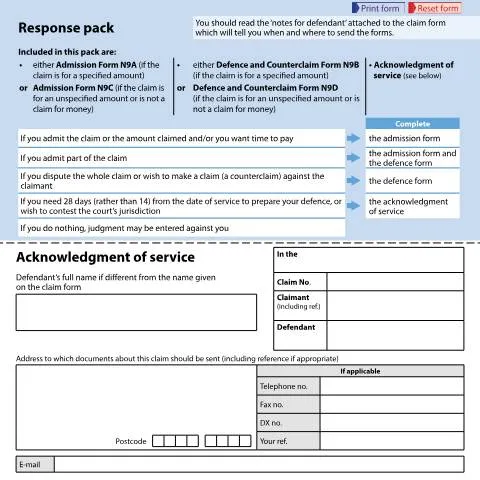
When Court Proceedings Land on Your Doorstep: Understanding the N9 Acknowledgment of Service
The moment you receive a claim form through the post, the clock starts ticking. Whether it's an unpaid invoice, a contractual dispute, or damages for alleged wrongdoing, you face an immediate decision: how will you respond to this legal challenge? The standard 14-day deadline to file your defence can feel impossibly tight, particularly when the case involves complex commercial arrangements or requires specialist legal advice.
This is precisely where Form N9 proves invaluable. Far from being merely another piece of court bureaucracy, the acknowledgment of service represents a strategic breathing space that can make the difference between a rushed, inadequate defence and a properly prepared legal response. By filing this single-page document, defendants can secure an additional fortnight to marshal their arguments, gather evidence, and engage appropriate legal representation.
The form serves dual purposes within England and Wales' civil court system. Primarily, it extends your defence deadline from 14 to 28 days from the date of service. Secondly, it provides a mechanism to challenge the court's jurisdiction—questioning whether the chosen court has legal authority to hear your particular case. Understanding when and how to use Form N9 effectively can significantly impact the trajectory of your legal proceedings.
The Strategic Timing of Your Response
Time constraints in civil litigation operate with mathematical precision. Once a claim form is served upon you—whether by post, personal delivery, or alternative methods approved by the court—the 14-day countdown begins immediately. Weekends and bank holidays offer no reprieve; these are calendar days, not working days.
Consider the practical implications: if you receive a complex commercial claim on a Friday evening, you effectively have less than two weeks to understand the allegations, review relevant documentation, assess your legal position, and prepare a comprehensive defence. For individuals without legal training, or businesses whose key decision-makers are travelling or unavailable, this timeline can prove wholly inadequate.
Filing Form N9 transforms this scenario entirely. Your defence deadline extends to 28 calendar days from the original service date—not from when you file the acknowledgment. This distinction is crucial: if you file the acknowledgment on day 10, you still have 18 additional days (to day 28) rather than starting a new 28-day period.
The timing strategy becomes particularly nuanced in specific circumstances:
- Seasonal considerations: Claims served just before Christmas or summer holiday periods may benefit from the extended deadline, allowing proper consultation once key personnel return
- International elements: Where evidence or witnesses are located overseas, additional time proves essential for gathering materials
- Insurance notifications: Commercial defendants often need time to notify insurers and await coverage decisions before proceeding
- Complex documentation: Claims involving extensive contractual relationships or technical specifications require thorough analysis
Navigating the Three Response Options
Form N9 presents defendants with three distinct strategic choices, each carrying different implications for subsequent proceedings. Understanding these options thoroughly prevents inadvertent commitments that may undermine your position.
Defending All of the Claim
Ticking the first box—"I intend to defend all of this claim"—signals total rejection of the claimant's allegations. This represents the most combative stance, indicating you dispute both the factual basis and legal validity of the entire claim. Such a position commits you to filing a comprehensive defence addressing every material allegation within your extended 28-day period.
This option suits scenarios where you genuinely believe the claim is fundamentally flawed, misconceived, or based on incorrect facts. However, it also signals to the court and opposing party that you're prepared for potentially lengthy and costly litigation proceedings.
Partial Defence Strategy
The second option—"I intend to defend part of this claim"—offers greater tactical flexibility. This approach acknowledges that while some aspects of the claim may have merit, significant portions remain disputed. It's particularly valuable in commercial disputes where liability might be accepted in principle, but quantum (the amount claimed) remains contentious.
For instance, you might accept that goods were delivered late (establishing some liability) while disputing the extent of consequential losses claimed by the claimant. This nuanced approach can facilitate earlier settlement discussions while maintaining protection over disputed elements.
Jurisdictional Challenges
The third option—"I intend to contest jurisdiction"—raises fundamental questions about the court's authority to hear the case. Jurisdictional challenges typically arise in several contexts:
| Jurisdictional Issue | Typical Scenarios | Key Considerations |
|---|---|---|
| Geographical jurisdiction | Contract specifies different court location | Must be raised promptly to avoid waiver |
| International elements | Defendant based overseas, limited UK connections | Brussels Regulation or common law rules apply |
| Exclusive jurisdiction clauses | Agreement mandates arbitration or foreign courts | May require stay of proceedings pending resolution |
| Specialist tribunal jurisdiction | Employment, consumer, or regulatory matters | Different courts may have exclusive competence |
Importantly, jurisdictional challenges operate under compressed timescales. You must file any jurisdiction application within 14 days of filing the acknowledgment, not the original service date. Miss this deadline, and you're deemed to have accepted the court's jurisdiction, potentially waiving valuable procedural rights.
Completing the Form: Technical Requirements and Common Pitfalls
While Form N9 appears deceptively straightforward, several technical requirements demand careful attention. Errors at this stage can compromise your position or create unnecessary complications later in proceedings.
Identity and Address Details
The form requires your "full name if different from the name given on the claim form." This seemingly simple requirement addresses a common litigation complication: claimants sometimes use abbreviated names, trading names, or slightly incorrect formulations when initiating proceedings.
Provide your complete legal name as it appears on official documents—passport, driving licence, or company registration. For businesses, include the full registered company name and registration number. This precision helps avoid later disputes about proper service or identity.
The address section demands equal attention. Specify where you want to receive all future court documents relating to this case. This might differ from your usual correspondence address for practical reasons:
- Legal representatives: If solicitors are handling the matter, use their address to ensure professional management of deadlines
- Secure delivery: Choose addresses where someone can reliably receive urgent court documents during business hours
- Confidentiality concerns: Business disputes might require separation from your usual commercial address
Date of Birth Requirements
The date of birth field serves multiple administrative purposes within the court system. It distinguishes between defendants with similar names, assists with enforcement procedures if judgments are later obtained, and helps court staff manage case files effectively.
For individual defendants, provide your actual date of birth. Company defendants should leave this section blank, as it doesn't apply to corporate entities. Some defendants worry about privacy implications, but this information remains part of the court file and may be required for various procedural purposes throughout the litigation.
Signature and Dating Protocol
The signature section includes several categories: defendant, defendant's legal representative, or litigation friend. Choose the appropriate category based on who is actually signing the document.
Litigation friends represent defendants who lack capacity to conduct proceedings themselves—typically minors or adults with mental health conditions affecting decision-making capacity. If you're signing as a litigation friend, you must also indicate your relationship to the defendant and provide evidence of your authority to act on their behalf.
For company defendants, the signatory should indicate their position within the organisation. Directors, company secretaries, or authorised managers can typically sign, but the specific role should be clearly stated to demonstrate authority.
Filing Procedures and Administrative Pathways
Once completed, Form N9 must reach the court within your original 14-day deadline. The method of filing can impact both timing and your ability to track the document's progress through the system.
Electronic Filing Options
Many courts now accept electronic filing for acknowledgments of service, particularly in County Courts dealing with money claims. The online system typically provides immediate confirmation of receipt and automatically updates court records. This method offers several advantages:
Electronic timestamps provide definitive proof of filing date and time, eliminating disputes about whether deadlines were met. The system also generates automatic confirmation emails, creating an audit trail for your records. However, not all court centres accept electronic filings for all case types, so verification of availability remains essential.
Postal Filing Considerations
Traditional postal filing requires more careful planning around delivery times. Documents are considered filed on the day they reach the court office, not when posted. This distinction proves crucial when working close to deadlines.
First-class post typically takes 1-2 working days within the UK, but this assumes normal postal service operation. During strikes, severe weather, or holiday periods, delays can occur. Many practitioners use recorded delivery or special delivery services for important court documents, providing tracking information and proof of delivery.
Personal Delivery to Court Offices
Hand delivery to the court office provides maximum certainty about filing timing. Most court offices maintain specific opening hours for receiving documents—typically 10:00 AM to 4:00 PM on weekdays. Court staff will provide a receipt stamped with the date and time of filing.
This method proves particularly valuable when filing on the final day of your deadline. However, some court centres have limited parking or restricted public access, so advance planning remains advisable.
The Broader Litigation Landscape: How N9 Fits Your Strategy
Form N9 operates within a broader ecosystem of civil litigation procedures, each with specific timing requirements and strategic implications. Understanding these interconnections helps you make informed decisions about your overall approach to the dispute.
Relationship with Defence Preparation
Filing an acknowledgment of service commits you to subsequently filing a substantive defence within your extended 28-day period. This defence document—Form N9B for specified amounts or N9D for unspecified claims—must address each material allegation in the claim form with sufficient detail to establish your position.
The additional time granted by Form N9 should be used productively. Courts expect defendants who seek extended time to produce more comprehensive, well-reasoned defences. A perfunctory or inadequate defence filed after claiming additional preparation time may attract adverse cost consequences if the court views the delay as unjustified.
Settlement Negotiation Opportunities
The extended timeline created by filing Form N9 often facilitates meaningful settlement discussions. Claimants frequently interpret acknowledgment filing as evidence that you're taking the claim seriously and preparing a substantive response. This perception can encourage more realistic settlement positions from both sides.
The additional fortnight provides space for:
- Without prejudice correspondence: Exploring settlement possibilities without compromising your legal position
- Mediation arrangements: Organising alternative dispute resolution processes that might resolve matters without full litigation
- Commercial discussions: Addressing underlying business relationships that may have contributed to the dispute
Consequences of Different Filing Scenarios
Your decision about whether and how to file Form N9 creates different procedural pathways, each with distinct implications for case management and cost exposure.
Filing with Subsequent Defence
The optimal scenario involves filing Form N9 promptly, then using the extended time to prepare a comprehensive defence addressing all material issues. This approach demonstrates procedural competence while maximising your preparation time.
Courts generally view this approach favourably, particularly in complex cases where additional preparation time serves the interests of justice. The key requirement is ensuring your eventual defence justifies the additional time claimed.
Filing Without Subsequent Defence
If you file Form N9 but then fail to submit your defence within the extended 28-day period, the claimant can apply for default judgment. This scenario combines the worst aspects of both approaches: you've signalled intention to defend (encouraging the claimant to prepare for litigation) while ultimately failing to participate in proceedings.
Default judgments obtained in these circumstances can be particularly difficult to set aside, as you must demonstrate both a good defence on the merits and explain why you failed to file despite claiming additional preparation time.
No Filing at All
Failing to file either Form N9 or a substantive defence within the original 14-day period allows claimants to seek default judgment immediately. While default judgments can sometimes be set aside, the process requires demonstrating good reasons for the failure and a defence with reasonable prospects of success.
Managing Expectations and Next Steps After Filing
Filing Form N9 represents just the beginning of your formal engagement with the litigation process. Understanding what happens next helps you maintain momentum and avoid procedural missteps that could undermine your position.
Upon receiving your acknowledgment, the court will update its records to reflect your intention to participate in proceedings. The claimant receives notification that you've filed, preventing them from seeking immediate default judgment. However, this protection expires precisely 28 days after the original service date, regardless of when you actually filed the acknowledgment.
Use the extended period strategically. Begin gathering documentary evidence immediately, as witness memories fade and documents become harder to locate over time. If the case involves technical issues, arrange for expert consultation early in the process. Commercial disputes often benefit from forensic accounting or industry specialist input, both of which require time to organise effectively.
Consider also whether counterclaims against the claimant might be appropriate. If you have grievances against the claimant arising from the same transaction or relationship, these can often be raised in your defence document, potentially strengthening your negotiating position or offsetting their claimed damages.
The period between filing your acknowledgment and submitting your defence also provides valuable opportunity for evidence preservation. Ensure relevant electronic communications are backed up, physical documents are secured, and potential witnesses are identified and contacted. In today's digital environment, evidence can be accidentally deleted or overwritten if not properly preserved from the outset.
Remember that civil litigation operates on disclosure principles requiring you to reveal documents that support or undermine either party's case. Beginning this process early allows you to understand the full scope of relevant material and identify any gaps in your evidence base that might need addressing before trial.
Throughout this process, maintain detailed records of all actions taken, deadlines met, and correspondence exchanged. These records prove invaluable if disputes later arise about procedural compliance or if cost applications require detailed justification of steps taken during case preparation.