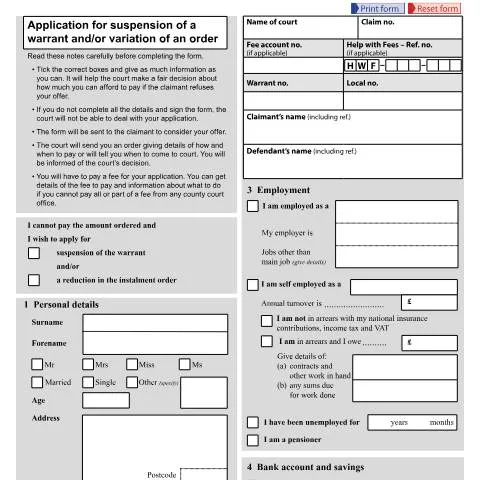
When Court Enforcement Becomes Unmanageable: The N245 Lifeline
The knock at the door from a bailiff, the threat of goods being seized, or the realisation that a court-ordered payment plan has become impossible to maintain – these scenarios drive thousands of people to complete Form N245 each year. This application form serves as a crucial safety valve within the enforcement system, allowing debtors to formally request that HM Courts & Tribunals Service either suspend an active warrant or adjust the terms of existing court-ordered payments when financial circumstances have deteriorated beyond their control.
The form represents more than a simple administrative procedure; it embodies the principle that enforcement should be proportionate and that courts must consider a person's genuine ability to pay. Whether facing redundancy, illness, family breakdown, or other financial catastrophe, the N245 provides a structured mechanism to communicate changed circumstances to the court and propose realistic alternative arrangements.
Understanding this form's intricacies becomes essential when standard payment arrangements fail, as incorrect completion can result in rejection, continued enforcement action, and mounting costs that compound an already difficult situation.
Navigating the Two-Pronged Relief System
Form N245 addresses two distinct but often interconnected enforcement scenarios. Warrant suspension applies when bailiffs have been authorised to seize goods or take other enforcement action, while variation of payment orders concerns modifying existing instalment arrangements that have become unaffordable.
The warrant suspension element proves particularly urgent. Once a warrant of execution is issued, bailiffs typically have twelve months to enforce it, and they may visit without further notice. The N245 application can halt this process, but timing becomes critical – applications made after goods have been seized face additional complications and costs.
Payment order variations, meanwhile, recognise that circumstances change. A monthly payment that seemed manageable when originally set may become impossible following job loss, reduced hours, increased childcare responsibilities, or unexpected expenses. The court retains discretion to adjust these arrangements, but requires comprehensive evidence of the changed financial position.
The Strategic Timing Element
Successful N245 applications often depend on timing. Courts view favourably applications made promptly after circumstances change, demonstrating proactive engagement rather than avoidance. Conversely, applications submitted only after multiple missed payments or when bailiffs are already active may face greater scrutiny and scepticism about the applicant's intentions.
The form itself makes clear that once submitted, it will be sent to the claimant (the person owed money) for their consideration. This creates a negotiation opportunity – reasonable offers backed by detailed financial disclosure often receive acceptance, avoiding the need for a court hearing.
Dissecting the Financial Disclosure Requirements
The heart of Form N245 lies in sections 3 through 10, which create a comprehensive financial snapshot. This disclosure goes far beyond simple income and expenditure – it requires detailed analysis of employment status, savings, property ownership, and existing debt obligations.
Section 3's employment details demand particular attention. Self-employed applicants must declare annual turnover and specify whether they're current with National Insurance contributions, income tax, and VAT obligations. Arrears in these areas can significantly impact credibility, as courts expect applicants to prioritise statutory obligations. The section also requires disclosure of contracts and work in hand, recognising that self-employed income often fluctuates significantly.
The Dependants Calculation Challenge
Section 2's dependants information directly affects affordability calculations. Courts recognise that supporting children or other dependants reduces available income for debt payments. However, the definition extends beyond biological children to include anyone the applicant supports financially, such as elderly parents or disabled relatives. Ages and dates of birth allow courts to verify dependency periods and calculate appropriate household living costs.
| Dependency Type | Documentation Typically Required | Impact on Assessment |
|---|---|---|
| Children under 16 | Birth certificates, Child Benefit statements | Higher living allowances applied |
| Children 16-19 in education | School/college enrollment proof | Continued dependency recognised |
| Disabled dependants | DWP disability assessments | Additional care costs considered |
| Elderly relatives | Financial support evidence | Reduced disposable income acknowledged |
Banking and Savings Transparency
Sections 4 and 5 require complete disclosure of financial resources. Courts scrutinise bank account details closely – significant credit balances may suggest ability to make lump sum payments, while persistent overdrafts demonstrate genuine financial pressure. Building society accounts, ISAs, premium bonds, and other savings vehicles must all be declared, as courts can order these to be used before granting payment reductions.
Property ownership details in section 5 affect both credibility and enforcement options. Owner-occupiers may face suggestions to remortgage or sell, while tenants must demonstrate that rent payments represent necessary expenses rather than lifestyle choices.
Constructing a Credible Offer Strategy
Section 11's payment offer represents the application's culmination, where mathematical calculation meets practical reality. The form provides a basic formula – subtracting total expenses, priority debts, court order payments, and credit commitments from total income – but courts expect more sophisticated analysis.
Priority debts listed in section 8 receive preferential treatment, as these can lead to loss of home, essential services, or liberty. Rent and mortgage arrears, council tax debts, utility arrears, and maintenance payments typically take precedence over commercial creditors. Courts expect realistic proposals for addressing these alongside the current application.
The distinction between regular expenses in section 7 and priority debt arrears in section 8 proves crucial. Regular mortgage payments represent ongoing commitments, while mortgage arrears constitute priority debts requiring separate attention. Confusing these categories can undermine the application's credibility.
The Psychology of Reasonable Offers
Courts and claimants respond more favourably to offers that demonstrate genuine effort rather than token amounts. A £5 monthly offer on a £10,000 debt may seem insulting, even if it represents the applicant's genuine capacity. Better to offer £20 monthly with clear evidence of tight budgeting than £5 with unexplained income surplus.
The form allows for immediate lump sum payments alongside monthly instalments. Even modest upfront payments – perhaps from selling unnecessary items or borrowing from family – can demonstrate commitment and encourage acceptance of lower monthly amounts.
Court Processing Procedures and Timescales
Once submitted, N245 applications follow established administrative procedures within HM Courts & Tribunals Service. The court first checks completeness – incomplete forms face immediate rejection, causing delays while enforcement continues. Complete applications are then forwarded to the claimant or their representatives for consideration.
This claimant consideration period typically lasts 14 days, though no statutory timeframe applies. Commercial creditors often respond quickly, while individuals may take longer to consider proposals. If the claimant accepts the offer, the court issues a varied order without requiring a hearing. Rejection or counter-proposals trigger the next procedural stage.
Disputed applications require court determination, usually at brief hearings before District Judges. These hearings focus on affordability evidence rather than the underlying debt's validity – the original judgment established liability, leaving only payment terms for determination.
The Fee Structure and Help with Fees
N245 applications require fees, though the exact amount depends on the application type and court location. The form provides space for Help with Fees reference numbers, recognising that many applicants face genuine financial hardship. Successful Help with Fees applications can reduce or eliminate these costs, though processing delays may occur.
Fee payment becomes particularly important for warrant suspension applications, where urgency often necessitates immediate payment to halt enforcement action. Courts may accept cheques or postal orders, but telephone payments or online systems often provide faster processing for time-sensitive applications.
When Applications Face Rejection or Challenge
Not all N245 applications succeed, and understanding potential rejection reasons helps avoid common pitfalls. Courts may reject applications that lack supporting evidence, propose unrealistic payment terms, or fail to address priority debts adequately. Claimants might challenge applications they consider unreasonable or suspect of hiding assets or income.
Insufficient income evidence represents the most common rejection reason. Bank statements, payslips, benefit statements, and tax returns provide objective verification of declared income. Self-employed applicants face particular scrutiny, as declared turnover may not reflect actual available income after business expenses.
Excessive expenditure claims also trigger rejection. Courts apply standard living cost guidelines and may question expenses that seem disproportionate to income or family size. Luxury items, expensive hobbies, or premium service contracts may face challenges, with courts expecting applicants to demonstrate reasonable lifestyle adjustments.
The Appeals and Variation Process
Rejected N245 applications don't necessarily end the process. Applicants can submit fresh applications with additional evidence, corrected calculations, or modified offers. Courts may also suggest alternative arrangements during hearings, allowing negotiated settlements that address both parties' concerns.
Circumstances continuing to change after successful applications may justify further variations. Job loss after securing reduced payments, family changes, or health problems can all warrant fresh N245 submissions. Courts generally accept that financial situations remain fluid, particularly during economic uncertainty.
Special Circumstances and Complex Cases
Certain situations require additional consideration when completing Form N245. Self-employed applicants must provide more detailed business information, including recent accounts, ongoing contracts, and seasonal variations in income. Courts recognise that self-employment income fluctuates, but expect realistic assessments based on typical earning patterns rather than worst-case scenarios.
Pension-age applicants face different assessment criteria, with courts recognising fixed incomes and potential health-related expenses. State pension income provides stable baseline figures, while private pension arrangements may offer more flexibility in payment timing.
Benefit recipients must declare all income sources, including Universal Credit, Employment and Support Allowance, or Jobseeker's Allowance. Courts apply benefit protection rules, preventing seizure of essential benefit payments while expecting reasonable contributions from any surplus income.
Multiple Court Orders and Competing Claims
Section 9 addresses situations where multiple court orders exist, requiring careful prioritisation. Courts expect applicants to propose realistic distributions between competing creditors, often based on debt sizes, ages, and creditor types. Statutory debts typically receive priority, followed by secured creditors and judgment debts.
The form's requirement to specify which court order payments are in arrears helps courts understand the broader debt situation. Applicants maintaining some payments while struggling with others may receive more sympathetic treatment than those defaulting across all obligations.
Maximising Success Through Preparation and Presentation
Successful N245 applications combine accurate financial disclosure with realistic proposals and supporting evidence. The key lies in presenting a complete, honest picture that demonstrates both genuine hardship and sincere intention to meet obligations within available means.
Documentation standards matter significantly. Bank statements should cover recent months to show typical account activity, while benefit letters must reflect current entitlements rather than outdated awards. Employment contracts, payslips, and redundancy notices provide objective verification of declared circumstances.
The application's tone and presentation also influence outcomes. Professional, respectful language acknowledging the debt's validity while explaining changed circumstances typically receives better reception than defensive or aggressive approaches. Courts appreciate applications that demonstrate understanding of creditors' positions while asserting legitimate financial constraints.
Form N245 ultimately represents a balancing act between enforcement necessity and payment reality. Success requires honest assessment of financial circumstances, realistic proposals for debt resolution, and clear communication of genuine constraints. When completed thoroughly and submitted promptly, it provides an effective mechanism for achieving workable payment arrangements that serve both creditors' recovery interests and debtors' capacity to maintain essential living standards while meeting their legal obligations.
Understanding the Legal Framework Behind Form N245 Applications
The Form N245 application operates within a sophisticated legal framework governed by the Civil Procedure Rules (CPR), particularly Part 83 which deals with writs and warrants generally, and specific provisions under the Tribunals, Courts and Enforcement Act 2007. When you submit a Form N245, you're essentially asking the court to exercise its inherent jurisdiction to review and potentially modify enforcement proceedings that may have become inappropriate due to changed circumstances.
The court's power to suspend warrants stems from its equitable jurisdiction, meaning judges can consider fairness alongside strict legal entitlements. This is particularly relevant when dealing with vulnerable debtors, those experiencing temporary financial hardship, or situations where the original debt circumstances have materially altered. The court must balance the creditor's legitimate right to recover their debt against the debtor's capacity to pay and their fundamental needs for shelter, sustenance, and dignity.
Under CPR Rule 83.7, the court has discretionary powers to stay, suspend, or set aside warrants of execution. This discretion isn't unlimited – judges must consider established case law principles, including the debtor's conduct, their efforts to engage with the debt, and whether any proposed payment arrangement is realistic and fair to both parties. The landmark case of Tomlin v Standard Telephones and Cables Ltd established that courts should consider the debtor's entire financial picture, not just their ability to service the specific debt in question.
Fill in your form directly online
No printing: type your details into the boxes of the official form, tick, then download the PDF ready to send.
- 1Type into the form boxes
- 2Tick in one click
- 3Save and download the PDF
For warrant suspension applications, the court will typically apply the "means and reasonableness" test. This involves assessing whether the debtor has demonstrated genuine inability to pay the full amount immediately, whether they've made reasonable efforts to communicate with the creditor, and whether their proposed payment plan shows good faith and realistic prospects of completion. The court may also consider external factors such as employment prospects, health issues, or caring responsibilities that affect the debtor's financial capacity.
When varying payment arrangements, different legal principles apply. The court must ensure that any new payment schedule doesn't render the original judgment meaningless through excessive delay, whilst also ensuring the debtor isn't pushed into destitution. The Insolvency Service's guidance on reasonable living expenses often influences judicial decisions, even though Form N245 applications don't fall under insolvency legislation. Judges frequently refer to these guidelines when assessing whether proposed payment amounts leave sufficient funds for essential household needs.
Specific Scenarios and Strategic Considerations for Different Debtor Profiles
The success rate and approach for Form N245 applications varies significantly depending on your specific circumstances and debtor profile. Understanding which category you fall into can help you tailor your application more effectively and set realistic expectations about likely outcomes.
Employed Debtors with Steady Income: If you're in regular employment, courts generally expect more substantial payment offers and shorter repayment periods. Your application should demonstrate that you've calculated a realistic monthly payment based on your actual disposable income after essential expenses. Courts are often sympathetic to temporary reductions in income due to reduced hours or pay cuts, but you'll need to provide evidence such as recent payslips showing the change. For employed debtors, the court may suggest attachment of earnings as an alternative to warrant suspension, particularly if your employment is stable and your proposed payments seem artificially low.
Self-Employed and Freelance Workers: Variable income creates particular challenges for Form N245 applications. Courts understand that self-employed income fluctuates, but they expect you to provide comprehensive evidence of your typical earnings patterns. This might include bank statements covering several months, recent tax returns, or accountant's letters confirming your average income. Your proposed payment plan should reflect seasonal variations or business cycles. For instance, if you're a landscaper with higher summer earnings, the court might approve a variable payment schedule that acknowledges these fluctuations.
Benefit Recipients and Those on Universal Credit: Debtors whose primary income comes from benefits face unique considerations. Courts generally recognise that benefit levels are set to meet basic needs, leaving little room for debt repayment. However, this doesn't automatically guarantee warrant suspension – you'll need to demonstrate that you've maximised your income through benefit checks and that any proposed payments won't compromise your ability to meet essential needs. The court may be more receptive to very small payments (sometimes as low as £5-10 monthly) if you can show consistent payment history and genuine engagement with the debt.
Homeowners Facing Warrant of Possession: Property-related warrants require particularly careful handling in Form N245 applications. If you're facing eviction due to mortgage arrears, the court will expect to see evidence that you've engaged with your lender's pre-action protocol requirements. This includes demonstrating that you've sought debt advice, explored all available options (such as payment holidays or term extensions), and that your proposed payment plan addresses both ongoing mortgage payments and arrears reduction. Courts are generally more willing to suspend possession warrants when homeowners can demonstrate a clear path to resolving the underlying financial difficulties.
Tenants Facing Eviction for Rent Arrears: Rental arrears cases often involve additional complexity because they may include claims for ongoing use and occupation charges. Your Form N245 application should address both historical arrears and your ability to maintain current rent payments going forward. Courts frequently require tenants to demonstrate that the circumstances causing the arrears have been resolved – for example, by providing evidence of benefit awards that were delayed, or new employment that provides sufficient income to meet ongoing obligations.
Business Debtors and Company Directors: Commercial debts require a different approach, particularly if you're personally liable for company debts through personal guarantees. The court will expect detailed financial information about both personal and business assets and liabilities. You may need to provide evidence that the business is viable going forward, or conversely, that it's being wound down in an orderly fashion. Courts are often less sympathetic to applications that appear to be delaying tactics in failing businesses, but may be receptive if you can demonstrate genuine prospects of recovery or orderly asset realisation.
Post-Decision Procedures and Ongoing Compliance Requirements
Successfully obtaining a warrant suspension or payment variation through Form N245 is only the beginning of an ongoing legal relationship with both the court and your creditor. Understanding your obligations and the potential consequences of non-compliance is crucial for maintaining the protection you've gained and avoiding more severe enforcement action.
Immediate Post-Decision Requirements: Once the court grants your application, you'll typically receive a formal order setting out the terms of the suspension or variation. This order becomes legally binding immediately, and you must comply with its terms precisely. The order will usually specify exact payment amounts, due dates (often monthly), and the method of payment. Some orders include specific requirements such as providing annual financial updates to the court or creditor, or notifying them immediately if your financial circumstances change significantly.
Payment compliance must be exact and punctual. Courts have little tolerance for debtors who fail to maintain payments they've specifically requested and been granted. Even a single missed payment can result in the creditor applying to lift the suspension and proceed with immediate enforcement. When making payments, always retain proof of payment and ensure they're clearly referenced to the case number and your name to avoid any disputes about whether payments have been made.
Financial Monitoring and Reporting Obligations: Many court orders include ongoing monitoring requirements. You might be required to provide updated financial statements annually, or whenever your circumstances change materially. "Material change" typically means any alteration in income of more than 10-15%, changes in employment status, receipt of windfalls (such as inheritance or insurance payouts), or significant changes in essential expenditure. Failure to report material improvements in your financial position can result in the court treating this as contempt, potentially leading to more severe penalties.
If your financial situation improves significantly, you're generally expected to apply to increase your payment amounts voluntarily. Courts view this favourably and it demonstrates good faith engagement with the process. Conversely, if your situation deteriorates, you should apply promptly for a further variation rather than simply stopping payments. The court is more likely to be sympathetic to applications made before you fall into arrears on the court order.
Creditor Rights and Enforcement Options: Your creditor retains significant rights even after a successful Form N245 application. They can apply to lift the suspension if you breach the payment terms, and they may continue to add statutory interest to the outstanding balance (unless the court order specifically states otherwise). Creditors can also apply for information about your financial circumstances through examination procedures, requiring you to attend court to answer questions about your assets and income under oath.
Understanding these ongoing risks helps you maintain compliance and avoid actions that might jeopardise your position. For instance, making large purchases or taking expensive holidays while claiming inability to increase debt payments could be viewed as acting in bad faith, potentially leading to the suspension being lifted and immediate enforcement action resumed.
Long-term Strategic Planning: Successful Form N245 applicants should develop long-term strategies for full debt resolution. This might involve gradually increasing payments as financial circumstances improve, exploring debt consolidation options, or setting aside additional funds when possible to make lump-sum offers for final settlement. Many creditors are willing to accept reduced settlements if offered a substantial immediate payment, particularly for older debts where collection costs are mounting.
Consider also the impact on your credit rating and future borrowing capacity. While court judgments remain on credit files for six years, maintaining consistent payments under a court order can demonstrate financial responsibility to future lenders. Some creditors will mark accounts as "satisfied" once payment plans are successfully completed, which can help with credit rehabilitation.
Regular review of your financial position is essential. Set calendar reminders to reassess your budget quarterly, and consider whether you can afford to increase payments or make occasional additional payments to reduce the capital balance. This proactive approach not only reduces the overall cost of the debt (through reduced interest accumulation) but also demonstrates good faith that may be beneficial if you need to make future applications to the court.