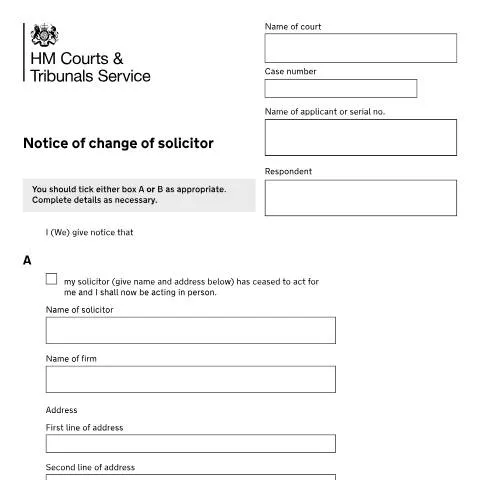
When Legal Representation Changes Mid-Case: The FP8 Notification Process
Family court proceedings rarely follow a straight path, and one of the most common disruptions occurs when legal representation changes during an ongoing case. Whether a solicitor withdraws from acting, a client decides to represent themselves, or new legal counsel is appointed, the court must be formally notified through Form FP8 - Notice of Change of Solicitor. This seemingly straightforward administrative step carries significant implications for case management, service of documents, and the protection of all parties' procedural rights.
The FP8 serves as the official mechanism to ensure the court's records remain accurate and that all future correspondence reaches the correct recipient. Without proper notification, documents could be sent to former solicitors who no longer represent a party, potentially causing delays, missed deadlines, or procedural unfairness that could undermine the entire case.
Understanding the Two Pathways: Self-Representation and New Instruction
Form FP8 addresses two distinct scenarios through its dual-track structure, each requiring different information and having different procedural consequences.
Section A: Transition to Litigant in Person Status
When a party's solicitor ceases to act and the individual will continue proceedings without legal representation, Section A must be completed. This transition typically occurs for several reasons:
- Financial constraints: Legal aid has been withdrawn or private funding has been exhausted
- Professional relationship breakdown: Irreconcilable differences between client and solicitor regarding case strategy
- Solicitor withdrawal: The legal representative can no longer continue acting due to professional conduct issues or conflicts of interest
- Strategic decision: The client chooses to represent themselves for personal or tactical reasons
Section A requires comprehensive details of the departing solicitor, including their full name, firm details, and complete address. This information ensures the court can verify the change and prevent any confusion about who previously held conduct of the case.
Section B: Appointment of New Legal Representation
The alternative pathway involves the appointment of new solicitors to replace previous legal representation. Section B captures both the incoming and outgoing solicitor details, creating a clear audit trail of representation changes.
This scenario commonly arises when:
- A client transfers to a specialist family law firm
- The previous solicitor's firm dissolves or merges
- Conflicts of interest emerge requiring new representation
- The client relocates and requires local legal representation
Critically, Section B includes a declaration that notice of the change has been served on every party in the application and the former solicitor. This service requirement prevents parties from being blindsided by representation changes and ensures procedural fairness.
Service Requirements and Procedural Safeguards
The FP8 process incorporates several safeguards to protect all parties' interests and maintain procedural integrity. The service obligations differ depending on which section applies.
Mandatory Service to All Parties
When new solicitors are appointed (Section B), they must serve notice on:
- Every other party to the proceedings
- The former solicitor being replaced
- The court itself
This comprehensive service requirement prevents situations where opposing parties continue corresponding with solicitors who no longer have authority to act. Such miscommunication could lead to procedural irregularities, missed opportunities for settlement, or unfair tactical advantages.
Timing Considerations and Deadlines
While the FP8 form itself doesn't specify mandatory timeframes, prompt notification is essential. Family court cases often involve tight deadlines for evidence filing, hearings, and compliance with court orders. Delays in notifying representation changes can result in:
- Important documents being sent to the wrong address
- Missed court hearings due to inadequate notice
- Procedural applications being invalid due to incorrect service
- Costs sanctions against parties who fail to maintain proper communication channels
Completing Section C: Establishing New Communication Channels
Section C of the FP8 focuses entirely on establishing reliable communication channels with new legal representation. This section requires detailed contact information that goes beyond basic correspondence needs.
Essential Contact Details
| Required Information | Purpose | Critical Considerations |
|---|---|---|
| Solicitor's full name and firm | Formal identification for court records | Must match Law Society registration details |
| Complete postal address | Service of court documents and orders | Should be the firm's principal office or designated service address |
| Telephone number | Urgent communications and hearing notifications | Must be monitored during business hours |
| Email address | Electronic service and case management communications | Should comply with professional email standards |
| DX number | Document exchange services | Essential for rapid document transmission between legal representatives |
| Reference number | File identification and billing | Helps prevent cross-contamination between similar cases |
The Significance of DX Numbers
The Document Exchange (DX) system remains a cornerstone of legal communication in England and Wales. Including a DX number on the FP8 signals to the court and other parties that the solicitor participates in this rapid document transmission network. This can significantly accelerate the exchange of time-sensitive documents, particularly important in family cases involving child welfare or urgent financial applications.
Signature Requirements and Authority to Act
The signature section of Form FP8 reveals important nuances about legal authority and representation status in family proceedings.
Who Can Sign the Form
The form provides six distinct signature options:
- Applicant: When transitioning to self-representation or confirming new instruction
- Applicant's solicitor: When acting under existing authority or new instruction
- Applicant's litigation friend: For protected parties including children or adults lacking mental capacity
- Respondent: Corresponding roles for the responding party
- Respondent's solicitor: Acting with proper authority
- Respondent's litigation friend: For protected respondents
Corporate and Institutional Signatures
The form specifically requires individuals signing on behalf of firms or companies to state their position or office held. This requirement reflects the legal principle that only properly authorised individuals can bind legal entities. Partners, directors, or specifically authorised employees must clearly identify their role to validate their signature.
Dating Requirements and Legal Effect
The date field requires completion in the standard UK format (day/month/year), and this date carries legal significance. It establishes when the change of representation takes effect, which can impact:
- Liability for ongoing legal costs
- Authority to receive confidential information
- Responsibility for compliance with existing court orders
- Service obligations for future court documents
Strategic Implications and Case Management Considerations
Changes in legal representation often occur at critical junctures in family proceedings, and the timing can significantly impact case outcomes.
Impact on Ongoing Proceedings
When representation changes occur during active proceedings, several practical considerations arise:
Continuity of case knowledge: New solicitors must rapidly familiarise themselves with case history, previous court orders, and ongoing obligations. This transition period can create vulnerabilities if not managed carefully.
Hearing preparedness: If representation changes shortly before significant hearings, the court may need to consider adjournment applications to ensure fair representation. However, such applications are not automatically granted and may result in cost consequences.
Settlement negotiations: Ongoing settlement discussions may be disrupted by representation changes, particularly if the new solicitor adopts a different strategic approach or needs time to assess the case merits.
Financial Implications and Cost Management
Representation changes can trigger various financial consequences that extend beyond the obvious transition costs:
- Liability for accrued costs: Clients remain responsible for legal costs incurred by previous solicitors, even after representation ends
- Security for costs applications: Opposing parties may seek security for their legal costs if representation changes suggest financial instability
- Legal aid implications: Changes may require new legal aid applications or assessments, potentially affecting case funding
- Duplicate work costs: New solicitors often need to review entire case files, creating additional billable hours
Common Complications and Resolution Strategies
The FP8 process, while seemingly straightforward, can encounter various complications that require careful navigation.
Disputed Representation Changes
Occasionally, disputes arise about whether a solicitor has properly ceased to act or whether new instructions are validly given. These situations typically involve:
Unpaid legal fees: Solicitors may assert a lien over case files until outstanding fees are paid, complicating the transition to new representation.
Capacity concerns: Questions may arise about a client's mental capacity to instruct new solicitors, particularly in cases involving vulnerable adults.
Authority disputes: Family disputes sometimes extend to disagreements about who has authority to instruct legal representation, especially in cases involving children or disputed financial arrangements.
Incomplete or Defective FP8 Forms
Courts may reject FP8 forms that contain errors or omissions, potentially causing procedural delays. Common defects include:
- Incorrect case numbers or party names
- Missing signature or date information
- Incomplete service details for new solicitors
- Failure to specify whether acting for applicant or respondent
- Missing evidence of service on other parties (Section B cases)
When defects are identified, the court typically provides an opportunity to file an amended form, but this can delay case progression and potentially affect hearing schedules.
Cross-Border Representation Issues
Family cases involving parties in different UK jurisdictions can complicate representation changes. Scottish or Northern Irish solicitors may have limited rights of audience in English and Welsh family courts, requiring careful consideration of representation arrangements and potential collaboration with local counsel.
Electronic Filing and Modern Court Administration
While Form FP8 maintains traditional paper-based formatting, many family courts now accept electronic filing through various digital platforms. This modernisation creates both opportunities and challenges for representation changes.
Digital Service and Communication
Electronic filing of FP8 forms can accelerate the notification process, but it requires careful attention to:
- Digital signature validity: Ensuring electronic signatures meet legal requirements for court documents
- Email service protocols: Following court-specific rules for electronic service on other parties
- System access transfer: Arranging for new solicitors to gain access to electronic case management systems
- Security considerations: Protecting confidential client information during electronic transmission
Integration with Case Management Systems
Modern family courts increasingly rely on integrated case management systems that automatically update party and representative information across multiple databases. Proper completion of the FP8 ensures these systems maintain accurate records, preventing administrative errors that could compromise case management efficiency.
The shift toward digital court administration also means that representation changes must be communicated not only to human court staff but also to automated systems that generate hearing notices, case progression orders, and other routine communications. Incomplete or inaccurate FP8 information can disrupt these automated processes, potentially affecting case timelines and procedural compliance.
As family court procedures continue evolving toward greater digitisation, the humble FP8 form remains a crucial bridge between traditional legal practice and modern case management requirements, ensuring that changes in representation are properly documented and communicated regardless of the technological framework supporting the proceedings.
When Multiple Changes Occur: Managing Sequential Legal Representation Updates
Complex family proceedings often involve multiple changes in legal representation throughout the case lifecycle. Understanding how to manage sequential updates using Form FP8 becomes crucial when solicitors withdraw, barristers are instructed separately, or parties switch between represented and self-represented status multiple times.
When a second change occurs before the first FP8 has been processed, you must still submit separate forms for each change. The court requires a clear chronological record, so if your original solicitor withdrew on 15th March and you appointed new representation on 22nd March, file the first FP8 for the withdrawal, then a second FP8 for the new appointment once it's finalised.
Fill in your form directly online
No printing: type your details into the boxes of the official form, tick, then download the PDF ready to send.
- 1Type into the form boxes
- 2Tick in one click
- 3Save and download the PDF
Sequential changes create particular challenges in ongoing proceedings. If hearings are scheduled between representation changes, you must immediately notify the court by telephone, followed by the written FP8. The listing office needs to know whether to serve documents on your former representatives or directly to you during transition periods.
For parties switching between direct access barristers and solicitor-led representation, the notification requirements differ slightly. When moving from a direct access barrister to a solicitor, your new solicitor typically handles the FP8 submission as part of their file opening procedures. However, when transitioning from solicitor representation to direct access, you're usually responsible for submitting the form yourself, though your departing solicitor may assist as a final service.
Particular attention is required when changes occur during appeal periods. If you're considering an appeal and your representation changes, the FP8 must clearly indicate whether the new representatives will handle the appeal or if you're proceeding as a litigant in person. Appeal deadlines continue running regardless of representation changes, so immediate notification prevents procedural complications.
Emergency representation changes, such as when a solicitor becomes unavailable due to illness or practice closure, require expedited FP8 processing. While the standard form is still required, you should contact the court office directly to explain the urgency. Some courts may accept telephone notification followed by same-day email submission of the completed FP8, particularly if imminent hearings are affected.
Electronic Filing and Digital Case Management Considerations
The increasing digitisation of family court processes affects how Form FP8 integrations with electronic case management systems. While the form itself remains largely paper-based or basic PDF submission, understanding the digital implications ensures smoother processing and reduces administrative delays.
Most family courts now use the Common Platform or legacy systems that automatically update party representation details once FP8 is processed. However, this electronic updating typically occurs within 2-3 working days of form submission, creating a window where court records may not reflect current representation status. During this period, documents might still be served on former representatives or sent to outdated addresses.
When submitting FP8 electronically, ensure all fields are completed in a format compatible with court data entry systems. Incomplete postcodes, missing email addresses, or incorrectly formatted telephone numbers can cause processing delays. The court's administrative staff must manually input FP8 data into case management systems, so clear, complete information expedites the process.
For cases involving multiple jurisdictions or transferred proceedings, electronic records don't always synchronise immediately between court centres. If your case has been transferred from one family court to another, your FP8 submission should reference both the original and current case numbers. This helps administrative staff locate the correct electronic file and update representation details across all relevant systems.
Digital document service presents particular considerations when representation changes occur. If your case involves electronic document exchange through professional platforms, the FP8 change affects not only court records but also service arrangements between parties. Your new representatives must be set up on any existing digital service protocols, which can take additional time beyond the basic FP8 processing.
Court hearing dial-in details and video conference access codes are typically sent to registered legal representatives. When FP8 processing is delayed, parties risk missing hearing access information. For urgent hearings occurring within days of representation changes, contact the court's listing office directly to ensure new representatives receive necessary access details promptly.
Some courts now accept FP8 submissions through online portals, though this varies by jurisdiction. Where available, online submission provides immediate confirmation of receipt and often faster processing than postal submission. However, you must still ensure hard copy documents reach the court file, as not all systems automatically print and file electronic submissions.
Special Circumstances and Exceptional Procedures
Certain family law scenarios require modified approaches to Form FP8 submission, reflecting the sensitive nature of family proceedings and protection requirements for vulnerable parties.
In cases involving domestic abuse where address confidentiality is crucial, Form FP8 submissions require careful handling. If you're changing representation due to safety concerns about your current solicitor's office location or security arrangements, you may request that your new representative's address details be kept confidential from other parties. This requires specific notation on the FP8 and may involve separate correspondence with the court's security officer.
Children's proceedings present unique FP8 considerations, particularly when children's guardians or CAFCASS officers are involved. Changes to children's legal representation must be coordinated with existing safeguarding arrangements. The FP8 should clearly indicate whether the representation change affects only adult parties or includes separate representation for children, as this impacts court scheduling and document service protocols.
International family cases, particularly those involving Brussels II bis regulations or Hague Convention proceedings, require enhanced detail in FP8 submissions. When representation changes occur in cross-border cases, the form should specify whether new representatives are qualified to handle international elements or if separate specialist counsel will be instructed for those aspects.
Mental capacity considerations add complexity to FP8 procedures. If a party lacks capacity to instruct representatives directly, changes in legal representation typically require Court of Protection involvement or litigation friend arrangements. The FP8 must clearly identify the authority under which representation changes are made and may require supporting documentation about capacity assessments or best interests decisions.
High-conflict cases where parties have extensive litigation history may have specific court directions about representation changes. Some judges issue orders requiring advance permission before representation changes, particularly if previous changes have caused procedural delays. Check existing court orders carefully before submitting FP8 in long-running cases, as additional permissions may be required.
For cases involving McKenzie friends transitioning to formal legal representation, the FP8 process differs from standard representation changes. McKenzie friends don't appear on court records as legal representatives, so the change represents new representation rather than replacement representation. This distinction affects how the court processes the form and updates its records.
Emergency protection proceedings require expedited FP8 handling due to the urgent nature of such cases. If representation changes occur during emergency applications or interim hearings, telephone notification to the court is essential, followed by immediate FP8 submission. Some courts maintain out-of-hours contact procedures for such scenarios, though these are typically reserved for genuine emergencies affecting child welfare.