Understanding the Context of Form D5 in Legal Proceedings
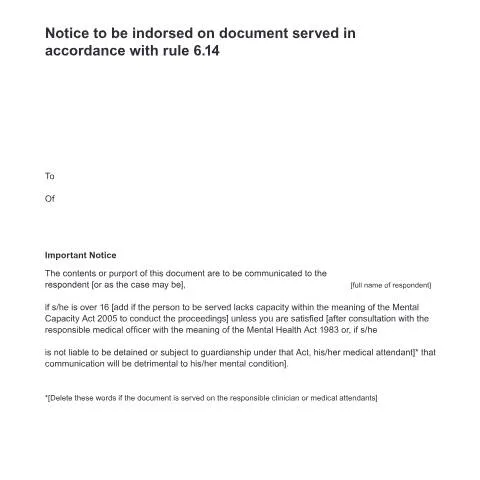
When involved in legal proceedings within the UK, particularly in family law or mental health contexts, the importance of complying with procedural rules cannot be understated. The Notice to be indorsed on document served in accordance with rule 6.14: Form D5 serves as a critical instrument for ensuring that the communication process adheres to established legal protocols. This notice is pivotal when documents are served to respondents, especially concerning their mental well-being and legal capacity.
The Audience and Importance of Form D5
This notice is specifically designed for legal practitioners and individuals engaged in proceedings where a respondent must be served legal documents. Understanding whom exactly this form addresses is essential for effective legal communication.
- Legal Professionals: Solicitors and barristers must be familiar with the implications of the D5 notice in legal documentation.
- Individuals Involved in Proceedings: This includes anyone acting on behalf of a respondent, particularly in family law cases or mental health proceedings.
- Support Networks: Family members or guardians of individuals with diminished capacity may also need to understand this notice to navigate the process appropriately.
Situations Where Form D5 Becomes Indispensable
There are specific scenarios where the use of Form D5 is not merely advisable but essential:
- When serving documents to respondents who are over the age of 16 and may have mental health concerns.
- In cases where the respondent lacks the mental capacity to understand the proceedings, necessitating additional protocols to protect their interests.
- When the proceedings involve sensitive information that could adversely affect the respondent's mental health if communicated improperly.
Interpreting the Legal Language: Key Concepts
The language used within Form D5 can often be complex and laden with legal jargon. A clear understanding of its key terms is crucial for proper application:
- Respondent: This term refers to the individual who is required to respond to the legal proceedings initiated against them.
- Mental Capacity: Refers to an individual's ability to understand and participate in legal processes, as defined under the Mental Capacity Act 2005.
- Responsible Medical Officer: A qualified health professional who can assess the respondent's mental health condition and communicate their capacity accurately.
Navigating Common Procedural Questions
Legal processes can often lead to confusion regarding procedural rules. Here are some commonly encountered questions related to Form D5:
- What if the respondent is unable to understand the notice? In such cases, it is imperative to consult with a responsible medical officer to ensure that proper protocols are followed for communication.
- Can the notice be served if the respondent is not present? Yes, but it should be done in accordance with the rules outlined in the Family Procedure Rules and the provisions of the Mental Health Act 1983.
- What happens if the notice is not served correctly? Failure to comply with the procedural requirements may result in delays or complications in the legal proceedings.
Exploring the Interconnectivity with Other Legal Documents
Form D5 does not exist in isolation; it is part of a broader framework of legal documentation that includes various forms and notices. Understanding how it connects with other documents is vital for effective legal practice:
| Document | Purpose | Relation to Form D5 |
|---|---|---|
| Form D50 | Application for a Parenting Order | May require D5 when serving notice to parents |
| Form M1 | Request for Assessment of Mental Capacity | Use alongside D5 to address mental capacity issues |
| Notice of Hearing | Informs parties of upcoming court dates | Must include D5 if respondents have mental health concerns |
Practical Steps for Using Form D5 Effectively
Utilizing Form D5 effectively involves a series of calculated steps to ensure compliance with legal requirements:
- Identify the Respondent: Confirm the legal identity of the respondent, ensuring age and mental capacity are appropriately assessed.
- Consult Professionals: Engage with mental health professionals to determine the best approach for serving notice without causing distress.
- Serve with Care: Deliver the notice in a way that is sensitive to the respondent’s condition, adhering to any recommendations provided by health professionals.
- Keep Records: Document each step taken in serving the notice, including consultations and the method of delivery, to ensure compliance can be demonstrated if needed.
What Form D5 Covers and Its Limitations
While Form D5 is comprehensive in addressing communication requirements, it does have limitations that must be acknowledged:
- Scope of Use: The notice is specifically tailored for situations defined under rule 6.14 and may not be applicable in other legal contexts.
- Conditions of Service: The effectiveness of the notice depends critically on the respondent's mental health status being accurately assessed.
- Legal Implications: Failure to follow the guidelines outlined in Form D5 can lead to legal repercussions or challenges in court.
Final Thoughts on Navigating Form D5 in Legal Processes
In the intricate landscape of legal proceedings in the UK, the Notice to be indorsed on document served in accordance with rule 6.14: Form D5 serves as an essential tool for ensuring that communication with respondents is conducted with sensitivity and care. By understanding its purpose, the intended audience, and the proper procedural steps, legal practitioners and individuals can navigate the complexities of their cases with greater confidence. It is imperative to remain vigilant about the nuances of this notice, especially in contexts involving vulnerable individuals, to uphold the integrity of the legal process.
Understanding Rule 6.14: The Importance of Proper Indorsement
Rule 6.14 of the Civil Procedure Rules (CPR) governs the manner in which certain documents must be served in the UK legal system. This rule is particularly significant as it outlines the requirements for serving documents in a way that ensures the recipient receives proper notice. For documents that are served according to this rule, the indorsement on the document — using Form D5 — is crucial.
The purpose of the indorsement is to provide an official notice to the recipient about the nature of the document being served, as well as to affirm the proper methods that have been followed during the service process. This includes specifying the date, time, and method of service. It is essential to comply with these requirements as failure to do so may lead to complications or delays in legal proceedings.
When filling out Form D5, it is vital to include detailed information about the document served, the parties involved, and any relevant case numbers. If you are uncertain about the particulars to include or how to correctly complete Form D5, consulting a legal professional is advisable to avoid any breaches of procedure that could impact your case.
Scenarios Requiring Indorsement on Documents
There are several scenarios in which the indorsement of documents served in accordance with Rule 6.14 becomes essential. Understanding these scenarios can help ensure compliance with legal expectations and protect the integrity of the serving process.
1. Personal Service: When documents are served personally to the defendant or respondent, an indorsement is necessary to validate that the documents were indeed handed over and that the recipient acknowledged their receipt. This is especially pertinent in cases where the recipient may dispute having received the documents.
2. Service by Post: In instances where documents are sent via post, Rule 6.14 mandates specific requirements regarding the use of registered or recorded delivery systems. The indorsement must reflect the method of service and provide proof of mailing, which can be crucial if the service is later challenged.
3. Electronic Service: With advancements in technology, many documents are now served electronically. However, the requirement for indorsement still applies. In these cases, it is important to indicate the email address used for service and confirm the recipient's consent to receive documents this way. This is particularly relevant given the provisions of the Data Protection Act 2018, which governs the handling of personal data.
Each scenario illustrates the need for meticulousness in the completion of Form D5. The specifics of how the document was served must be clearly reflected in the indorsement to ensure there are no grounds for contestation in court.
Consequences of Non-compliance with Rule 6.14
Non-compliance with Rule 6.14 can have serious repercussions in legal proceedings. It is crucial to understand the potential outcomes of failing to properly indorse documents served in accordance with this rule.
1. Invalid Service: If a document is not correctly indorsed, it may render the service invalid. This could lead to the recipient being able to argue that they were never properly served, which can delay proceedings significantly as the court may be required to address the validity of the service.
2. Impact on Case Progression: An invalid service can stall the entire legal process, meaning that hearings could be postponed or rescheduled. This not only wastes the court's resources but can also adversely affect the claimant's position, particularly if there are statutory deadlines involved.
3. Increased Costs: Failing to comply with the proper procedures can lead to additional costs. If an application needs to be made to the court to re-serve documents or if a hearing is delayed due to issues with service, parties may incur extra legal fees and court costs.
4. Judicial Discretion: Ultimately, it is at the court's discretion to determine whether non-compliance has occurred and what consequences will follow. In some cases, a judge may exercise leniency, but relying on judicial discretion is a risky strategy that could undermine the credibility of the proceedings.
As such, utmost attention must be paid to the completion of Form D5 and the proper indorsement of all documents served under Rule 6.14 to avoid these pitfalls. Legal practitioners should always ensure that they remain up-to-date with current practices and procedural requirements to safeguard their clients' interests.