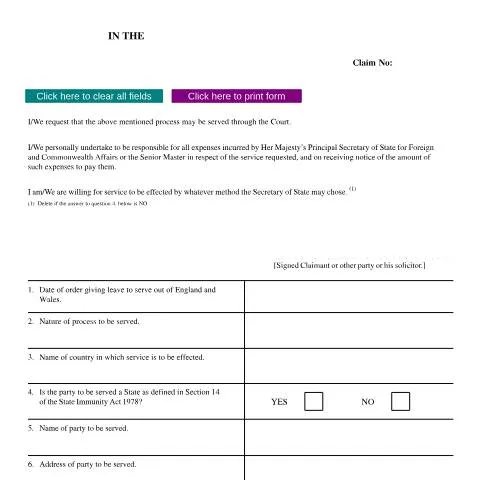
When Legal Proceedings Cross International Boundaries
Pursuing legal action against someone located outside England and Wales presents unique procedural challenges that require careful navigation of international service protocols. Form N224 serves as the gateway for claimants seeking court assistance to serve legal documents across international borders, whether through diplomatic channels, consular services, or foreign judicial authorities.
The form represents a critical juncture where domestic legal proceedings intersect with international law and diplomatic relations. Unlike standard service within England and Wales, international service demands prior court permission, specific procedural compliance, and often involves significant time delays and additional costs that can fundamentally alter litigation strategy.
The Judicial Framework for Cross-Border Document Service
Form N224 operates within a complex web of international treaties, bilateral agreements, and diplomatic protocols that govern how legal documents can be legitimately served across national boundaries. The Hague Service Convention provides the primary framework for service between signatory countries, establishing designated central authorities responsible for processing service requests from foreign courts.
The form specifically references Section 14 of the State Immunity Act 1978, which becomes relevant when serving documents on foreign states or state entities. This distinction carries profound implications for service methodology and diplomatic protocol requirements. When the defendant is a foreign government or state-controlled entity, additional layers of diplomatic consideration apply, potentially requiring service through the Foreign, Commonwealth and Development Office rather than standard judicial channels.
For non-Hague Convention countries, alternative service routes must be pursued, often involving British consular authorities or direct government-to-government cooperation where such arrangements exist. These alternative pathways typically involve longer processing times and may require additional documentation to satisfy the receiving country's internal legal requirements.
Securing Judicial Permission Before International Service
The N224 form cannot be submitted without first obtaining a court order granting permission to serve proceedings outside England and Wales. This preliminary step requires demonstrating to the court that the case has sufficient connection to England and Wales to justify the court's jurisdiction, and that there are reasonable prospects of successful service in the foreign jurisdiction.
The court considers several factors when granting permission, including the nature of the claim, the defendant's connections to England and Wales, and whether England and Wales represents the appropriate forum for resolving the dispute. The date of this permission order must be recorded precisely on the N224 form, as it establishes the legal foundation for the entire international service process.
Different types of claims face varying thresholds for obtaining permission. Contract disputes may require evidence that the contract was made in England and Wales or is governed by English law, while tort claims might need demonstration that the harmful act occurred within the jurisdiction or caused damage in England and Wales.
Timing Considerations for Permission Applications
Applications for permission to serve outside the jurisdiction should be made promptly after proceedings are issued. Delay in seeking permission can raise questions about the claimant's commitment to pursuing the case and may influence the court's assessment of whether England and Wales remains the appropriate forum for the dispute.
Navigating the Service Route Selection Process
The N224 form presents four distinct service pathways, each with specific implications for timing, cost, and procedural requirements. Understanding these options enables informed decision-making about the most appropriate route for each case.
| Service Method | Typical Timeframe | Best Suited For | Key Considerations |
|---|---|---|---|
| Hague Convention Authority | 2-6 months | Commercial disputes in signatory countries | Most reliable but potentially slow |
| Foreign Judicial Authority | 3-8 months | Complex cases requiring judicial oversight | May require translation of all documents |
| British Consular Authority | 1-4 months | Service on UK nationals abroad | Limited to countries with consular presence |
| Foreign Government | Variable | Cases involving government cooperation | Depends on bilateral agreements |
The selection between these routes often depends on the defendant's nationality, the receiving country's legal system, and existing diplomatic relationships. Service through Hague Convention authorities generally provides the most predictable process, though it may not always be the fastest option.
Special Considerations for State Defendants
When serving documents on foreign states or state entities, the State Immunity Act 1978 requirements significantly impact the service process. The form specifically asks whether the defendant qualifies as a state under this Act, triggering additional procedural safeguards and potentially requiring service through diplomatic channels rather than standard judicial processes.
Essential Information Requirements and Documentation Standards
Completing Form N224 accurately requires gathering comprehensive information about the defendant, the receiving country's legal requirements, and the nature of the legal proceedings being served. Each field serves a specific purpose in facilitating international service and ensuring compliance with foreign legal systems.
The defendant's complete address must be provided in the format recognised by the receiving country's postal and legal systems. This often means researching local address conventions, administrative divisions, and postal code systems to ensure the information can be effectively used by foreign authorities.
Determining the defendant's nationality status requires careful consideration, as this affects both service methodology and potential diplomatic implications. UK nationals abroad may be served through British consular offices, while foreign nationals typically require service through local judicial or administrative authorities.
Process Documentation Requirements
The "nature of process to be served" field requires specific identification of the documents being served, whether claim forms, judgment orders, or other court documents. Different types of legal documents may face varying requirements in foreign jurisdictions, with some countries requiring additional certifications or translations for certain document categories.
Translation requirements vary significantly between countries and document types. While some jurisdictions accept documents in English, others mandate certified translations into the local language before service can be completed. These translation requirements should be investigated before submitting the N224 form to avoid delays in the service process.
Financial Responsibilities and Cost Management
The undertaking clause in Form N224 represents a significant financial commitment that extends beyond standard court fees. Applicants personally guarantee payment of all expenses incurred by the Foreign, Commonwealth and Development Office or the Senior Master in facilitating international service.
These expenses can include administrative fees charged by foreign authorities, translation costs, courier services, and diplomatic processing fees. The total cost often exceeds several hundred pounds and can reach thousands of pounds for complex cases or service in countries with expensive administrative systems.
The "whatever method the Secretary of State may choose" clause provides flexibility to diplomatic authorities in selecting the most appropriate service route, but it also means applicants cannot control the specific methodology or associated costs. This flexibility often proves essential when initial service attempts encounter legal or administrative obstacles in foreign jurisdictions.
Payment Processing and Expense Recovery
Expenses are typically invoiced after service completion, though some cases may require advance payments or deposits. The invoicing process can take several weeks after successful service, and payment terms are usually strictly enforced given the international nature of the cooperation involved.
In litigation contexts, these international service costs may be recoverable from unsuccessful defendants, but this depends on the case outcome and the court's assessment of reasonableness. Keeping detailed records of all service-related expenses supports any subsequent cost recovery applications.
Procedural Compliance and Quality Control Measures
Form N224 submission requires meticulous attention to procedural details, as errors or omissions can result in significant delays or service failures that may prejudice the underlying legal proceedings. The court's administrative staff review submissions for completeness and compliance with international service requirements before forwarding requests to appropriate authorities.
The claim number must correspond exactly to the court proceedings for which service is sought. Discrepancies between the N224 form and the court file can cause processing delays and may require resubmission with corrected information.
Signature requirements are strictly enforced, with the form requiring personal signature by the claimant or their legal representative. Electronic signatures are generally not acceptable for international service requests due to authentication requirements in foreign jurisdictions.
Document Preparation and Submission Standards
All documents intended for service must be prepared according to the receiving country's legal requirements before N224 submission. This preparation phase often involves researching foreign legal systems, consulting with local lawyers, and ensuring document formats comply with international standards.
The court may require additional documentation beyond the N224 form, including copies of the permission order, translations of key documents, or certificates confirming the documents' authenticity. These supporting materials should be prepared concurrently with the N224 form to avoid processing delays.
Monitoring Progress and Managing Extended Timeframes
International service through Form N224 typically involves extended timeframes that can significantly impact litigation timetables and case management strategies. Unlike domestic service, which usually completes within days or weeks, international service commonly requires months and may extend beyond a year in challenging jurisdictions.
The court provides limited progress updates during the service process, as much of the activity occurs within foreign legal systems or diplomatic channels. Applicants should expect minimal communication during the service period and should plan litigation strategies accordingly.
Service completion is confirmed through official documentation from the foreign authority that effected service, typically including details of the service date, method, and recipient identity. This documentation becomes crucial evidence for proving valid service in subsequent proceedings.
Contingency Planning for Service Difficulties
When initial service attempts fail, the court may explore alternative service routes or return the case for further instructions. These situations often require additional N224 submissions with modified service requests or alternative approaches to reaching the defendant.
Persistent service difficulties may necessitate considering alternative legal strategies, including applications for service by alternative methods or reassessing whether proceedings should continue in England and Wales or be commenced in the defendant's home jurisdiction instead.
Cross-Border Service Considerations and International Legal Frameworks
When seeking service outside England and Wales through Form N224, understanding the complex web of international legal frameworks becomes essential for ensuring your application succeeds. The approach varies dramatically depending on whether you're serving documents within the European Union, to Commonwealth countries, or to nations with specific bilateral agreements with the UK.
For EU member states, despite Brexit, certain transitional arrangements and existing conventions continue to apply. The Service Regulation (EC) No 1393/2007, whilst no longer directly applicable to the UK, may still influence proceedings where reciprocal arrangements exist. However, you'll increasingly need to rely on the Hague Service Convention of 1965, to which both the UK and most EU countries remain signatories. This convention provides a standardised method for serving judicial documents across borders, typically through designated Central Authorities in each country.
Commonwealth countries often present unique opportunities due to historical legal connections. Countries like Australia, Canada, and New Zealand frequently have streamlined processes for accepting service from UK courts. However, don't assume uniformity – each jurisdiction maintains its own specific requirements. For instance, serving documents in Scotland or Northern Ireland, whilst technically within the UK, may require different procedures than those applicable in England and Wales, particularly for certain types of proceedings.
The complexity increases significantly when dealing with non-Hague Convention countries or those with restricted diplomatic relations. In such cases, service often must proceed through diplomatic channels via the Foreign, Commonwealth & Development Office (FCDO). This process can extend timelines considerably – potentially six months or more – and may require additional documentation, translations, and diplomatic certifications.
Your Form N224 application should specifically address which international framework applies to your case. Include details about the target country's Central Authority (if applicable), any known bilateral agreements, and whether alternative service methods might be more appropriate. Courts particularly scrutinise applications involving countries known for service difficulties or those requiring consular involvement.
Consider also the enforceability implications of your chosen service method. A judgment obtained following service that doesn't comply with the defendant's home country legal requirements may prove unenforceable, rendering your entire proceedings futile. Research the target jurisdiction's recognition requirements early in your planning process.
Technical Requirements and Documentation Standards
Form N224 applications for international service demand meticulous attention to technical documentation requirements that often catch applicants unprepared. Beyond the basic form completion, courts expect comprehensive supporting evidence that demonstrates both the necessity for overseas service and your understanding of the practical implications.
Translation requirements represent a critical technical hurdle. Most destination countries require documents to be translated into their official language(s) by certified translators. However, the definition of "certified" varies significantly between jurisdictions. Some countries accept translations certified by UK-based translators who are members of professional bodies like the Institute of Translation and Interpreting (ITI). Others demand translations certified by translators qualified in the destination country or apostilled translations meeting specific formatting requirements.
Your Form N224 should include detailed translation arrangements, including translator credentials, expected completion timelines, and costs. Courts may require you to demonstrate that translations will accurately convey legal concepts that may not have direct equivalents in the target language. Complex commercial or technical proceedings often necessitate specialist legal translators familiar with both jurisdictions' legal terminology.
Document formatting and authentication requirements add another layer of complexity. Many countries require UK court documents to bear an apostille – an authentication certificate issued by the FCDO under the Hague Apostille Convention. The apostille process typically takes several weeks and requires original documents or properly certified copies. Some non-apostille countries instead require consular legalisation, involving authentication by both UK authorities and the destination country's embassy or consulate in London.
Electronic service presents emerging opportunities but remains limited in international contexts. Whilst UK courts increasingly accept electronic service domestically, most international legal frameworks haven't adapted to digital methods. Your N224 application should address whether electronic alternatives might be available and demonstrate why traditional service methods remain necessary.
Timeline management becomes crucial given these technical requirements. Courts expect realistic service timelines that account for translation, authentication, postal delays, and the destination country's internal processing times. A well-prepared N224 application includes contingency planning for technical delays and alternative approaches if initial service attempts fail.
Evidence preservation requirements also demand attention. International service often involves multiple intermediaries – Central Authorities, process servers, diplomatic missions – each potentially requiring original documents or specific copy formats. Your application should demonstrate adequate document preparation to satisfy all intermediaries whilst maintaining court-acceptable proof of service.
Alternative Service Methods and Strategic Considerations
Beyond standard international service procedures, Form N224 opens opportunities for alternative service methods that may prove more effective, economical, or legally robust depending on your specific circumstances. Understanding these alternatives and their strategic implications can significantly improve your chances of successful service and subsequent enforcement.
Contractual service provisions offer one of the most straightforward alternatives when applicable. If your dispute arises from a contract containing specific service clauses – such as service to a particular address, through nominated representatives, or via specific communication methods – courts may permit service according to these agreed terms rather than standard international procedures. Your N224 application should highlight any contractual service provisions and explain why they provide adequate notice to the defendant.
Service through UK-based representatives presents another strategic option. Many international businesses maintain UK subsidiaries, registered offices, or appointed agents for service. If you can demonstrate a genuine connection between the overseas defendant and their UK representative, courts may permit service at the UK address. However, you must establish that the UK entity has actual authority to accept service on behalf of the overseas defendant, not merely a commercial relationship.
Digital communication methods, whilst limited internationally, may be permitted in specific circumstances. Courts occasionally authorise service via email, social media platforms, or business communication systems when traditional methods prove impractical and you can demonstrate the defendant regularly uses these channels. Your N224 application would need compelling evidence of the defendant's digital communication patterns and explanations for why conventional service methods are inadequate.
Substituted service orders represent the court's ultimate discretion in ensuring defendants receive adequate notice whilst enabling proceedings to progress. These might involve service through local newspapers in the defendant's area, posting at business premises, or service through known associates. Courts grant substituted service only when conventional methods have failed or appear impractical, requiring detailed evidence of previous service attempts and their outcomes.
Strategic timing considerations often influence service method selection. International service during local holidays, political instability, or postal disruptions can cause significant delays. Your N224 application should demonstrate awareness of destination country conditions and propose service timing that maximises success chances. Some practitioners recommend avoiding service during major religious festivals, national elections, or known periods of civil unrest.
Cost-benefit analysis should inform your alternative service strategy. Whilst diplomatic service through the FCDO provides maximum legal certainty, costs can exceed several thousand pounds and require months to complete. Alternative methods might achieve equivalent legal effect at substantially lower cost and faster timelines, but with potentially higher risks of successful challenge by defendants.
Consider also the defendant's likely response strategy. Sophisticated international defendants often challenge service validity as a preliminary defence, regardless of the underlying claim's merits. Your service method choice should anticipate such challenges and provide robust legal foundations that withstand scrutiny. This might favour conventional Hague Convention service over creative alternatives, even if the latter appear more practical.
Documentation of alternative service attempts becomes crucial for subsequent enforcement proceedings. International courts examining UK judgments for recognition and enforcement purposes scrutinise service procedures carefully. Your chosen method should not only satisfy UK court requirements but also meet the service standards expected by courts in potential enforcement jurisdictions.