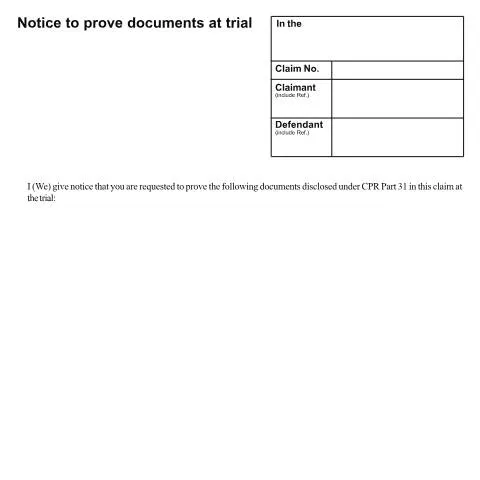
When Court Documents Need Authentication: Understanding the N268 Notice
During civil litigation proceedings, parties routinely exchange thousands of pages of evidence through the disclosure process under Civil Procedure Rule (CPR) Part 31. Yet not every document automatically becomes admissible evidence at trial. The N268 Notice to prove documents at trial represents a critical procedural mechanism that transforms disclosed materials from mere exchanged paperwork into legally authenticated evidence that can influence a judge's decision.
This notice serves as the formal bridge between disclosure obligations and trial evidence. When a party receives an N268, they face a clear choice: either formally prove the authenticity of specified documents or risk having them excluded from consideration during the trial hearing. Understanding this process becomes essential for anyone navigating civil litigation, whether as a litigant in person or working alongside legal representatives.
The Strategic Timing Behind Document Proof Requests
The timing of an N268 notice reflects careful tactical consideration rather than administrative routine. Parties typically serve these notices during the pre-trial period, often following the case management conference or as part of trial preparation activities. This timing allows sufficient opportunity for the recipient to arrange formal proof while preventing last-minute disruptions to trial proceedings.
Critical Windows for Service
While CPR Part 31 doesn't specify absolute deadlines for serving N268 notices, practical considerations create natural boundaries. Most practitioners serve these notices at least 28 days before trial to allow adequate preparation time. Courts may view later service as potentially prejudicial, particularly if it forces adjournments or creates unfair disadvantage.
The notice must identify specific documents with sufficient precision to enable the recipient to locate them within their disclosure bundle. Vague references such as "all financial records" would likely prove inadequate, whereas "the lease agreement dated 15 March 2023 between Smith Properties Ltd and Jones Enterprises" provides clear identification.
Documents Most Commonly Challenged
Certain categories of disclosed documents frequently attract N268 notices due to their potential impact on case outcomes:
- Financial records and accounts - particularly when substantial damages claims depend on accurate profit calculations
- Contracts and agreements - especially in commercial disputes where terms interpretation proves central
- Correspondence and communications - including emails, letters, and meeting minutes that establish crucial timelines
- Technical reports and expert materials - where professional opinions carry significant evidential weight
- Photographs and digital evidence - particularly relevant in personal injury or property damage cases
Responding to Authentication Demands: Practical Options
Receipt of an N268 notice triggers several response pathways, each carrying distinct implications for trial strategy and case costs. The responding party must evaluate both the importance of the challenged documents and the practical feasibility of formal proof.
Formal Proof Through Witness Evidence
The most straightforward response involves calling a witness who can authenticate the disputed documents. This typically requires someone with direct knowledge of the document's creation, custody, or contents. For business records, this might include the accounts manager who prepared financial statements or the HR director who maintained personnel files.
Witness statements for document proof must address specific authentication elements: the document's origin, the circumstances of its creation, any alterations or modifications, and the witness's personal knowledge of its accuracy. Generic statements asserting that "records appear genuine" provide insufficient foundation for admission.
Agreed Facts and Admissions
Parties can avoid the expense and complexity of formal proof by reaching agreement on document authenticity. This approach works particularly well for routine business records or documents where authenticity isn't genuinely disputed. CPR Part 32.18 provides the framework for such admissions, which must be clear, unambiguous, and properly recorded.
Negotiating agreed facts requires careful consideration of what exactly is being admitted. Agreeing that a document is authentic doesn't necessarily mean accepting its contents as accurate or accepting the interpretation placed upon it by the opposing party.
The Consequences of Ignoring Authentication Requirements
Failing to respond adequately to an N268 notice carries significant risks that extend beyond simple document exclusion. Courts take a dim view of parties who treat procedural requirements casually, particularly when this affects trial efficiency.
Immediate Evidential Impact
Documents that cannot be properly proved face exclusion under CPR Part 32 evidence rules. This exclusion can prove devastating when key documents support central elements of a party's case. For instance, in contract disputes, inability to prove the agreement's authenticity might eliminate the foundation for the entire claim.
The exclusion operates strictly - even documents that appear obviously genuine may be rejected if proper proof procedures haven't been followed. Courts prioritise procedural compliance over apparent document reliability when making admissibility decisions.
Cost Implications and Wasted Expenses
Beyond evidential consequences, inadequate responses to N268 notices can trigger adverse cost orders. If a party's failure to prove documents causes trial delays or adjournments, they may face liability for the additional legal costs incurred by all parties, including court fees and lost hearing time.
| Response Type | Typical Costs | Risk Level | Success Probability |
|---|---|---|---|
| Witness statement proof | £500-2000 | Low | High if properly prepared |
| Agreed admissions | Minimal | Very low | High with cooperation |
| No response | Potential cost orders | Very high | Document exclusion likely |
| Late compliance | Additional court fees | Moderate | Court discretion dependent |
Technical Requirements for Document Authentication
The legal standards for document proof extend beyond simple witness confirmation. Courts require evidence that meets specific technical criteria, particularly for documents that form crucial case elements or involve complex authentication issues.
Chain of Custody Considerations
For documents where integrity questions arise, establishing a clear chain of custody becomes essential. This particularly applies to digital evidence, where concerns about alteration or manipulation may exist. Witnesses must demonstrate continuous control over the document from creation through to trial presentation.
Digital documents present particular challenges, requiring evidence about file creation dates, modification history, and storage security. Email evidence often necessitates testimony about server management, backup procedures, and user access controls to establish reliability.
Expert Evidence for Complex Documents
Certain document types may require expert authentication, particularly where technical knowledge exceeds lay witness capabilities. Financial statements prepared according to specific accounting standards, medical records containing technical terminology, or engineering drawings requiring professional interpretation often benefit from expert testimony.
The expert's role extends beyond mere authenticity confirmation to include explanation of professional standards, industry practices, and technical accuracy. This dual function - authentication plus interpretation - can prove particularly valuable in specialist commercial disputes.
Strategic Considerations When Serving N268 Notices
Deciding whether to serve an N268 notice involves careful tactical evaluation rather than automatic response to document disclosure. Effective litigation strategy requires balancing the potential benefits of challenging document authenticity against the costs and risks of formal proof procedures.
Targeting High-Impact Documents
Experienced practitioners focus N268 notices on documents that could significantly influence case outcomes rather than attempting comprehensive challenges. This targeted approach maximises strategic impact while minimising procedural costs and complexity.
Priority typically goes to documents that:
- Support key elements of the opposing party's case
- Contain potentially disputed facts or interpretations
- May have authenticity concerns based on their appearance or provenance
- Would be difficult or expensive for the opponent to prove formally
Leveraging Settlement Negotiations
The threat of document proof requirements can provide negotiating leverage in settlement discussions. Parties facing expensive authentication procedures may become more amenable to compromise, particularly when key documents face challenge and formal proof would require costly expert evidence or multiple witness statements.
However, this tactical approach requires careful handling to avoid accusations of procedural abuse or attempts to increase costs unreasonably. Courts may impose sanctions on parties who serve N268 notices primarily to create expense rather than for legitimate evidential purposes.
Practical Management of Multiple Document Challenges
Large-scale commercial litigation often involves N268 notices covering dozens or even hundreds of documents. Managing these challenges efficiently requires systematic approaches that balance thoroughness with practical resource constraints.
Categorisation and Prioritisation Systems
Effective response strategies begin with document categorisation based on importance, proof complexity, and available witness resources. Category A documents might include those essential to case success, requiring formal witness proof regardless of cost. Category B documents could represent supporting evidence where alternatives exist, making them candidates for admission negotiations. Category C documents might include peripheral materials that could be abandoned if proof costs prove excessive.
This systematic approach enables informed decisions about resource allocation and helps identify opportunities for negotiated admissions that reduce overall case costs while preserving essential evidential elements.
Coordinating Multiple Witnesses
Complex cases may require testimony from numerous witnesses to authenticate different document categories. Efficient management involves coordinating witness availability, preparing comprehensive statements that address multiple documents where appropriate, and scheduling court appearances to minimise disruption and costs.
Witness preparation must address potential cross-examination on authentication issues, ensuring that each witness understands the limits of their knowledge and the specific foundations required for the documents they're proving.
Integration with Broader Case Management
The N268 notice operates within the wider framework of civil procedure, interacting with case management directions, witness statement deadlines, and trial preparation requirements. Understanding these connections helps parties develop coherent strategies that address authentication requirements alongside other procedural obligations.
Case Management Conference Implications
Document proof issues often surface during case management conferences, where judges may enquire about potential authentication challenges and their impact on trial duration. Parties should be prepared to address N268 implications when seeking case management directions, particularly regarding witness requirements and trial timetabling.
Early identification of document proof issues allows courts to make appropriate directions for witness statement service, expert evidence deadlines, and trial time allocation. This forward planning prevents last-minute complications that could derail trial preparation or necessitate adjournments.
Impact on Expert Evidence Procedures
When N268 notices target technical documents requiring expert authentication, this intersects with CPR Part 35 expert evidence procedures. Courts may need to consider whether authentication experts should be joint experts, whether their evidence can be provided through written reports, or whether cross-examination will be necessary.
The relationship between document authentication and substantive expert evidence requires careful coordination to avoid duplication while ensuring comprehensive coverage of technical issues. This becomes particularly important in construction, professional negligence, or intellectual property disputes where document authenticity and technical interpretation often intertwine.
Understanding the N268 notice's role within this broader procedural landscape enables parties to develop integrated strategies that address authentication requirements efficiently while advancing their overall case objectives. Success depends not just on technical compliance with proof requirements, but on strategic integration of these obligations within comprehensive litigation management approaches that maximise chances of favourable outcomes while controlling costs and procedural risks.
Strategic Considerations for Document Selection and Presentation
The effectiveness of Form N268 extends beyond mere compliance with procedural requirements—it demands strategic thinking about which documents to include and how to present them most persuasively. Courts expect parties to demonstrate not just the existence of relevant documents, but their materiality to the issues in dispute.
Fill in your form directly online
No printing: type your details into the boxes of the official form, tick, then download the PDF ready to send.
- 1Type into the form boxes
- 2Tick in one click
- 3Save and download the PDF
When selecting documents for your notice, consider the chronological narrative they create. A well-structured N268 should tell a coherent story through documentation, with each exhibit building upon the previous one. For instance, in a breach of contract claim, you might begin with the original agreement, progress through correspondence showing performance or non-performance, and conclude with evidence of damages suffered.
The court's case management powers under CPR Part 32 mean that judges can exclude documents they consider irrelevant or disproportionate, even if properly served. This makes the initial selection process crucial. Each document should serve a specific evidential purpose—whether establishing a fact in issue, undermining the opponent's case, or providing essential context for other evidence.
Particular attention should be paid to electronic documents and their metadata. The Civil Procedure Rules recognise that modern litigation increasingly involves digital evidence, from email chains to database records. When serving notice of such documents, parties must consider whether the metadata itself forms part of the evidence they wish to rely upon. If so, this should be clearly stated in the N268, and arrangements made for the technical presentation of such evidence at trial.
For cases involving expert evidence, the interaction between documentary evidence and expert reports requires careful coordination. Documents that experts have relied upon in forming their opinions must typically be included in the trial bundle, but the N268 serves as the formal mechanism for ensuring their admissibility. This is particularly relevant in professional negligence cases where contemporaneous file notes and records form the backbone of expert analysis.
International elements add further complexity to document selection. Where proceedings involve foreign law or overseas transactions, parties may need to serve notice of documents in languages other than English, accompanied by certified translations. The N268 should specify both the original document and its translation, with clear identification of the translator's qualifications where this may be material to weight rather than admissibility.
Common Pitfalls and How to Avoid Them
Experience from the courts reveals several recurring errors that can undermine otherwise strong cases. Perhaps the most frequent mistake involves the timing of service relative to document disclosure. Parties sometimes assume that documents disclosed during the standard disclosure process are automatically admissible at trial—this is incorrect. Even disclosed documents require formal notice under Form N268 unless they fall within specific exceptions.
Another common error occurs with witness statements and their supporting documentation. While witness statements themselves are covered by separate provisions under CPR Part 32.4, the documents they refer to or exhibit require individual consideration. If a witness statement references a particular email or contract, but that document isn't separately noticed on Form N268, the court may refuse to admit it even though it appears to support the witness's testimony.
The description of documents on Form N268 frequently causes problems when it's either too vague or overly specific. Descriptions such as "correspondence between the parties" are generally insufficient—the court needs to understand exactly which communications are being relied upon. Conversely, overly technical descriptions that don't clearly identify the document's relevance can also prove problematic. The key is striking a balance between precision and clarity.
Parties often underestimate the importance of the continuing duty to update their N268. If additional relevant documents come to light after service of the initial notice, or if circumstances change such that previously noticed documents become irrelevant, the form should be amended accordingly. Failure to do so can result in either exclusion of important evidence or wasted court time dealing with immaterial documents.
In multi-party litigation, coordination failures between co-defendants or co-claimants can create confusion over which party is serving notice of particular documents. This is especially problematic where documents are relevant to multiple parties' cases but may be interpreted differently by each. Clear communication and, where appropriate, joint notices can help avoid duplication and ensure comprehensive coverage.
Technical failures in service remain a persistent issue, particularly with electronic service methods. While CPR Part 6 provides various methods for service of documents, parties must ensure that their chosen method is both permissible for Form N268 and practically effective. Email service, for instance, requires prior agreement or court order, and parties should retain delivery confirmations as proof of proper service.
The Role of N268 in Case Management and Settlement
Form N268 serves purposes beyond trial preparation—it plays a crucial role in the broader case management process and can significantly influence settlement negotiations. The act of preparing a comprehensive notice forces parties to review their documentary evidence systematically, often revealing strengths and weaknesses in their case that weren't previously apparent.
This revelatory function can be particularly powerful during the period between service of N268 and trial. Opponents reviewing the noticed documents may recognise the strength of evidence against them, or conversely, may identify gaps in the other party's case that suggest opportunities for tactical advantage. Experienced litigators often use the exchange of N268 forms as a catalyst for renewed settlement discussions.
The court's case management powers extend to requiring parties to explain their document selection where it appears excessive or insufficient. This can occur during case management conferences or pre-trial reviews, where judges may question whether the volume of documents noticed is proportionate to the issues in dispute. Such judicial intervention can pressure parties to refine their approach and focus on genuinely material evidence.
In cases proceeding under the shorter or intermediate tracks, the court's active case management role means that Form N268 may be scrutinised more closely than in multi-track cases where parties have greater autonomy over trial preparation. Track allocation can therefore influence both the timing and content of document notices, with faster track cases requiring earlier and more focused submissions.
The relationship between N268 and costs management deserves particular attention. Under the costs management regime, parties must justify their litigation expenditure, including time spent reviewing and preparing documentary evidence. An overly broad or poorly targeted N268 can expose parties to adverse costs consequences, particularly if the court later determines that extensive document preparation was unnecessary or disproportionate.
Alternative dispute resolution processes can also be influenced by Form N268 preparation. Mediations occurring after exchange of document notices often prove more productive because all parties have a clearer understanding of the available evidence. This transparency can facilitate more realistic settlement discussions and help identify the key factual disputes that might otherwise derail negotiation efforts.
For cases involving public bodies or regulated entities, the preparation of N268 may trigger additional considerations around disclosure of sensitive information. Public interest immunity claims, legal professional privilege, and regulatory confidentiality requirements can all impact which documents can be noticed for trial use, requiring careful liaison with relevant authorities before finalising the form.