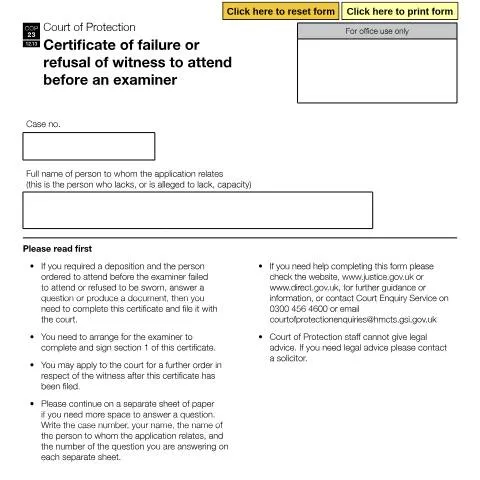
Understanding Form COP23: A Crucial Document for Legal Proceedings
When legal situations arise, particularly those involving witnesses, the role of documentation becomes pivotal. One such document is the Form COP23: Certificate of Failure or Refusal of Witness to Attend Before an Examiner, issued by the HM Courts & Tribunals Service. This form plays a critical role in ensuring that the legal process adheres to its required protocols, especially when a witness fails to attend or refuses to cooperate. This article explores the ins and outs of this certificate, detailing its significance, the process of obtaining it, and its various applications.
Navigating the Process: How to Obtain Form COP23
Obtaining Form COP23 is a structured process that requires careful attention to detail. If a witness fails to attend or refuses to comply with an examiner's requests, this form becomes necessary to formally document the situation.
Step-by-Step Guide to Obtaining Form COP23
- Determine Necessity: Assess whether the witness's non-attendance or refusal constitutes a breach of the court order.
- Complete the Certificate: The examiner must fill out Sections 1 and 2 of the COP23, noting the specifics of the situation, including the witness's name, the date and time of the examination, and details of the witness's refusal to comply.
- Submit the Form: Once filled out, the completed COP23 must be submitted to the Court of Protection, specifically addressed to the designated PO Box.
- Follow Up: After submission, you may need to apply for further orders regarding the witness, depending on the case's progression.
It is crucial to keep a copy of the filled form for your records, as this certificate may be requested in future legal proceedings.
Eligibility Criteria: Who Can Request Form COP23?
Understanding who can request this certificate is vital for ensuring that the correct parties are involved in the legal process.
Qualifying Parties for Form COP23
- Litigants: Any party involved in the ongoing litigation who requires the deposition of a witness may file for Form COP23.
- Legal Representatives: Solicitors representing clients can also initiate the process when a witness fails to meet their obligations.
- Examiner’s Role: The examiner conducting the proceedings is responsible for completing the certificate.
It is essential to note that the request and completion of this form must align with established legal standards to ensure its validity.
Legal Weight: The Significance of the Certificate
The COP23 not only serves as documentation of a witness's failure to comply but also bears significant legal weight in subsequent proceedings.
What the COP23 Certifies
The certificate attests to:
- Failure to attend the examination.
- Refusal to be sworn in for the examination.
- Refusal to answer specified lawful questions.
- Failure to produce requested documents.
By formalizing these refusals, the certificate aids in establishing a record that can influence future court decisions. It provides a foundation for potential legal actions against the non-compliant witness.
Validity and Renewal: Understanding the Lifespan of Form COP23
In the realm of legal documents, understanding validity is crucial. The COP23 certificate has specific parameters concerning its lifespan and the conditions that could lead to its renewal or withdrawal.
Duration and Validity
The COP23 remains valid as long as the associated court case is open. However, if significant time elapses without further legal action, the relevance of the certificate may diminish.
Conditions for Withdrawal
Withdrawal of the certificate can occur under specific circumstances:
- If the witness subsequently complies with the court order.
- Upon resolution of the case where the issues concerning the witness are no longer applicable.
In these instances, the legal team may need to formally notify the court of the updated situation regarding the witness.
Real-World Applications: Where and When is COP23 Required?
The practical applications of Form COP23 stretch across various legal scenarios, particularly within the Court of Protection context.
Common Situations Requiring COP23
Some scenarios where this certificate is necessary include:
- Testamentary Proceedings: When a witness fails to appear for a will reading or related proceedings.
- Personal Injury Claims: If a key witness fails to attend a deposition related to a personal injury case.
- Family Law Cases: When witnesses are unable to provide testimony relevant to custody arrangements.
In each of these instances, documenting a witness's failure through the COP23 allows for legal recourse, further examinations, or adjustments to the court's approach to the case.
What to Do When Issues Arise: Handling Errors or Loss of Form COP23
Errors in the documentation process can create complications. Therefore, understanding how to rectify such issues is paramount for all parties involved.
In Case of Errors on the Form
Should you discover an error on the COP23 after submission, take the following steps:
- Notify the Court: Contact the Court of Protection immediately to inform them of the error.
- Request Correction: Seek guidance on the process for amending the submitted form.
- Document Communications: Keep a record of all communications regarding the error for future reference.
What If the Form is Lost?
In the unfortunate event that Form COP23 is lost:
- Reapply: You may need to fill out a new COP23 and resubmit it, following the original procedures.
- Seek Legal Advice: Consulting a solicitor may provide clarity on the implications of the loss and the steps to mitigate any adverse effects.
Final Thoughts: The Importance of Compliance and Record-Keeping
Through understanding and utilizing Form COP23 effectively, involved parties can ensure the legal process remains transparent and fair. This document not only serves as a record but also plays a crucial role in upholding the integrity of the judicial system.
Being proactive in addressing any issues related to the COP23 can lead to more streamlined legal proceedings. Engaging with the appropriate legal channels when necessary sets the stage for justice and accountability, reinforcing the importance of witness cooperation in legal frameworks.
Understanding the Purpose of Form COP23
Form COP23, officially known as the Certificate of Failure or Refusal of Witness to Attend Before an Examiner, plays a crucial role in legal proceedings within the United Kingdom. This form is utilized when a witness fails to comply with a notice demanding their attendance at a hearing or examination. The purpose of this document is to formally record the inability of a witness to attend, whether it is due to a refusal or a failure to respond to the summons. It is important to note that this form is particularly relevant in relation to proceedings governed by the Civil Procedure Rules (CPR) and is often associated with civil litigation.
To complete Form COP23 effectively, it is essential to provide specific details, including the witness's name, the date of the notice, and the reasons for their failure to attend. This information not only substantiates the claim made by the party submitting the form but also aids the court in understanding the context of the situation. In cases where a witness refuses to attend, it is vital to include any prior communications that might highlight the witness’s unwillingness. This can encompass messages, emails, or even recorded phone conversations that demonstrate efforts made to engage the witness.
Consequences of Submitting Form COP23
The submission of Form COP23 is not a mere administrative task; it carries significant implications for the legal proceedings at hand. When a party files this form with the court, it may affect the overall strategy and direction of the case. For instance, failure to produce a key witness could hinder the ability to present a robust argument, potentially leading to adverse outcomes for the party relying on the witness's testimony.
Moreover, the court may react in various ways upon receiving Form COP23. One possibility is that the court may issue a further order compelling the witness to attend, thereby escalating the situation. In instances where a witness is deemed critical to the case, the judge may be inclined to impose penalties on the witness for non-compliance, which may include fines or even legal repercussions, reflecting the seriousness of their refusal to appear.
It's also important to consider the impact on the timeline of the proceedings. The filing of Form COP23 may result in delays as the court assesses the situation and determines the next steps. Parties involved should be prepared for potential adjournments and should keep the court informed about any developments regarding the witness's attendance.
Navigating Potential Challenges with Form COP23
Completing and submitting Form COP23 is not without its challenges. One of the predominant issues faced by legal practitioners is proving the validity of the witness's refusal or failure to attend. This often requires diligent record-keeping and strong communication strategies. It's advisable to document all attempts to contact the witness, as well as any reasons they provide for their absence. Legal representatives should be aware that the burden of proof lies with the party submitting Form COP23 to demonstrate that they have made reasonable efforts to secure the witness's attendance.
Additionally, parties may encounter challenges related to the interpretation of witness responses. If a witness provides vague or ambiguous reasons for their non-attendance, it can complicate the case. Legal representatives are encouraged to seek clarification from the witness, preferably in writing, to ensure that their motives are clearly understood and documented.
Moreover, there may be situations where a witness is unable to attend for legitimate reasons, such as illness or other personal circumstances. In such cases, it is essential to approach the completion of Form COP23 with sensitivity, as the failure to attend may not always be a deliberate refusal. Legal representatives should be prepared to explore alternative solutions, such as remote testimonies or video conferencing, to accommodate genuine circumstances. This flexibility can not only help in maintaining the integrity of the proceedings but also foster a more cooperative atmosphere between all parties involved.
In summary, while Form COP23 serves a specific administrative function in legal proceedings, its implications stretch far beyond mere documentation. Understanding the purpose, consequences, and challenges associated with this form is vital for anyone involved in civil litigation in the UK. By navigating these aspects with diligence and foresight, legal practitioners can better advocate for their clients and contribute to the fair administration of justice.