When a Child's Location Remains Unknown: Compelling Disclosure Through Court Orders
When a child has disappeared from their usual place of residence and standard enquiries have failed to locate them, parents and legal guardians face a distressing situation that requires urgent legal intervention. The Family Law Act 1986 provides specific mechanisms to compel individuals who may possess crucial information about a child's whereabouts to disclose what they know to the court. This legal framework recognises that in cases of suspected child abduction, concealment, or unexplained disappearance, certain parties may deliberately withhold vital information that could facilitate the child's safe return.
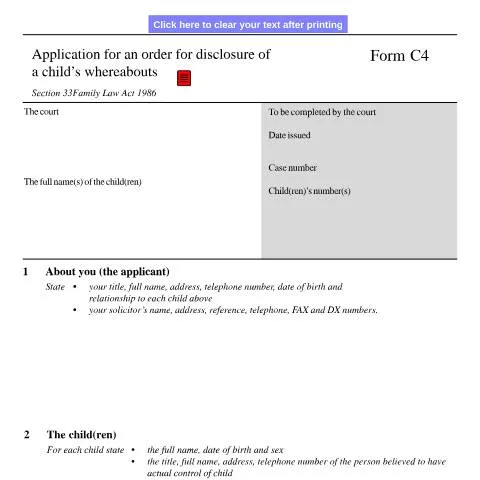
Form C4 represents a formal application to HM Courts & Tribunals Service requesting judicial authority to order disclosure of information regarding a child's location. Unlike general missing person procedures handled by police, this court-based approach specifically targets situations where identified individuals are believed to possess relevant information but are unwilling to share it voluntarily. The application triggers a legal process that can compel disclosure under penalty of contempt of court.
The Legal Framework Behind Information Disclosure Orders
Section 33 of the Family Law Act 1986 establishes the court's authority to direct any person to disclose information about a child's whereabouts when specific conditions are met. This provision operates within the broader context of child protection and family law, recognising that children's welfare may depend on swift location and recovery.
The statutory framework distinguishes between different types of disclosure scenarios. Direct disclosure orders require named individuals to provide information directly to the court, whilst indirect disclosure mechanisms may involve third-party organisations such as schools, healthcare providers, or local authorities. The court's jurisdiction extends to compelling disclosure from both private individuals and public bodies, though different procedural considerations apply to each category.
| Type of Respondent | Common Information Sources | Typical Disclosure Timeframe |
|---|---|---|
| Family Members | Current address, contact details, travel plans | 7-14 days from service |
| Educational Institutions | School records, emergency contacts, collection arrangements | 5-10 working days |
| Healthcare Providers | Registration details, appointment records, emergency contacts | 10-21 days (subject to data protection considerations) |
| Local Authorities | Housing records, benefit claims, social services involvement | 14-28 days |
Relationship to Other Family Proceedings
Form C4 applications frequently arise within existing family disputes, particularly following relationship breakdown where one parent may have removed children from their usual residence. However, the application can also be initiated independently when a child's disappearance occurs outside formal custody arrangements. Courts recognise the urgent nature of these applications and typically expedite hearings when evidence suggests immediate risk to a child's welfare.
Building Your Case: Evidence Requirements and Strategic Preparation
Successfully obtaining a disclosure order requires demonstrating both the court's lack of adequate information and the respondent's likely knowledge of relevant details. This dual burden means applicants must present evidence showing they have exhausted reasonable enquiries whilst simultaneously establishing grounds for believing specific individuals possess the missing information.
Documenting Previous Search Efforts
Courts expect applicants to demonstrate diligent efforts to locate the child through conventional means before seeking disclosure orders. This typically includes:
- Police missing person reports and reference numbers
- Contact attempts with the child's school, including communications with head teachers and attendance officers
- Enquiries with the child's GP surgery and any specialist healthcare providers
- Attempts to contact known friends, relatives, and associates of the person believed to have the child
- Checks with local authority housing departments and benefit offices where appropriate
The key principle is demonstrating that reasonable enquiries have been made but have failed to yield sufficient information. Courts distinguish between thorough investigation and exhaustive searches that might delay urgent applications unnecessarily.
Establishing Respondents' Likely Knowledge
Identifying appropriate respondents requires careful consideration of who realistically possesses relevant information. Close family members, particularly grandparents and siblings, often feature as respondents due to their emotional connections and practical involvement in childcare arrangements. However, applications may also target:
- Former partners or spouses who maintain contact with the person believed to have the child
- Employers who may have forwarding addresses or emergency contact details
- Landlords or letting agents familiar with current accommodation arrangements
- Social media contacts who may have recent information about the child's location
Navigating the Application Form: Section-by-Section Breakdown
Form C4 comprises four distinct sections, each requiring specific types of information and supporting evidence. The court uses this information to assess both the merits of the application and the appropriate scope of any disclosure order granted.
Applicant Details and Legal Standing
Section 1 establishes the applicant's identity and relationship to the missing child. Beyond basic personal information, applicants must clearly articulate their legal standing to make the application. This typically involves demonstrating parental responsibility, guardianship, or other lawful interest in the child's welfare.
When legal representation is involved, solicitor details must be comprehensive, including DX numbers for court communications. Self-represented applicants should provide reliable contact information and consider designating an alternative contact person in case of emergency developments.
Child Identification and Current Circumstances
Section 2 requires detailed information about each child subject to the application. Beyond standard identifying details, applicants must provide information about the person believed to have actual control of the child. This section often proves challenging when the child's current circumstances remain largely unknown.
Recent photographs serve multiple purposes: they assist in identification, provide evidence of the child's appearance at the time of disappearance, and may be distributed to relevant agencies if disclosure orders reveal potential locations. Photographs should be dated and show clear facial features, with multiple images preferred when available.
Crafting Effective Disclosure Requests
Section 3 requires applicants to specify precisely what information they seek from whom. Generic requests for "any information about the child's whereabouts" prove less effective than targeted enquiries addressing specific types of knowledge the respondent likely possesses.
Effective disclosure requests often include:
- Current address information - specific residential addresses, temporary accommodation, or contact addresses
- Communication details - telephone numbers, email addresses, or social media accounts
- Travel information - planned or recent journeys, transportation methods, or destination details
- Third-party contacts - individuals who may have additional relevant information
- Routine information - school attendance, healthcare appointments, or regular activities
Substantiating Grounds for the Application
Section 4 requires applicants to demonstrate why court intervention is necessary and appropriate. This involves showing both the inadequacy of current information and the respondent's likely knowledge of relevant details. Successful applications typically present evidence of specific connections between respondents and the missing child or the person believed to have control.
Court Procedures and Timeline Expectations
Once submitted, Form C4 applications follow expedited procedures reflecting the urgent nature of child location cases. Courts typically schedule initial hearings within 7-14 days of filing, though emergency applications may receive same-day consideration when evidence suggests immediate risk to the child's welfare.
Service Requirements and Respondent Rights
All named respondents must receive formal notice of the application and hearing details, typically requiring personal service or alternative methods approved by the court. Respondents have the right to attend hearings and may oppose disclosure orders on various grounds, including data protection concerns, personal safety considerations, or disputes about their actual knowledge.
The court balances competing interests when considering objections. While child welfare remains paramount, legitimate concerns about privacy, safety, or the burden of compliance receive careful consideration. Some respondents may seek to limit disclosure scope or request anonymity protections when providing information.
Enforcement Mechanisms and Compliance
Disclosure orders carry significant legal weight, with non-compliance potentially constituting contempt of court. However, courts recognise that some respondents may genuinely lack the requested information or face legitimate obstacles to compliance. The enforcement approach typically involves:
- Initial compliance periods allowing reasonable time for information gathering
- Clarification procedures when respondents seek guidance about disclosure scope
- Graduated enforcement measures beginning with warnings and escalating to potential penalties
- Protection mechanisms for respondents who comply in good faith but provide incomplete information
Post-Disclosure: Converting Information into Child Recovery
Successful disclosure orders provide information rather than directly recovering missing children. The quality and completeness of disclosed information varies significantly, requiring careful evaluation and strategic follow-up. Courts may need to consider additional applications based on disclosed information, particularly when initial disclosures reveal new potential respondents or suggest the child's location in different jurisdictions.
Coordinating with Other Agencies
Information obtained through disclosure orders often requires coordination with police investigations, social services assessments, or international family law procedures. The court retains jurisdiction to make further orders based on disclosed information, including location and collection orders or prohibited steps orders preventing further concealment.
When disclosed information suggests the child is outside England and Wales, additional considerations arise regarding international child abduction procedures, Hague Convention applications, or diplomatic interventions through the Foreign and Commonwealth Office.
Practical Considerations for Complex Cases
Form C4 applications involving multiple children, international elements, or sophisticated concealment efforts require enhanced preparation and strategic planning. These cases often involve respondents across different jurisdictions, requiring careful consideration of service procedures, enforcement mechanisms, and coordination with international authorities.
Managing Multi-Respondent Applications
Applications targeting multiple respondents benefit from coordinated service and hearing procedures, though courts may need to consider individual circumstances affecting each respondent's ability to comply. Some respondents may possess overlapping information, whilst others hold unique pieces of the overall picture.
Strategic sequencing of disclosure requests sometimes proves effective, with initial orders targeting respondents most likely to possess comprehensive information, followed by supplementary applications based on disclosed details. This approach can reduce the overall burden on both the court system and individual respondents whilst maximising the likelihood of successful child location.
The success of Form C4 applications ultimately depends on careful preparation, realistic expectations about information quality, and effective coordination with other legal and practical measures designed to ensure children's safe return to appropriate care arrangements. Courts approach these applications with recognition of their urgent nature whilst maintaining appropriate procedural safeguards and consideration for all parties' legitimate interests.
Understanding the Legal Framework: Children Act 1989 and Court Powers
Form C4 operates within the comprehensive framework established by the Children Act 1989, which grants courts specific powers to locate children and ensure their welfare. When you submit this form, you're invoking Section 33 of the Family Law Act 1986, which empowers courts to order disclosure of a child's whereabouts from any person believed to have relevant information.
The court's jurisdiction extends beyond immediate family members to include schools, healthcare providers, local authorities, and even employers who might have knowledge of a child's location. This broad scope reflects the paramount consideration given to child welfare in English law, where the child's best interests override most other considerations, including privacy rights of third parties.
Under the Children Act 1989, courts can compel disclosure from various sources including:
- Educational institutions where the child was previously enrolled
- NHS trusts and GP practices that hold medical records
- Local authority children's services departments
- Housing associations and private landlords
- Utility companies with billing information
- Employers of the person believed to be with the child
The legal test applied by courts considers whether the requested information is necessary for the proper administration of justice and whether disclosure serves the child's welfare. Courts must balance competing interests, including the child's right to privacy under Article 8 of the European Convention on Human Rights, now incorporated into UK law through the Human Rights Act 1998.
Importantly, the court retains discretion to refuse disclosure orders where evidence suggests the child might be at risk of harm if their location is revealed. This protective mechanism is particularly relevant in cases involving domestic violence or child abuse allegations, where the Family Court will scrutinize applications more rigorously.
The procedural framework requires that disclosure orders specify exactly what information is sought and from whom. Vague or overly broad requests are likely to be refused, as courts must ensure proportionality between the intrusion on third parties and the legitimate need to locate the child. The order typically includes time limits for compliance, usually between 7 to 14 days, and may specify the format in which information should be provided.
Fill in your form directly online
No printing: type your details into the boxes of the official form, tick, then download the PDF ready to send.
- 1Type into the form boxes
- 2Tick in one click
- 3Save and download the PDF
Strategic Considerations and Alternative Approaches Before Filing Form C4
Before resorting to formal court proceedings through Form C4, family law practitioners typically recommend exhausting alternative avenues that might prove more efficient and less adversarial. These preliminary steps can strengthen your eventual court application by demonstrating reasonable efforts to locate the child through other means.
Mediation services, accredited by the Family Mediation Council, offer structured discussions between parents to resolve location disputes without court intervention. Many family courts now expect evidence of mediation attempts or valid reasons for bypassing this stage, particularly in private law children matters. The Mediation Information and Assessment Meeting (MIAM) requirement may apply to your case, and failure to attend could affect how the court views your application.
Child Arrangement Programme (CAP) provides another framework for resolving disputes about children's living arrangements and contact. This court-based programme encourages collaborative problem-solving before formal hearings, potentially eliminating the need for disclosure orders if parents can reach agreement about the child's location and future arrangements.
Local authority involvement presents a crucial consideration, particularly where child protection concerns exist. If you believe the child may be at risk, contacting the relevant local authority children's services department could trigger their duty to investigate under Section 47 of the Children Act 1989. This investigative power often proves more effective than court orders for locating children, as social workers have established networks and protocols for such situations.
Police involvement becomes appropriate where criminal offences may have occurred, such as child abduction under the Child Abduction Act 1984. The police can issue All Ports Warnings to prevent children being taken abroad and can use their investigative powers to trace missing children more rapidly than court processes allow. However, police will only act where they're satisfied that criminal activity is suspected or the child is at immediate risk.
International considerations require specialist attention where cross-border child abduction is suspected. The Hague Convention on International Child Abduction provides mechanisms for securing children's return from signatory countries, but these procedures operate independently of Form C4 applications. The International Child Abduction and Contact Unit (ICACU), part of the Ministry of Justice, coordinates such cases and can advise on appropriate action.
Technology-based tracing methods, while not directly available through court orders, can inform your application strategy. Social media investigations, conducted within legal boundaries, might reveal the child's general location or the intentions of the person with whom they're staying. However, you must ensure any information gathering complies with data protection legislation and doesn't constitute harassment or stalking under the Protection from Harassment Act 1997.
Post-Order Procedures: Enforcement and Compliance Mechanisms
Once the court grants your Form C4 application and issues disclosure orders, understanding enforcement mechanisms becomes crucial for ensuring compliance and protecting your legal position. The court's order creates binding legal obligations on named parties, with significant consequences for non-compliance that extend beyond simple monetary penalties.
Contempt of court proceedings represent the primary enforcement mechanism where individuals fail to comply with disclosure orders. The Contempt of Court Act 1981 provides the framework for these proceedings, which can result in imprisonment for up to two years or unlimited fines. However, courts typically view imprisonment as a last resort, preferring to encourage compliance through incremental pressure and alternative sanctions.
The enforcement process begins with filing an application for committal, supported by evidence demonstrating non-compliance with the original order. This evidence must be presented through witness statements or affidavits, clearly documenting when and how the order was served, the deadline for compliance, and the specific failure to provide required information. Courts scrutinize these applications carefully, as contempt proceedings can result in deprivation of liberty.
Before contempt proceedings, courts often prefer alternative enforcement methods including:
- Penal notices attached to orders, warning of imprisonment consequences
- Cost orders against non-compliant parties
- Sequestration orders against assets of corporate entities
- Mandatory court attendance to explain non-compliance
Corporate entities face particular enforcement challenges, as companies cannot be imprisoned for contempt. Instead, courts may issue sequestration orders freezing company assets until compliance occurs, or make personal liability orders against company directors who actively frustrate court orders. These mechanisms prove particularly relevant when seeking disclosure from employers, schools, or healthcare providers.
The quality and completeness of disclosed information often requires careful evaluation, as partial compliance might not satisfy the court's original order. Where organizations provide limited or arguably irrelevant information, you may need to return to court seeking clarification of the original order or additional disclosure requirements. This iterative process can extend the overall timeline but ensures you obtain genuinely useful information for locating your child.
Data protection considerations significantly impact how disclosed information can be used and shared. Organizations providing information under court order typically seek assurances about data handling, storage, and destruction timelines. The court order itself provides legal justification for processing personal data under UK GDPR, but recipients must still comply with data protection principles regarding proportionate use and secure handling.
Third-party costs represent an often-overlooked aspect of disclosure orders, particularly for large organizations required to search extensive records. While courts cannot order organizations to bear unreasonable costs, they may require applicants to provide undertakings covering reasonable administrative expenses. These costs can include staff time for record searches, copying charges, and legal review expenses, potentially adding hundreds of pounds to your overall case costs.
International enforcement presents additional complexities where disclosure orders extend to overseas entities or information located abroad. UK court orders have limited territorial scope, though reciprocal enforcement arrangements with some jurisdictions may assist in compelling disclosure from foreign organizations with UK connections. The European Investigation Order, despite Brexit, may still apply in certain criminal contexts involving child abduction cases.