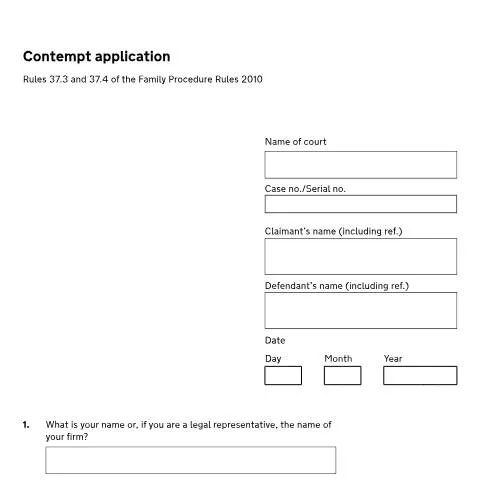
When Court Orders Fall on Deaf Ears: The FC600 Contempt Application
In the intricate machinery of family justice, court orders and undertakings represent the final word on matters ranging from child arrangements to financial settlements. Yet what happens when a party simply refuses to comply, treating these legal directives as mere suggestions? This is where Form FC600 enters the picture—a powerful legal instrument that allows affected parties to formally ask HM Courts & Tribunals Service to consider whether someone has committed contempt of court.
The FC600 application carries significant weight within the family justice system. Unlike standard enforcement mechanisms, contempt proceedings can result in imprisonment, substantial fines, or asset seizure. The form serves as the gateway to these serious sanctions, requiring applicants to present their case with precision and supporting evidence that meets the criminal standard of proof—beyond reasonable doubt.
Understanding when and how to deploy this mechanism effectively requires navigating complex procedural rules, gathering compelling evidence, and appreciating the profound consequences that may follow. The stakes are high for both parties: applicants seeking justice for non-compliance, and defendants facing potential loss of liberty.
Decoding the Legal Framework Behind Contempt Applications
The FC600 application operates under Rules 37.3 and 37.4 of the Family Procedure Rules 2010, which establish the procedural framework for contempt proceedings in family courts. This regulatory foundation distinguishes contempt applications from ordinary civil enforcement, elevating them to quasi-criminal proceedings with enhanced procedural safeguards.
The form addresses several distinct categories of contempt. Breach of court orders represents the most common scenario, where a party fails to comply with specific directions such as contact arrangements or financial provisions. Breach of undertakings—formal promises made to the court—constitutes another significant category. Finally, the form covers interference with the administration of justice, including situations involving false statements in sworn documents.
Crucially, certain contempt applications require prior permission from the court. This additional hurdle applies to allegations of interference with justice administration (except in existing High Court or family court proceedings) and cases involving knowingly false statements in affidavits or other verified documents. The permission requirement serves as a filter, ensuring that only meritorious cases proceed to full hearings.
| Type of Contempt | Permission Required | Evidence Standard | Potential Consequences |
|---|---|---|---|
| Breach of court order | No | Beyond reasonable doubt | Fine, imprisonment, asset seizure |
| Breach of undertaking | No | Beyond reasonable doubt | Fine, imprisonment, asset seizure |
| False statement in sworn document | Yes | Beyond reasonable doubt | Fine, imprisonment, asset seizure |
| Interference with justice administration | Yes (with exceptions) | Beyond reasonable doubt | Fine, imprisonment, asset seizure |
Navigating the Application Process: From Initial Consideration to Court Filing
Before completing Form FC600, applicants must carefully assess whether contempt proceedings represent the most appropriate remedy. The decision carries significant implications, as unsuccessful applications may result in adverse costs orders and damaged relationships between parties. The quasi-criminal nature of contempt proceedings means that less confrontational enforcement methods—such as applications for specific performance or variation of orders—may prove more effective in certain circumstances.
The application process begins with identifying the correct respondent and gathering comprehensive evidence. Personal service requirements for the original order or undertaking create an initial hurdle. If the defendant was not personally served with the order allegedly breached, applicants must either obtain evidence of an order dispensing with personal service or acknowledge this deficiency in their application.
The presence or absence of a penal notice on the original order significantly impacts the strength of the contempt application. Penal notices—warnings attached to court orders stating the consequences of non-compliance—are not strictly required for all contempt applications, but their presence strengthens the case by demonstrating that the defendant was clearly warned of potential sanctions.
Essential Documentation and Evidence Requirements
Form FC600 demands substantial supporting documentation, primarily in the form of affidavits or affirmations prepared according to Family Procedure Rules. These sworn statements must detail the factual basis for the contempt allegation, presented chronologically with numbered paragraphs for clarity.
The evidence threshold mirrors criminal proceedings—proof beyond reasonable doubt rather than the civil standard of balance of probabilities. This elevated standard requires compelling documentation of non-compliance, such as:
- Photographic or video evidence of ongoing breaches
- Contemporary records of failed compliance attempts
- Third-party witness statements corroborating the breach
- Communication records demonstrating wilful disregard of court orders
- Financial records evidencing non-payment of ordered sums
For undertaking breaches, applicants must demonstrate that the person giving the undertaking understood both its terms and the consequences of non-compliance. This requirement often necessitates evidence of the circumstances surrounding the undertaking's acceptance, including any explanations provided by the court or legal representatives.
Completing Form FC600: Section-by-Section Guidance
The form's structure reflects the serious nature of contempt proceedings, requiring detailed information across thirteen numbered sections. Early sections establish basic case information—court name, case number, and party details—but accuracy here proves crucial as errors may delay proceedings or result in service failures.
Sections 1 and 2 identify the applicant and their status. Legal representatives must provide firm details, while self-represented litigants should ensure their contact information remains current throughout proceedings. The court uses this information for all subsequent correspondence, making accuracy essential.
Section 3 requires comprehensive defendant details, including full names and current addresses. Incomplete or outdated information may prevent proper service, effectively derailing the application before it reaches a hearing. Where multiple parties require service, continuation sheets must be prepared with identical detail levels.
The Critical Evidence and Permission Sections
Section 4 mandates written evidence attachment, typically in affidavit form. This evidence forms the foundation of the contempt allegation and must be prepared with exceptional care. The Family Procedure Rules specify formatting requirements, including proper attestation clauses and exhibit marking conventions.
Section 5 addresses permission requirements, creating a potential procedural trap for unwary applicants. Those requiring permission must provide compelling grounds demonstrating why the court should allow the application to proceed. Insufficient justification at this stage may result in summary dismissal without consideration of the underlying contempt allegation.
The form's detailed notes provide crucial guidance on permission requirements, but applicants should carefully consider whether their case falls within excepted categories. For instance, applications relating to existing High Court or family court proceedings may proceed without permission even when alleging interference with justice administration.
Dissecting the Breach Details: Orders, Service, and Undertakings
Sections 6 through 13 require comprehensive details of the alleged contempt. The nature of contempt must be clearly articulated, distinguishing between order breaches, undertaking violations, and other forms of court contempt. This classification affects both procedural requirements and potential defences.
For order breaches, sections 8 through 10 demand precise details of the original order's date and terms, service arrangements, and penal notice presence. Multiple orders require separate entries, creating potential complexity for cases involving sequential or varied directions. The personal service date proves particularly significant, as contempt proceedings generally cannot proceed without evidence of proper service.
Undertaking breaches, addressed in sections 11 and 12, present additional challenges. Applicants must not only detail the undertaking's terms but also demonstrate the defendant's understanding of both the commitment and its consequences. This requirement often necessitates evidence of court explanations or legal advice provided when the undertaking was accepted.
The final section requires a chronological summary of facts constituting the contempt. This narrative should be concise yet comprehensive, presenting events in numbered paragraphs that correspond to supporting evidence. Effective summaries avoid legal conclusions, focusing instead on observable facts that support the contempt allegation.
Understanding Defendant Rights and Procedural Safeguards
Form FC600 includes a detailed rights notice for defendants, reflecting the serious nature of contempt proceedings and their potential consequences. These rights mirror those found in criminal proceedings, acknowledging that contempt sanctions may include imprisonment or substantial financial penalties.
The right to legal representation extends beyond mere permission to instruct solicitors. Defendants are entitled to reasonable time to obtain representation and may qualify for legal aid without the usual means testing requirements. This enhanced access to justice recognises that liberty may be at stake in contempt proceedings.
Language support through court interpreters ensures that non-English speakers can fully participate in proceedings. Unlike some civil matters where interpretation costs may fall on parties, HMCTS provides this service directly, removing potential barriers to effective participation.
The Right to Silence and Burden of Proof
Defendants enjoy the right to remain silent and cannot be compelled to provide potentially self-incriminating answers. This protection, borrowed from criminal law, acknowledges that contempt proceedings may result in punishment rather than mere civil remedies.
Fill in your form directly online
No printing: type your details into the boxes of the official form, tick, then download the PDF ready to send.
- 1Type into the form boxes
- 2Tick in one click
- 3Save and download the PDF
The burden of proof rests entirely on the applicant, who must satisfy the court beyond reasonable doubt of both the facts constituting contempt and that those facts actually constitute contempt in law. This dual requirement means that even clear breaches of court orders may not result in contempt findings if mitigating circumstances exist.
Proceedings may continue in the defendant's absence, but courts must still be satisfied of guilt to the criminal standard. Non-attendance does not create presumptions of guilt or reduce the evidence threshold, though it may limit the defendant's ability to present mitigating factors.
Court Process and Potential Outcomes
Once filed, FC600 applications trigger a formal court process culminating in public hearings unless exceptional circumstances justify private proceedings. The public nature of contempt hearings serves both transparency and deterrent functions, marking these proceedings as matters of public interest rather than private disputes.
Courts possess wide discretionary powers when dealing with proven contempt. Imprisonment represents the ultimate sanction, reserved for serious breaches or cases demonstrating flagrant disregard for court authority. Financial penalties may include both fines payable to the court and compensation for losses caused by the breach. Asset seizure provides an alternative enforcement mechanism, particularly effective in financial cases.
The court's approach to sentencing considers numerous factors, including the breach's severity, its impact on other parties, the defendant's previous compliance history, and any expressions of remorse or apology. Defendants who acknowledge their contempt and demonstrate genuine remorse typically receive more lenient treatment than those who continue to deny clear breaches.
Written Findings and Public Records
Courts must provide written findings as soon as practicable after hearings, documenting both factual conclusions and legal reasoning. These written judgments become part of the public record, potentially affecting the defendant's reputation and future court proceedings.
The permanent nature of contempt findings creates long-term consequences extending beyond immediate sanctions. Future applications for variation or discharge of orders may be influenced by contempt history, while custody and access determinations may consider patterns of non-compliance with court directions.
Strategic Considerations for Effective Applications
Successful contempt applications require careful timing and tactical awareness. Filing too early may result in dismissal if the defendant subsequently complies, while excessive delay may suggest that the breach lacks genuine urgency. The most effective applications demonstrate clear, wilful, and continuing non-compliance despite reasonable opportunities for voluntary compliance.
The relationship between contempt proceedings and other enforcement mechanisms requires careful consideration. Simultaneous applications for specific performance, variation, or discharge may confuse issues and dilute the contempt application's impact. However, sequential approaches—attempting less confrontational remedies before pursuing contempt—often strengthen the ultimate application by demonstrating the defendant's intransigence.
Cost implications extend beyond court fees to potential adverse orders if applications fail. Unsuccessful contempt applicants may face substantial legal costs, particularly where defendants successfully argue that alternative remedies should have been pursued. This financial risk necessitates realistic assessment of evidence strength before proceeding.
The quasi-criminal nature of contempt proceedings also affects disclosure obligations and privilege claims. Documents that might be protected in purely civil proceedings may become disclosable where contempt allegations arise, while legal advice privilege may be waived through the conduct of proceedings.
Form FC600 represents a significant escalation in family court enforcement, transforming civil disputes into quasi-criminal proceedings with potentially life-changing consequences. Its effective deployment requires not only procedural compliance but also strategic awareness of the broader implications for all parties involved. When properly utilised with compelling evidence and careful preparation, the contempt application provides a powerful tool for ensuring that court orders retain their authority and effectiveness within the family justice system.