The High Court's Ultimate Safety Net for Vulnerable Children
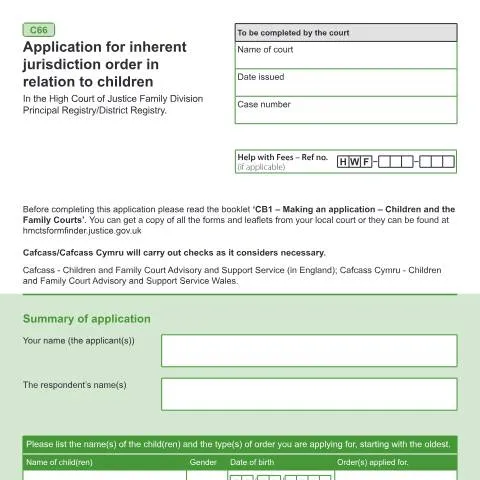
When statutory child protection frameworks fall short and conventional family court remedies prove inadequate, the High Court's inherent jurisdiction provides a unique judicial pathway to safeguard children's welfare. Form C66 serves as the gateway to this extraordinary jurisdiction, enabling applications for bespoke court orders that transcend the boundaries of standard Children Act 1989 provisions. This jurisdiction becomes particularly vital in cases involving international child abduction, forced marriage threats, female genital mutilation risks, or situations where a child's safety cannot be adequately protected through existing legal mechanisms.
The inherent jurisdiction represents the High Court's ancient parens patriae powers, allowing judges to craft innovative protective measures tailored to each child's specific circumstances. Unlike statutory applications under the Children Act, these cases often involve complex cross-border elements, unusual family structures, or emerging forms of harm that existing legislation hasn't anticipated. Form C66 applications frequently arise in urgent situations where traditional court processes would prove too slow or inflexible to protect a child effectively.
Legal practitioners typically resort to this jurisdiction when dealing with international relocation disputes involving non-Hague Convention countries, cases where children face cultural or religious practices that could cause significant harm, or situations involving sophisticated attempts to circumvent existing court orders. The jurisdiction also proves essential when addressing modern challenges such as online radicalisation, trafficking concerns, or complex medical treatment decisions where parental views conflict dramatically with professional medical advice.
Navigating the Principal Registry and District Registry Options
Form C66 applications can be filed either at the Principal Registry of the Family Division in London or at designated District Registries across England and Wales. The choice of venue often depends on the urgency of the situation, geographical convenience, and the complexity of the case. The Principal Registry, located in First Avenue House, typically handles the most complex international cases and those requiring immediate judicial attention from specialist High Court judges.
District Registries, however, offer significant advantages for cases with strong regional connections or where urgent hearings need to be accommodated within tight timeframes. Manchester District Registry frequently handles cases involving Northern England and Scotland connections, while Cardiff District Registry manages Welsh cases through CAFCASS CYMRU involvement. The Birmingham and Leeds registries serve as crucial hubs for Midlands and Yorkshire cases respectively.
Practitioners should consider that certain District Registries have developed particular expertise in specific types of inherent jurisdiction cases. For instance, some registries have extensive experience with forced marriage protection cases, while others frequently handle international child abduction matters. The court's administrative staff can provide guidance on which registry might be most appropriate, though urgent cases often proceed at whichever registry can accommodate the earliest hearing date.
| Registry Location | Typical Case Types | Specialist Expertise | Urgency Response |
|---|---|---|---|
| Principal Registry, London | International abduction, complex medical | Cross-border jurisdiction | Same-day emergency hearings |
| Manchester District Registry | Northern England, Scotland connections | Cultural practice cases | 48-hour urgent applications |
| Cardiff District Registry | Welsh jurisdiction, CAFCASS CYMRU | Bilingual proceedings | Emergency Welsh language support |
| Birmingham District Registry | Midlands-based families | Religious community disputes | Regional urgent response |
Decoding the Application Structure and Critical Information Requirements
The C66 form demands meticulous completion across eight distinct sections, each serving a crucial evidential purpose in establishing the court's jurisdiction and the child's need for protection. Section 1 requires comprehensive applicant details, including a five-year address history that enables the court to assess jurisdictional connections and potential conflicts of interest. Applicants who have lived at multiple addresses must provide complete residential chronology, as gaps or inconsistencies can delay proceedings significantly.
The confidential address provisions in Section 1 prove particularly important in cases involving domestic violence or where revealing the applicant's location could compromise child safety. Form C8 allows applicants to provide address details confidentially to the court while preventing disclosure to potentially dangerous respondents. This protection mechanism frequently proves essential in forced marriage cases or situations involving serious domestic abuse.
Section 2 requires detailed information about each child, including their current whereabouts and any concerns about habitual residence in other jurisdictions. This section proves critical for establishing whether English courts have jurisdiction to make orders, particularly in international cases. Courts scrutinise habitual residence claims carefully, as incorrect assertions can result in jurisdictional challenges that derail entire proceedings.
The relationship details in Section 2 must accurately reflect complex family structures, including step-relationships, cultural adoption arrangements, or guardianship situations that might not align with traditional legal definitions. Foster care arrangements, kinship care, or informal guardianship situations require particularly careful explanation to establish the applicant's standing to bring proceedings.
Articulating the Relief Sought and Supporting Grounds
Section 3 demands a clear, concise summary of the court orders sought, while Section 4 requires supporting facts without descending into full witness statement territory. Practitioners must strike a delicate balance between providing sufficient detail to establish urgency and avoiding premature disclosure of their entire case strategy. The court needs enough information to understand the child's immediate risk while preserving the applicant's ability to develop their case through subsequent evidence.
Human Rights Act 1998 considerations in Section 3 require careful analysis, as inherent jurisdiction cases frequently engage Article 8 rights to family life and Article 3 prohibitions against inhuman or degrading treatment. Forced marriage cases invariably involve human rights considerations, as do cases involving female genital mutilation risks or international relocation against a child's wishes.
The Mediation Prerequisite and Recognised Exceptions
Section 5 addresses family mediation requirements, though inherent jurisdiction cases often benefit from specific exceptions to the general expectation that parties attempt mediation before court proceedings. Cases involving domestic violence, child protection concerns, or urgent international elements typically satisfy the criteria for bypassing mediation requirements entirely.
The court recognises that mediation proves inappropriate or impossible in many inherent jurisdiction scenarios. International child abduction cases cannot realistically be mediated when one parent has already breached court orders or removed children unlawfully. Similarly, forced marriage protection cases often involve family dynamics where mediation would expose the child to additional risk rather than providing constructive dialogue opportunities.
When mediation has been attempted unsuccessfully, applicants should provide specific details about why the process failed and whether any safety concerns emerged during mediation sessions. Shuttle mediation attempts in domestic violence cases might demonstrate good faith efforts while maintaining necessary safety boundaries, though even these approaches often prove inadequate for inherent jurisdiction-level disputes.
Risk Assessment Protocols and Supplementary Documentation
Section 6's risk assessment triggers automatic Form C1A requirements when any domestic abuse, household violence, child abduction risks, or concerning conduct exists. The C1A supplement provides detailed frameworks for documenting these risks systematically, enabling courts to implement appropriate protective measures from the outset of proceedings.
Child abduction risks require particularly detailed analysis in C1A submissions, including assessment of the respondent's connections to other jurisdictions, access to travel documents, financial resources for international travel, and any previous threats or attempts to remove children. Courts regularly make passport surrender orders, port alert arrangements, or prohibited steps orders based on abduction risk assessments provided through Form C1A.
The "other conduct or behaviour" category in Section 6 captures emerging forms of harm that traditional risk assessment tools might not address adequately. Online grooming concerns, radicalisation risks, exposure to extremist ideologies, or sophisticated manipulation tactics often fall within this category, requiring detailed explanation in C1A supplements.
Historical Proceedings and Multi-Agency Involvement
Section 7 demands comprehensive disclosure of all previous court cases involving the children, including cases that might appear tangentially related or historically remote. Courts need complete pictures of previous judicial decisions, ongoing monitoring arrangements, and any existing orders that might interact with proposed inherent jurisdiction relief.
Emergency Protection Orders, Care Orders, and Supervision Orders create statutory frameworks that must be considered alongside inherent jurisdiction applications. Local authority involvement through these orders doesn't preclude inherent jurisdiction applications but requires careful coordination to avoid conflicting court directions or duplicated protective measures.
Previous Family Law Act 1996 proceedings for non-molestation or occupation orders often provide crucial background context for inherent jurisdiction cases, particularly where domestic violence has escalated beyond the scope of standard protective orders. Similarly, existing child arrangements orders under Section 8 of the Children Act 1989 might require variation or supplementation through inherent jurisdiction powers.
CAFCASS and CAFCASS CYMRU Investigation Frameworks
Both CAFCASS (Children and Family Court Advisory and Support Service) in England and CAFCASS CYMRU in Wales automatically conduct safeguarding checks upon receipt of Form C66 applications. These organisations possess extensive databases and information-sharing arrangements that enable rapid assessment of child protection concerns, previous court involvement, and multi-agency safeguarding activity.
CAFCASS safeguarding letters typically arrive within 48 hours of application filing, providing courts with immediate intelligence about existing concerns, ongoing social services involvement, or previous CAFCASS recommendations in related proceedings. These letters often prove decisive in determining whether emergency protective measures should be implemented before the first hearing.
Fill in your form directly online
No printing: type your details into the boxes of the official form, tick, then download the PDF ready to send.
- 1Type into the form boxes
- 2Tick in one click
- 3Save and download the PDF
CAFCASS CYMRU operates under slightly different protocols, with particular emphasis on Welsh language provisions and cultural sensitivity in cases involving Welsh-speaking families or communities. Their safeguarding processes include specific provisions for cases involving cultural practices, religious considerations, or cross-border elements between Wales and England.
The automatic nature of CAFCASS involvement means that applicants cannot control the timing or scope of these investigations. Practitioners should prepare clients for potential contact from CAFCASS officers and ensure that any immediate safety concerns are clearly articulated in the initial application to inform CAFCASS risk assessments.
Financial Considerations and Help with Fees Provisions
Inherent jurisdiction applications attract substantial court fees, though the Help with Fees scheme provides remission opportunities for qualifying applicants. The HWF reference number field at the top of Form C66 enables applicants to claim fee remissions where financial circumstances justify such support.
Emergency applications often proceed without immediate fee payment, with courts accepting undertakings to pay fees once remission applications are processed or financial circumstances clarify. This approach prevents urgent child protection needs from being delayed by administrative fee processing, though applicants remain liable for fees unless formal remission is granted.
Legal aid availability for inherent jurisdiction cases depends heavily on the specific circumstances involved. Cases involving domestic violence, child abduction, or forced marriage often qualify for exceptional funding, while other cases might require private funding arrangements. Solicitors should assess legal aid eligibility carefully before advising clients on proceeding with applications.
The court fee structure for inherent jurisdiction applications includes application fees, hearing fees, and potential additional costs for urgent or out-of-hours applications. District Registries might have slightly different administrative arrangements for fee payment, though all registries accept the same Help with Fees provisions and remission criteria.
Post-Application Procedures and Judicial Case Management
Once Form C66 is filed, the court's case management approach depends heavily on the urgency and complexity of the situation presented. Emergency applications might receive same-day judicial consideration, with judges making interim protective orders based on the application materials and any immediate CAFCASS intelligence available.
Standard case management directions typically include timetables for respondent service, evidence filing, and CAFCASS reporting requirements. The court often makes directions for children's guardian appointment in complex cases, particularly where the child's views and interests might not align with either parent's position.
International elements frequently require additional case management provisions, including service arrangements for overseas respondents, evidence gathering from foreign jurisdictions, or coordination with international court systems. The Principal Registry maintains specialist expertise for managing these complex procedural requirements.
Urgent cases might proceed through multiple interim hearing stages before final resolution, with the court maintaining ongoing oversight of protective measures and adjusting orders based on evolving circumstances. This flexible approach enables the inherent jurisdiction to respond dynamically to changing child protection needs while maintaining appropriate procedural safeguards for all parties involved.