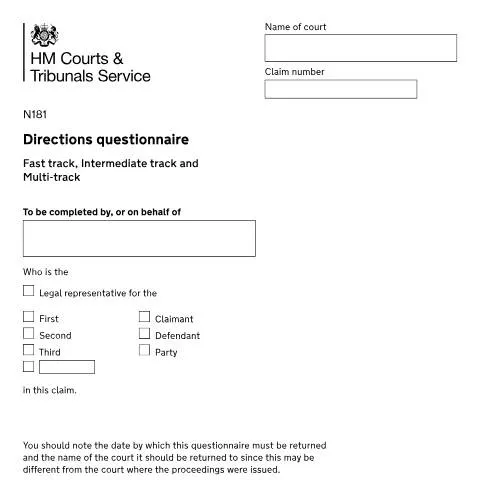
When Court Case Management Takes Shape: Understanding the N181 Directions Questionnaire
Once a civil claim progresses beyond the initial stages of defence filing and moves towards judicial case management, parties encounter a critical juncture where the court must determine how their dispute will be handled. The Form N181 Directions questionnaire represents this pivotal moment, serving as the mechanism through which HM Courts & Tribunals Service gathers essential information to allocate cases to the most appropriate management track and establish procedural directions.
This comprehensive questionnaire becomes mandatory when a claim requires active case management, typically after the defence has been filed and the court needs to chart the path towards resolution. Unlike simpler claim forms that initiate proceedings, the N181 addresses the sophisticated logistics of managing litigation through the English civil justice system's three-tier track structure.
The form's significance extends beyond mere administrative convenience. It directly influences cost budgets, procedural timelines, and the overall trajectory of legal proceedings. Whether a commercial dispute worth £30,000 proceeds along the fast track with streamlined directions or gets elevated to multi-track handling with extensive case management conferences often hinges on the information provided in this questionnaire.
Navigating the Three-Track System: Allocation Strategy and Complexity Bands
The N181's primary function centres on track allocation, where the court assigns cases to fast track, intermediate track, or multi-track based on monetary value, complexity, and practical considerations. This allocation determines not merely procedural rules but fundamentally shapes the entire litigation experience.
Track Allocation Parameters and Financial Thresholds
| Track Type | Typical Value Range | Key Characteristics | Complexity Bands |
|---|---|---|---|
| Fast Track | £10,000 - £25,000 | Streamlined procedure, limited trial time | Bands 1-4 |
| Intermediate Track | £25,000 - £100,000 | Enhanced case management, flexible approach | Bands 1-4 |
| Multi-track | Above £100,000 | Comprehensive management, case conferences | Not applicable |
The questionnaire's Section D addresses track allocation directly, requiring parties to specify their preferred track and justify any departure from standard monetary guidelines. Complexity bands within fast and intermediate tracks represent a sophisticated cost management tool, creating an ascending scale of allowable costs proportionate to case complexity.
Strategic Considerations in Track Selection
Parties must carefully consider track allocation implications beyond simple monetary thresholds. A £24,000 commercial contract dispute involving multiple parties and complex documentary evidence might warrant intermediate track allocation despite falling within fast track parameters. Conversely, a straightforward debt recovery claim exceeding £25,000 could potentially remain on fast track if complexity factors support such allocation.
The questionnaire specifically asks whether proposed track allocation is agreed with other parties. Unanimous agreement often influences judicial allocation decisions, though courts retain ultimate discretion based on case management efficiency and proportionality principles.
Settlement Dynamics and Early Resolution Mechanisms
Section A of the N181 addresses settlement attempts with particular emphasis on the Civil Procedure Rules' expectation that parties actively pursue resolution before trial. This section carries significant weight in subsequent cost determinations, as courts increasingly scrutinise parties' settlement efforts when awarding costs.
The questionnaire distinguishes between legal representatives and litigants in person, requiring solicitors and barristers to confirm they have explained settlement options and potential cost sanctions to their clients. This professional obligation reflects the courts' emphasis on early dispute resolution and cost proportionality.
Mediation and Alternative Dispute Resolution
The form specifically references the Civil Mediation Council's directory of accredited providers, highlighting mediation as a preferred settlement mechanism. Parties requesting a one-month stay for settlement discussions must still complete the entire questionnaire, ensuring case management preparation continues alongside settlement efforts.
When parties decline settlement attempts, they must provide detailed reasons for considering settlement inappropriate. These explanations become part of the court record and may influence subsequent cost orders, particularly if the case eventually settles on terms similar to those previously available.
Venue Selection and Geographic Considerations
Section B addresses court location preferences, acknowledging that initial claim filing location may not represent the optimal venue for trial management. This flexibility becomes particularly relevant in High Court proceedings, where cases can transfer between the Royal Courts of Justice, regional Civil Trial Centres, or appropriate County Court hearing centres.
The questionnaire requires specific justification for venue preferences, considering factors such as witness convenience, document location, and regional expertise. Commercial disputes involving specialist knowledge might benefit from London Commercial Court allocation, while personal injury claims with local expert evidence could proceed more efficiently at regional centres.
High Court Retention Versus County Court Transfer
High Court claims face particular scrutiny regarding venue appropriateness. The N181 specifically asks whether cases should remain in their issued division or transfer to County Court jurisdiction. This decision impacts not only procedural complexity but also cost exposure and judicial resources.
Factors supporting High Court retention include case value, legal complexity, precedent importance, and specialist jurisdiction requirements. However, proportionality principles increasingly favour County Court handling for disputes that can be resolved efficiently at that level.
Pre-Action Protocol Compliance and Case Preparation
Section C addresses pre-action protocol compliance, reflecting the courts' expectation that parties engage meaningfully before formal proceedings commence. This requirement extends beyond mere box-ticking, requiring detailed explanation of any non-compliance or partial compliance with relevant protocols.
Different dispute types attract specific pre-action protocols, from construction and engineering disputes to professional negligence claims. The questionnaire references the comprehensive protocol directory available through the Justice Ministry website, emphasising the importance of identifying and following appropriate protocols.
Consequences of Protocol Non-Compliance
Failure to comply with pre-action protocols can result in cost sanctions, procedural restrictions, or adverse case management directions. The N181 provides parties with an opportunity to explain non-compliance circumstances, potentially mitigating subsequent penalties if reasonable justification exists.
Common acceptable reasons for protocol non-compliance include urgent applications, limitation period constraints, or opposing party non-engagement. However, mere convenience or cost considerations rarely justify protocol departure.
Application History and Ongoing Procedural Management
The questionnaire's case management information section requires disclosure of any existing applications within the proceedings, recognising that interim applications can significantly impact case management directions. Outstanding applications for summary judgment, strike-out, or interim injunctions may necessitate delayed or modified case management approaches.
Parties must provide specific details of application hearing dates, allowing courts to coordinate case management directions with interim application outcomes. This coordination prevents conflicting directions and ensures efficient use of judicial resources.
Integration with Existing Court Orders
Existing court orders, whether from application hearings or earlier case management conferences, may constrain or influence the directions available through the N181 process. Parties should consider how previous orders interact with their questionnaire responses, ensuring consistency and compliance with established procedural framework.
Completing and Submitting the N181: Practical Requirements
The directions questionnaire requires completion by or on behalf of legal representatives or litigants in person, with clear identification of party representation status. The form emphasises the importance of return deadlines and correct court identification, noting that these may differ from the original claim issuing court.
All supporting documents must bear the claim number and attach securely to the questionnaire, preventing administrative separation and ensuring complete case management information reaches the allocated judge. The form specifically warns that settlement after questionnaire submission requires immediate court notification to prevent unnecessary case management directions.
Coordination Between Multiple Parties
Multi-party proceedings require careful coordination of N181 responses, as conflicting proposals for track allocation, venue, or case management directions can complicate judicial decision-making. While unanimous party agreement carries weight, courts retain discretion to impose alternative directions serving case management efficiency and proportionality objectives.
The questionnaire's design accommodates representation complexity, allowing completion by legal representatives for first, second, or third parties, with clear identification requirements preventing confusion about party positions and representation status.
Strategic Impact on Cost Management and Procedural Control
Beyond immediate case management implications, the N181 influences broader litigation strategy through its impact on cost budgeting, disclosure obligations, and trial preparation timelines. Track allocation determines applicable cost management regimes, while complexity band assignment directly affects recoverable cost levels.
Fast and intermediate track cases benefit from predictable cost structures through complexity band assignment, providing parties with greater certainty about potential cost exposure. Multi-track allocation offers flexibility but requires comprehensive cost budgeting exercises that can significantly impact case economics.
The questionnaire responses become part of the court record, potentially influencing subsequent case management decisions and cost determinations. Parties should approach completion strategically, considering both immediate case management objectives and longer-term litigation goals within the structured framework of English civil procedure.
Through its comprehensive approach to case management information gathering, the N181 directions questionnaire serves as the foundation for efficient, proportionate case handling within HM Courts & Tribunals Service's structured approach to civil litigation management.
Strategic Considerations for Track Allocation
The track allocation decision fundamentally shapes your litigation strategy, and understanding the nuances can significantly impact your case outcome. When completing Form N181, you're not merely filling boxes – you're positioning your case within the court system's framework to maximise efficiency and cost-effectiveness.
Financial value remains the primary determinant, but the courts exercise considerable discretion when cases fall near boundary thresholds. For claims valued between £24,500 and £26,000, parties should carefully consider whether additional factors might push their case towards intermediate track. The court will examine the complexity of facts, legal issues involved, number of parties, and likely trial duration. A seemingly straightforward contract dispute worth £25,500 involving multiple defendants and complex commercial arrangements may well merit intermediate track allocation despite falling within fast track's financial parameters.
Remedy sought plays a crucial role often overlooked by litigants. Claims primarily seeking injunctive relief, regardless of monetary value, typically receive multi-track allocation due to their inherently complex nature. Similarly, cases involving professional negligence, construction disputes, or intellectual property matters frequently exceed fast track's complexity thresholds even when financial values suggest otherwise.
The number of witnesses becomes particularly significant for track allocation. Fast track assumes trials lasting no more than one day, typically accommodating 2-3 witnesses per side. If your case requires extensive witness testimony – perhaps involving multiple expert witnesses or numerous factual witnesses to establish a chain of events – you should clearly indicate this in your directions questionnaire. The court needs accurate estimates to ensure appropriate track allocation and avoid subsequent case management complications.
Expert evidence requirements deserve special attention. Fast track generally permits one expert per party per field of expertise, with joint experts strongly encouraged. If your case demands multiple experts – for instance, a personal injury claim requiring both medical and accident reconstruction specialists – this complexity factor may push allocation towards intermediate track even if damages fall within fast track parameters.
Fill in your form directly online
No printing: type your details into the boxes of the official form, tick, then download the PDF ready to send.
- 1Type into the form boxes
- 2Tick in one click
- 3Save and download the PDF
Document volume and complexity significantly influence track decisions. Cases involving extensive disclosure, complex financial records, or technical documentation often exceed fast track's streamlined procedures. When completing Section C of Form N181, provide realistic estimates of document quantities and complexity rather than optimistic assessments that might prove inadequate later.
Cost Implications and Budget Management
Track allocation directly impacts cost exposure and budget planning, making accurate completion of cost-related sections in Form N181 essential for effective litigation management. Each track operates under different cost regimes, with varying degrees of cost protection and recovery opportunities.
Fast track cases benefit from fixed cost regimes for many standard applications and a costs cap system that provides certainty for parties. Trial costs are generally limited to £750 plus VAT for cases up to £3,000, rising to £1,500 plus VAT for cases between £15,000 and £25,000. However, these caps don't cover all aspects of litigation – interim applications, expert costs, and certain procedural steps may incur additional expenses not subject to fixed fee protection.
Intermediate track introduces costs budgeting requirements that fundamentally change financial planning approaches. Parties must prepare and exchange costs budgets using Precedent H, typically within specific timeframes following track allocation. The court will then conduct a Costs and Case Management Conference (CCMC) where budgets receive judicial scrutiny and approval. This process, while potentially time-consuming, provides greater cost certainty and control throughout proceedings.
The costs budgeting process requires careful preparation. Your budget must be realistic, properly particularised, and justified by reference to the case's specific requirements. Courts increasingly scrutinise inflated or inadequately explained budget items, and approved budgets bind parties to specific spending parameters. Significant departures from approved budgets require court permission and compelling justification.
Multi-track cases face the most complex cost regimes, with detailed costs budgeting mandatory for most claims. The court's case management powers extend to controlling when and how costs are incurred, potentially requiring advance approval for significant expenditure items. This level of judicial oversight aims to ensure proportionality between costs and case value but requires sophisticated budget management and regular court interaction.
Cost protection considerations vary significantly between tracks. Fast track's fixed cost regime provides certainty but may not fully compensate for actual costs incurred, particularly in complex cases requiring extensive preparation. Intermediate and multi-track cases offer greater potential for full cost recovery but expose parties to higher adverse cost risks if unsuccessful.
When completing cost-related sections of Form N181, consider not only current expenditure but realistic projections for the entire litigation lifecycle. Include estimates for expert fees, court fees, potential interim applications, and trial preparation costs. Underestimating costs at the directions questionnaire stage can create budget pressures later, while overestimating may influence track allocation decisions inappropriately.
Electronic Filing and Case Management Integration
The integration of Form N181 within the court's electronic case management systems represents a significant evolution in civil procedure administration, affecting how directions questionnaires are processed, managed, and monitored throughout proceedings.
CE-File (Civil Electronic Filing) system integration allows electronic submission of directions questionnaires in many court centres, streamlining the administrative process and providing immediate confirmation of receipt. However, electronic filing requirements vary between courts and case types, with some jurisdictions maintaining paper-based systems or hybrid approaches. Before submitting Form N181 electronically, verify your specific court's capabilities and requirements through the Court Service website or direct court contact.
Electronic submission offers several procedural advantages beyond convenience. Digital timestamps provide precise filing records, eliminating disputes over compliance with court deadlines. Electronic systems also facilitate automatic case progression, with submitted directions questionnaires triggering subsequent case management steps without manual administrative intervention.
Case Management Information (CMI) systems utilise data from Form N181 to populate case tracking databases, enabling judicial and administrative oversight of case progress. Information regarding estimated trial duration, witness numbers, and expert requirements helps courts plan listing arrangements and allocate appropriate judicial resources. Accurate completion of these sections therefore impacts not only your specific case but broader court efficiency and resource allocation.
The Portal system integration affects certain case types, particularly those arising from pre-action protocols. Claims progressing through the RTA Portal or EL/PL Portal may have directions questionnaire requirements modified or streamlined based on information already captured during the portal process. Understanding these integrations prevents duplication of effort and ensures compliance with modified procedural requirements.
Digital case files increasingly replace traditional paper-based systems, with Form N181 becoming part of comprehensive electronic records accessible to all parties and the court. This accessibility facilitates remote hearings, electronic case management conferences, and streamlined document review processes. However, it also requires attention to data protection considerations and appropriate redaction of sensitive information.
Automated case progression systems may trigger standard directions based on Form N181 responses, particularly in fast track cases following established procedural templates. While this automation increases efficiency, it also demands accurate and complete questionnaire responses to avoid inappropriate standard directions that may not suit your case's specific requirements.
Electronic signature and verification requirements vary between courts and submission methods. Some systems accept electronic signatures through secure login credentials, while others require traditional 'wet' signatures on scanned documents. Understanding these requirements before submission prevents delays and ensures compliance with authentication standards.
The integration with listing systems allows courts to schedule case management conferences and trials more efficiently based on realistic time estimates provided in directions questionnaires. Inaccurate estimates can lead to inadequate court time allocation, potentially causing adjournments and additional costs. Conversely, overestimating requirements may result in unnecessarily delayed hearing dates due to court availability constraints.