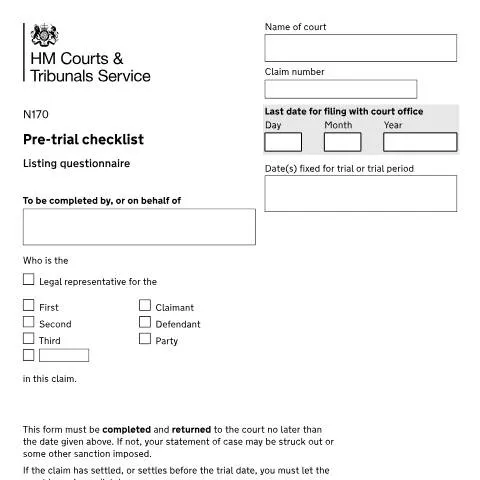
When Civil Litigation Reaches the Pre-Trial Threshold: Understanding Form N170
In the intricate machinery of civil litigation within England and Wales, Form N170 represents a pivotal checkpoint where legal proceedings shift from preparation to imminent trial reality. This listing questionnaire serves as the court's essential tool for orchestrating the final pre-trial arrangements, ensuring that when parties arrive at the courthouse door, every witness, expert, and piece of evidence is precisely coordinated for efficient judicial proceedings.
The N170 emerges at a critical juncture when case management directions have largely been fulfilled, witness statements exchanged, and expert reports filed. It's the administrative bridge between the intensive preparation phase and the courtroom drama itself, requiring legal representatives—or litigants in person—to confirm their readiness and declare any outstanding procedural requirements.
Unlike earlier case management forms that focus on disclosure and evidence gathering, the N170 demands granular detail about trial logistics: which witnesses will attend, whether interpreters are needed, if experts require special scheduling, and crucially, whether all previous court directions have been satisfied. The form's completion triggers the court's listing process, potentially fixing firm trial dates that carry significant cost implications if subsequently altered.
Navigating the Civil Procedure Rules Framework
The N170 listing questionnaire operates within the Civil Procedure Rules (CPR) framework, specifically under the court's case management powers established in CPR Part 3. Its deployment varies significantly across the three main tracks that govern civil litigation complexity and value.
For fast track cases—typically claims between £10,000 and £25,000—the N170 appears when the court is ready to list a trial that should conclude within one day. These cases follow a standardised timetable, with the listing questionnaire serving to confirm that the 30-week journey from allocation to trial has proceeded smoothly. The form captures any last-minute complications that might derail the carefully choreographed fast track schedule.
In multi-track litigation, where claims exceed £25,000 or involve complex legal issues, the N170 carries additional weight. Here, legal representatives must attach proposed trial timetables and, where no costs management order exists, provide detailed cost estimates. The court relies on these submissions to allocate appropriate hearing time—often multiple days—and ensure that judicial resources match the case's complexity.
The recently introduced intermediate track, bridging fast and multi-track procedures for claims between £25,000 and £100,000, presents its own N170 considerations. These cases benefit from enhanced case management while maintaining efficiency expectations, requiring careful attention to the form's trial duration estimates and witness scheduling requirements.
Mandatory Compliance Declarations and Their Consequences
Section 1 of Form N170 demands unflinching honesty about compliance with existing court directions. This isn't merely administrative housekeeping—non-compliance declarations can trigger immediate judicial intervention, potentially including case management conferences, cost sanctions, or in extreme cases, striking out of statements of case.
When completing section 1.1, legal representatives must audit their adherence to every direction issued since allocation. Common areas of non-compliance include:
- Delayed disclosure of documents, particularly where privilege claims have caused disputes
- Expert evidence issues, including failure to obtain court permission for additional experts or late filing of reports
- Witness statement deficiencies, such as missing statements from key witnesses or late service on opposing parties
- Costs budgeting failures in multi-track cases, where revised Precedent H forms should have been filed following significant developments
The court views section 1.2 applications for additional directions with particular scrutiny. These requests must demonstrate genuine necessity rather than strategic delay, supported by draft orders that specify precisely what relief is sought. Parties who repeatedly seek extensions through N170 applications risk adverse costs orders and judicial criticism that can influence settlement negotiations.
Witness Coordination and Courtroom Logistics
The witness-related sections of Form N170 reveal the practical complexities of modern litigation. Section 2 requires careful consideration of not just how many witnesses will attend, but their specific needs and availability constraints.
| Witness Category | Key N170 Considerations | Potential Complications |
|---|---|---|
| Factual witnesses | Availability during trial period, special needs | Work commitments, medical appointments |
| Professional witnesses | Diary conflicts, interpreter requirements | International availability, language barriers |
| Vulnerable witnesses | Special measures applications, support arrangements | Screen requirements, intermediary needs |
Section 2.3 addresses special facilities with increasing sophistication as courts adapt to diverse population needs. Beyond traditional wheelchair accessibility, contemporary requirements might include hearing loops for witnesses with hearing impairments, separate waiting areas for vulnerable witnesses, or video link facilities for witnesses unable to attend in person due to medical conditions or security concerns.
The interpreter provisions in section 2.4 carry particular weight in commercial litigation involving international parties. While parties typically arrange their own interpreters, the court must know in advance to ensure appropriate seating arrangements and allow for the extended time that interpreted evidence invariably requires.
Expert Evidence Protocols and Joint Instructions
Section 3 of Form N170 addresses one of civil litigation's most complex areas: expert evidence coordination. The court's permission requirements for expert testimony mean that any gaps in section 3.1 can prove fatal to a party's case strategy.
The distinction between joint experts and party-appointed experts carries significant cost and tactical implications. Joint experts, increasingly favoured by courts for their efficiency and reduced adversarial character, require careful coordination through the N170 process. When experts haven't signed joint statements as required by CPR Part 35, the listing questionnaire provides the final opportunity to address these deficiencies before trial.
Expert availability presents unique challenges, particularly in specialised fields where qualified professionals maintain international practices. The N170's expert scheduling provisions allow parties to flag potential conflicts, though courts generally expect experts to prioritise court commitments over commercial engagements.
The court's emphasis on joint expert statements reflects broader efficiency drives within civil justice. Where experts have discussed issues but failed to produce signed joint statements, judges may order concurrent evidence sessions—'hot tubbing'—where experts give evidence together, potentially disrupting traditional litigation strategies.
Legal Representation Dynamics and Trial Advocacy
Section 4's focus on trial representation reflects practical realities that extend beyond simple attorney scheduling. The choice between solicitor and counsel advocacy affects everything from trial duration estimates to courtroom space allocation, with senior barristers often requiring additional preparation time that impacts listing decisions.
For litigants in person, section 4.1 presents particular challenges. Self-represented parties must honestly assess their capability to present complex evidence, cross-examine witnesses effectively, and navigate procedural requirements during trial. Courts increasingly provide guidance for unrepresented litigants, but the N170 stage demands realistic self-evaluation of advocacy capabilities.
The availability constraints in section 4.2 often reveal the hierarchical nature of legal practice. Senior counsel's diary commitments can effectively dictate trial dates, particularly in complex commercial litigation where specialist expertise commands premium fees and limited availability. Courts balance these professional realities against efficient list management, sometimes requiring parties to accept alternative representation or face listing consequences.
Trial Duration Estimates and Judicial Resource Allocation
Section 5's trial time estimates carry profound implications for court listing efficiency and costs liability. Inaccurate estimates can result in part-heard trials, wasted court time, and substantial additional costs that courts increasingly pass to responsible parties.
The requirement for agreed time estimates between parties reflects judicial frustration with strategic timing disputes. When parties cannot agree on trial duration, courts may impose their own estimates based on experience, potentially creating pressure for settlements or procedural shortcuts that neither party originally contemplated.
Multi-track cases requiring attached trial timetables must demonstrate realistic scheduling that accounts for:
- Opening submissions and their complexity given the legal issues involved
- Evidence-in-chief duration, particularly where witness statements are lengthy or technical
- Cross-examination time allocation between parties, often the most unpredictable element
- Expert evidence sessions, including time for judicial questions and clarification
- Closing arguments and any judicial reading time for complex legal submissions
Vulnerability Assessments and Modern Court Practice
Section 7's vulnerability provisions represent evolving judicial recognition of diverse participant needs within contemporary litigation. The special measures framework, originally developed for criminal proceedings, increasingly influences civil trial management through N170 declarations.
Vulnerability assessments extend beyond obvious physical disabilities to encompass mental health conditions, learning difficulties, cultural sensitivities, and age-related considerations. Young adult witnesses, elderly parties with cognitive decline, and individuals with anxiety disorders all merit special consideration that the N170 process must capture early enough for effective court preparation.
The form's vulnerability section requires specific detail about proposed adjustments, moving beyond general requests to practical solutions. Courts may provide screen facilities, allow frequent breaks, permit support persons, or arrange separate entrances to accommodate various needs. However, these accommodations require advance notice that the N170 deadline makes critically important.
Recent practice developments include ground rules hearings for cases involving vulnerable witnesses, where judges establish specific protocols for questioning and courtroom management. The N170 vulnerability declarations often trigger these preliminary hearings, adding another layer to pre-trial preparation.
Document Coordination and Final Procedural Steps
The N170's document checklist in section 8 serves as a final procedural gateway, ensuring that all supporting materials accompany the listing questionnaire. Missing attachments can delay listing decisions and potentially prejudice trial preparation, making careful attention to completeness essential.
Applications for additional directions attached to the N170 face heightened scrutiny given the advanced stage of proceedings. Courts expect compelling justification for late procedural requests, particularly where earlier case management opportunities existed. The application fee requirement underscores judicial expectation that parties should have anticipated and addressed procedural needs during earlier case management phases.
Proposed trial timetables must demonstrate sophisticated understanding of evidence complexity and witness requirements. Template timetables rarely suffice; effective submissions show detailed consideration of each witness's evidence scope, anticipated cross-examination duration, and realistic allowances for judicial interventions and clarifications.
The signature requirements in section 9 carry professional responsibility implications for legal representatives. Solicitors and barristers signing N170 forms effectively warrant their accuracy and completeness, with potential disciplinary consequences for material misstatements or omissions that affect court listing decisions.
Upon filing, the completed N170 triggers the court's listing process, potentially leading to firm trial dates within weeks. Parties who subsequently discover compliance failures or require material variations face increasingly limited options, with courts showing reduced tolerance for post-N170 procedural applications that could have been anticipated during the questionnaire's completion.
Strategic Timing and Case Management Considerations
The timing of your N170 submission carries significant strategic implications beyond mere compliance with court deadlines. Most practitioners overlook the tactical advantages of early submission, particularly in multi-track cases where the court's case management powers under CPR Part 3 become increasingly relevant.
Submit your listing questionnaire at least 14 days before the deadline whenever possible. This approach allows for rectification of any deficiencies the court identifies without triggering automatic sanctions or requiring urgent applications. Early submission also demonstrates robust case preparation to the court, potentially influencing subsequent case management decisions in your favour.
Consider the interplay between your N170 timing and ongoing disclosure obligations. If you're still receiving documents through extended disclosure, indicate this clearly in Section 6 rather than providing artificially precise time estimates. The court appreciates realistic assessments over optimistic projections that subsequently require variation applications.
Fill in your form directly online
No printing: type your details into the boxes of the official form, tick, then download the PDF ready to send.
- 1Type into the form boxes
- 2Tick in one click
- 3Save and download the PDF
For cases involving expert evidence, coordinate your N170 submission with expert availability. Courts increasingly scrutinise whether parties have genuinely attempted to secure expert dates before claiming unavailability. Document your efforts to contact experts before completing Section 8, as the court may request evidence of these attempts during case management conferences.
The relationship between N170 submission and Part 36 offers requires careful consideration. If you're contemplating making or receiving settlement offers, factor this into your time estimates and witness requirements. A well-timed Part 36 offer made shortly after N170 submission can significantly alter the case dynamics, potentially leading to early resolution without the need for extensive trial preparation.
When dealing with group litigation or cases involving multiple defendants, coordinate N170 submissions across all parties. Inconsistent time estimates or contradictory case management proposals between co-defendants often prompt the court to impose stricter timetables than any party originally envisaged.
Specific Provisions for Different Case Types
Personal injury claims require particular attention to medical evidence timelines in your N170. The court expects realistic assessments of when medical experts can examine claimants and produce reports. For chronic conditions or cases requiring specialist consultations, build in additional time for potential re-examinations or supplementary reports.
In clinical negligence cases, factor in the complexity of medical record disclosure when estimating trial preparation time. These cases often involve extensive expert conferences, and the court will expect your N170 to reflect the genuine time required for meaningful expert engagement rather than perfunctory meetings.
Commercial disputes involving technical evidence require careful consideration of the court's expertise. If your case involves industry-specific knowledge, consider whether you need to request a judge with relevant specialist experience. Some courts maintain lists of judges with particular commercial expertise, and early identification of this need in your N170 can influence listing decisions.
Construction and technology disputes often benefit from site visits or technical demonstrations. If your case might require such arrangements, indicate this in the additional information section. The court needs adequate notice to coordinate site access or arrange appropriate facilities for technical presentations.
For cases involving vulnerable witnesses, particularly in personal injury or clinical negligence claims, your N170 should reflect any special measures requirements under CPR Part 32. Consider whether witnesses need video links, screens, or other accommodations that might affect listing arrangements or trial venue selection.
Intellectual property cases frequently involve confidentiality issues that impact trial arrangements. If your case requires confidentiality clubs or restricted access to certain evidence, address these requirements in your N170 to ensure appropriate court facilities and listing arrangements.
Post-Submission Obligations and Variations
Your responsibilities don't end with N170 submission. The court expects parties to update their positions if circumstances change materially between submission and trial. This ongoing duty extends beyond formal variation applications to include informal updates where appropriate.
Monitor your case regularly for developments that might affect your original N170 responses. Settlement negotiations, changes in expert availability, or new disclosure requirements all potentially trigger update obligations. The court's case management powers include sanctions for parties who fail to provide timely updates about material changes.
If you need to vary your N170 responses, use Form N244 for formal applications, but consider whether informal correspondence might suffice for minor adjustments. The court's approach to variations depends heavily on the timing and reasoning provided. Last-minute changes without compelling justification often attract cost sanctions or adverse case management directions.
Develop a systematic approach to tracking N170 commitments throughout your case preparation. Many practitioners create internal checklists linking N170 responses to specific preparation milestones, ensuring compliance with estimates provided to the court.
The relationship between N170 variations and costs budgeting in appropriate cases requires careful management. If your variations suggest increased preparation time or complexity, consider whether this affects your costs budget and whether you need to make variation applications under CPR 3.15A.
For cases approaching trial, the court may convene pre-trial reviews partly based on your N170 responses. Prepare for these hearings by reviewing your original submissions and identifying any areas where your preparation has deviated from initial estimates. Proactive disclosure of variations often receives more favourable treatment than reactive explanations following court queries.
Consider the impact of your N170 responses on subsequent case management decisions. Courts often refer back to listing questionnaire commitments when making directions about witness statements, expert evidence, or trial bundles. Ensure your ongoing case preparation aligns with the framework you've established in your N170 submission.