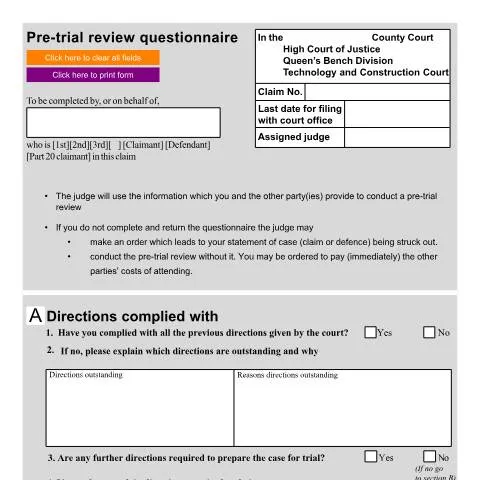
Understanding the TCC/PTR1 Pre-trial Review Questionnaire in Technology and Construction Courts
When litigation reaches the Technology and Construction Court (TCC), whether in the High Court or County Court, the journey toward trial involves careful preparation and judicial oversight. The Form TCC/PTR1 Pre-trial Review Questionnaire serves as a critical checkpoint in this process, allowing judges to assess case readiness and identify any outstanding issues before the substantive hearing begins.
This questionnaire becomes mandatory when the court schedules a pre-trial review, typically in complex construction disputes, professional negligence claims, or technology-related commercial matters. The form requires parties to provide comprehensive updates on their compliance with previous court directions, expert evidence arrangements, witness preparation, and practical trial requirements. Failure to complete and return this document can result in severe consequences, including having your statement of case struck out or facing immediate cost orders for the other parties' attendance at the review.
The Five-Section Framework: Navigating Compliance and Preparation Requirements
The TCC/PTR1 questionnaire follows a structured five-section approach, each addressing distinct aspects of trial preparation. Understanding this framework helps parties complete the form accurately and avoid potential sanctions.
Section A: Previous Directions Compliance Assessment
The opening section requires parties to confirm whether they have complied with all previous court directions. This isn't merely a tick-box exercise – the court expects detailed explanations where compliance has been incomplete. Common scenarios include:
- Delayed disclosure: Where document production has been hindered by third-party cooperation issues
- Expert report delays: Particularly relevant when technical assessments require extended site access or testing
- Settlement negotiation extensions: Where parties have sought additional time for alternative dispute resolution
- Witness availability complications: Especially in international construction projects involving overseas personnel
The questionnaire requires specific identification of outstanding directions alongside reasons for non-compliance. Generic explanations rarely satisfy judicial scrutiny – the court expects concrete details about obstacles encountered and steps taken to address them.
Expert Evidence Coordination in Section B
Section B addresses expert evidence arrangements, reflecting the TCC's emphasis on technical expertise in construction and technology disputes. The questionnaire distinguishes between different stages of expert involvement:
| Expert Evidence Stage | Required Information | Judicial Consideration |
|---|---|---|
| Written Evidence Permission | Names and fields of expertise | Relevance to disputed issues |
| Joint Expert Arrangements | Whether experts are jointly instructed | Cost efficiency and case management |
| Expert Discussions | Confirmation discussions have occurred | Narrowing of technical disputes |
| Oral Evidence Permission | Justification for live testimony | Necessity and proportionality |
The form specifically addresses expert availability during the trial period. In construction cases, this often involves coordinating multiple technical specialists – structural engineers, quantity surveyors, project managers – whose availability may be constrained by ongoing project commitments. The court uses this information to avoid adjournments and ensure efficient trial scheduling.
Witness Management and Practical Trial Arrangements
Section C: Other Witnesses Beyond Expert Testimony
The questionnaire's treatment of factual witnesses reflects the practical realities of construction litigation, where key personnel may be scattered across different jurisdictions or engaged in time-sensitive projects. Parties must provide comprehensive witness details, including:
- Complete names and addresses: Essential for service of witness summons if cooperation becomes problematic
- Availability restrictions: Particularly relevant for site personnel with seasonal or project-specific constraints
- Special facility requirements: Including language interpretation, accessibility needs, or video link arrangements for overseas witnesses
- Statement agreements: Identifying any witness statements accepted by opposing parties, potentially reducing trial time
The form's emphasis on interpreter requirements acknowledges the international nature of many construction projects. Parties must specify not just language interpretation needs but also specialized requirements for deaf or blind witnesses, ensuring the court can arrange appropriate facilities well in advance.
Legal Representation and Case Presentation Planning
Section D addresses practical aspects of legal representation, requiring parties to identify who will present their case and confirm their availability during the trial period. This section proves particularly important in TCC cases, where specialist construction barristers or solicitor-advocates may have limited availability due to the niche nature of the practice area.
The court uses this information to avoid last-minute representation changes that could necessitate adjournments. Where parties indicate potential unavailability of their chosen advocate, the judge may require alternative arrangements or adjust trial dates accordingly.
Trial Duration Estimates and Bundle Preparation Considerations
Section E requires parties to provide realistic estimates of trial duration and evidence bundle size – critical factors in TCC case management given the typically voluminous documentation in construction disputes.
Duration Assessment Methodology
Trial length estimation in TCC cases involves several unique considerations:
- Technical evidence complexity: Expert testimony often requires detailed examination of plans, specifications, and technical reports
- Site inspection requirements: Some cases necessitate judicial site visits, affecting overall trial scheduling
- Document review time: Construction contracts and correspondence can generate substantial paper trails requiring careful court examination
- Cross-examination intensity: Technical witnesses may require extended questioning to clarify complex engineering or commercial issues
The questionnaire requests estimates in minutes, hours, or days, allowing parties to provide granular assessments. Unrealistic estimates can lead to scheduling difficulties and potential cost sanctions if trials overrun significantly.
Evidence Bundle Volume Management
The requirement to estimate trial bundle page numbers reflects the TCC's approach to managing extensive documentation. Construction cases routinely involve thousands of pages of contracts, correspondence, technical drawings, and expert reports. Accurate estimates help the court:
Allocate appropriate hearing time for document review, arrange suitable courtroom facilities for voluminous bundles, and set realistic expectations for judicial preparation requirements.
Parties should consider not just primary documents but also supporting materials, cross-referenced exhibits, and any demonstrative aids when calculating bundle size.
Judicial Case Management Through Questionnaire Responses
The TCC/PTR1 questionnaire enables judges to conduct meaningful pre-trial reviews by providing comprehensive case status information. This process serves several judicial case management objectives that distinguish TCC practice from general civil litigation.
Proactive Issue Identification
Judges use questionnaire responses to identify potential trial complications before they arise. Common issues flagged through the process include:
- Expert evidence gaps: Where technical issues remain unexplored or expert discussions have failed to narrow disputes
- Witness coordination problems: Particularly in international cases where multiple jurisdictions complicate witness attendance
- Disclosure deficiencies: Where document production remains incomplete despite previous directions
- Settlement opportunity assessment: Identifying cases where additional negotiation time might resolve disputes without trial
Resource Allocation and Scheduling Efficiency
The detailed information collected through TCC/PTR1 questionnaires allows the Technology and Construction Court to optimize its limited judicial resources. By understanding expert availability, witness requirements, and realistic trial durations, the court can:
| Court Management Aspect | Questionnaire Input | Judicial Decision |
|---|---|---|
| Courtroom Allocation | Bundle size and technical equipment needs | Assignment of appropriate facilities |
| Judge Assignment | Case complexity and specialist knowledge requirements | Allocation of judges with relevant expertise |
| Listing Priorities | Witness availability and representation constraints | Trial date optimization within available windows |
| Time Allocation | Realistic duration estimates and evidence volume | Appropriate hearing time reservation |
Consequences of Non-Compliance and Strategic Considerations
The TCC/PTR1 form includes explicit warnings about the consequences of non-compliance, reflecting the court's commitment to efficient case management in complex commercial disputes.
Immediate Sanctions for Non-Submission
Parties who fail to complete and return the questionnaire by the specified deadline face two potential sanctions:
- Statement of case striking out: The court may strike out the party's claim or defence, effectively ending their participation in the proceedings
- Immediate cost orders: Non-compliant parties may be required to pay the other parties' costs of attending the pre-trial review immediately, rather than awaiting final cost assessment
These sanctions reflect the TCC's approach to maintaining tight case management control, particularly important given the high-value nature of many construction disputes and the court's limited capacity.
Strategic Implications of Questionnaire Responses
Experienced practitioners recognize that TCC/PTR1 responses can influence judicial perceptions and case management decisions beyond the immediate pre-trial review. Comprehensive, realistic responses demonstrate professional competence and case preparation, potentially influencing:
- Future direction compliance expectations: Parties with strong compliance records may receive more flexible deadlines in subsequent orders
- Cost protection applications: Demonstrated efficiency and preparation can support applications for protective cost orders or cost capping
- Settlement pressure: Realistic trial estimates and thorough preparation may encourage opposing parties to engage more seriously in settlement discussions
- Case management conference outcomes: Well-prepared questionnaire responses often lead to more favorable case management directions
Integration with Broader TCC Case Management Philosophy
The TCC/PTR1 questionnaire represents more than administrative form-filling – it embodies the Technology and Construction Court's distinctive approach to managing complex commercial disputes efficiently and cost-effectively.
Proportionality and Case-Specific Tailoring
Unlike standard civil litigation, TCC cases often involve substantial commercial interests alongside complex technical issues. The questionnaire's detailed requirements reflect judicial recognition that effective case management requires comprehensive information about each party's preparation status and practical constraints.
The form's structure accommodates the reality that construction disputes frequently involve multiple parties with varying levels of sophistication and resources. By requiring detailed disclosure of witness availability, expert arrangements, and practical requirements, the court can tailor case management directions to each case's specific circumstances.
Encouraging Early Resolution Through Transparency
The comprehensive disclosure required by the TCC/PTR1 questionnaire often promotes settlement discussions by providing all parties with clear information about their opponents' case preparation and likely trial approach. This transparency can highlight strengths and weaknesses that influence settlement negotiations, potentially avoiding lengthy and expensive trials.
The questionnaire's emphasis on expert evidence coordination particularly supports this objective. When parties must disclose their expert witnesses' identities, availability, and the status of joint discussions, it becomes apparent where technical disputes have been narrowed or where significant disagreements persist, informing realistic settlement assessments.
Completing the PTR1 Questionnaire: Section-by-Section Guidance
The PTR1 questionnaire requires methodical completion across multiple sections, each serving specific case management purposes. Understanding what information the court expects in each section prevents delays and ensures your pre-trial review proceeds smoothly.
Case Details and Party Information
The opening section demands precise case identification details. Your claim number must match exactly with court records - any discrepancy can cause administrative confusion. When listing parties, include full legal names as they appear on the original claim form, not abbreviated versions or trading names unless specifically noted in brackets.
For corporate parties, specify whether you're dealing with a limited company, partnership, or sole trader, as this affects certain procedural requirements. If party details have changed since the claim was issued - through company restructuring, change of solicitors, or address updates - highlight these changes clearly in the designated section rather than simply overwriting original information.
Current Status of Directions Compliance
This critical section requires honest assessment of your compliance with previous court orders. The court takes a dim view of parties who claim full compliance when evidence suggests otherwise. If you've encountered difficulties meeting deadlines, explain the circumstances rather than hoping the court won't notice.
Common compliance issues include delays in disclosure, witness statement preparation, or expert report exchange. For each direction where compliance is incomplete, specify what remains outstanding, when you realistically expect completion, and what factors have caused delay. The court may be more sympathetic to genuine difficulties if you demonstrate you're actively addressing them rather than ignoring problems.
Where directions have been varied by consent between parties, confirm this explicitly and reference any relevant correspondence or court orders approving the variations.
Outstanding Interlocutory Applications
Detail any pending applications that might affect trial preparation or timing. This includes applications for summary judgment, strike out, specific disclosure orders, or permission to call additional witnesses. Even if you believe certain applications are unlikely to succeed, their pendency can impact trial scheduling.
For applications seeking to amend pleadings, the court needs to understand how proposed amendments might affect witness requirements, expert evidence, or trial duration estimates. Applications for security for costs or interim payments also require mention, as their outcome could influence whether the case proceeds to trial at all.
Evidence Preparation and Management Considerations
The PTR1 questionnaire's evidence-related sections require careful consideration of your case's evidential landscape. The court uses this information to allocate appropriate trial time and identify potential case management issues before the hearing date.
Fill in your form directly online
No printing: type your details into the boxes of the official form, tick, then download the PDF ready to send.
- 1Type into the form boxes
- 2Tick in one click
- 3Save and download the PDF
Witness Evidence Planning
When completing witness-related sections, distinguish between factual witnesses and expert witnesses. For factual witnesses, indicate whether they're employees, former employees, or independent third parties, as this affects availability and potential credibility considerations. Professional witnesses - such as doctors, accountants, or engineers providing factual evidence about their professional dealings - occupy a middle ground requiring specific identification.
Consider practical witness availability issues. Witnesses residing overseas may require special arrangements for video links or face-to-face attendance, potentially extending trial duration. Witnesses with health conditions, caring responsibilities, or work commitments during proposed trial dates need early identification so the court can accommodate these constraints when listing.
For expert witnesses, specify their areas of expertise precisely. "Engineering expert" provides less useful information than "structural engineer specialising in foundation defects in Victorian buildings." The court needs to understand whether experts will give concurrent evidence (hot-tubbing) or sequential evidence, affecting time allocation.
Documentary Evidence Volume and Complexity
Accurate estimation of documentary evidence helps the court understand trial complexity. A case involving thousands of emails and technical drawings requires different preparation from one turning on interpretation of a single contract clause. When estimating bundle size, include all documents likely to be referred to during trial, not just those currently identified.
Complex documentary cases might benefit from electronic presentation systems, but these require advance court approval and technical setup time. If your case involves substantial foreign language documents, highlight translation requirements and confirm whether translations are agreed or disputed between parties.
Consider whether certain documents require special handling - for example, documents subject to confidentiality restrictions, privileged communications disclosed inadvertently, or documents with national security implications. These issues can significantly impact trial management if not identified early.
Technical Evidence and Demonstrations
Cases involving technical evidence may require site visits, demonstrations of equipment, or presentation of physical samples. The PTR1 questionnaire should identify these requirements early, as they affect courtroom suitability and trial duration. Some courts lack facilities for large physical exhibits or technical demonstrations, necessitating alternative venues or arrangements.
If your case requires site inspections - whether of construction projects, accident locations, or business premises - specify access requirements, safety considerations, and seasonal constraints. Winter site visits may be impractical for outdoor locations, while industrial sites might require specific safety equipment or personnel.
Settlement Discussions and Alternative Dispute Resolution
The court's increasing emphasis on proportionate dispute resolution means the PTR1 questionnaire explores settlement prospects and ADR opportunities more thoroughly than previously. This reflects the overriding objective's requirement to deal with cases justly and at proportionate cost.
Assessing Genuine Settlement Prospects
When asked about settlement discussions, provide realistic assessments rather than formulaic responses. Courts recognise that some cases genuinely require judicial determination - particularly those involving pure questions of law, regulatory interpretation, or where precedent-setting decisions benefit wider industries or communities.
However, many commercial disputes contain elements suitable for compromise, even where liability appears clear-cut. Quantum disputes often lend themselves to structured settlement discussions, particularly where future loss calculations involve inherent uncertainty. Professional negligence cases might settle on basis of partial admission with apportionment of responsibility.
If previous settlement discussions have failed, identify what obstacles prevented resolution. Sometimes these obstacles can be addressed through different ADR approaches or judicial input. For example, disputes over expert evidence interpretation might benefit from early neutral evaluation, while multi-party construction disputes could suit structured mediation processes.
Mediation and Other ADR Options
The questionnaire typically explores mediation prospects, but don't limit consideration to traditional face-to-face mediation. Online mediation platforms have proven effective for certain dispute types, particularly those involving parties in different geographical locations or where document-heavy evidence makes electronic presentation advantageous.
Early neutral evaluation works well for technically complex cases where parties genuinely disagree about likely outcomes. Expert determination suits disputes turning on technical or professional standards, where parties accept that specialist knowledge should determine outcomes rather than legal argument.
For multi-party disputes, consider whether some issues could be resolved between certain parties while others proceed to trial. This might reduce trial complexity and cost, even if complete settlement proves impossible. Construction cases often benefit from this approach, resolving subcontractor disputes while main contractor issues proceed to determination.
Costs Budgeting Implications
Settlement discussions interact closely with costs budgeting requirements. If your case is subject to costs management, unreasonable refusal to engage with settlement discussions can affect the court's view of proportionality when approving costs budgets or making costs orders.
However, courts also recognise that premature settlement pressure can prejudice proper case preparation. The key is demonstrating that settlement discussions are genuine attempts to resolve disputes rather than tactical positioning. This might involve sharing key documents early, agreeing joint expert instructions, or participating in without prejudice discussions about case strengths and weaknesses.
Where settlement discussions are ongoing, the PTR1 questionnaire should indicate realistic timescales for resolution attempts. Courts may be willing to accommodate brief adjournments where genuine progress is being made, but indefinite delays while parties "explore settlement" are generally unacceptable once trial dates are fixed.