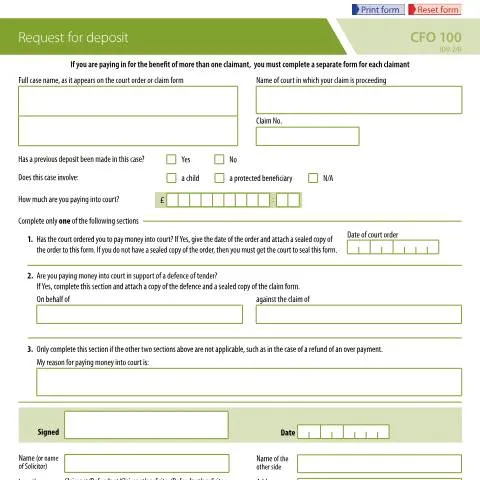
When Court Orders Meet Financial Reality: The CFO 100 Payment Mechanism
In the labyrinthine world of civil litigation, moments arise when the court's gavel falls and money must physically change hands—not between the parties directly, but into the protective custody of the judicial system itself. The Court Funds Office Request for deposit (CFO 100) serves as the formal gateway for these court-ordered payments, transforming legal obligations into tangible financial deposits that safeguard the interests of all parties whilst proceedings continue.
Whether you're a defendant seeking to demonstrate good faith through a payment of tender, a party complying with a specific court order to lodge funds, or dealing with the administrative necessity of correcting an overpayment, this form represents your formal instruction to the Court Funds Office in Sunderland to accept and hold monies on behalf of the court system.
The Three Pathways: Understanding Your Legal Standing
The CFO 100 form acknowledges three distinct scenarios, each reflecting different legal circumstances that necessitate court-held deposits. Understanding which pathway applies to your situation determines both the supporting documentation required and the legal implications of your payment.
Court-Ordered Payments: When the Judge Directs
The most straightforward scenario involves direct judicial instruction. When a court issues an order requiring money to be paid into court, this typically occurs during interim applications, security for costs orders, or as part of settlement negotiations overseen by the court. The sealed court order becomes your legal authority and must accompany your CFO 100 form.
The requirement for a sealed copy reflects the court's formal authentication of the order. Should you lack this sealed documentation, the form itself can be presented to the court for sealing, though this adds an additional administrative step that may delay the deposit process.
Defence of Tender: Demonstrating Readiness to Pay
A defence of tender represents a sophisticated legal strategy where a defendant claims they were always ready and willing to pay the amount claimed, but the claimant unreasonably refused to accept it. By paying money into court under this defence, you're essentially telling the court: "Here's the money—I was always prepared to pay this sum."
This pathway requires both your defence document and a sealed copy of the original claim form, establishing the complete legal context. The tactical advantage lies in potential cost implications: if your tender equals or exceeds any eventual judgment, the claimant may face adverse costs consequences despite winning their case.
Administrative Corrections and Miscellaneous Deposits
The third category encompasses various administrative scenarios, most commonly overpayment refunds or corrections to previous deposits. This flexibility recognises that the court funds system must accommodate the practical realities of complex litigation where initial calculations may prove incorrect or circumstances change.
| Deposit Type | Required Documentation | Typical Timeline | Legal Effect |
|---|---|---|---|
| Court Order Compliance | Sealed court order | Within order timeframe | Satisfies court direction |
| Defence of Tender | Defence + sealed claim form | With defence filing | Potential costs protection |
| Administrative | Explanatory statement | Variable | Corrective action |
Navigating Multiple Claimants and Complex Case Structures
The form's emphasis on completing separate forms for each claimant when multiple parties are involved reflects the Court Funds Office's need for precise financial accountability. This requirement ensures that funds can be properly attributed and distributed according to eventual court determinations or settlement agreements.
In multi-party litigation, this separation becomes particularly crucial. Consider a professional negligence case involving several claimants with varying levels of loss—each requires their own CFO 100 form, even if the payments stem from a single court order. This administrative precision prevents future complications when funds must be released or redistributed.
Protected Parties: Special Considerations for Children and Vulnerable Adults
The form specifically enquires about cases involving children or protected beneficiaries, reflecting the court's enhanced supervisory role over settlements affecting vulnerable parties. When children are involved, any settlement typically requires court approval, and funds may be held until the child reaches majority or the court authorises earlier release for specific purposes such as medical treatment or education.
For protected beneficiaries—adults lacking mental capacity to manage their affairs—similar protective mechanisms apply. The Court of Protection may become involved, and deputies or attorneys must demonstrate proper authority before funds can be accessed.
The Mechanics of Payment: From Instruction to Deposit
Payment processing through the Court Funds Office follows established banking protocols adapted for judicial oversight. Cheques must be made payable to "Accountant General of the Senior Courts"—a title reflecting the historical role of this office as custodian of court-held funds dating back centuries.
The Sunderland address represents the centralised processing hub for all court funds across England and Wales, regardless of where your case is being heard. This centralisation ensures consistent handling and reduces administrative burdens on individual court offices.
Electronic Alternatives and Modern Payment Methods
Whilst the CFO 100 form itself remains paper-based, the Court Funds Office increasingly accommodates electronic payment methods for the actual funds transfer. However, the formal request must still follow the prescribed format, ensuring proper legal documentation accompanies every deposit.
The Customer Helpline (0300 0200 199) provides essential support for payment queries, though complex legal questions about your obligation to make payments should be directed to legal advisors rather than administrative staff.
Timing Imperatives and Strategic Considerations
The timing of your CFO 100 submission can carry significant legal consequences. Court orders typically specify deadlines for compliance, and failure to meet these can result in adverse consequences ranging from cost penalties to default judgments.
For defence of tender scenarios, timing becomes particularly strategic. The payment must accompany or closely follow your defence filing to maximise the protective effect. Delayed tender payments may still be accepted by the court but could lose some of their tactical advantages in costs proceedings.
Previous Deposits and Case Continuity
The form's inquiry about previous deposits serves multiple purposes. It alerts the Court Funds Office to existing case records, ensures proper aggregation of funds, and helps prevent duplicate processing. When cases involve multiple interim payments or staged settlements, this continuity becomes essential for accurate financial tracking.
The claim number and full case name must match exactly with court records and any previous deposits. Discrepancies can delay processing and potentially create administrative complications that affect time-sensitive legal proceedings.
Professional Practice: Solicitors and Self-Representation
The form accommodates both legally represented parties and litigants in person, though the practical implications differ significantly. Solicitors typically handle CFO 100 submissions as part of their case management responsibilities, drawing on established relationships with the Court Funds Office and familiarity with procedural requirements.
Self-represented parties face additional challenges in ensuring correct completion and supporting documentation. The form's design attempts to guide non-lawyers through the process, but complex cases may still require professional advice to avoid costly mistakes.
Reference Numbers and Case Tracking
Both claimant and defendant sections include reference number fields, reflecting modern case management systems that rely on unique identifiers for tracking purposes. These references become particularly important when cases span extended periods or involve multiple interim applications.
Legal representatives should ensure their internal file references appear on the form, facilitating future correspondence and avoiding confusion when the Court Funds Office responds to queries or provides updates on fund status.
Data Protection and Privacy Safeguards
The form's reference to privacy notices reflects compliance with the Data Protection Act 2018 and UK GDPR requirements. The Court Funds Office processes substantial personal and financial information, necessitating robust data protection measures and transparent information handling policies.
Parties submitting CFO 100 forms should understand that their information may be shared with relevant court personnel, legal representatives of other parties, and potentially with other government departments where legal obligations require such disclosure. The privacy notice available through the gov.uk website provides comprehensive details of these data processing activities.
Beyond Deposit: What Happens to Your Money
Once accepted, court-held funds enter a sophisticated management system designed to preserve capital whilst generating modest returns. The Accountant General's Office invests these funds conservatively, typically in government securities or approved financial instruments that prioritise security over high returns.
Fund release requires either court order, settlement agreement, or satisfaction of the original deposit conditions. This process can involve additional paperwork and may take several weeks, particularly for large sums or complex cases involving multiple parties.
Interest accrual on deposited funds follows established rates set by the Lord Chancellor, typically below commercial investment returns but providing some protection against inflation during extended proceedings. Parties should factor potential delays in fund release when considering settlement timing and cash flow planning.
The CFO 100 form thus represents far more than simple administrative paperwork—it serves as the crucial interface between legal obligations and financial reality, ensuring that court proceedings can continue with proper financial safeguards whilst protecting the interests of all parties involved in the judicial process.
Understanding Court Fund Investment Options and Interest Calculations
When your money sits in the Court Funds Office, it doesn't remain static. The CFO operates several investment funds designed to preserve and potentially grow deposited amounts whilst maintaining the security expected of court-held assets. Understanding these options helps you make informed decisions about how your deposit should be managed during what might be an extended period.
The Court Funds Investment Fund represents the primary investment vehicle for most deposits. This fund pools money from various court cases and invests in a diversified portfolio of government securities, corporate bonds, and other low-risk instruments. The fund aims to achieve returns above inflation whilst protecting the capital value of deposits. Interest rates fluctuate based on market conditions, but the CFO publishes quarterly performance reports showing actual returns achieved.
For smaller deposits or those expected to be withdrawn quickly, the Special Investment Account may be more appropriate. This operates similarly to a high-interest savings account, offering immediate access to funds whilst providing modest returns. The minimum balance requirements and notice periods for withdrawals differ significantly from the main investment fund, making it suitable for interim payments or temporary lodgements pending case resolution.
Deposits exceeding £50,000 may qualify for the Basic Fund, which offers different investment terms and potentially higher returns due to the larger capital base. However, this option comes with longer minimum investment periods and different withdrawal procedures. The CFO's investment managers actively review fund performance and may recommend transfers between funds based on changing circumstances in your case.
Interest calculations follow specific rules established by the Ministry of Justice. Simple interest applies to most deposits, calculated daily and credited annually on the anniversary of the deposit date. However, compound interest may apply to longer-term deposits exceeding certain thresholds. The CFO publishes annual interest rates in advance, though these may be adjusted quarterly based on market performance and operational costs.
Fill in your form directly online
No printing: type your details into the boxes of the official form, tick, then download the PDF ready to send.
- 1Type into the form boxes
- 2Tick in one click
- 3Save and download the PDF
Tax implications require careful consideration. Interest earned on court fund deposits may be subject to income tax, particularly if you're a higher-rate taxpayer. The CFO doesn't automatically deduct tax, leaving this responsibility with the depositor or their representatives. If you're receiving legal aid or benefits, additional income from court fund interest could affect your entitlements, requiring notification to relevant authorities.
Special Circumstances and Complex Deposit Scenarios
Certain legal situations create unique requirements for court fund deposits that extend beyond standard procedures. Understanding these special circumstances ensures proper handling of complex cases and prevents unnecessary delays or complications.
Multi-party litigation often requires sophisticated deposit arrangements. When several claimants seek damages from the same defendant, or when cross-claims exist between parties, the court may order segregated accounts within the broader court fund structure. Each party's interest must be clearly identified and protected, requiring detailed documentation about percentage entitlements, priority orders, and distribution conditions. The CFO maintains separate records for each beneficiary whilst pooling funds for investment purposes.
Cases involving protected parties – including children under 18 and adults lacking mental capacity – trigger additional safeguards. The Court of Protection may need to approve deposit arrangements, and appointed deputies or guardians must demonstrate authority to act. These deposits often remain in court funds until the protected party reaches majority or regains capacity, sometimes spanning decades. Periodic reviews ensure the investment strategy remains appropriate for the extended timeframe.
International elements add layers of complexity. When foreign parties are involved, or when deposits derive from overseas assets, currency considerations become paramount. The CFO typically holds deposits in pounds sterling, requiring currency conversion at prevailing exchange rates. Fluctuating exchange rates between deposit and withdrawal can significantly impact final amounts, particularly for large sums or volatile currencies. Some courts may accept deposits in major foreign currencies, but this requires specific approval and involves additional administrative costs.
Structured settlements present particular challenges. These arrangements, common in personal injury cases, involve regular payments over extended periods rather than lump-sum awards. The court fund must accommodate periodic deposits from defendants whilst enabling scheduled withdrawals to claimants. Investment strategies for structured settlements differ from single deposits, focusing on matching cash flows with payment obligations whilst maintaining capital preservation.
Bankruptcy proceedings create urgent deposit requirements. When a party becomes insolvent during litigation, contested funds may need immediate protection from creditors. Emergency deposit procedures allow rapid transfer of disputed amounts into court funds, preserving assets until insolvency proceedings conclude. These deposits require coordination between commercial courts hearing the main litigation and insolvency courts managing bankruptcy matters.
Professional negligence cases, particularly against solicitors or financial advisors, may involve deposits of compensation awards pending appeal or related proceedings. The Solicitors Regulation Authority or Financial Conduct Authority might require specific deposit conditions to protect public interests. These regulatory requirements can override standard court fund procedures, necessitating bespoke arrangements.
Monitoring, Reporting, and Long-term Fund Management
Active management of court fund deposits requires ongoing attention, particularly for substantial amounts or extended periods. The Court Funds Office provides various monitoring tools and reporting mechanisms, but depositors and their representatives must understand how to utilise these effectively.
The online portal system offers real-time access to account information, including current balances, recent transactions, interest calculations, and investment performance. However, access requires proper authentication and authorisation. Solicitors can register for direct access using their firm's credentials, whilst parties in person must complete additional verification procedures. The portal displays historical data, enabling tracking of deposit performance over time and comparison with relevant benchmarks.
Quarterly statements provide detailed breakdowns of investment returns, administrative charges, and any deductions. These statements become crucial for tax planning and benefit calculations. The CFO's reporting format follows standardised accounting principles, making statements acceptable to HMRC for tax purposes and to the Department for Work and Pensions for benefit assessments.
Long-term deposits require periodic reviews to ensure continued appropriateness of investment strategies. The CFO's investment committee meets quarterly to assess fund performance and market conditions. Depositors can request strategy reviews if circumstances change significantly – for example, if case timelines extend beyond original expectations or if beneficiaries' needs evolve.
Dormant accounts present particular challenges. When cases conclude but deposits remain unclaimed, or when parties cannot be located, special procedures apply. The CFO maintains unclaimed balances for extended periods, but eventually, dormant funds may transfer to the government's unclaimed assets scheme. Proactive communication with all interested parties helps prevent accounts becoming dormant inadvertently.
Regular reconciliation between court records and CFO accounts ensures accuracy and prevents discrepancies. Court staff periodically verify that deposit amounts match court orders and that all authorised withdrawals have been processed correctly. These reconciliation procedures become particularly important in complex cases with multiple transactions over extended periods.
Estate planning considerations arise when deposit holders die during proceedings. The CFO requires proper grants of probate or letters of administration before releasing funds to executors or administrators. These requirements can create delays if estate planning hasn't anticipated court fund deposits, emphasising the importance of keeping estate representatives informed about pending court deposits.
Performance monitoring extends beyond simple interest calculations. The CFO publishes annual reports comparing fund performance against relevant benchmarks, including government bond yields and inflation rates. Understanding these comparisons helps assess whether court fund investment is optimal for particular circumstances or whether alternative arrangements might better serve depositors' interests.