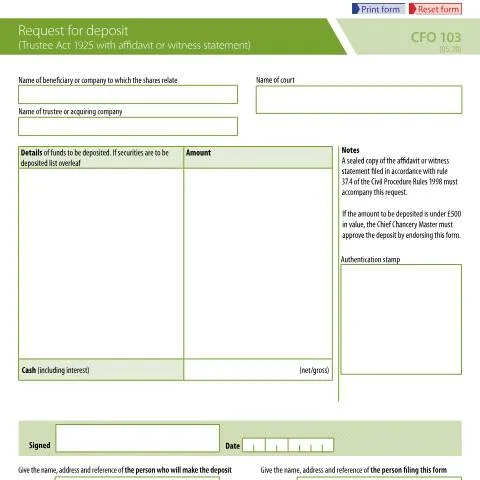
When Court-Approved Trustees Must Lodge Funds: Understanding CFO 103 Requirements
The CFO 103 form represents a critical juncture in trustee administration where legal obligations meet practical procedure. When trustees find themselves compelled by court order or statutory requirement to deposit funds into the Court Funds Office, this document becomes their gateway to compliance with the Trustee Act 1925. Unlike routine banking transactions, these deposits carry significant legal weight and must satisfy stringent evidential requirements before acceptance.
The Ministry of Justice maintains strict protocols for these deposits, recognising that funds arriving through CFO 103 often represent the culmination of complex legal proceedings or statutory interventions. Whether arising from disputed inheritances, corporate acquisitions requiring court protection, or trustee appointments where beneficiaries cannot be traced, each deposit must demonstrate clear legal authority and proper procedural compliance.
The Statutory Foundation: When Deposits Become Mandatory
The Trustee Act 1925 provides the legislative framework compelling trustees to deposit funds with the court in specific circumstances. This requirement typically arises when trustees cannot safely discharge their duties through conventional means, creating a legal obligation to seek court protection through the deposit mechanism.
The most common trigger occurs when beneficiaries cannot be located despite reasonable enquiries. In such cases, trustees face potential personal liability if they distribute funds incorrectly, making court deposit the prudent legal option. The CFO 103 process provides statutory protection, effectively transferring responsibility from the trustee to the court system.
Corporate scenarios frequently generate CFO 103 requirements during takeovers or mergers where shareholders cannot be traced. The acquiring company, acting as trustee, must deposit the consideration due to missing shareholders rather than risk improper distribution. Similarly, when companies are struck off the register with unclaimed dividends or assets, the court may order deposit pending resolution of ownership disputes.
Court-Ordered Deposits vs Voluntary Deposits
The form accommodates both court-mandated and voluntary deposits, though the evidential requirements differ significantly. Court-ordered deposits arise from specific judicial directions, typically following applications under the Trustee Act where the court has determined that deposit represents the appropriate course of action. These deposits benefit from clear legal authority but require strict adherence to the court's specific directions.
Voluntary deposits occur when trustees proactively seek court protection without prior judicial order. These require more extensive justification through the accompanying affidavit or witness statement, as the trustee must demonstrate why deposit represents the proper course of action in the circumstances.
Decoding the CFO 103: Section-by-Section Requirements
The form's deceptively simple appearance masks complex procedural requirements that determine whether deposits will be accepted or rejected. Each section serves a specific legal purpose, and incomplete or incorrect entries frequently result in delays or refusal.
Beneficiary and Trustee Identification
The opening sections require precise identification of both beneficiaries and trustees. For individual beneficiaries, full names must match those in the underlying trust documentation or court order. Corporate beneficiaries require their full registered name and company number. Trustees must similarly be identified with complete accuracy, including any professional qualifications or appointments that establish their authority to act.
Where shares are involved, the form demands specific details linking the securities to the named beneficiaries. This connection proves crucial for the Court Funds Office's subsequent administration, as incorrect linkage can prevent proper distribution when beneficiaries eventually come forward.
The Critical £500 Threshold
Deposits under £500 face additional scrutiny through the Chief Chancery Master approval requirement. This provision recognises that small deposits may not justify the administrative costs of court management, requiring specific judicial endorsement before acceptance.
| Deposit Amount | Approval Required | Processing Time | Additional Requirements |
|---|---|---|---|
| Under £500 | Chief Chancery Master endorsement | Extended | Justification for court involvement |
| £500 and above | Standard CFO processing | Standard | Compliant documentation only |
This threshold requirement frequently catches trustees off-guard, particularly when dealing with residual trust funds or final distributions. The endorsement process requires separate application to the Chief Chancery Master with detailed justification for why such modest sums warrant court protection.
Cash vs Securities: Different Deposit Procedures
The form distinguishes between cash deposits and securities deposits, each requiring different handling procedures. Cash deposits, whether net or gross of accrued interest, follow straightforward payment procedures through cheques payable to the "Accountant General of the Senior Courts".
Securities deposits involve more complex procedures, requiring detailed listing on the form's reverse side. Each security must be precisely described with nominal value where appropriate, ensuring accurate registration in the Court Funds Office records. The timing of securities deposits often proves critical, particularly where market values fluctuate significantly.
The Affidavit Requirement: Proving Legal Authority
Every CFO 103 submission must include a sealed affidavit or witness statement filed in accordance with Civil Procedure Rules Part 37.4. This requirement represents the form's most technically demanding aspect, as the affidavit must establish clear legal authority for the deposit while demonstrating compliance with all relevant procedural requirements.
The affidavit serves multiple purposes: it provides sworn evidence of the circumstances necessitating deposit, demonstrates the trustee's authority to act, and establishes compliance with any applicable notice requirements or enquiry procedures. Defective affidavits represent the most common cause of CFO 103 rejection, often requiring complete resubmission with corrected documentation.
Essential Affidavit Content
Effective affidavits typically address several key areas. The deponent must establish their authority to act as trustee, whether through appointment, succession, or court order. They must detail the circumstances requiring deposit, including any attempts to locate beneficiaries or resolve uncertainties. Where applicable, they must demonstrate compliance with statutory notice requirements or court directions.
The affidavit should also address any potential challenges to the deposit, acknowledging known issues while explaining why deposit represents the appropriate course of action. This proactive approach helps prevent subsequent challenges and demonstrates thorough consideration of alternatives.
Submission Channels and Processing Procedures
The Court Funds Office operates from Sunderland, handling all CFO 103 submissions through established channels designed to ensure security and proper processing. Understanding these procedures helps avoid common submission errors that delay processing or result in rejection.
Primary Submission Routes
Postal submission remains the standard approach, with forms sent to the Court Funds Office at the Sunderland address. The inclusion of DX 328004 Sunderland 19 provides an alternative for legal professionals using document exchange services. All submissions must include the required sealed affidavit and any supporting documentation.
The customer helpline (0300 0200 199) provides essential support for complex submissions, particularly where unusual circumstances arise or guidance is needed on specific requirements. Email enquiries through [email protected] offer another route for preliminary guidance, though formal submissions require postal delivery.
Payment Procedures and Security
All payments accompanying CFO 103 forms must be made by cheque payable to "Accountant General of the Senior Courts". This specific payee designation ensures proper routing through the court's financial systems and provides essential security safeguards. Personal cheques or alternative payment methods are not acceptable for these statutory deposits.
The timing of payment submission proves critical, particularly where court orders specify deadlines for deposit. Late deposits may result in trustees facing contempt proceedings or personal liability, making prompt submission essential once the decision to deposit has been made.
Post-Submission: What Happens to Deposited Funds
Once accepted, deposited funds enter the Court Funds Office's management system, where they remain until proper claim or court direction authorises distribution. This period can extend for many years, particularly where beneficiaries remain untraced or legal disputes continue.
The Court Funds Office maintains detailed records of all deposits, enabling future tracing and distribution when circumstances permit. Interest accrues on cash deposits according to prescribed rates, while securities are managed according to court directions and prevailing investment policies.
Claiming Against Deposits
Beneficiaries seeking to claim against deposits must demonstrate clear entitlement through appropriate documentation and court procedures. The original deposit circumstances often determine the claiming requirements, with some deposits requiring full court applications while others may be released through administrative procedures.
The Court Funds Office's role remains administrative rather than adjudicative, meaning disputed claims typically require resolution through separate court proceedings before funds can be released. This protection ensures that funds are only distributed to properly entitled recipients.
Common Complications and Procedural Pitfalls
Several recurring issues complicate CFO 103 submissions, often resulting in rejection or significant delays. Understanding these potential problems helps trustees prepare more effective submissions and avoid common mistakes.
Incomplete trustee authority represents a frequent problem, particularly where multiple trustees exist or appointments have been varied. The form requires clear identification of all relevant trustees, and submissions from partial trustee groups often face rejection unless specific authority can be demonstrated.
Inadequate beneficiary identification creates particular difficulties where trusts involve multiple generations or complex family structures. Generic descriptions or incomplete names frequently result in deposits being rejected, as the Court Funds Office requires precise identification to enable future distribution.
Timing and Deadline Pressures
Court-ordered deposits often involve strict deadlines that leave little margin for error. Trustees facing such deadlines should prepare submissions well in advance, allowing time for any required corrections or additional documentation. The sealed affidavit requirement alone can take several days to complete properly through court procedures.
Securities valuations present particular timing challenges, as market fluctuations can affect deposit values between preparation and submission. Trustees should consider whether to seek court guidance on valuation dates or accept the risks of market movement during the submission process.
Strategic Considerations for Trustees
The decision to proceed with CFO 103 deposit carries significant implications for trustees and beneficiaries alike. While deposit provides legal protection for trustees, it also removes funds from active management and may delay ultimate distribution to beneficiaries.
Trustees should carefully consider alternative approaches before committing to deposit, particularly where beneficiaries might be traced through additional enquiries or where other protective mechanisms might be available. The irreversible nature of many deposits makes this initial assessment crucial.
Professional trustees often maintain detailed decision-making records when considering CFO 103 deposits, documenting their reasoning and the alternatives considered. This approach provides protection against subsequent challenges while demonstrating proper discharge of trustee duties. The Court Funds Office's privacy notice, available through their website, outlines how depositor information will be managed throughout the process.
For trustees operating under time pressure, early engagement with the Court Funds Office helpline can clarify specific requirements and help avoid submission errors that might prove costly in terms of both time and legal exposure.
Trustee Responsibilities and Fiduciary Duties When Managing Court Fund Deposits
When appointed as a trustee handling court fund deposits, you assume significant legal responsibilities that extend far beyond the initial deposit request. The Court Funds Office operates under strict regulatory oversight, and trustees must demonstrate competence in managing funds that often represent vulnerable beneficiaries' entire financial security.
Your primary fiduciary duty involves acting in the absolute best interests of beneficiaries whilst complying with court orders and statutory requirements. This means making investment decisions that balance capital preservation with reasonable growth, particularly for long-term settlements involving minors or protected parties. The Court Funds Office provides several investment options, from basic deposit accounts earning minimal interest to more sophisticated equity-based funds for larger sums exceeding £50,000.
Documentation requirements for trustees are extensive and non-negotiable. You must maintain detailed records of all transactions, correspondence with beneficiaries or their representatives, and any changes to personal circumstances affecting the trust. The Court Funds Office conducts periodic reviews, particularly for high-value deposits or cases involving multiple beneficiaries, and trustees failing to provide adequate documentation face potential removal and personal liability.
Fill in your form directly online
No printing: type your details into the boxes of the official form, tick, then download the PDF ready to send.
- 1Type into the form boxes
- 2Tick in one click
- 3Save and download the PDF
Professional trustees, such as solicitors or licensed trust corporations, must also consider their regulatory obligations under the Solicitors Regulation Authority or Financial Conduct Authority respectively. These bodies impose additional reporting requirements and professional indemnity insurance obligations that complement court fund management duties.
Conflicts of interest present particular challenges in trustee appointments. You cannot benefit personally from trust assets, even indirectly, and must declare any relationships with beneficiaries, co-trustees, or professional advisers involved in the case. Where conflicts arise, the court may require independent professional trustees or impose additional oversight measures.
Communication with beneficiaries requires careful balance between transparency and protection. Adult beneficiaries generally have rights to information about fund performance and investment decisions, whilst protected parties rely on litigation friends or appointed deputies. Trustees must understand these different relationships and tailor their communication accordingly, always ensuring compliance with data protection requirements.
Investment Options and Fund Management Within the Court Funds Office Framework
The Court Funds Office offers a structured range of investment products designed to meet different risk profiles and time horizons typically associated with court-ordered settlements. Understanding these options is crucial for trustees making deposit requests, as the initial choice significantly impacts long-term returns and beneficiary outcomes.
The Basic Account represents the most conservative option, offering guaranteed capital protection with interest rates typically tracking Bank of England base rates. This account suits short-term deposits, elderly beneficiaries requiring immediate access, or cases where court orders specifically mandate capital preservation. Interest is calculated daily and paid annually, with no fees charged for basic transactions.
For medium to long-term deposits, particularly those involving minors reaching majority in 10-15 years, the Special Investment Account provides exposure to a diversified portfolio managed by professional fund managers. This option requires minimum deposits of £10,000 and involves annual management charges, but historically delivers superior returns over extended periods. The fund invests primarily in UK equities, government bonds, and commercial property, with quarterly performance reports available to trustees.
The Equity Index Fund, introduced in recent years, offers passive investment tracking major UK stock market indices. This low-cost option appeals to trustees seeking market returns without active management fees, though it requires beneficiaries or their representatives to acknowledge increased volatility risks. Minimum investment thresholds apply, and switching between funds is permitted annually subject to administrative procedures.
Specialist funds cater to particular circumstances, such as the Ethical Investment Fund for beneficiaries with strong environmental or social preferences, and the Inflation-Protected Fund designed for very long-term settlements where purchasing power preservation is paramount. These options require additional documentation demonstrating suitability for the beneficiary's circumstances.
Fund switching procedures allow trustees to adjust investment strategies as beneficiaries' needs change or market conditions evolve. However, switches must be justified by changed circumstances rather than short-term market timing, and frequent changes may trigger Court Funds Office reviews. Some switches incur charges, particularly when moving from higher-risk to lower-risk options, reflecting the costs of unwinding investment positions.
Performance monitoring becomes increasingly important for larger deposits or multiple beneficiaries. The Court Funds Office provides annual statements, but trustees should maintain their own records tracking performance against stated objectives and beneficiary needs. Poor performance alone doesn't constitute grounds for trustee criticism, but failure to monitor and respond to sustained underperformance might breach fiduciary duties.
Withdrawal Procedures and End-of-Trust Administration
Withdrawing funds from court deposits involves distinct procedures depending on beneficiary status, withdrawal amounts, and the underlying court order's terms. These procedures often prove more complex than initial deposit requests, requiring careful coordination between trustees, beneficiaries, legal representatives, and the Court Funds Office.
Partial withdrawals for maintenance, education, or emergency expenses require court approval unless the original order specifically authorises such payments. Trustees must demonstrate that proposed expenditure serves the beneficiary's best interests and falls within permitted categories. The application process involves submitting detailed budgets, supporting evidence (such as school fee invoices or medical reports), and sometimes independent assessments of necessity.
Age-related withdrawals, particularly when minors reach 18, follow more straightforward procedures but still require identity verification and capacity assessments. Beneficiaries must provide current identification, proof of address, and sometimes complete financial literacy questionnaires before accessing substantial sums. The Court Funds Office may impose graduated withdrawal schedules for very large sums, releasing funds in tranches over several years to protect young adults from financial mismanagement.
Final distributions upon trust termination require comprehensive accounting to all interested parties. Trustees must prepare detailed statements showing all receipts, expenditure, investment gains or losses, and administrative costs throughout the trust's duration. These accounts undergo scrutiny by beneficiaries or their representatives, and disputes may require court resolution before final discharge.
Tax implications of withdrawals vary significantly depending on beneficiary circumstances, withdrawal timing, and accumulated investment returns. Income tax may apply to interest or dividend income, whilst capital gains tax could affect investment fund withdrawals exceeding annual exemptions. Trustees should advise beneficiaries to seek independent tax advice, particularly for substantial withdrawals that might affect their overall tax position.
International beneficiaries face additional complications, particularly regarding currency conversion, overseas tax obligations, and anti-money laundering requirements. The Court Funds Office maintains correspondent banking relationships to facilitate international transfers, but processing times extend considerably, and additional documentation proving beneficiary identity and residence becomes necessary.
Death of beneficiaries before fund withdrawal triggers estate administration procedures. Surviving trustees must coordinate with executors or administrators, potentially requiring new court orders if the original settlement didn't address this eventuality. These situations often involve complex legal issues requiring specialist probate advice, particularly where multiple beneficiaries or overseas assets are involved.
Trustee retirement or replacement during the fund management period requires court approval and careful handover procedures. Incoming trustees must satisfy the Court Funds Office's competency requirements and assume full responsibility for past decisions and ongoing management. The transition process includes comprehensive briefings, document transfers, and sometimes overlap periods ensuring continuity of administration.