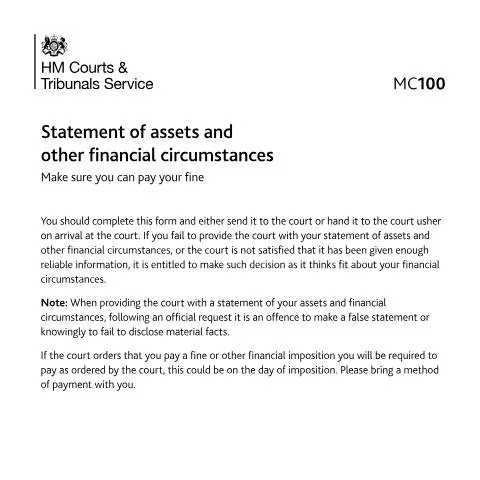
Understanding the MC100: Your Financial Disclosure Gateway to Court
When facing prosecution for an offence in England and Wales, defendants encounter a crucial document that directly impacts their financial future: Form MC100. This statement of assets and other financial circumstances serves as the court's primary tool for determining appropriate fine levels and payment arrangements. Far from being a mere formality, the MC100 represents a legal obligation that can significantly influence both the severity of financial penalties and the defendant's ability to manage them effectively.
The form's official title, "Make sure you can pay your fine," immediately signals its dual purpose: ensuring courts have accurate financial information while helping defendants prepare for immediate payment obligations. This document bridges the gap between judicial decision-making and practical enforcement, creating a framework where financial penalties align with individual circumstances.
Legal Framework and Mandatory Disclosure Requirements
The MC100 operates under strict legal provisions that make financial disclosure compulsory rather than optional. When the Designated Officer issues an official request for financial information, defendants must comply regardless of their preferences or concerns about privacy. This mandatory nature stems from the court's need to make informed decisions about proportionate financial penalties.
The legal consequences of non-compliance are deliberately severe. Failing to provide the required statement constitutes an offence in itself, potentially resulting in additional penalties. More significantly, the form explicitly warns that making false statements or knowingly concealing material facts represents a criminal offence punishable by further fines. This creates a legal framework where honesty becomes both legally required and practically beneficial.
Critical Legal Warning: Every piece of information provided on Form MC100 carries legal weight. Defendants who attempt to manipulate their financial picture through false declarations face prosecution for additional offences, potentially compounding their legal difficulties considerably.
The court's authority extends beyond simple information gathering. When defendants fail to provide adequate financial disclosure, or when the court questions the reliability of submitted information, judicial officers possess broad discretionary powers to make assumptions about financial circumstances. These assumptions may not favour the defendant, highlighting the importance of complete, accurate disclosure.
Detailed Section-by-Section Navigation Through MC100
Personal Details Foundation
Section 1 establishes the defendant's identity and basic circumstances using block capitals throughout. Beyond standard identification fields like name, address, and National Insurance number, this section captures vehicle ownership details that directly impact fine enforcement capabilities. The inclusion of vehicle registration numbers reflects the court's awareness that vehicles represent both assets and potential enforcement targets.
The dependent children field carries particular significance, as courts consider family responsibilities when determining payment arrangements. However, having dependents doesn't automatically reduce fine amounts—rather, it influences payment scheduling and enforcement approaches.
Income Assessment Complexities
Section 2 divides defendants into employed and non-employed categories, each requiring different information types. Employed defendants must provide comprehensive employment details including employer contact information, enabling courts to verify income claims and potentially pursue enforcement through employers if necessary.
The distinction between gross and take-home pay requires careful attention. Courts focus on disposable income rather than headline salaries, making accurate net income calculations essential. Self-employed defendants face additional complexity, as their irregular income patterns require careful documentation to establish reliable payment capabilities.
Non-employed defendants must specify their unemployment duration and benefit entitlements. This information helps courts understand whether unemployment represents a temporary situation or longer-term circumstance, influencing both fine levels and payment terms. Partner income inclusion recognises household financial realities while maintaining individual responsibility for penalties.
Comprehensive Outgoings Analysis
Section 3 demands detailed expenditure breakdown across essential and discretionary categories. The court distinguishes between unavoidable commitments like rent, council tax, and utility bills, versus discretionary spending on television subscriptions or non-essential travel. This categorisation directly influences how courts assess available income for fine payments.
| Essential Outgoings | Discretionary Spending | Court Priority |
|---|---|---|
| Rent/Mortgage | Television subscriptions | High protection |
| Council tax | Non-essential travel | Medium protection |
| Utility bills | Entertainment | Low protection |
| Child maintenance | Luxury purchases | No protection |
Existing financial obligations receive special attention. Other court fines, county court orders, and loan repayments demonstrate the defendant's existing financial commitments while potentially indicating payment difficulties. Courts use this information to avoid creating unsustainable payment burdens that might lead to default.
Additional Information and Asset Disclosure
Section 4 provides defendants with opportunities to highlight circumstances not captured elsewhere. This might include irregular income patterns, temporary financial difficulties, or assets that don't fit standard categories. The savings declaration requires particular honesty, as hidden assets discovered later can result in additional charges for false declaration.
Strategic Timing and Submission Protocols
Form MC100 submission timing significantly impacts court proceedings and defendant outcomes. The form can be submitted before the hearing date, allowing courts to review financial information in advance and potentially streamline proceedings. Early submission demonstrates cooperation and may influence judicial attitudes towards payment arrangements.
Defendants have three submission options: postal delivery to the designated court, hand delivery to court staff, or presentation to the court usher upon arrival. Email and telephone submissions are explicitly prohibited, reflecting the document's legal significance and the need for verifiable delivery.
The court address appears on the original summons, charge, or requisition form, but defendants can obtain this information from their local magistrates' court if needed. Ensuring correct delivery to the appropriate court prevents delays and demonstrates compliance with legal requirements.
Evidence Preparation Requirements
Supporting documentation transforms MC100 from simple declaration to verifiable financial statement. Defendants should prepare comprehensive evidence including recent payslips, benefit award letters, bank statements, bills, and loan agreements. Courts may request immediate verification of declared information, making thorough preparation essential.
The form specifically mentions bringing copies rather than original documents, protecting defendants from losing important papers while enabling court verification. This practical consideration reflects the court system's understanding of defendants' ongoing financial obligations and documentation needs.
Payment Enforcement and Immediate Obligations
The MC100's most critical aspect lies in its repeated emphasis on immediate payment obligations. Courts can order payment "on the day of imposition," requiring defendants to arrive prepared for immediate settlement. This policy reflects judicial efficiency priorities while emphasising the immediate consequences of criminal convictions.
Multiple payment methods accommodate different defendant preferences and capabilities. Online payments through gov.uk, telephone payments, payment cards, standing orders, and direct debits provide flexibility while ensuring reliable collection. However, defendants must understand that payment method availability doesn't guarantee extended payment terms.
The form's warning about potential imprisonment for non-payment carries serious implications. Courts possess enforcement powers including attachment of earnings, bailiff action, and ultimately custody for persistent defaulters. These consequences make accurate financial disclosure and realistic payment planning essential.
Time to Pay Applications
Defendants may request additional payment time, but courts hold discretionary authority over such applications. The MC100 explicitly states that requests "will be considered but may not be granted," emphasising that extended payment terms represent judicial favour rather than automatic entitlement.
Successful time-to-pay applications typically require detailed financial evidence demonstrating genuine inability to pay immediately while showing realistic prospects for future payment. Courts balance defendant circumstances against public interest in prompt fine collection and deterrent effects.
External Support Networks and Professional Guidance
Recognition of defendants' potential financial difficulties leads Form MC100 to include specific external support contacts. The National Debt Line (0808 8084000) provides specialist advice on debt management strategies, while Citizens Advice offers broader legal and financial guidance. These resources acknowledge that criminal penalties often impact individuals already experiencing financial pressures.
The availability of impartial external advice serves multiple purposes: ensuring defendants understand their obligations, providing debt management strategies, and potentially reducing court time spent on payment arrangement discussions. Courts benefit when defendants arrive with realistic payment proposals developed through professional guidance.
Accessibility Provisions and Multi-Language Support
Form MC100 demonstrates commitment to accessibility through comprehensive language support. Beyond English, the form provides versions in Chinese (traditional and simplified), Croatian, Czech, Greek, Gujarati, Hindi, and Kurdish. This linguistic diversity reflects the multicultural nature of modern British society and ensures legal obligations remain clear regardless of defendants' language backgrounds.
The hmctsformfinder.justice.gov.uk website enables defendants to locate appropriate language versions by entering "MC100" in the form number search field. This digital accessibility complements traditional court assistance while empowering defendants to prepare independently.
For defendants with reading difficulties, direct contact with the issuing magistrates' court provides personalised assistance. This human support element balances digital efficiency with recognition that some individuals require additional help to meet their legal obligations effectively.
The MC100 ultimately represents more than administrative paperwork—it embodies the justice system's attempt to balance punishment with practicality, ensuring financial penalties achieve their intended deterrent effect while remaining enforceable within defendants' genuine capabilities. Success in completing this form accurately and honestly can significantly influence both immediate court experiences and longer-term financial consequences.
Alternative Payment Arrangements and Financial Hardship
When facing genuine financial difficulties, the magistrates' court recognises that immediate payment of a fine may not always be feasible. Form MC100 serves as your gateway to exploring various payment alternatives that can prevent enforcement action whilst ensuring you meet your legal obligations.
If you're experiencing temporary cash flow problems, you can request a time to pay arrangement directly through the court office. This doesn't require a formal hearing in most cases - court staff have delegated authority to approve reasonable payment plans for fines up to certain thresholds. When submitting your request, provide specific details about your income cycle: if you're paid weekly, fortnightly, or monthly, as this affects how instalments are structured.
For those on variable income - such as seasonal workers, freelancers, or zero-hours contract employees - the court can establish flexible payment schedules. These arrangements might involve higher payments during peak earning periods and reduced amounts during quieter months. You'll need to demonstrate your income pattern over the previous 12 months, including evidence from HMRC self-assessment records if you're self-employed.
Universal Credit recipients face particular challenges with lump-sum payments. The Department for Work and Pensions can arrange direct deductions from benefits at source, typically capping these at 5% of your standard allowance. This prevents the fine from affecting your housing costs or essential living expenses. Contact your work coach to initiate this process - they'll liaise directly with the court's enforcement team.
In cases of severe financial hardship, magistrates can consider remission applications. This isn't debt forgiveness but rather a formal assessment of whether the fine amount creates undue hardship relative to your circumstances. The court examines factors including caring responsibilities, medical expenses, and essential debt commitments. Supporting evidence from Citizens Advice, debt counselling services, or social services can strengthen such applications.
For fines exceeding £500, some courts operate community work schemes as an alternative to monetary payment. These programmes allow you to discharge your fine through supervised community service, typically calculated at the National Minimum Wage rate. Availability varies by local authority area, and you must be physically capable of undertaking the work assigned.
Enforcement Consequences and Asset Protection
Understanding the enforcement powers available to magistrates' courts helps you make informed decisions about payment strategies and protect essential assets. The court's enforcement options escalate progressively, beginning with administrative measures and potentially culminating in imprisonment for wilful non-payment.
The most common initial enforcement action involves attachment of earnings orders. These direct your employer to deduct specified amounts from your wages before they reach you. The deduction rates follow statutory tables based on your net weekly income, with protections ensuring you retain sufficient funds for basic living costs. Employers cannot dismiss you solely for having an attachment order, though they may charge a small administrative fee for processing deductions.
If attachment of earnings isn't viable - perhaps because you're self-employed or unemployed - the court may issue a warrant of control. This authorises enforcement agents (bailiffs) to seize and sell your goods to recover the debt. However, significant protections exist around essential items: your primary residence, basic household furniture, tools of your trade up to £1,350 in value, and essential clothing remain exempt from seizure.
Vehicle seizure represents a particular concern for many defendants. Enforcement agents can remove vehicles registered in your name, but they must consider whether the vehicle is essential for your employment or caring responsibilities. If you rely on your car for work - particularly in rural areas with limited public transport - you can apply for exceptional hardship protection. This requires detailed evidence of how vehicle loss would affect your ability to maintain employment and support dependants.
For those with property assets, the court can register a charging order against your home. This doesn't force immediate sale but creates a legal charge similar to a mortgage, recoverable when you eventually sell or refinance. The court must balance the debt amount against potential hardship to you and your family. Charging orders under £1,000 are rarely granted due to disproportionate administrative costs.
Bank account freezing represents another enforcement tool, though courts exercise this power cautiously. Third-party debt orders can freeze funds in current accounts, but protections exist for benefits payments, wages, and funds designated for essential expenses. If you receive regular benefit payments, inform your bank immediately about any freezing order to ensure protected funds remain accessible.
The ultimate sanction involves committal to prison for up to 90 days, though this only applies where the court finds wilful refusal or culpable neglect in payment. The magistrates must be satisfied that you have the means to pay but deliberately choose not to. Before imposing imprisonment, the court must consider all alternative enforcement methods and your personal circumstances, including health, family responsibilities, and employment status.
Record-Keeping and Future Implications
Maintaining comprehensive records throughout the fine payment process protects you from administrative errors and provides essential evidence should disputes arise. The court's administrative systems, whilst generally robust, can experience delays or processing errors that affect your payment status.
Every payment you make should generate a receipt or confirmation reference. When paying online through the court's payment portal, screenshot or print confirmation pages showing transaction details, reference numbers, and timestamp information. For postal payments, use recorded delivery and retain proof of posting alongside copies of cheques or postal orders. Phone payments require you to note the operator reference number and call duration.
If you've arranged an instalment plan, maintain a payment diary recording each scheduled payment date, amount due, and actual payment made. This becomes crucial if enforcement action begins despite your compliance with agreed terms. Courts can take several weeks to process and allocate payments, during which automated enforcement systems may continue generating demands.
Your payment history affects future interactions with the criminal justice system. Outstanding fines appear on Police National Computer records, potentially influencing bail decisions in any subsequent proceedings. Magistrates consider previous compliance with court orders when imposing future sentences, making prompt payment beneficial beyond the immediate case.
For driving-related offences, unpaid fines can trigger DVLA enforcement action including vehicle registration marks being flagged for Automatic Number Plate Recognition systems. This can result in roadside stops and potential vehicle seizure until outstanding amounts are settled. The integration between court and DVLA systems means payment updates can take 48-72 hours to reflect across all databases.
Credit reference agencies don't routinely receive information about magistrates' court fines, but enforcement action can indirectly affect your credit rating. If bailiffs are instructed and enforcement fees accrue, these may be registered as County Court Judgments if the matter escalates to civil recovery proceedings. Similarly, charging orders against property appear on Land Registry records, potentially affecting future mortgage applications.
Professional licensing bodies sometimes require disclosure of outstanding court orders. Teachers, social workers, financial services employees, and security industry workers may face fitness-to-practice investigations if fine payment becomes subject to enforcement action. Early resolution prevents these complications from affecting your career prospects.
Immigration status can be affected by persistent non-payment of court-imposed fines. While a single unpaid fine rarely triggers immigration consequences, patterns of non-compliance with court orders can influence character assessments in citizenship applications or visa renewals. Home Office guidance considers adherence to legal obligations as evidence of integration and respect for UK law.