When Every Hour Counts: Urgent Appeals Beyond Court Hours
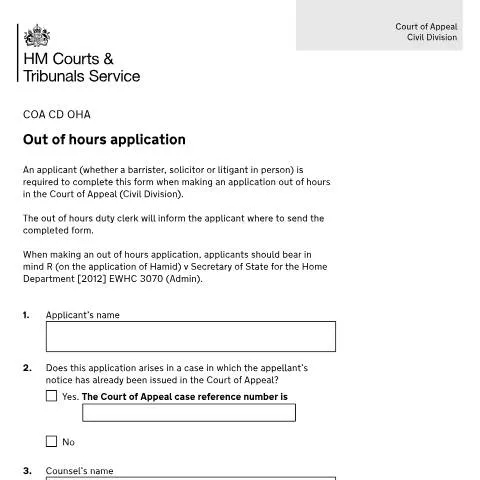
In the relentless pace of modern litigation, legal emergencies rarely respect the conventional boundaries of court operating hours. When a crucial deadline looms at midnight, when an urgent injunction must be secured over the weekend, or when deportation threatens during bank holidays, the Court of Appeal's out-of-hours service becomes the last line of defence. The COA CD OHA form serves as the gateway to this exceptional jurisdiction, enabling barristers, solicitors, and litigants in person to seek urgent judicial intervention when the Civil Division would otherwise be closed.
This specialised application process exists precisely because justice cannot always wait for Monday morning. Whether dealing with liberty cases where someone faces immediate detention, commercial disputes where irreparable harm threatens over a weekend, or immigration matters where removal is imminent, the out-of-hours system provides essential access to appellate justice when time is the most critical factor.
The Anatomy of Genuine Urgency: Understanding When Out-of-Hours Applications Apply
The Court of Appeal does not operate an out-of-hours service for convenience or poor planning. The system exists exclusively for cases where genuine urgency exists and where waiting until normal court hours would render any subsequent relief meaningless. The landmark case R (on the application of Hamid) v Secretary of State for the Home Department [2012] EWHC 3070 (Admin) provides crucial guidance on what constitutes appropriate use of this emergency jurisdiction.
Typical scenarios warranting out-of-hours applications include:
- Immigration and asylum cases where removal is scheduled outside court hours and would make any appeal academic
- Injunctive relief where continuing harm occurs during court closure periods
- Liberty cases involving detention or bail applications where delay compromises fundamental rights
- Commercial matters where weekend or holiday delays would cause irreversible financial damage
- Family cases involving child welfare where immediate judicial intervention is essential
The application must clearly demonstrate why the matter could not have been dealt with during normal court hours. This includes providing specific details about when solicitors and counsel were first instructed, what steps were taken during regular hours, and why the urgency only became apparent outside standard operating times.
The Immigration Context: A Particular Focus
Immigration and asylum matters represent a significant proportion of out-of-hours applications. The form specifically asks whether the case involves immigration or asylum issues and requires the Home Office reference number. This reflects the reality that removal directions often occur outside standard court hours, creating genuine emergencies where appellate intervention must be sought immediately or become impossible.
Navigating the Application Architecture: From Initial Contact to Judicial Decision
The out-of-hours application process begins with contact to the Court of Appeal's duty system. Unlike standard court procedures, applicants cannot simply file documents through normal channels. Instead, the out-of-hours duty clerk serves as the initial gatekeeper, providing instructions on where to send the completed COA CD OHA form once the urgency has been established.
This preliminary screening serves multiple purposes. It prevents abuse of the emergency system by filtering out non-urgent matters, ensures that genuine emergencies receive immediate attention, and directs applicants to the correct submission process. The duty clerk's role is crucial because they possess the authority to determine whether a matter warrants disturbing a Lord Justice during unsocial hours.
The Professional Representation Framework
The form's structure reflects the reality that out-of-hours applications typically involve professional representation, though provision exists for litigants in person. The detailed requirements for counsel and solicitor information serve practical purposes beyond mere identification:
| Information Required | Purpose | Critical Considerations |
|---|---|---|
| Counsel's chambers details | Verification of professional standing | Must include full address and contact details |
| Phone numbers | Immediate contactability | Applicant must remain available until decision made |
| Email addresses | Rapid communication of decisions | Essential for receiving urgent directions |
| Solicitor firm details | Professional accountability | Required even when counsel acts directly |
The emphasis on contactability cannot be overstated. Note 6 explicitly requires applicants to "remain contactable on this number until your application has been dealt with". This reflects the compressed timeframes involved and the need for immediate clarification or additional information.
The Critical Declaration: Confirming Procedural Propriety
Section 22 of the form contains what may be its most significant element: a mandatory confirmation that fundamentally shapes how out-of-hours applications operate. This declaration serves dual purposes that reflect both procedural integrity and practical case management.
The applicant must confirm two crucial elements:
First, that no previous application has been made to the Court of Appeal regarding this matter. This includes an obligation for barristers and solicitors to verify this position with their clients, preventing multiple or duplicative applications that could abuse the emergency system.
Second, an undertaking to file an appellant's notice and issue fee within 48 hours via the Civil Appeals Office E-Filing system. This ensures that emergency relief, if granted, translates into properly constituted proceedings.
This 48-hour undertaking represents a critical bridge between emergency intervention and formal appellate process. It prevents the out-of-hours system from becoming a substitute for proper appellate procedure while ensuring that urgent relief can be granted without compromising procedural requirements.
The E-Filing Imperative
The mandatory use of CE-File for the subsequent appellant's notice reflects the Court of Appeal's digital transformation. This electronic filing requirement serves multiple purposes: it ensures rapid processing of the follow-up documentation, creates immediate digital records linked to the emergency application, and enables efficient case tracking from emergency intervention through to substantive hearing.
Judicial Decision-Making: The Lord Justice's Determination Process
Once submitted, the application reaches a Lord Justice who must make an immediate decision based solely on the information provided. This decision-making process operates under unique constraints that distinguish it from normal appellate consideration.
The judge's options, as reflected in the form's completion section, include:
- Granting the application - providing immediate relief or directions
- Refusing the application - where urgency is not established or the case lacks merit
- Giving specific directions - which may include conditional relief or requirements for further information
The form also addresses the practical mechanics of implementing decisions through its query about whether "an order needs to be drawn and sent out by Associates". This administrative detail reflects the reality that emergency decisions often require immediate formal orders, particularly where third parties (such as the Home Office in immigration cases) must be notified of judicial directions.
The Urgency Classification System
When formal orders are required, the system includes provisions for marking them as urgent or non-urgent. This classification affects how quickly the order is processed and distributed, ensuring that truly time-critical matters receive priority attention even within the emergency system.
Case Categorisation and Cross-Referencing: Managing Complex Appeal Pathways
The form's structure reveals sophisticated case management considerations that reflect the complexity of modern appellate practice. The distinction between cases where an appellant's notice has already been issued and entirely new matters creates different procedural pathways with distinct implications.
For cases with existing Court of Appeal reference numbers, the out-of-hours application becomes part of ongoing appellate proceedings. This might involve applications for expedition, variation of directions, or urgent interim relief within established cases. The existing reference number enables immediate access to case files and previous directions.
For new matters, the application represents the first contact with the appellate system, creating additional responsibilities for the duty clerk and deciding judge to ensure proper case initiation alongside emergency relief.
Lower Court Integration
The detailed requirements for lower court information serve multiple analytical purposes:
- Jurisdictional verification - ensuring the Court of Appeal has proper jurisdiction over the matter
- Procedural compliance - confirming that appropriate lower court procedures were followed
- Timing analysis - enabling assessment of whether urgency claims are genuine based on when the lower court decision was made
- Judge identification - facilitating potential contact with the lower court judge if clarification is needed
The requirement to specify the exact time of the lower court decision reflects the precision needed in emergency applications where every hour may be significant.
Documentary Requirements and Supporting Evidence: Building the Emergency Case
Unlike standard court applications where comprehensive documentation can be assembled over time, out-of-hours applications must be supported by immediately available evidence. Note 19 emphasises that applicants must "send any relevant paperwork with this form", creating challenges in rapidly assembling persuasive supporting materials.
The types of supporting documentation typically required include:
Fill in your form directly online
No printing: type your details into the boxes of the official form, tick, then download the PDF ready to send.
- 1Type into the form boxes
- 2Tick in one click
- 3Save and download the PDF
| Document Type | Purpose | Availability Challenges |
|---|---|---|
| Lower court judgment | Understanding the decision being appealed | May not yet be available in written form |
| Removal directions (immigration cases) | Demonstrating imminent threat | Often received at short notice |
| Evidence of harm | Supporting urgency claims | May be developing in real-time |
| Previous applications | Avoiding duplication | Requires comprehensive file review under pressure |
The challenge lies in balancing thoroughness with speed. Applicants must provide sufficient information for informed judicial decision-making while working within the compressed timeframes that define genuine emergencies.
The Immigration Documentation Imperative
Immigration cases present particular documentation challenges. Home Office reference numbers must be provided, removal directions must be evidenced, and the connection between the lower court decision and the removal threat must be clearly established. This often requires rapid coordination between immigration solicitors, appellate counsel, and detention centre contacts to assemble necessary evidence within hours rather than days.
Procedural Safeguards and System Integrity: Preventing Abuse While Ensuring Access
The out-of-hours system operates within carefully constructed safeguards designed to prevent abuse while ensuring genuine emergencies receive appropriate attention. These safeguards operate at multiple levels, from initial duty clerk screening through to post-decision follow-up requirements.
The prohibition on previous applications serves as a primary safeguard against forum shopping and repeated applications. By requiring confirmation that no previous application has been made, the system prevents applicants from making multiple emergency applications or using the out-of-hours service to circumvent previous negative decisions.
The 48-hour undertaking requirement ensures that emergency relief translates into properly constituted proceedings. This prevents the out-of-hours system from becoming a substitute for normal appellate procedure while ensuring that genuine emergencies can receive immediate attention.
Professional Accountability Mechanisms
The detailed professional identification requirements create accountability mechanisms that extend beyond individual applications. Chambers and solicitor firms become associated with out-of-hours applications, creating professional incentives for appropriate use of the emergency system.
The requirement for legal representatives to confirm with their clients that no previous applications have been made creates additional verification layers, ensuring that the prohibition on repeat applications is effectively enforced.
Digital Integration and Modern Court Administration: The CE-File Connection
The integration with the CE-File system represents more than mere administrative convenience; it reflects the Court of Appeal's broader digital transformation and creates seamless connections between emergency applications and ongoing case management.
The mandatory use of E-Filing for subsequent appellant's notices ensures that emergency decisions are immediately integrated into the court's digital case management systems. This creates audit trails, enables efficient tracking of case progression, and ensures that emergency relief can be properly monitored and enforced.
The form's reference to specific guidance on CE-File support reflects the practical reality that out-of-hours applicants may need immediate technical assistance to comply with digital filing requirements within the compressed 48-hour timeframe.
The fee structure for Court of Appeal applications applies equally to cases initiated through out-of-hours applications, with the 48-hour undertaking specifically including both the appellant's notice and the issue fee. This ensures that emergency access does not circumvent normal court fee requirements while recognising that immediate payment may not be possible during the initial emergency application.
This integration between emergency procedure and standard court administration demonstrates the sophisticated balance required between immediate access to justice and maintaining procedural integrity. The out-of-hours system operates as an exception to normal court hours but not as an exception to normal court procedures, creating a framework where emergency relief can be granted without compromising the fundamental requirements of appellate justice.