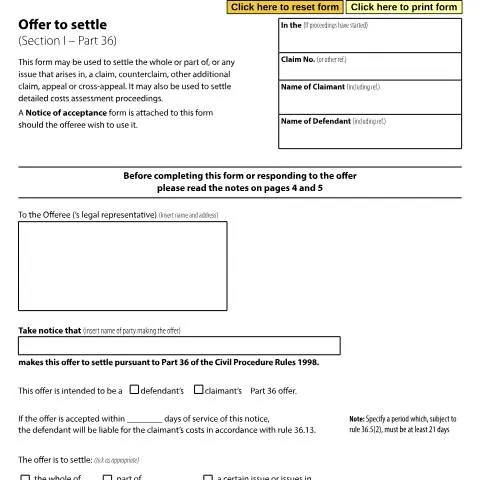
Understanding the Strategic Role of Form N242A in Civil Settlement Negotiations
When legal proceedings reach a crossroads where litigation costs threaten to spiral beyond reason, Form N242A emerges as a crucial mechanism for bringing disputes to a controlled resolution. This notice of offer to settle operates under Part 36 of the Civil Procedure Rules 1998, creating a formal framework that transforms settlement negotiations from informal exchanges into legally binding propositions with significant cost consequences.
The form serves multiple purposes across the breadth of civil proceedings, from straightforward contract disputes to complex personal injury claims involving provisional damages. Its versatility extends to counterclaims, appeals, cross-appeals, and even detailed costs assessment proceedings, making it an indispensable tool for solicitors and barristers managing diverse case portfolios.
What distinguishes Form N242A from ordinary settlement correspondence is its capacity to trigger specific cost protection mechanisms. When properly executed, it creates a benchmark against which the eventual outcome of proceedings will be measured, potentially exposing the rejecting party to adverse cost orders if they fail to better the offer at trial.
Navigating the Complexities of Part 36 Offer Classifications
The form requires parties to identify whether they are making a claimant's offer or a defendant's offer, a distinction that fundamentally alters the legal consequences of acceptance or rejection. This classification system reflects the underlying dynamics of civil litigation and determines the cost liability framework that will apply.
A defendant's offer represents a proposal to settle the claimant's claim by paying a specified sum or taking defined action, coupled with an acceptance of liability for the claimant's legal costs up to the point of the offer. Conversely, a claimant's offer indicates willingness to accept a particular sum or outcome in full settlement of their claim, with the expectation that the defendant will bear their reasonable legal costs.
The complexity increases significantly in multi-party proceedings or cases involving counterclaims. Here, the same party might simultaneously occupy both roles, making a defendant's offer on the primary claim whilst advancing a claimant's offer on their counterclaim. The form specifically addresses this scenario, requiring clear articulation of whether each offer takes into account any adverse claims running in parallel.
Special Considerations for Appeal Proceedings
Appeal proceedings introduce additional layers of complexity to the offer classification system. An appellant seeking to settle their appeal should frame their proposal as a claimant's offer, whilst a respondent defending the appeal would typically make a defendant's offer. This reversal of roles from the original proceedings reflects the appellant's position as the party pursuing a remedy through the appeal process.
Cross-appeals further complicate this landscape, as they effectively create reciprocal claimant positions. The form accommodates these scenarios through detailed guidance notes that help practitioners navigate the classification requirements without inadvertently undermining their client's position.
Personal Injury Claims: Enhanced Protections and Specialist Provisions
Personal injury cases receive dedicated treatment within Form N242A, reflecting both their prevalence in civil courts and their unique characteristics. Section 2 specifically addresses claims for provisional damages, recognising that some injuries may deteriorate over time or lead to the development of related conditions that cannot be fully quantified at the time of initial settlement.
When provisional damages are claimed, the offeror faces two distinct approaches. They may offer settlement on the assumption that the feared deterioration or disease will not materialise, whilst preserving the claimant's right to return for additional compensation should it occur within a specified timeframe. Alternatively, they may exclude provisional damages entirely from their offer, leaving this element to be resolved separately.
| Provisional Damages Approach | Implications for Settlement | Risk Profile |
|---|---|---|
| Assumption-based offer | Creates future liability window | Higher defendant risk, greater claimant protection |
| Exclusion-based offer | Separates immediate and future claims | Limited defendant exposure, reduced claimant certainty |
Social Security Benefits and Compensation Interaction
Section 3 addresses the intricate relationship between compensation payments and recoverable social security benefits under the Social Security (Recovery of Benefits) Act 1997. Defendants must specify whether their offer accounts for the Compensation Recovery Unit's potential claim for benefit recovery, a decision that significantly impacts the net value received by claimants.
Where defendants have not yet obtained a Certificate of Recoverable Benefits, they may make offers without regard to benefit liability, effectively shifting this risk to the settlement negotiation phase. Alternatively, they may specify gross compensation figures with identified deductions for known recoverable benefits, providing claimants with clarity about their net entitlement.
Timing Mechanisms and the 21-Day Protection Period
Form N242A incorporates sophisticated timing mechanisms designed to balance the need for prompt decision-making with adequate consideration periods. The offeror must specify an acceptance period, subject to a minimum 21-day requirement under rule 36.5(2), during which the offer remains open for acceptance with standard cost consequences.
This 21-day period serves multiple functions within the Part 36 framework. It provides offerees with reasonable time to obtain legal advice and assess the offer's merits against their prospects at trial. Simultaneously, it creates a defined window during which acceptance triggers the standard cost rule under rule 36.13, typically requiring the defendant to pay the claimant's costs on the standard basis.
The interaction between offer timing and case management directions requires careful consideration. Courts may set deadlines for disclosure, witness statements, or expert reports that influence the strategic timing of Part 36 offers. Practitioners must coordinate these elements to maximise their offer's effectiveness whilst complying with procedural requirements.
Consequences of Late Acceptance
Acceptance after the specified period remains possible but triggers different cost consequences. The accepting party loses the automatic entitlement to standard cost protection and may face liability for costs incurred after the offer period expired. This mechanism incentivises prompt decision-making whilst preserving settlement opportunities throughout the litigation process.
Strategic Deployment Across Different Proceedings Types
The form's versatility extends across the full spectrum of civil proceedings, each presenting distinct strategic considerations. In straightforward contract disputes, offers typically focus on monetary compensation with relatively simple cost arrangements. However, complex commercial litigation may involve offers combining financial settlements with specific performance obligations or ongoing business relationships.
Counterclaim scenarios require particularly careful handling, as parties must clearly articulate whether their offers account for adverse claims. A defendant offering £50,000 to settle a claimant's personal injury claim must specify whether this figure assumes abandonment of any counterclaim for vehicle damage or property recovery. Failure to address these interactions can lead to disputes about the offer's scope and enforceability.
Costs Assessment Proceedings
Detailed costs assessment proceedings represent a specialised application of Form N242A, where the receiving party (typically a successful claimant) makes claimant's offers whilst paying parties (usually defendants) make defendant's offers. These proceedings often involve substantial sums, particularly in complex commercial or clinical negligence cases where legal costs may exceed the underlying damages.
The form facilitates offers that may encompass entire bills of costs or specific categories of expenditure. Given the detailed nature of costs disputes, offers in this context often require extensive supporting documentation to justify proposed settlement figures and demonstrate reasonableness.
Procedural Integration with Case Management Systems
Form N242A operates within the broader case management framework established by the Civil Procedure Rules, requiring coordination with various procedural deadlines and court directions. The timing of offers must consider disclosure obligations, expert evidence deadlines, and pre-trial review dates to maximise strategic effectiveness.
Service requirements under Part 6 of the Civil Procedure Rules apply to Part 36 offers, demanding compliance with specific methods and timing provisions. Electronic service has become increasingly prevalent, but practitioners must ensure their chosen method satisfies the formal requirements for offer validity.
The attached Notice of Acceptance form streamlines the acceptance process, providing a standardised mechanism for offerees to formally accept offers without drafting separate correspondence. This attachment eliminates potential disputes about acceptance validity whilst ensuring compliance with procedural requirements.
Multi-Party Complications
Multi-party proceedings present particular challenges for Part 36 offers, especially where defendants face joint and several liability. Rule 36.15 addresses scenarios where offers are made by some but not all defendants, requiring careful consideration of the remaining defendants' positions and potential contribution claims.
The form accommodates these complications through detailed guidance notes, but practitioners must consider the broader strategic implications of partial settlements on ongoing proceedings against non-settling parties.
Cost Protection Mechanisms and Risk Assessment
The form's primary strategic value lies in its capacity to create cost protection for offerors who ultimately achieve better results at trial than their rejected offers. This protection extends beyond simple cost recovery to encompass enhanced cost rates and additional penalties that can substantially exceed the underlying claim value.
Risk assessment becomes crucial when evaluating potential offers, as rejection carries significant downside exposure if the offeree fails to better the offer at trial. Courts have increasingly recognised the importance of Part 36 offers in encouraging settlement and may impose substantial cost penalties on parties who unreasonably reject reasonable offers.
The interaction between Part 36 costs consequences and other cost protection mechanisms, such as after-the-event insurance or costs budgeting, requires sophisticated analysis. Practitioners must consider how offer acceptance or rejection affects these arrangements and their clients' overall risk exposure.
Proportionality Considerations
Recent reforms have emphasised proportionality in costs awards, influencing how courts approach Part 36 cost consequences. Whilst the form itself remains unchanged, judicial interpretation of appropriate cost penalties has evolved to reflect broader case management objectives and access to justice concerns.
This evolution affects offer strategy, as parties must consider not only the likelihood of bettering their offers at trial but also the proportionality of any resulting cost awards. The form facilitates these considerations by requiring clear articulation of offer terms and scope, enabling informed risk assessment by all parties.
Documentation Requirements and Evidential Considerations
Form N242A demands meticulous completion to ensure offer validity and enforceability. The requirement for detailed offer descriptions extends beyond simple monetary figures to encompass specific performance obligations, timeframes for compliance, and any conditions precedent to settlement.
Personal injury claims involving future losses or ongoing treatment requirements present particular documentation challenges. Offers must clearly specify what elements of claimed damages are included, whether future treatment costs are covered, and how any ongoing care arrangements will be funded.
The form's integration with expert evidence becomes crucial in complex cases where offers must reflect technical assessments of liability, causation, or quantum. Practitioners must ensure their offers accurately reflect expert opinions whilst maintaining sufficient flexibility to accommodate potential variations in expert testimony.
Authentication requirements demand careful attention to signature provisions and authority confirmations, particularly where offers are made by legal representatives on behalf of corporate clients or protected parties. The form includes specific provisions for position confirmation, ensuring offer validity cannot be challenged on authority grounds.
Preservation of offer documentation extends beyond initial service to encompass ongoing case management requirements. Courts may require production of offer correspondence at costs hearings or when determining Part 36 consequences, making comprehensive record-keeping essential for successful offer deployment.
Strategic Considerations for Making Settlement Offers
The timing and amount of your settlement offer through Form N242A can significantly impact both the outcome of your case and your liability for costs. Understanding when to make an offer requires careful consideration of the strength of your position, the evidence available, and the potential risks of proceeding to trial.
Making an offer too early in proceedings may undervalue your claim or defence, particularly if disclosure has not yet revealed all relevant documents. Conversely, leaving an offer too late may reduce its tactical advantage and limit the cost protection it provides. Many legal practitioners recommend making initial settlement approaches after the defence has been filed and before the case management conference, allowing both parties to assess their positions whilst keeping costs proportionate.
The amount of your offer should reflect a realistic assessment of your case's prospects. For claimants, this typically means considering not just the value of the claim if successful, but also the likelihood of success and the defendant's ability to pay. A Part 36 offer that is too ambitious may provide little tactical advantage, whilst one that is too conservative may not incentivise settlement.
When calculating settlement amounts, factor in the costs you will save by avoiding trial preparation, expert witness fees, and court attendance. For defendants, remember that an early settlement often costs significantly less than the combined risk of judgment plus the claimant's costs. The calculation becomes more complex in cases involving multiple parties or counterclaims, where separate offers may need to be made for different aspects of the dispute.
Fill in your form directly online
No printing: type your details into the boxes of the official form, tick, then download the PDF ready to send.
- 1Type into the form boxes
- 2Tick in one click
- 3Save and download the PDF
Consider also whether to make your offer inclusive or exclusive of interest and costs. Part 36 offers are deemed to be inclusive unless expressly stated otherwise, which can create complications in calculating whether an offer has been beaten at trial. For larger claims, the interest element can be substantial, particularly if proceedings have been ongoing for an extended period.
In personal injury cases, be aware of the interaction between Part 36 offers and qualified one-way costs shifting (QOCS). The costs consequences of Part 36 offers can override QOCS protection in certain circumstances, making the tactical considerations particularly nuanced for both claimants and defendants in these cases.
Responding to Settlement Offers: Your Options and Obligations
Receiving a Form N242A settlement offer triggers specific obligations and opens several response options, each with distinct legal and tactical implications. Understanding these choices is crucial for making informed decisions about your case's progression.
Upon receiving a Part 36 offer, you have no obligation to respond, but failing to engage with reasonable settlement proposals can have costs consequences later. The court expects parties to give serious consideration to settlement offers, and unreasonably rejecting a generous offer may result in adverse costs orders even if you ultimately win your case.
If you wish to accept the offer, you must serve written notice of acceptance on the offeror. Acceptance can occur at any time whilst the offer remains open, but the costs consequences vary depending on when acceptance occurs. Accepting within the relevant period (usually 21 days) typically results in the offeror paying your costs up to the date of acceptance on the standard basis.
Accepting after the relevant period requires either the offeror's agreement to the costs position or a court order determining costs liability. This can create tactical considerations for offerors about whether to agree to late acceptance or force a costs hearing.
Rather than simply accepting or rejecting an offer, you may choose to make a counter-offer using your own Form N242A. This keeps settlement negotiations alive whilst protecting your position on costs. Counter-offers should be carefully calibrated – too close to the original offer may suggest it was reasonable, whilst too far apart may indicate unrealistic expectations.
In multi-party litigation, you may receive offers from multiple defendants or need to consider how acceptance of one offer affects claims against other parties. The rules around acceptance become complex where offers relate to part of a claim or where there are issues of contribution between defendants.
Some offers include conditions beyond simple payment, such as confidentiality clauses, non-admission provisions, or requirements for specific actions. Evaluate these terms carefully, as acceptance creates binding obligations beyond the financial settlement.
Document your decision-making process, particularly your reasons for rejecting offers. If the case proceeds to trial and you fail to beat a rejected Part 36 offer, the court may examine whether your rejection was reasonable. Clear documentation of your reasoning, based on legal advice where appropriate, can help justify your position.
Common Pitfalls and How to Avoid Them
Settlement negotiations through Form N242A are fraught with potential errors that can have serious cost and tactical consequences. Recognising these common pitfalls can help you navigate the process more effectively and avoid expensive mistakes.
One frequent error is failing to comply with the strict formal requirements of Part 36. Offers that don't meet these requirements may still have persuasive value in settlement negotiations, but won't carry the costs protection that properly made Part 36 offers provide. Always ensure your offer clearly states it's made under Part 36, specifies the relevant period, and includes all required information about what the offer covers.
Ambiguous offer terms create particular problems. Offers should specify exactly what is being offered, whether costs are included, and any conditions that apply. Vague language about "reasonable costs" or "appropriate interest" can lead to disputes about what acceptance actually means, potentially requiring court intervention to interpret the offer's terms.
Timing errors are surprisingly common and can be costly. Making an offer too close to trial may reduce its tactical value, whilst withdrawing offers without proper notice can create complications. Remember that Part 36 offers generally cannot be withdrawn during the relevant period without the court's permission, and improper withdrawal attempts may be ineffective.
In cases involving protected parties (including children or those lacking mental capacity), special rules apply to settlement. Offers involving protected parties require court approval even if accepted, and the usual Part 36 costs consequences may not apply. Failing to recognise when these rules apply can invalidate purported settlements.
Currency and interest calculations often cause problems in longer-running cases or those involving foreign elements. Be precise about the currency of payment, applicable interest rates, and how interest is calculated. For offers involving foreign currency, consider whether to specify the exchange rate or date for conversion.
Multiple defendant scenarios create complexity around apportionment and contribution. An offer to one defendant may not protect against claims by co-defendants, and accepting an offer from one party may affect your ability to pursue others. Consider whether joint offers or separate offers to each defendant better serve your interests.
Data protection compliance is increasingly important in settlement documentation. Ensure that any personal information included in offers or acceptance notices complies with UK GDPR requirements, particularly if sensitive personal data is involved or if documents will be disclosed to multiple parties.
Finally, be cautious about informal settlement discussions that might inadvertently create binding agreements outside the Part 36 framework. Whilst "without prejudice" communications are generally not admissible in court, they can still create contractual obligations if they meet the requirements for agreement. Keep clear boundaries between formal Part 36 offers and informal settlement discussions to avoid unintended consequences.