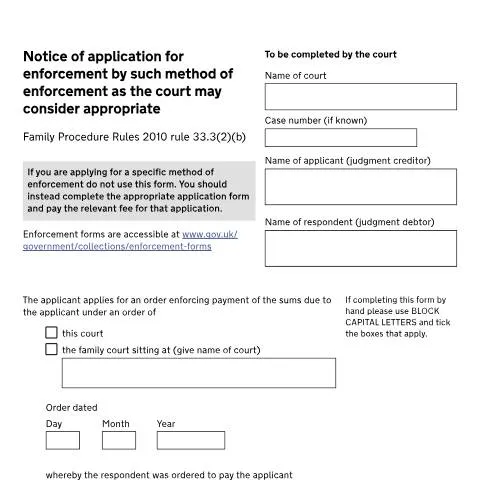
When Court Orders Go Unpaid: Understanding the D50K Enforcement Notice
When a family court order requiring payment remains unfulfilled, creditors face a frustrating reality: having a court judgment means little without effective enforcement. The D50K Notice of Application for Enforcement represents a strategic legal tool that places the burden of choosing the most appropriate enforcement method squarely on the court's shoulders, rather than requiring the applicant to predict which approach will prove most effective.
This eight-page notice, governed by Family Procedure Rule 33.3(2)(b), differs fundamentally from specific enforcement applications. Rather than committing to a particular method—such as an attachment of earnings order or charging order—the D50K allows applicants to present their case and request that the court determine the most suitable enforcement route based on the debtor's circumstances and available assets.
The document serves as both an application and a formal notice to the judgment debtor, triggering mandatory disclosure requirements and court attendance obligations. For family court practitioners and individuals pursuing unpaid maintenance, child support, or other financial orders, understanding the D50K's mechanics proves essential when standard payment arrangements fail.
Strategic Positioning Within Family Court Enforcement Procedures
The D50K occupies a unique position in the family court's enforcement hierarchy. Unlike applications for specific enforcement methods, which require the creditor to identify and justify a particular approach, this notice acknowledges that creditors may lack sufficient information about the debtor's financial circumstances to make an informed choice.
The form explicitly warns against its use when seeking a specific enforcement method, directing applicants instead to complete the appropriate targeted application and pay the relevant fee. This distinction matters significantly: the D50K serves as an investigative tool that compels disclosure before determining the enforcement strategy, rather than pursuing a predetermined course of action.
| Enforcement Method | Best Suited For | Information Required |
|---|---|---|
| Attachment of Earnings | Regular employment income | Employer details, salary information |
| Third Party Debt Order | Bank accounts, investments | Account details, financial institutions |
| Charging Order | Property ownership | Property details, ownership structure |
| Warrant of Control | Personal property, goods | Asset location, accessibility |
| Receiver Appointment | Complex assets, business interests | Detailed financial structure |
The court's discretionary power under the D50K extends beyond simply selecting from available options. Judges may combine multiple enforcement methods, vary the approach based on emerging information, or defer enforcement pending further investigation. This flexibility proves particularly valuable in family law contexts where financial arrangements often involve complex structures or deliberate concealment of assets.
Mandatory Disclosure Requirements and Form E1 Obligations
Upon issuing the D50K, the court automatically requires the judgment debtor to complete and return Form E1, a comprehensive financial statement that reveals income, expenditure, assets, and liabilities. This mandatory disclosure represents one of the D50K's most powerful features, as it compels information that creditors might otherwise struggle to obtain through voluntary disclosure or separate proceedings.
The E1 requirement operates under court order, making failure to comply a contempt of court matter. Debtors cannot simply ignore the obligation or provide incomplete information without risking enforcement action. The form must be sent to both the court and the applicant, ensuring transparency in the enforcement process.
Beyond the E1 completion, the notice requires the debtor's attendance at a court hearing to provide further information about their means or other relevant circumstances. This dual requirement—written disclosure plus oral examination—creates comprehensive visibility into the debtor's financial position, enabling informed enforcement decisions.
Timing and Service Considerations
The D50K includes specific provisions for service on the judgment debtor, recognising that effective enforcement depends on proper notification. The form prioritises email service where possible, requiring confirmation that only the respondent has access to the provided email account. This approach balances efficiency with security, ensuring confidential financial information reaches the intended recipient.
Applicants may opt for postal service only or arrange service themselves, providing flexibility for situations where standard court service may prove problematic. The geographical jurisdiction requirements ensure that enforcement proceedings occur in appropriate venues, either where the debtor resides, conducts business, or where the original order was made.
Arrears Calculations and Historical Payment Tracking
The D50K requires detailed documentation of payment shortfalls, distinguishing between periodical payments (such as ongoing maintenance) and lump sum orders. For periodical payments, applicants must specify the payment frequency, amount, and total arrears accumulated by the application date. This calculation often requires careful record-keeping, particularly where payments have been made irregularly or partially.
Lump sum enforcement presents different challenges, as applicants must demonstrate either complete non-payment or identify the outstanding balance following partial payments. The form requires specific dates and amounts, creating an evidentiary foundation for the enforcement proceedings.
Interest calculations add another layer of complexity, as the D50K accommodates both court-ordered interest and statutory interest on judgment debts. Applicants must provide detailed calculations showing how arrears figures have been reached, with supporting evidence attached where necessary. This documentation becomes crucial during court hearings, as judges require clear evidence of the debt before ordering enforcement measures.
Twelve-Month Rule and Historical Arrears
The D50K specifically addresses enforcement of arrears that became due more than twelve months before the application date. Such historical arrears require court permission to enforce, reflecting the policy that old debts should not accumulate indefinitely without enforcement action. Applicants seeking to enforce historical arrears must indicate this intention on the form and be prepared to justify the delay at the hearing.
This provision encourages prompt enforcement action while recognising that circumstances may legitimately prevent immediate enforcement proceedings. Courts consider factors such as the debtor's changing circumstances, previous enforcement attempts, and the creditor's reasons for delayed action when deciding whether to permit historical arrears enforcement.
Court Discretion and Available Enforcement Methods
The D50K empowers courts to select from the full range of available enforcement methods, each suited to different circumstances and asset types. Attachment of earnings orders work effectively against employed debtors with regular salaries but prove useless against self-employed individuals or those with irregular income streams.
Third party debt orders target bank accounts and other financial instruments held by third parties, requiring knowledge of where the debtor maintains accounts. These orders can freeze accounts pending further proceedings but depend on accurate information about the debtor's banking arrangements.
Charging orders create security over property interests, effectively placing a charge on the debtor's home or other real estate. While powerful, these orders require property ownership and may face challenges where properties are jointly owned or subject to existing charges with higher priority.
Warrants of control authorise enforcement officers to seize and sell the debtor's personal property, though practical limitations exist regarding essential household items and tools of trade. This method works best where debtors possess valuable, accessible personal property.
Receiver appointments represent the most comprehensive enforcement option, placing an independent officer in control of the debtor's assets or income streams. Courts typically reserve this remedy for complex cases involving business interests or where other methods have proved ineffective.
Combining Enforcement Approaches
The D50K's flexibility allows courts to combine multiple enforcement methods simultaneously or sequentially. A typical approach might involve an attachment of earnings order for ongoing payments coupled with a charging order to secure existing arrears. This dual strategy addresses both current compliance and historical debt while providing security for future enforcement needs.
Practical Considerations for Applicants and Respondents
Successful D50K applications require careful preparation and realistic expectations. Applicants must gather comprehensive documentation of the original order, payment history, and current arrears calculations. The more detailed the financial picture presented, the better positioned the court becomes to select appropriate enforcement measures.
The application process involves completing detailed sections covering both parties' contact information, including email addresses for service purposes. Reference numbers and case details must match court records exactly, as discrepancies can delay proceedings or result in rejected applications.
For judgment debtors receiving a D50K notice, immediate action becomes essential. Ignoring the E1 requirement or failing to attend the scheduled hearing risks contempt proceedings and may result in enforcement orders made without the debtor's input. Engaging early with the process, providing complete financial disclosure, and attending hearings demonstrates cooperation that courts may consider when determining enforcement approaches.
Professional Representation Considerations
While the D50K can be completed by litigants in person, the complexity of enforcement law and the potential consequences of different enforcement methods often justify professional legal representation. Solicitors experienced in family court enforcement can advise on strategic considerations, help prepare supporting documentation, and represent parties at enforcement hearings.
The notice includes provisions for legal representatives' contact details and service addresses, recognising that enforcement proceedings frequently involve professional representation. Courts may direct correspondence to representatives rather than parties directly, streamlining communication in complex cases.
Variation Applications and Ongoing Proceedings
The D50K requires applicants to disclose any pending applications to vary the order being enforced. This provision recognises that enforcement and variation proceedings may run simultaneously, potentially affecting the appropriateness of different enforcement methods. Courts must balance enforcement needs against pending variation applications that might reduce or eliminate future payment obligations.
Where variation applications exist, courts may defer enforcement decisions pending resolution of the variation proceedings. Alternatively, they might implement interim enforcement measures while preserving the debtor's right to seek order modifications. This balancing act requires careful judicial consideration of competing interests and timing considerations.
The interaction between enforcement and variation proceedings highlights the importance of strategic timing in family court proceedings. Debtors facing enforcement action may seek to vary orders as a defensive measure, while creditors may accelerate enforcement proceedings to prevent variation applications from undermining their position.
Understanding these dynamics helps both parties approach D50K proceedings with realistic expectations and appropriate strategic considerations. The notice serves not merely as an enforcement tool but as part of the broader family court's approach to ensuring compliance with financial orders while maintaining fairness and proportionality in enforcement measures.
Understanding the Court's Assessment Criteria for Appropriate Enforcement Methods
When the court receives Form D50K, it initiates a comprehensive evaluation process to determine the most suitable enforcement mechanism for your specific circumstances. This assessment goes far beyond a simple tick-box exercise and involves multiple factors that directly impact the likelihood of successful debt recovery.
The court's primary consideration centres on the judgment debtor's financial capacity and assets. If you've previously obtained information through examination proceedings or asset disclosure orders, this intelligence proves invaluable. For instance, if bank account details were disclosed showing regular salary deposits, attachment of earnings becomes a viable option. Conversely, evidence of property ownership might steer the court towards charging orders or orders for sale.
Proportionality represents another crucial element in the court's decision-making matrix. A £500 debt rarely warrants the expense and complexity of appointing High Court Enforcement Officers, whereas substantial commercial debts exceeding £600 might justify such robust intervention. The court must balance enforcement costs against potential recovery, ensuring the chosen method doesn't consume the entire debt amount in fees and expenses.
The nature of the original claim also influences enforcement selection. Consumer credit disputes often face different treatment compared to commercial contract breaches or professional negligence claims. Vulnerable debtors—those experiencing mental health difficulties, disability, or severe financial hardship—trigger additional protective considerations that may limit certain enforcement options.
Geographic factors play an increasingly important role, particularly for property-based enforcement. Rural properties with uncertain valuations present different challenges compared to urban residential or commercial premises with established market values. The court considers practical accessibility for enforcement agents and the realistic prospects of achieving a satisfactory outcome.
Previous enforcement attempts significantly shape the court's approach. If standard methods like warrants of control have proven unsuccessful due to insufficient goods, the court may approve more sophisticated strategies such as third-party debt orders targeting bank accounts or interim charging orders securing the debt against property assets.
The judgment debtor's cooperation level throughout proceedings influences available options. Persistent non-compliance with court orders, failure to attend examination hearings, or providing false asset information may justify more intensive enforcement measures that might otherwise seem disproportionate.
Tactical Considerations for Maximising Enforcement Success
Successfully recovering judgment debts requires strategic thinking that extends beyond simply completing Form D50K. The most effective approach involves layering multiple enforcement methods in a coordinated sequence, each building upon information gathered from previous attempts.
Fill in your form directly online
No printing: type your details into the boxes of the official form, tick, then download the PDF ready to send.
- 1Type into the form boxes
- 2Tick in one click
- 3Save and download the PDF
Intelligence gathering forms the foundation of any successful enforcement strategy. Before submitting Form D50K, conduct thorough research into the judgment debtor's circumstances. Companies House records reveal director details, registered addresses, and filing compliance for corporate debtors. Land Registry searches, available for £3 per property, confirm ownership details and existing charges that might affect recovery prospects.
Social media and professional networking platforms often provide valuable insights into lifestyle and business activities that contradict claimed financial hardship. However, ensure any information gathering complies with data protection requirements and doesn't constitute harassment or stalking behaviour.
Timing enforcement applications strategically can significantly improve success rates. Submitting applications immediately after salary payment dates increases the likelihood of successful third-party debt orders. Similarly, timing property-based enforcement to avoid peak moving seasons or school holidays may reduce complications from occupancy issues.
Consider the psychological impact of enforcement actions on judgment debtors. Sometimes, the formal service of a charging order application prompts voluntary payment to avoid property complications, even when the debtor previously ignored standard demands. The threat of public examination or bailiff attendance often motivates settlement negotiations.
Maintain detailed records of all enforcement attempts, including dates, methods, outcomes, and any debtor communications. This documentation proves invaluable when applying for alternative enforcement methods or seeking to demonstrate that standard approaches have been exhausted.
Where multiple creditors exist, coordination can prevent conflicting enforcement actions that reduce everyone's recovery prospects. Informal creditor meetings or formal insolvency proceedings might achieve better outcomes than competing individual enforcement efforts.
For high-value debts exceeding £5,000, consider whether transferring enforcement to the High Court might provide access to more experienced enforcement agents and broader powers. High Court Enforcement Officers often achieve higher success rates due to their enhanced authority and professional expertise.
International elements require specialist consideration. If assets exist overseas, enforcement may require recognition proceedings in foreign jurisdictions, substantially increasing complexity and costs. European Enforcement Orders provide streamlined mechanisms within participating EU countries, though Brexit has complicated these arrangements for UK judgments.
Managing Enforcement Complications and Debtor Responses
Enforcement proceedings rarely proceed smoothly, and judgment creditors must prepare for various complications that can arise following Form D50K submission. Understanding potential obstacles and appropriate responses helps maintain momentum towards successful debt recovery.
Debtor applications to set aside or vary enforcement orders represent common challenges. These applications often cite procedural irregularities, changes in circumstances, or disputes over the original judgment. When facing such applications, respond promptly with comprehensive evidence supporting your enforcement application and demonstrating compliance with all procedural requirements.
Claims of financial hardship require careful evaluation. While genuine hardship may justify suspended or reduced payment arrangements, some debtors exaggerate difficulties to delay enforcement. Request detailed financial statements, bank statements, and supporting documentation to verify claimed circumstances. The court expects creditors to act reasonably but not accept unsupported assertions without evidence.
Third-party claims frequently complicate enforcement against goods or property. When bailiffs seize items claimed by family members, business partners, or other parties, enforcement may halt pending resolution. Prepare for such scenarios by gathering evidence of the judgment debtor's ownership rights and questioning suspicious transfers of assets that occurred after judgment.
Corporate debtors may attempt to frustrate enforcement through restructuring, asset transfers, or threatening insolvency. Monitor Companies House filings for significant changes and consider whether such actions constitute unfair prejudice to creditors' interests. Director disqualification proceedings might be appropriate where companies are deliberately rendered judgment-proof.
Bankruptcy or company liquidation applications can halt enforcement proceedings entirely. While these procedures may ultimately provide better recovery through formal insolvency processes, they require immediate legal response to protect your position as a creditor. Ensure your debt is properly documented and any security interests are validly registered.
Human rights challenges occasionally arise, particularly regarding residential property enforcement. Article 8 rights to family life and peaceful enjoyment of property can complicate charging orders and orders for sale. Courts must balance creditor rights against proportionate interference with human rights, often requiring detailed evidence of necessity and reasonableness.
Professional advice becomes essential when enforcement faces significant resistance or legal challenges. Specialist debt recovery solicitors understand the tactical options available and can navigate complex procedural requirements that might defeat unrepresented creditors.
Consider alternative dispute resolution even during enforcement proceedings. Mediation or direct negotiation might achieve faster, more cost-effective outcomes than protracted enforcement battles. Many debtors prefer negotiated settlements to the uncertainty and public nature of continued court proceedings.
Maintain professional standards throughout enforcement proceedings. Aggressive or harassment-type behaviour can result in restraining orders, costs sanctions, or even criminal liability. The Financial Conduct Authority regulates debt collection activities, and professional creditors must comply with relevant guidelines and codes of practice.
Document all enforcement-related communications carefully. This includes recording telephone conversations where legally permissible, retaining copies of all correspondence, and maintaining chronological files showing the progression of enforcement attempts. Such documentation proves invaluable if disputes arise regarding procedural compliance or reasonable creditor behaviour.