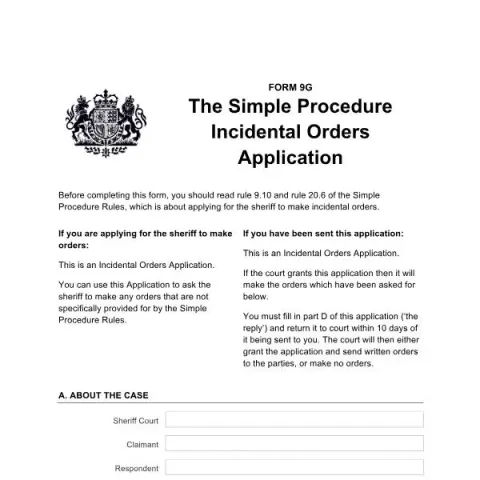
Introduction to the Form 9G: The Simple Procedure Incidental Orders Application
The Form 9G, titled The Simple Procedure Incidental Orders Application, is an official document issued by the Scottish Courts and Tribunals Service. It is designed for parties involved in civil cases under the Simple Procedure rules who seek to request incidental orders from the sheriff. This form plays a crucial role in ensuring that parties can effectively apply for additional or specific orders not explicitly covered by the standard rules, thus facilitating a more flexible and comprehensive resolution process.
Understanding the Purpose and Scope of Form 9G
The primary purpose of Form 9G is to enable a party to formally request the sheriff to make incidental orders that are relevant to their case but are not explicitly provided for within the existing rules of the Simple Procedure. These incidental orders may include a variety of directions or decisions that assist in the management and resolution of the case, such as procedural directions, evidence handling, or other specific reliefs.
This application is relevant for claimants, respondents, or interested parties who believe that additional orders are necessary for the efficient conduct of the case. It is essential to note that the form must be completed in accordance with the provisions set out in rule 9.10 and rule 20.6 of the Simple Procedure Rules, which govern incidental orders.
Who Can Use the Form and When?
The Form 9G can be used by any party involved in a case who wishes to request the sheriff to make orders beyond those explicitly provided for in the Simple Procedure Rules. It is particularly useful when an application arises during ongoing proceedings that require the court’s intervention to clarify or implement specific directions.
If you have received this application form, it indicates that you are being asked to respond to a request for incidental orders. Conversely, if you are the applicant, you will need to complete the relevant sections and submit the form to the court within the specified timeframe.
It is important to submit your reply, known as Part D of the form, within 10 days of the application being sent to you. Failure to respond within this period may affect the court’s ability to consider your objections or support for the application.
Step-by-Step Guide to Filling Out Form 9G
Part A: About the Case
- Claimant or Respondent: Identify the role you hold in the case.
- Case Reference Number: Provide the unique reference number assigned to your case.
Part B: About You
- Name: Enter your full name, including middle name if applicable.
- Party Type: Tick the box that corresponds to your role—Claimant, Respondent, or Interested Party.
- Additional Capacity: If you are acting in a representative capacity or trading name, specify this information.
Part C: The Application
- Orders Requested: Clearly set out the specific orders you are asking the court to make.
- Justification: Explain why these orders are necessary and why the court should grant them.
- Date of Sending: Record the date you sent the application to the court.
Part D: The Reply
- Name: Complete your full name and capacity if applicable.
- Support for Orders: Indicate whether you agree (Yes) or oppose (No) the orders requested.
- Objections: If you oppose, provide reasons why the court should not make the orders.
Important Considerations and Deadlines
When submitting Part D of the form, ensure that it is done within the 10-day period from the date the application was sent to you. This deadline is strict and vital for the court to consider your response in the decision-making process.
Failure to respond within the specified timeframe may result in the court proceeding without your input or objections, potentially affecting the outcome of the incidental orders requested.
Fill in your form directly online
No printing: type your details into the boxes of the official form, tick, then download the PDF ready to send.
- 1Type into the form boxes
- 2Tick in one click
- 3Save and download the PDF
Post-Submission Procedures
Once the court receives your reply, it will review the application and your response. The court may either:
- Grant the incidental orders as requested, issuing written directions to all parties, or
- Refuse the application if it deems the orders unnecessary or inappropriate.
Parties will be notified of the court’s decision in writing. It is advisable to keep copies of all submissions and correspondence for your records.
Conclusion
Form 9G serves as a vital tool within the Scottish civil justice system, allowing parties to seek additional procedural directions or specific orders to facilitate case management. Proper understanding of its purpose, correct completion, and timely submission are crucial for ensuring that your application is considered effectively by the sheriff, ultimately contributing to a fair and efficient resolution of the case.