Understanding the Scottish Courts and Tribunals Service Form 20A: The Simple Procedure Provisional Orders Application
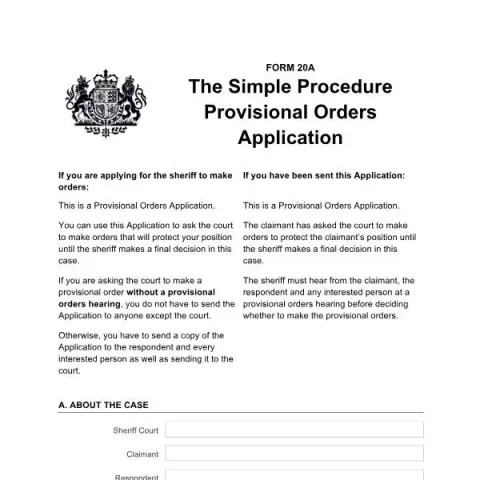
The Form 20A issued by the Scottish Courts and Tribunals Service is an official legal document designed for use within the Simple Procedure framework. This form enables claimants to request provisional orders from the sheriff court to safeguard their position pending a final decision in a case. It is particularly relevant in civil cases where immediate protective measures are necessary to preserve assets or prevent certain actions by the respondent.
Purpose and Scope of the Form
The primary function of Form 20A is to facilitate the application for provisional orders, which act as temporary measures until the sheriff can hear the case in full and make a final ruling. These provisional orders include:
- Arrestment on the dependence: Freezing assets or funds held by a third party.
- Inhibition on the dependence: Preventing the respondent from selling land or taking secured loans.
- Interim attachment: Restricting the sale or removal of goods.
Claimants use this form to request such orders, especially when they believe that their position needs urgent protection before the final hearing.
Who Should Use This Form?
This form is intended for claimants who are involved in civil proceedings within the Scottish sheriff courts and wish to apply for provisional orders. It is suitable when the claimant seeks to:
- Secure assets or funds temporarily to prevent dissipation.
- Stop the respondent from disposing of land or property.
- Prevent the removal of goods or assets from the respondent’s possession.
Applicants should be aware that the form is used either with or without a provisional orders hearing, depending on the circumstances and the type of order sought.
Step-by-Step Guide to Filling Out the Form
1. Identifying the Case
Begin by providing the details of the Sheriff Court involved, including the Case reference number. Clearly state the Claimant and Respondent names, ensuring accuracy to avoid delays.
2. Claimant Details
Complete Part B by entering your full name, including any middle names, and your trading name or capacity if applicable. This information establishes your identity and role in the case.
3. Selecting the Provisional Order
In Part C, specify the type of provisional order you are requesting. Options include arrestment, inhibition, or interim attachment, each corresponding to different protective measures. Provide a brief explanation of why the court should grant this order in Part C2.
4. Requesting a Hearing
Decide whether you want the court to consider your application without a hearing or to hold a hearing before making a decision. Complete Part D accordingly, indicating your preference for how the application should be processed.
5. Providing Details of Third Parties (if applicable)
If requesting an arrestment, complete Part E by providing details of the third party holding the respondent’s goods or funds. This includes their name, address, contact details, and, if relevant, company registration information.
6. Interested Persons
In Part F, list any individuals or entities with a vested interest in the application, excluding the respondent and any third parties already detailed.
Fill in your form directly online
No printing: type your details into the boxes of the official form, tick, then download the PDF ready to send.
- 1Type into the form boxes
- 2Tick in one click
- 3Save and download the PDF
Important Considerations and Deadlines
Claimants should be mindful of procedural requirements, including the necessity to send copies of the application to the respondent and interested persons if a hearing is requested. The form must be completed accurately and comprehensively to avoid delays or rejection.
While the form itself does not specify deadlines, applicants should be aware that provisional orders are temporary measures pending the final hearing, which will be scheduled by the court. It is advisable to submit the application promptly once the need for urgent protection arises.
After Submission
Once the application is submitted to the sheriff court, the court will assess whether to grant the provisional order. If a hearing is scheduled, all parties will be notified accordingly. The court’s decision will determine whether the provisional order remains in effect until the final judgment.
In conclusion, Form 20A is a vital tool for claimants seeking immediate legal protection within the Scottish civil justice system. Proper completion and timely submission can significantly influence the effectiveness of the provisional measures granted by the sheriff court.