Understanding the Simple Procedure Application to Amend (Form 9D) in Scottish Courts and Tribunals
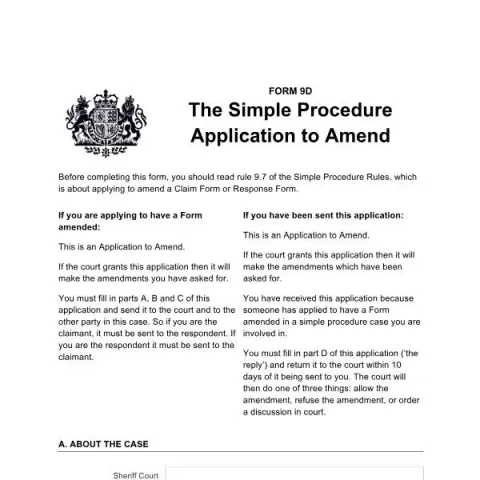
The Form 9D is an official document used within the Scottish Courts and Tribunals Service to facilitate amendments to claims or responses in cases governed by the Simple Procedure Rules. This form is essential for parties wishing to modify the details of their claim or response after initial submission. Its proper use ensures that cases proceed with accurate and up-to-date information, maintaining the integrity of the judicial process.
Purpose and Scope of the Form
The primary objective of Form 9D is to provide a formal mechanism for parties involved in a simple procedure case to request amendments to their claim form or response form. Whether the claimant or respondent, parties can apply to the court to correct errors, add new information, or make other necessary adjustments. The form is particularly relevant when circumstances change or mistakes are identified after the original submission.
Before completing the form, applicants are advised to review rule 9.7 of the Simple Procedure Rules. This rule governs the process for applying to amend a claim or response and provides guidance on the circumstances under which amendments are permitted.
How to Complete and Submit Form 9D
Part A: About the Case
- Claimant or Respondent: Indicate whether you are the claimant or the respondent in the case.
- Case Reference Number: Provide the unique case number assigned by the court.
Part B: About You
- Full Name: Enter your complete name, including middle name if applicable.
- Party Role: Specify whether you are the claimant or respondent.
Part C: The Application
- Amendments Requested: Clearly detail the changes you wish to make to the original claim or response. It is often helpful to attach a version of the document with tracked changes to illustrate the modifications.
- Justification: Explain why these amendments are necessary and why the court should approve them. This may include clarifying facts, correcting errors, or updating information.
- Date of Submission to Court: Record the date the application was sent to the court, whether by email or post.
Part D: The Reply (to be completed by the opposing party)
- Full Name: The respondent or opposing party should fill in their full name.
- Decision: Indicate whether the amendments should be allowed (Yes) or not (No).
- Objections: If opposing the amendments, state the reasons why they should be refused.
Submission and Response Timeline
Once the application is submitted, the opposing party has 10 days to respond by completing Part D of the form. The court will then decide whether to:
- Allow the amendments as requested;
- Refuse the amendments, providing reasons; or
- Order a hearing to discuss the application further.
Key Considerations for Applicants
Applicants should ensure that their application is clear and supported by relevant documentation, such as tracked changes versions of the original forms. Properly completing the form and adhering to deadlines are vital for the court to process the application efficiently.
It is also important to send copies of the completed Form 9D to the other party involved in the case, ensuring transparency and fairness throughout the process.
Fill in your form directly online
No printing: type your details into the boxes of the official form, tick, then download the PDF ready to send.
- 1Type into the form boxes
- 2Tick in one click
- 3Save and download the PDF
Contact and Further Information
For detailed guidance on completing Form 9D or the application process, parties should consult the Simple Procedure Rules and may contact the court directly for assistance. The court's contact details are available through the Scottish Courts and Tribunals Service website or local court offices.
Using the correct procedures and submitting comprehensive applications helps ensure that amendments are considered promptly, contributing to the fair and efficient resolution of disputes under the Scottish simple procedure framework.