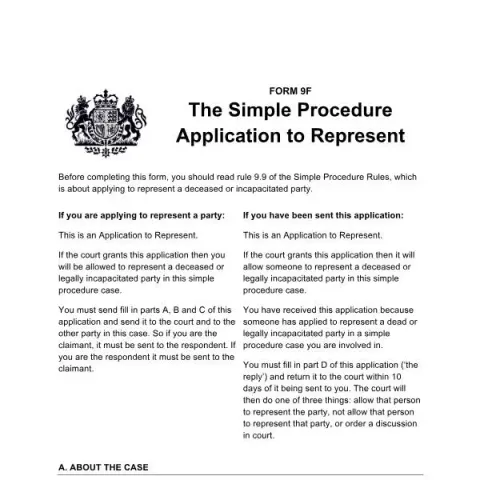
Introduction to Form 9F: The Simple Procedure Application to Represent
The Form 9F is an official document issued by the Scottish Courts and Tribunals Service designed for individuals seeking to obtain court permission to represent a deceased or legally incapacitated party in a simple procedure case. This form is essential for those wishing to act on behalf of someone who cannot do so themselves, ensuring proper legal procedures are followed within the Scottish civil justice framework.
Understanding the Purpose and Scope of Form 9F
The primary purpose of Form 9F is to facilitate the application process for representation in cases where the party involved is unable to participate directly due to death or incapacity. This might include situations such as estate administration, debt recovery, or other civil disputes under the simple procedure rules.
Before completing the form, applicants should review rule 9.9 of the Simple Procedure Rules, which details the circumstances under which someone may apply to represent a deceased or incapacitated party. The form serves both claimants and respondents involved in ongoing cases, providing a clear process for requesting or responding to such applications.
Conditions and Eligibility for Applying to Represent
To be eligible to submit Form 9F, the applicant must demonstrate a legal interest in representing the party, such as being an estate administrator, a legal representative, or having a legitimate claim to act on behalf of the incapacitated individual. The court assesses these applications based on the information provided and any supporting documents, such as death certificates or medical evidence of incapacity.
It is important that the applicant clearly states their relationship to the party in question and provides relevant details to justify their request. The court then reviews the application to determine whether representation is appropriate and consistent with legal requirements.
Step-by-Step Guide to Completing Form 9F
Part A: About the Case
- Fill in the case reference number and identify whether you are the claimant or respondent.
Part B: About You
- Provide your full name, including any middle names or trading names.
- Specify which party you wish to represent and your relationship to that party.
- Indicate whether you are the claimant or respondent in the case.
Part C: The Application
- Explain why the court should grant you permission to represent the party, including relevant circumstances and supporting documents.
- State the date on which you are sending the application to the court.
Part D: The Reply (for the opposing party)
- The opposing party must complete this section, indicating whether they agree or object to the application.
- If objecting, they should specify the reasons why representation should not be granted.
Important Deadlines and Submission Procedures
Once completed, Form 9F must be sent to the court and the other party involved in the case. The recipient party then has 10 days to respond by completing Part D of the form and returning it to the court.
It is crucial to adhere to these deadlines to ensure the application is considered in a timely manner. Failure to respond within the specified period may result in the court making a decision based solely on the submitted documentation.
Post-Submission Process and Court Decisions
After receiving the application and the reply, the court will decide whether to:
Fill in your form directly online
No printing: type your details into the boxes of the official form, tick, then download the PDF ready to send.
- 1Type into the form boxes
- 2Tick in one click
- 3Save and download the PDF
- Grant the application, allowing the applicant to represent the deceased or incapacitated party;
- Refuse the application, denying permission to represent;
- Order a hearing for further discussion or clarification.
The court’s decision will be communicated to all parties involved, and if permission is granted, the applicant can proceed with representing the party in the ongoing case.
Conclusion and Legal Considerations
The Form 9F plays a vital role in ensuring that individuals who are unable to represent themselves due to death or incapacity can still participate in civil proceedings under the simple procedure rules. Proper completion and timely submission of this form are essential for maintaining the integrity of the legal process and protecting the rights of all parties involved.
For detailed guidance, applicants should consult the relevant court rules and consider seeking legal advice if necessary to ensure compliance with all procedural requirements.