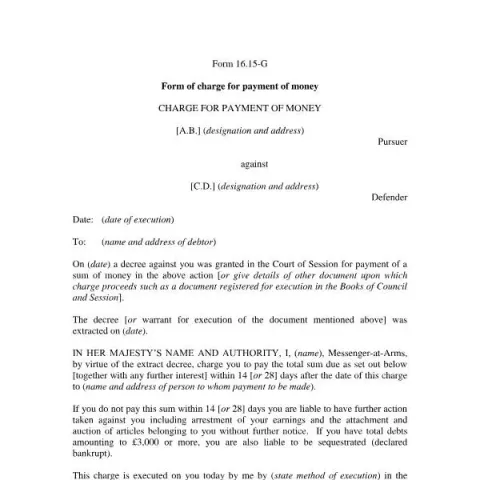
Understanding the Official Charge for Payment of Money Form (16.15-G) in Scotland
The Form of charge for payment of money, designated as form code 1615-G, is an official document issued by the Scottish Courts and Tribunals Service. It serves as a formal legal instrument used to enforce a court decree or warrant for the recovery of a specified sum of money. This article aims to guide individuals and legal practitioners through the purpose, preparation, and processing of this form, ensuring clarity in its application within the Scottish legal framework.
Purpose and Legal Context of the Form
The primary objective of the Form 16.15-G is to provide a structured and official way for the Messenger-at-Arms to notify a debtor of a court-ordered obligation to pay a specific amount. It acts as a formal charge that compels the debtor to settle the debt within a set period, generally 14 or 28 days from the date of service. The form is rooted in the legal authority granted to the Messenger-at-Arms under the Court of Session procedures, facilitating the enforcement of civil judgments related to monetary claims.
This form is typically used in situations where a debtor has failed to comply with a court decree, warrant, or other enforceable document requiring payment. Its use ensures that the debtor is officially informed of their obligation and the potential consequences of non-payment, including attachment, seizure of assets, or bankruptcy proceedings.
Preparing the Charge for Payment of Money
Gathering Necessary Information
Before completing the form, the creditor or their legal representative must compile all relevant details, including:
- The full name and address of the Pursuer (the claimant) and the Defender (the debtor).
- The date of the court decree or warrant that forms the basis of the charge.
- The exact amount owed, including principal, interest, and any expenses incurred.
- Details of the method of execution, such as seizure or attachment, used by the Messenger-at-Arms.
Completing the Form
The form must be filled out accurately and legibly, including:
- The date of execution and the name and address of the debtor.
- A clear statement of the total sum due, breaking down principal, interest, and expenses.
- The deadline for payment, typically 14 or 28 days.
- Details of the person to whom payment should be made.
- The method of execution and the witness involved, if applicable.
It is crucial that the form reflects the actual amount owed and the legal basis for the charge to ensure enforceability.
Modalities of Service and Enforcement
Serving the Charge
The completed form is typically served on the debtor by a Messenger-at-Arms, who is an officer of the court authorized to execute such processes. Service can be carried out in person, by leaving the document at the debtor’s residence or place of business, or by other authorized methods.
Follow-up Actions
Once served, the debtor is legally obliged to settle the amount within the stipulated timeframe. Failure to do so may lead to further enforcement actions, including:
- Attachment of earnings or assets.
- Seizure and sale of property.
- Bankruptcy proceedings if debts exceed the statutory threshold.
The Messenger-at-Arms will document the process and may provide a receipt of service, which is essential for any subsequent legal steps.
Fees and Additional Costs
The form includes a detailed breakdown of costs, such as:
Fill in your form directly online
No printing: type your details into the boxes of the official form, tick, then download the PDF ready to send.
- 1Type into the form boxes
- 2Tick in one click
- 3Save and download the PDF
- The agent’s fee for executing the charge.
- Expenses related to travel, witness fees, and other outlays.
- Any additional costs incurred during the process.
These costs are added to the total amount due and are recoverable from the debtor as part of the enforcement process.
Legal Advice and Further Assistance
Given the legal significance of the Form 16.15-G, debtors and creditors are advised to seek independent legal advice if they are uncertain about their rights or obligations. Local legal aid agencies, Citizens Advice Bureaux, or solicitors specializing in Scottish civil law can provide guidance on the implications of this process and the appropriate steps to take.
Conclusion
The Form of charge for payment of money is a vital instrument within Scotland’s civil enforcement framework, ensuring that court judgments are effectively executed. Proper preparation, service, and understanding of this form are essential for both creditors seeking to recover debts and debtors wishing to understand their legal obligations. Adherence to the procedures outlined by the Scottish Courts and Tribunals Service ensures the enforceability and legality of the process, safeguarding the rights of all parties involved.