When the Court Requires Payment: Understanding CAPSBACS2 in Civil and Commercial Proceedings
In the complex landscape of civil litigation and commercial disputes, certain moments demand immediate financial action from parties involved in proceedings. Whether following a judgment for damages, an order for costs, or compliance with a freezing injunction, the Form CAPSBACS2 emerges as the crucial bridge between a court's decision and its practical enforcement. This payment details form, issued by HM Courts & Tribunals Service, transforms legal obligations into concrete banking instructions, ensuring that monetary awards and court-ordered payments reach their intended destination through the formal judicial system.
Unlike standard commercial transactions, payments processed through CAPSBACS2 carry the weight of judicial authority. They represent the final stage of legal proceedings where words on court orders translate into actual financial transfers, overseen by the court system itself. The form's existence reflects a fundamental principle of English civil justice: that court judgments must be enforceable in practice, not merely theoretical pronouncements.
The Banking Infrastructure Behind Court-Ordered Payments
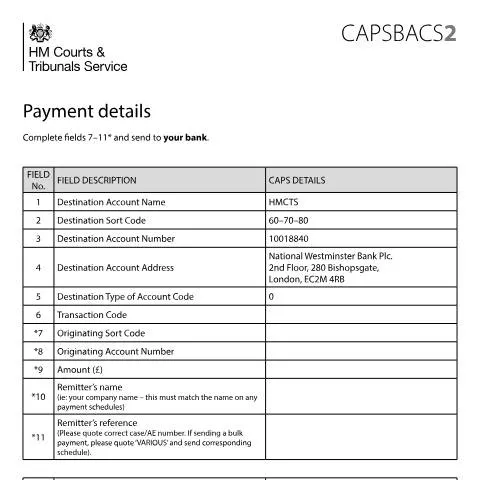
The technical specifications embedded within Form CAPSBACS2 reveal a sophisticated payment infrastructure managed directly by HM Courts & Tribunals Service. The destination account details—sort code 60-70-80 and account number 10018840—direct funds to a dedicated NatWest account at 280 Bishopsgate, London. This centralised system ensures that all court-mandated payments flow through monitored channels, maintaining judicial oversight throughout the transfer process.
The International Bank Account Number (IBAN) GB41NWBK60708010018840 accommodates international transfers, recognising that modern litigation often involves parties with overseas banking arrangements. This provision acknowledges the globalised nature of commercial disputes while maintaining the territorial authority of English courts over payment enforcement.
| Payment Element | Specification | Purpose |
|---|---|---|
| Destination Sort Code | 60-70-80 | Routes payment to designated HMCTS account |
| Account Number | 10018840 | Identifies specific court payments account |
| Account Type Code | 0 | Specifies current account classification |
| IBAN | GB41NWBK60708010018840 | Enables international transfers |
Completing the Critical Fields: Your Banking Instructions
The responsibility for completing fields 7 through 11 rests entirely with the paying party, transforming them from passive recipients of court orders into active participants in the payment process. Field 7 (Originating Sort Code) and Field 8 (Originating Account Number) identify the source of funds, creating an audit trail that courts can verify against declared assets during enforcement proceedings.
The amount specified in Field 9 must correspond exactly to court orders or agreed settlement figures. Discrepancies, even minor ones, can trigger queries that delay proceedings and potentially result in additional costs orders. The precision required reflects the legal principle that court orders must be complied with in full, not approximated.
The Remitter's Identity: More Than Just a Name
Field 10 (Remitter's name) demands particular attention, requiring exact correspondence with payment schedules and court records. For corporate entities, this means using the precise legal name as registered with Companies House, including any "Limited" or "Plc" designations. Sole traders must use their registered business names, while partnerships require the formal partnership designation. This requirement prevents confusion in multi-party litigation where similar entity names might exist.
The remitter's reference in Field 11 serves as the crucial link between banking transactions and specific legal proceedings. Case numbers follow established court formats—typically combining court location codes with sequential numbering systems. For Administrative Court matters, references begin with "AE" followed by numerical sequences. The instruction to quote "VARIOUS" for bulk payments acknowledges that some parties may consolidate multiple obligations into single transfers, provided supporting schedules accompany the payment.
Bulk Payments and Schedule Requirements
The provision for bulk payments within CAPSBACS2 reflects the practical realities of complex litigation involving multiple claims or parties. When a single entity faces various court-ordered payments—perhaps damages to different claimants, costs orders from separate proceedings, or compliance payments under different injunctions—the "VARIOUS" reference system allows consolidation while maintaining individual case tracking.
Supporting payment schedules must itemise each component payment, including case references, recipient details, and amounts. These schedules become part of the court record, ensuring that bulk payments can be properly allocated despite being processed as single banking transactions. The requirement maintains accountability while reducing administrative burden on both paying parties and court staff.
International Payment Considerations
For entities with overseas banking arrangements, the IBAN facility provides essential access to the English court payment system. However, international transfers often involve additional compliance requirements under anti-money laundering regulations and may attract currency conversion considerations. Banks processing such transfers typically require enhanced documentation proving the legitimate judicial basis for payments.
Exchange rate fluctuations can create complications where court orders specify sterling amounts but overseas accounts hold different currencies. The paying party bears responsibility for ensuring that converted amounts satisfy court orders in full, potentially requiring slight over-payments to account for rate movements between instruction and settlement dates.
Integration with Wider Court Processes
Form CAPSBACS2 operates within a broader ecosystem of court payment mechanisms, each serving distinct procedural functions. Unlike fee payments for issuing proceedings or application fees that utilise the separate Fee Account Payment System, CAPSBACS2 specifically handles post-judgment and enforcement-related transfers. This distinction matters because different payment types trigger different administrative processes within court offices.
The form's integration with case management systems allows court staff to track payment compliance against outstanding orders. When properly completed CAPSBACS2 forms generate payment confirmations that update case records, potentially triggering automated processes such as satisfaction of judgment entries or release notifications for frozen assets.
Timing and Settlement Periods
Banking processing times affect the practical implementation of court orders, particularly where compliance deadlines apply. Standard BACS transfers typically settle within three working days, but international transfers may require five to seven working days. Parties facing urgent compliance deadlines must account for these processing periods when initiating payments through CAPSBACS2.
The court system recognises these inherent delays, generally treating payment instructions submitted before deadlines as satisfying compliance obligations, provided funds subsequently arrive within reasonable processing timeframes. However, this tolerance does not extend to situations where payment instructions contain errors requiring correction and resubmission.
Compliance Monitoring and Enforcement Implications
Payments processed through Form CAPSBACS2 create formal records within court systems that serve multiple enforcement functions. Successful payments may automatically trigger processes such as discharge of charging orders, release of frozen assets, or satisfaction of judgment entries. Conversely, failed or incomplete payments can initiate contempt proceedings or additional enforcement measures.
The centralised payment system enables courts to monitor compliance patterns across multiple cases and parties. Entities with histories of payment delays or failures may face enhanced scrutiny in future proceedings, potentially affecting decisions about security for costs or interim payment applications.
Record-Keeping Requirements
Parties utilising CAPSBACS2 should maintain comprehensive records of their payment instructions, including copies of completed forms, bank transmission confirmations, and any supporting schedules. These records prove crucial if payment queries arise or if courts require evidence of compliance during subsequent proceedings. The formal nature of court-ordered payments demands higher documentation standards than typical commercial transactions.
Professional advisors often recommend retaining CAPSBACS2 documentation for extended periods beyond standard business record retention policies, recognising that court proceedings can involve long limitation periods and that payment evidence may become relevant in future related disputes or enforcement actions.
Technical Precision in High-Stakes Situations
The apparently straightforward nature of Form CAPSBACS2 masks its critical importance in ensuring that court orders translate into practical outcomes. Every field requires careful completion because errors can cascade into significant procedural complications, delayed compliance, and additional costs. The form represents the intersection between legal obligations and banking technicalities, demanding attention to both judicial requirements and financial service protocols.
For legal practitioners and their clients, CAPSBACS2 exemplifies how administrative precision supports substantive justice. Court orders without effective payment mechanisms remain hollow victories, while properly executed payment processes through forms like CAPSBACS2 ensure that judicial decisions achieve their intended real-world impact. The form's role in transforming legal theory into financial reality underscores its fundamental importance within the English civil justice system.
Understanding CAPSBACS2's requirements and procedures enables parties to navigate post-judgment processes efficiently, maintaining compliance with court orders while minimising administrative complications. In high-value commercial litigation, where payment obligations can reach substantial sums, the precision demanded by this seemingly simple form becomes a crucial component of successful case resolution and enforcement strategy.
Common Payment Processing Delays and Resolution Strategies
Understanding potential delays in payment processing through Form CAPSBACS2 helps you plan accordingly and take appropriate action when issues arise. Payment delays can occur for various reasons, ranging from technical processing issues to incomplete documentation, and knowing how to address these situations effectively can prevent unnecessary complications.
Bank processing delays represent one of the most frequent causes of payment timing issues. Different financial institutions operate varying processing schedules, particularly for BACS payments which typically follow a three-day cycle but can extend longer during bank holidays or when crossing month-end periods. If you've submitted your Form CAPSBACS2 on a Friday afternoon, for instance, processing might not commence until the following Tuesday, assuming Monday isn't a bank holiday.
Incomplete or incorrect bank details constitute another significant delay factor. When sort codes don't match the nominated account holder name, or when account numbers contain transposed digits, the automated validation systems will flag these discrepancies. The processing authority will typically attempt to contact you for clarification, but this verification process can add several working days to your payment timeline. Always double-check your banking details against a recent statement before submission, paying particular attention to distinguishing between similar-looking numbers like 6 and 9, or 1 and 7.
System maintenance windows can also impact processing schedules, particularly for government payment systems which often undergo updates during weekend periods. If you submit your form during these maintenance windows, processing may be delayed until systems come back online. While these delays are usually brief, they can coincide with other factors to create longer-than-expected processing times.
Anti-fraud verification procedures may trigger additional delays, especially for larger payment amounts or when payment patterns differ significantly from your historical norm. These security measures, while protective, can extend processing times by several days as additional verification checks are completed. If your payment involves substantial amounts or represents a significant change in your usual transaction patterns, factor in potential additional verification time.
To address delays proactively, maintain detailed records of your submission including reference numbers, submission dates, and copies of all supporting documentation. If a payment doesn't appear within the expected timeframe, contact the relevant department with these details readily available. Many authorities provide online tracking systems where you can monitor your payment status using your reference number.
When contacting authorities about delays, prepare specific information about your submission including the exact form reference, submission method, and any confirmation numbers received. Generic enquiries often result in standard responses, whereas specific, detailed queries typically receive more focused assistance. If telephoning, note that call volumes tend to be lower during mid-morning and mid-afternoon periods compared to opening and closing times.
International Considerations and Cross-Border Payment Complexities
Form CAPSBACS2 processing becomes significantly more complex when international elements are involved, whether through overseas bank accounts, foreign currency considerations, or cross-border regulatory requirements. Understanding these additional layers helps ensure smooth processing while maintaining compliance with both UK and international financial regulations.
Overseas bank accounts present unique challenges for BACS processing systems, which are designed primarily for UK domestic transfers. If your designated payment account is held with a non-UK financial institution, you may need to provide additional documentation including SWIFT codes, intermediate bank details, and currency conversion instructions. Some authorities may require you to nominate a UK-based account instead, necessitating separate arrangements for onward transfer to your overseas account.
Currency conversion timing can significantly impact final payment amounts when international transfers are involved. Exchange rates fluctuate continuously, and the rate applied to your payment depends on when the conversion occurs during the processing cycle. If your payment involves currency conversion, the final amount received may differ from initial calculations based on current exchange rates. Consider this variability when budgeting for payments where precise amounts are critical.
Correspondent banking relationships affect international payment routing and can introduce additional processing steps. Your payment might pass through multiple intermediary banks before reaching its final destination, each potentially applying handling fees or processing delays. These intermediate steps aren't always visible to you as the payee, but they can affect both timing and net amounts received.
International compliance requirements may necessitate additional documentation beyond standard Form CAPSBACS2 requirements. Anti-money laundering regulations, tax information exchange agreements, and sanctions screening procedures can all impact processing times and documentation requirements. If you're receiving payments from UK authorities while resident overseas, ensure you understand any reporting obligations in your country of residence.
Time zone differences complicate communication when issues arise with international payments. UK business hours may not align with your local availability, potentially extending resolution times for any queries or problems. When dealing with international payment issues, consider these timing differences and plan communication accordingly.
Tax implications of international payments often extend beyond simple currency conversion. Depending on your tax residence status and the nature of the payment, you may have reporting obligations in multiple jurisdictions. UK authorities typically won't provide tax advice for overseas obligations, so consider consulting appropriate professional advisers familiar with international tax matters.
Documentation retention becomes particularly important for international payments due to potential future enquiries from multiple tax authorities or regulatory bodies. Maintain comprehensive records including currency conversion rates applied, any fees deducted, and correspondence regarding the payment processing. These records may be required for tax filings or regulatory compliance in multiple countries.
Technology Integration and Digital Payment Evolution
The technological landscape surrounding Form CAPSBACS2 and similar payment instruments continues evolving rapidly, with digital transformation initiatives reshaping how citizens interact with government payment systems. Understanding current technological capabilities and future developments helps you navigate these systems more effectively while preparing for upcoming changes.
Open Banking integration represents one of the most significant recent developments affecting government payment systems. This technology enables more direct connections between government systems and your banking providers, potentially streamlining payment processing and reducing manual data entry requirements. However, Open Banking adoption varies between different government departments and payment types, so availability may differ depending on your specific circumstances.
Real-time payment systems like Faster Payments are increasingly being integrated into government payment processes, offering potential for same-day or even instant payment processing in certain circumstances. While traditional BACS processing remains the standard for many government payments, some authorities now offer faster payment options for specific payment types or urgent circumstances. These options typically require additional verification steps but can significantly reduce payment processing times.
Mobile-first design principles are increasingly influencing how government forms and payment systems are developed. Form CAPSBACS2 and similar documents are being optimised for mobile device completion, recognising that many citizens now primarily access government services through smartphones and tablets. This mobile optimisation includes simplified navigation, touch-friendly input fields, and responsive design elements that adapt to different screen sizes.
Artificial intelligence and machine learning technologies are being deployed to improve payment processing accuracy and speed. These systems can automatically validate bank details, detect potential fraud patterns, and route payments through optimal processing channels. While these improvements generally enhance user experience, they can occasionally flag legitimate transactions for additional review, particularly when payment patterns differ from established norms.
Blockchain technology exploration within government payment systems remains largely experimental, but pilot programmes are investigating potential applications for payment transparency and security. While mainstream adoption remains distant, understanding these technological directions helps anticipate future changes to payment processing systems and requirements.
Digital identity verification systems are becoming more sophisticated, potentially reducing the documentation requirements for payment processing while maintaining security standards. These systems can cross-reference multiple government databases to verify identity and payment eligibility more efficiently than traditional manual processes.
Accessibility improvements driven by technological advancement ensure that digital payment systems remain usable by citizens with diverse needs and capabilities. Screen reader compatibility, keyboard navigation options, and alternative input methods are being integrated into government payment platforms, making Form CAPSBACS2 and similar processes more inclusive.
Data analytics capabilities within government payment systems provide authorities with better insights into processing bottlenecks and user experience issues. This data-driven approach to system improvement means that common problems are being identified and addressed more systematically, potentially reducing the likelihood of processing delays and errors over time.