When Debt Meets Dialogue: Making Formal Settlement Offers Through the Courts
Being served with a county court claim can trigger anxiety, but it also opens a structured pathway to resolve disputes without the uncertainty of a full trial. Form N9A represents a crucial juncture in civil proceedings where defendants can take control of their situation by making formal admissions and proposing realistic payment arrangements. This document serves as both a legal admission and a negotiation tool, allowing you to acknowledge debt whilst requesting manageable repayment terms.
The form operates within England and Wales' civil court system, governed by the Civil Procedure Rules, and carries significant legal weight. Unlike informal payment discussions, offers made through N9A create binding obligations once accepted, making careful completion essential. The court treats these submissions as formal statements of your financial position, requiring complete honesty under penalty of potential contempt proceedings.
The Strategic Timing of Your Response
Time constraints dominate N9A proceedings from the moment you receive the claim pack. You typically have 14 days from service to respond if served personally within England and Wales, though this extends to 21 days for postal service or longer periods for overseas defendants. Missing these deadlines can result in default judgment, eliminating your opportunity to negotiate terms.
The form distinguishes between full and partial admissions, each following different procedural routes. Full admissions using N9A alone go directly to the claimant for consideration, bypassing immediate court involvement. Partial admissions require simultaneous completion of defence form N9B, with both documents submitted to the issuing court for judicial determination of disputed amounts.
| Admission Type | Forms Required | Submission Destination | Decision Maker |
|---|---|---|---|
| Full Admission | N9A only | Claimant's address | Claimant |
| Partial Admission | N9A + N9B | Issuing court | Court (for disputed portion) |
Strategic timing also involves assessing whether immediate payment might secure better terms than instalments. Claimants often prefer lump sums and may accept slightly reduced amounts for prompt settlement, though N9A doesn't facilitate discount negotiations—that requires separate discussions.
Dissecting Your Financial Landscape: The Form's Anatomy
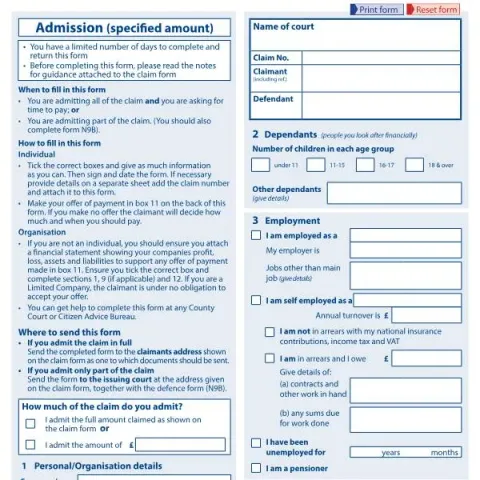
N9A's structure mirrors means assessment procedures used across the justice system, requiring comprehensive financial disclosure. The form progresses logically from personal details through income, expenditure, and existing commitments, building a complete picture of your payment capacity.
Personal Details and Household Composition
Section 1 captures basic identification data, whilst section 2 addresses financial dependants. The court recognises that supporting children or other dependants affects disposable income calculations. Include all dependants you support financially, not just those living with you—this might include elderly parents, disabled relatives, or children from previous relationships.
Age brackets for children reflect different financial impacts: younger children typically cost less than teenagers, whilst those over 18 in education may still qualify as dependants. Provide specific details for "other dependants" to help the court understand unusual circumstances affecting your budget.
Employment Status and Income Streams
Section 3's employment categories accommodate diverse working arrangements. Employed individuals should specify their role and employer, as job security influences payment sustainability. Self-employed respondents face additional scrutiny, with annual turnover figures and tax compliance status affecting credibility.
The form explicitly asks about tax arrears, National Insurance contributions, and VAT debts. Declaring non-compliance doesn't disqualify your application, but dishonesty can undermine your position. HMRC debts typically take priority over civil claims, so outstanding tax liabilities may limit available funds for other creditors.
Financial Assets and Liabilities
Banking information requires current balances, distinguishing between credit and overdraft positions. Multiple accounts should all be disclosed—concealing assets constitutes contempt of court. Building society accounts, ISAs, and other savings products must be included, though certain accounts like Child Trust Funds may be protected.
Housing status significantly influences the court's assessment. Homeowners demonstrate stability and potential security for future payments, whilst tenants may face greater financial pressures. Joint ownership complicates matters, as you cannot typically be forced to sell property without co-owner consent.
Income and Expenditure: The Heart of Your Proposal
Sections 6 and 7 form the calculation's core, determining your genuine payment capacity. The court applies established principles recognising that reasonable living expenses must be maintained—forcing defendants into poverty serves nobody's interests.
Documenting Income Sources
Take-home pay should reflect your actual weekly or monthly receipts after tax, National Insurance, and pension contributions. Include all regular income: overtime, commission, bonuses, benefits, pensions, and contributions from household members. Seasonal variations require explanation—construction workers or retail staff may have fluctuating earnings affecting sustainable payment levels.
State benefits need careful handling. Universal Credit, Employment and Support Allowance, and other DWP payments may be protected from certain enforcement actions, though this doesn't prevent voluntary payment arrangements. Child Benefit typically continues regardless of debt status, forming part of your available income.
Reasonable Living Expenses
The expenses section distinguishes between essential and discretionary spending. Courts generally accept housing costs, utilities, council tax, food, transport for work, and children's needs as legitimate expenses. Luxury items receive less sympathy—expensive gym memberships, premium television packages, or costly hobbies may be questioned.
Maintenance payments to former partners or children take priority over commercial debts. Court-ordered maintenance cannot typically be reduced to pay other creditors, though voluntary arrangements might be renegotiated separately.
Priority Debts and Existing Commitments
Sections 8, 9, and 10 establish your existing financial obligations, crucial for determining realistic payment capacity. The law recognises a hierarchy of debts, with some taking precedence over others regardless of when they arose.
Priority Debt Categories
Priority debts listed in section 8 typically cannot be ignored without serious consequences. Rent arrears can lead to eviction, mortgage arrears to repossession, and utility debts to disconnection. Council tax arrears carry particular weight, as local authorities can apply for attachment of earnings orders or even imprisonment in extreme cases.
These arrears should reflect amounts actually behind, not future payments. If you're current with regular payments but clearing historical arrears through agreed arrangements, show those repayment amounts rather than the total debt.
Court Orders and Credit Commitments
Existing court orders create legally binding payment obligations that new arrangements must accommodate. List all current orders with claim numbers and payment amounts—the court can verify these details and may prioritise earlier judgments.
Credit debts in section 10 cover loans, credit cards, and other commercial borrowing. Whilst these rank below priority debts, sustainable arrangements should acknowledge existing commitments. Defaulting on other agreements whilst proposing new payments raises questions about your reliability.
Crafting Your Payment Offer: Strategy and Realism
Section 11 represents your opportunity to propose terms that work for both parties. The court expects offers based on genuine affordability rather than wishful thinking, supported by the detailed financial information provided throughout the form.
Immediate Payment vs Instalments
Lump sum payments often receive favourable consideration, even if requiring short delays for asset liquidation or borrowing arrangements. Specify realistic dates—claiming you can pay "immediately" when your bank account shows insufficient funds undermines credibility.
Monthly instalments suit most situations but require careful calculation. The court typically expects payments to clear the debt within reasonable timeframes—offers stretching over many years may be rejected unless exceptional circumstances apply. A general guideline suggests clearing debts within 2-3 years for substantial amounts, though this varies based on individual circumstances.
Supporting Your Proposal
Brief reasons for delayed payment help the court understand your situation. Valid explanations include temporary unemployment, illness, family emergencies, or seasonal work patterns. Avoid lengthy narratives—focus on factual circumstances affecting your payment capacity.
For organisations, financial statements become mandatory, demonstrating the company's ability to meet proposed payments. Limited companies face particular scrutiny, as claimants have no obligation to accept their offers—personal guarantees or alternative security might be required.
Procedural Outcomes and Next Steps
Once submitted, N9A triggers different processes depending on whether you've made full or partial admissions. Understanding these pathways helps you prepare for likely outcomes and potential complications.
Full Admission Procedures
For complete admissions, the claimant receives your form and must decide whether to accept your proposed terms. They have several options: accepting your offer, requesting the court determine appropriate payments, or seeking immediate judgment for the full amount if no offer was made.
If accepted, the claimant should confirm this in writing, creating a binding agreement. Failure to maintain agreed payments can result in enforcement action without further court hearings. If rejected, the matter returns to court for determination based on your financial disclosure.
Partial Admission Complexities
Partial admissions create more complex procedures, as the court must resolve both the disputed amount and payment terms for any admitted portion. The defence form N9B addresses disputed elements, whilst N9A covers payment arrangements for accepted liability.
This dual approach can lead to bifurcated proceedings—quick resolution of payment terms for admitted amounts whilst disputed elements proceed through standard litigation processes. Success in defending part of the claim doesn't affect obligations for admitted portions.
When Offers Face Rejection: Alternative Paths Forward
Rejection doesn't end your options but requires swift action to avoid adverse consequences. Understanding why offers fail helps in developing improved proposals or preparing for court determination.
Common Rejection Reasons
Claimants frequently reject offers they consider inadequate relative to the debt size or your apparent means. Unrealistic proposals based on incomplete financial disclosure often fail, as do offers from defendants with histories of default on payment arrangements.
Commercial claimants may have internal policies requiring certain minimum payment levels or maximum repayment periods. Individual claimants might face their own financial pressures, needing prompt payment to meet obligations.
Court Determination Process
When parties cannot agree, district judges determine appropriate payment terms based on your N9A disclosure and any additional evidence submitted. The court applies consistent principles but retains discretion to vary payments based on specific circumstances.
Judges may order lower payments than originally offered if your financial position demonstrates genuine hardship. Conversely, they might increase payments if evidence suggests greater capacity than disclosed. The court's decision creates a binding order with enforcement powers backing compliance.
This formal process concludes with either acceptable payment arrangements or enforcement proceedings, making honest, realistic completion of N9A essential for achieving manageable outcomes. The form represents your opportunity to control the resolution process whilst demonstrating responsibility and good faith to all parties involved.
Understanding the Legal Framework and Court Procedures
Form N9A operates within the Civil Procedure Rules (CPR), particularly CPR Part 36 which governs offers to settle. When you submit an N9A, you're making what's known as a "Part 36 offer" under English civil law, though the form itself predates and exists alongside the formal Part 36 procedure. This distinction matters because it affects the legal consequences and costs implications of your offer.
Fill in your form directly online
No printing: type your details into the boxes of the official form, tick, then download the PDF ready to send.
- 1Type into the form boxes
- 2Tick in one click
- 3Save and download the PDF
The court will treat your N9A offer seriously, but it's important to understand that submitting the form doesn't automatically pause legal proceedings. Unlike a formal Part 36 offer, which has specific statutory protections, an N9A offer relies more heavily on the court's discretion when considering costs and case management directions. However, judges are generally encouraged to consider any genuine attempt at settlement favourably, particularly where it demonstrates a realistic assessment of liability.
If your offer is rejected and the case proceeds to trial, the court may take your N9A offer into account when deciding who pays legal costs. This is where strategic thinking becomes crucial. If the claimant ultimately recovers less at trial than you offered in your N9A, the court may order them to pay your legal costs from the date your offer was made, even if you lose the case overall. Conversely, if the claimant recovers significantly more than your offer, this could strengthen their position on costs.
The timing of your N9A submission can significantly impact its effectiveness. Courts generally view early offers more favourably than last-minute attempts to settle, as they demonstrate genuine engagement with the dispute resolution process. However, you shouldn't rush into making an offer without proper consideration of the claim's merits and your financial position.
One often overlooked aspect is that your N9A offer can include conditions beyond just the payment amount. You might specify that the offer is contingent on the claimant discontinuing the claim entirely, or that it includes an agreement that neither party will pursue the other for legal costs incurred to date. Such conditions must be clearly stated on the form and should be realistic given the circumstances of your case.
Financial Assessment and Affordability Considerations
Before completing Form N9A, you must undertake a thorough assessment of your financial circumstances. The court expects any offer to be realistic and sustainable, not merely a token gesture to delay proceedings. This means conducting an honest evaluation of your income, essential expenditure, existing debts, and assets that could potentially be used to satisfy the judgment debt.
Start by calculating your monthly disposable income after meeting priority debts such as mortgage or rent payments, council tax, utility bills, and minimum payments on secured loans. The court will expect you to demonstrate that you've prioritised the judgment debt appropriately within your overall financial obligations. If you're employed, gather recent payslips, P60 certificates, and any documentation showing deductions such as pension contributions or student loan repayments.
For self-employed individuals, the assessment becomes more complex. You'll need to provide evidence of your business income and expenses, typically through recent accounts or tax returns (SA302 forms from HMRC can be particularly useful). The court recognises that self-employed income can fluctuate, but you'll need to demonstrate a realistic average that supports your proposed payment schedule.
Asset valuation requires careful consideration. While you're not necessarily expected to sell your family home or essential vehicle to pay the debt immediately, the court will consider whether you have non-essential assets that could be realised. This might include investment properties, valuable collections, or business assets not essential to your livelihood. Be prepared to explain why certain assets should be considered exempt from enforcement action.
If you're receiving benefits such as Universal Credit, Jobseeker's Allowance, or Personal Independence Payment, your offer will need to reflect the reality that most benefits are protected from enforcement action under the Social Security Administration Act 1992. However, courts can still expect reasonable contributions from benefit recipients, particularly where there are other household incomes or sources of support.
Consider seasonal variations in your income, particularly if you work in industries such as construction, hospitality, or retail where earnings fluctuate throughout the year. Your N9A offer should account for these variations, perhaps proposing higher payments during peak earning periods and reduced payments during quieter months.
Don't forget to factor in potential changes to your circumstances. If you're expecting a promotion, inheritance, or other significant change in your financial position, consider whether this affects the realism of your proposed payment schedule. Similarly, if you're facing potential redundancy or health issues that might impact your earning capacity, these factors should influence your offer.
Strategic Considerations and Alternative Resolution Pathways
Form N9A represents just one tool in the broader landscape of debt resolution and dispute management. Understanding when and how to deploy this option effectively requires considering alternative approaches and their respective advantages and limitations within the English civil justice system.
Before submitting an N9A, consider whether direct negotiation with the claimant might achieve a better outcome. Many creditors, particularly commercial organisations, have established procedures for dealing with payment difficulties and may be willing to accept arrangements that wouldn't be available through the court process. Corporate creditors often have key performance indicators related to debt recovery costs and timeframes, making them potentially receptive to reasonable settlement offers that avoid protracted litigation.
However, direct negotiation carries risks. Without the court's involvement, you lose the protection of formal procedures and the potential costs consequences that can flow from reasonable offers under civil procedure rules. Additionally, any agreement reached outside the court process must be carefully documented to ensure enforceability and to prevent the creditor from subsequently pursuing the full original amount.
Consider whether your circumstances might justify an application for a stay of proceedings rather than, or alongside, your N9A offer. If you're experiencing temporary financial difficulties due to illness, unemployment, or other significant life events, the court has discretion to pause proceedings to allow you time to stabilise your position. This can be particularly relevant where your financial difficulties are clearly temporary and you can demonstrate a realistic prospect of resolving them within a reasonable timeframe.
For larger debts or complex financial situations, exploring formal insolvency procedures might be more appropriate than attempting to manage multiple debts through individual court processes. Individual Voluntary Arrangements (IVAs) can provide breathing space and allow you to propose a comprehensive solution to all your creditors simultaneously. However, IVAs require the approval of creditors holding 75% of your debt by value and involve ongoing supervision by a licensed insolvency practitioner.
The timing of your N9A offer in relation to other legal processes requires careful coordination. If you're already subject to other court proceedings or enforcement action, your offer should take account of these competing demands on your resources. Courts will expect you to demonstrate that you've considered your overall financial obligations and that your N9A offer represents a fair allocation of your available resources among competing creditors.
Consider the broader implications of your offer beyond the immediate case. If you're facing multiple similar claims, perhaps from different creditors, the precedent set by your N9A offer could influence your position in those other matters. Conversely, if you have strong grounds for defending the claim on its merits, making an offer might be interpreted as an admission of liability that could prejudice your position in related disputes.
Professional advice becomes particularly valuable when navigating these strategic considerations. While you can complete Form N9A yourself, the implications of your offer and the various alternative approaches available often justify seeking guidance from a solicitor experienced in civil litigation and debt recovery. Many solicitors offer initial consultations or fixed-fee advice services that can help you understand your options without committing to expensive ongoing representation.